

Return here to the Shadows in Eden home page.....

Tuesday, January 21, 2014

Coming of Age in Sparta

How do we learn about our own past? If we are interested enough, we can read books, or attend lectures and study courses, or – as I have just done – watch documentaries. This particular documentary was long – an hour and a half of detailed information about society in ancient Sparta by the History Channel. The program explained the way in which this society was structured around the arduous military training known as the agoge which each Spartan male must undergo to become the ultimate product of this Ancient Greek city-state: the peerless invincible warrior.


Having sat through the whole documentary, had I not known better I would have considered that I had received a fair grounding in the things of central importance to this ancient society of two and a half millennia ago. As it was, I sat bewildered and bemused, wondering how it was possible that a documentary which purported to be an examination of Spartan society could manage to go the whole ninety minutes without once mentioning what I already knew to be the central tenet of that society: that homosexuality was not merely encouraged – it was mandatory.


And the warrior training was not some month-long boot camp. At the tender age of seven a boy was taken away from his family home and sent to the [1]agoge, where he remained until he was thirty. In that time he was required to have a full relationship with his older mentor. The conditioning was so complete that although he was allowed back home for his wedding night, his Spartan [2]bride (presumably to ease the trauma of this first intimate encounter with female flesh) dressed as a man, and the encounter took place in a darkened room. The couple would thereafter see each other once every few months: Sparta must endure, after all, and new warriors needed to be begotten.


If you have seen the film 300 about the [3]battle of Thermopylae, in which a token force of three hundred Spartans stand against an overwhelming invading force of several hundred thousand Persians, you might now see all those rippling six-pack abs dripping with testosterone so prominently on display in the film in a slightly new light. Although an early sequence depicted the agoge, the film did not once mention this central aspect of Spartan society either. To be supplied with all the nitty-gritty details of how Spartan society really functioned, you will need to watch another documentary by the historian Bettany Hughes, aired by Britain’s Channel 4, and even longer than the History Channel’s offering.


What are we to conclude from this discreet manipulating of history? I find myself hesitating to do so, but it’s hard to ignore the simple fact that both 300 and the History Channel are American produced and financed, while Bettany Hughes’ scholarly and engaging account is as British as they come. Do American studio bosses with an eye on possible adverse financial consequences nervously shy away from including such material, however historically factual? Apparently so.


This conscious selecting of facts, of deliberately omitting material which you find either distasteful or discomforting, or weakening to a case which you wish to make, is known as ‘cherry picking’. It happens, not just in the occasional [4]documentary, but in many spheres of human activity. It certainly happens in [5]religious belief, and even at times in the [6]sciences. That all those strapping heroes who withstood the [7]Persian onslaught at Thermopylae turn out to be gay is apparently not a detail that the studio bosses in Hollywood (and at the History Channel) were prepared to digest, and history was cherry picked. Indeed, 300 appears to go out of its way to reassure us that those tough-guy Spartans were as straight as the long spears which were their principal weapons of choice.


But however strange Spartan society might seem to our own standards and values, surely it hardly matters. We might examine the methods Spartans employed to produce their much-feared warrior class, and we might find them distasteful and even shocking. But paradoxically they seem to have worked, for Spartans were indeed the most feared and formidable warriors in all of Ancient Greece – and even now we all of us owe them a profound debt for being so. It is sobering indeed to reflect that, had Persia defeated Greece at that time – and that so very nearly [8]happened – the fragile new social idea which the Greeks were then experimenting with would have been snuffed out. They called it ‘democracy’.
Hawkwood


On a small hillock at Thermopylae where the last Spartans fell is a memorial stone. The present stone replaces the one in antiquity found at the same spot, and repeats the preserved words of the original – one of the most famous epigraphs ever written:

Ὦ ξεῖν', ἀγγέλλειν Λακεδαιμονίοις ὅτι τῇδε
κείμεθα, τοῖς κείνων ῥήμασι πειθόμενοι.

“Go tell the Spartans, stranger passing by,
that here obedient to their laws we lie.”

The poignancy of the wording is in the implication that the Spartans must rely on a stranger to bring news of the outcome of the conflict to their homes, for none are left alive to bear the news themselves. And the ‘laws’ are the Spartans’ warrior code: to offer their lives, if that is what is required of them.


Notes:
[1] The training process of turning a boy into a Spartan warrior was so ruthlessly brutal that young lives could be – and were – lost before their training was concluded.

[2] Intriguingly, Spartan women enjoyed a degree of power and autonomy unknown in the other city-states of Ancient Greece. In contrast, Athenian women enjoyed (or endured) a gender-restricted status akin to women in today’s strictly Islamic states. This also accounts for why Hollywood depictions of Helen of Troy as a wafting young thing fall so short of the mark. Helen was in reality a feisty queen of Sparta.

[3] To the film’s credit, and in spite of the inclusion of some flamboyant fantasy elements, much of what was depicted on the screen was historically accurate, even to some of the actual dialogue which history has recorded and preserved. This includes the celebrated exchange between the Persian and Spartan emissaries: Persian: “Our arrows will blacken the sun...”  Spartan: “Then we will fight in the shade!” Stirring stuff indeed.

[4] Not just the History Channel documentary mentioned here has been cherry picked. A few years ago there were cries of outrage here in the Netherlands when it was discovered that the Dutch Christian Evangelical network was airing David Attenborough’s commendable Life of Mammals series with all specific references to evolution discreetly edited out.

[5] Please see the opening paragraph of my post Frontier Justice in the Promised Land for specific examples of this.

[6] When this is discovered in science – perhaps a scientist has loaded lab results to favour a specific outcome – such adverse publicity can destroy a scientist’s credibility and curtail a career without the need for further punitive action.

[7] A Tale of Two Cities: The eventual Greek victory was as much due to the brilliant strategy of Themistocles’ command of the Greek naval forces against those of the Persian fleet at the Straits of Salamis as to the heroic sacrifice of the Spartans at the pass of Thermopylae under the command of Leonidas. And although the invading Persians razed the Athenian Acropolis to the ground, it was rebuilt a generation later by the will of the politically adroit Pericles. Guarded by stone gryphons (below), the ruins of Persepolis, the once-glorious capital of the Persian Empire, are now a World Heritage Site. 


When in his turn Alexander the Great reached Persepolis on his eastward trail of conquest, he exacted retribution for the destruction of the Acropolis: his troops reduced the mighty Persian capital to smoldering ruins, and cultural treasures and manuscripts of incalculable price were lost to the flames. Persia apparently possessed no Pericles, and, unlike the Acropolis, Persepolis is a ruin still. Some seven centuries later the Parthenon (below) on the Acropolis was again sacked, this time by Christians eager to destroy this most important shrine to the goddess Athena. The Parthenon, even as a ruin, is still regarded as one of the greatest masterpieces of architecture ever built, and probably has influenced Western architecture more than any other single building. Take a walk around such cities as London and Washington D.C. if you want to see how far the influence of this pagan temple has reached.


[8] If you would like to read an exceptional you-are-there account of the Battle of Thermopylae, with both its build-up and aftermath, I can recommend no better title than Tom Holland’s vivid Persian Fire. This title also recounts the fragile birth of Western democracy in Athens and the vanquishing of the Persian Empire, the most powerful force in the world at that time. Typically for this author, this title offers sobering reminders that even the mightiest of world powers eventually fade from the stage of history, and the survival of our most treasured social institutions at times turns on mere chance.


Sources:
The History Channel documentary is: This is Sparta!

Bettany Hughes’ documentary is: The Spartans.

Images for this post are from 300, directed by Zack Snyder from the graphic novel by Frank Miller. Released by Warner Bros. and Legendary Pictures. Maps by Hawkwood for the David Bergen Studio © All Rights Reserved.


Friday, January 10, 2014

Gold, Frankincense and Myrrh

This month is traditionally the time in which the [1]‘wise men from the east’ brought their gifts to the new-born [2]Jesus. Scripture is low on specifics about them: any details beyond the above brief phrase – that they were kings, that there were three of them and what their names were – are all details added by later hands, but not mentioned in scripture.

The third eye - follow the star.
The assumption that these ‘wise men’ were a trio originated with the 2nd-3rd-century theologian Origen, who took his lead from the number of gifts mentioned. And it is here that the Gospel, so vague about these distinguished visitors up till now, suddenly becomes very specific. Each gift is carefully named in turn, as if there should be no mistake to the record. The gifts were gold, frankincense and myrrh. When scripture glosses over apparently otherwise-important circumstances, and then appears to become suddenly specific on [3]details, we can take it as a signal that something beyond the surface text is being conveyed: an extra layer of knowledge which more receptive minds would recognise and know how to access. Such specific details are, as it were, knowledge travelling in disguise. 

'Wise men from the east'.
I remember learning in Sunday School that these three gifts were ‘very precious’. Well, I knew that gold was valuable, and I took it on trust that the other two things with the strange names must therefore also have great value as well. And although the scriptural term ‘wise men’ is brief, it still tells us something about these men: that they were not just ‘wise’ in the sense of ‘being wise’, but in the sense of being men of knowledge. That is: knowledge of those things that in the Ancient World seamlessly blended art and science – astronomy, astrology, alchemy and the healing arts. And they were from ‘the east’ – the traditional lands (Persia, India, and other trade route countries) where these subjects were studied and practiced. Later tradition strengthened this idea by referring to these men as ‘magi’, from which comes the term ‘magic’, not in the sense of mere stage illusion, but in its original sense of practicing these ‘secret arts’.

Medieval stargazers. Astronomy and astrology were for centuries interchangeable subjects.
So we have three specifically-named gifts bestowed by ‘men of knowledge’ – men who would have known very well the true nature of what they were giving. All three gifts were certainly valuable commodities in the currency of the time. Gold still is, and there has been recent speculation about the possible healing properties of the other two. Gold is still so prized that it is a marketable currency which never tarnishes – literally and figuratively. The other two are resins obtained from two different trees. But the ‘gold’ given as a gift by the magi could have been more precious even than the gold of jewellery and bullion…

Gold in purported white powder and original nugget form.
Gold has long been associated with kings. It is the metal of royalty, and is found in every crown worthy of the name from the Ancient World onwards. We might infer that the magis’ gift of this metal was a recognition of the infant’s status as ‘king of kings’, and leave it at that. But supposing that this particular ‘gold’ was even more special? Supposing that this magis’ gift was pure alchemical gold? This mysterious substance apparently does exist. Under specific conditions gold is transformed – transmuted – into a different ‘monatomic’ structure, when it becomes a fine white powder. This remarkable alchemical powder, which apparently could extend life, promote good health, and even alter time and states of visibility, was known to the Dynastic Egyptians, and was ingested by the Pharaoh (and only by the Pharaoh) to prolong life. Even in Renaissance times and later it was believed that possession of alchemical gold would prolong life – even confer bodily immortality. Was this the true gift of the magi – an alchemical gold that would confer immortality and even miraculous changes of state? Even symbolically, the idea of this most precious form of gold as a gift now gathers a real power.

The resin and plant of frankincense.
Frankincense is a resin extruded by the Boswellia sacra tree. It has associations with the hormone melatonin manufactured by the pineal gland in the brain – a gland long associated with the ‘third eye’ of consciousness-expanding experiences and enlightenment. For this reason frankincense has been associated with the priesthood, with the ceremonies of an inner sanctum, whether that place is the inner shrine of a temple or within the individual initiate. Knowing this about the frankincense resin allows us to see this second gift of the magi in a very different light from the mere ‘precious’ gift of my Sunday School days. Frankincense was ‘precious’ for a good reason – and that reason lay beyond its material value of the time.

The resin and plant of myrrh.
Myrrh is also a resin, this time from the thorny Commifora myrrha tree. This particular resin has soporific properties, and for this reason is associated with a [4]death-like state – even with death itself. It has been found among the wrappings of Egyptian mummies, and its use in the mummification process is indicative of its associations with an apparent death – apparent, because the state was believed to be only the appearance of death. For how could death be real when the rich afterlife awaited? In many cultures and beliefs, death is merely the door to the other side: a necessary bridge that needs to be crossed. And that bridge was represented by the resin myrrh. This third gift of the magi, this ‘shamanic death’, was therefore indicative of death as a state that, however seemingly-powerful, nevertheless could be transcended.

In this detail from the painting, the artist - perhaps intuitively - has chosen to show a jewel embedded in the magi's forehead in the position of the third eye. 
In these specifically-named [5]three gifts we have the symbolic – perhaps even the actual – qualities of a priestly ‘kingship’ beyond mere earthly royalty, and mystical, symbolic death. For in resurrection even death is transcended, and true and glorious immortality awaits. The gifts of the magi together suggest a biography of their recipient’s life to come, even up to the crucifixion and beyond. Intriguingly, after their mention in this single verse in Matthew, these three extraordinary gifts then disappear completely from scripture. What became of them? Perhaps their symbolic use had now been served. And if actual, then their practical use would be applied in the infant’s life to come.
Hawkwood


Notes:
[1] Matthew 2:1-11. Contrary to tradition, the ‘wise men’ did not visit the infant at his place of birth, but some considerable time (weeks or even months) later at his ‘house’ (annotation on page 1354 to Matthew 2:11 in the Zondervan King James Study Bible).

[2] Jesus’ place of birth was not a ‘stable’, there was no census at that time held by the Roman authorities, there was no ‘inn’, and there certainly was no ‘massacre of the innocents’. The personal agendas of the original unknown writers of the Gospel texts (supplying the apparent fulfilment of Hebraic prophesies) together with accreted folklore growing around mistranslations of the original text has entrenched itself into a tradition which comprises the elements of the Nativity tableau as we know it today.

[3] Another classic example of this scriptural ‘knowledge travelling in disguise’ is in the 153 fishes of John 21:10-11, discussed in my post Vesica Piscis: The Tale of a Fish. Disguising such Gnostic teachings as details in stories became a way of slipping them under the radar of those who sought to eradicate such teachings from scriptural texts, and thus a way of preserving such knowledge.

[4] The symbolism of myrrh is particularly telling: the tree’s large thorns echo the crown of thorns of Jesus’ crucifixion, and the myrrh resin is harvested by deliberately ‘wounding’ the tree. A stake is driven into the tree deeper than bark level, which forces the tree to ‘bleed’ its precious resin.

[5] If you remain unconvinced by the symbolism which I describe here, then consider the words of the famous American carol We three Kings of Orient Are, written in 1857 by Rev. John Henry Hopkins. The relevant verses (sung in turn by each ‘king’ and then in chorus) are:

Born a King on Bethlehem's plain
Gold I bring to crown Him again
King forever, ceasing never
Over us all to reign

Frankincense to offer have I
Incense owns a Deity nigh
Prayer and praising, all men raising
Worship Him, God most high

Myrrh is mine, its bitter perfume
Breathes of life of gathering gloom
Sorrowing, sighing, bleeding, dying
Sealed in the stone-cold tomb

Glorious now behold Him arise
King and God and Sacrifice
Alleluia, Alleluia
Earth to heav'n replies


Sources:
Laurence Gardner: Genesis of the Grail Kings. Bantam Press, 1999. The idea for this post comes from a brief paragraph in chapter 13 of this title. While I might not always agree with this author’s conclusions, his collating of information and his insights into such material have been exemplary, and his researches in this field have become his legacy. Those wishing to know more about monatomic gold (a.k.a. white powder gold, the philosopher’s stone, manna, among other terms) can find much information in this and the author’s other title Lost Secrets of the Sacred Ark, Element Books, 2003.

The 19th-century painting is The Star of Bethlehem, by Edward Burne-Jones. It was the largest watercolour painted at that time - a remarkable accomplishment of technique in an unforgiving medium which allows little latitude for correction or alteration. The artist has here followed the traditional Nativity interpretation, folkloric rather than scriptural, of the 'kings' visiting the infant in a stable. But the created scene is of such verve that in this case passionate belief counts for more than scriptural accuracy.  

Tuesday, December 10, 2013

God, Single, Seeks Consort

A single omnipotent god is an oddity. To be sure, three of the world’s current major religions – Judaism, Christianity and Islam – have such a god, but such a god dominates our thoughts, is accepted as the ‘normal’ state of affairs, simply because of the numbers of today’s adherents. In terms of overall frequency in human history, such a single god is more rarely encountered.

A God without a consort.
Unless we live in India with the vast majority of its people endorsing the polytheistic Hindu faith, or unless we live in a politically atheist country, the idea of a single deity will be all around us, whether we ourselves are religious or not. And if you who are reading this belong to one of these three monotheistic faiths and find my opening sentence unreasonable, let me explain further:

It is a natural spiritual solution to share over a number of deities the widely differing situations which we as humans experience. This god will favour your coming sea voyage, that god has dark mood swings and needs to be kept on the right side of, another god will help you with a successful harvest. One goddess will ease your difficult labour pains, another will watch over your household, and yet another will smile on your fortunes in love and help you to find your partner. Such gods and goddesses have defined roles, and reflect our earthly trials and fortunes. But what happens when all these widely-varying aspects of our hopes and dreams are rolled into one single deity?

His realm, his rules. If you were planning a sea voyage, moody Poseidon needed to be respected. 
What happens is what scripture reveals. We end up with a deity who is magnanimous, jealous, loving, vindictive, creative, destructive, benevolent, picky about which sacrifices are made in his name, chooses (almost) to destroy his entire creation, and chooses to redeem it as well. This God who is the Prince of Peace is also the God who joins in the action on the field of battle. This infinitely merciful God who will grant you [1]eternal bliss in heaven is the very same God who will decide that you shall suffer the torments of the damned forever. All the widely-varying and contradictory characteristics which normally would be distributed over a number of different gods and goddesses are now all bundled into one deity – with all the inherent paradoxes which that inevitably produces.

Sekhmet unleashed.
In a recent [2]post I have described the dark savagery of the God who sanctions the many acts of mass slaughter which are chronicled in the Book of Joshua. If you are a Christian you will believe that this is the same compassionate God who redeems the world several Books and a Testament later. On the face of it, a God who creates the world and all the creatures in it, only to destroy it (and them) a few scant [3]generations later, holds less logic than the parallel version from Dynastic Egyptian religion in which the [4]creator god Re dispatches the ruthless lioness goddess Sekhmet to Earth to do the same. The destruction is wrought by a deity whose business is destruction, not by the creator himself. With each god and goddess assigned his or her specific task, no obvious deific logic has been breached.

Zeus and Hera: storms on Olympus for a wayward god with all-too-earthly desires.
There is another side to this train of thought. When many gods are in the pantheon, ‘god’ is not a bachelor. Osiris had his Isis, Shiva has his Shakti, Odin had his Freya, Jupiter had his Juno, Zeus had his Hera. And Hera had to cope with the various extra-marital shenanigans in which her oversexed husband Zeus indulged – although I’m pretty sure that a few deific pots and pans went sailing through the air when he got back to Olympus, having had his way (in a suitably disguised form) with some lonely mortal shepherdess. Although married life even for a god might at times have seemed a lot like the married life of mortals in the world below, bachelordom for a deity is, it seems, not the usual order of things. But is the god – certainly of Judaism and of Christianity – a ‘bachelor’ in the sense that this deity never actually had a partner?

Asherah: Tree of Life
Israelite religion evolved from the beliefs out of which the Israelite culture itself grew. In the Eden of Genesis, God refers to the plural forms of [5]’our’ and ‘us’. Clearly there is more than one God present on the scene. This other deity, who is referred to in scripture only obliquely, was later expunged from scriptural texts until only her shadowy ghost remained in the diction of these plural terms. Her name is Asherah, the Canaanite goddess in the [6]pantheon from which Israelite religion evolved. When the Israelites, who likely emerged from the Canaanite diaspora displaced by the Egyptian conquest of Canaan, made a drive to define their own distinctive religious forms, this new God of the Israelites was left in a state, not so much of bachelordom, but of forced separation. Deprived of his consort, answerable to no-one but himself, he was free to let rip with all the guy-stuff so prominently in evidence in such books as Joshua.

A male-dominated heaven creates its counterpart on earth.
In such a male-only godhead setup, women were left with little voice. Several millennia later they still are. It’s all ‘God the father’ and ‘God the Son’, with the soothing feminine restraints of a consort being painfully lacking. So does all this deific testosterone have a knock-on effect? Of course it does. We respectfully address ourselves to [7]His Holiness’, ‘His Eminence’ and ‘His Grace’. And let’s not even mention all those [8]imams, mullahs and ayatollahs. It’s more than high time that some healthy balance was restored to our deity’s bachelor boy existence. It’s time that ad was placed in the singles’ columns: “God, Single, Seeks Consort”.
Hawkwood 


Notes:
[1] It is a strident moral paradox that God redeems the world through the sacrifice of Christ, but nevertheless shows himself to be fully-committed to having souls suffer the torments of Hell forever with no hope of redemption. The mere existence of Hell in Christian doctrine negates the purpose of Christ’s mission, for what end has been served by Christ’s sacrifice if after death God negates the reason for his sacrifice for so many? The whole point of Hell is that there is no redemption – but according to Christian doctrine any and all souls already have been redeemed through Christ. This makes sense… not. L


[3] For a critical look at the vessel featured in this story please see my post The Lost Ark of Noah.

[4] Dynastic Egyptian religion begins with a single creator god – Re – but then becomes polytheistic with succeeding generations of gods. Isis and Osiris are the second generation, preceded by the earth and sky god and goddess Geb and Nut. Re himself emerges from a cosmic egg out of Nun, the primordial ocean which is the creative female principle.

[5] As in Genesis 1:26: “And God said, Let us make man in our image, after our likeness..” and Genesis 3:22: “And the LORD God said, Behold, the man is become as one of us, to know good and evil.” The phrase “as one of us” is particularly telling, clearly implying “as one of us gods”. That is: being able to determine all aspects of the moral spectrum, to have the same knowledge and insight as one of the immortal gods.

[6] From clay tablets it is possible to determine an evolution of deities. The supreme Canaanite god was El, with Asherah being his consort. When El eventually became the Israelite god Yahweh, Asherah endured as his consort until she was suppressed by the new monotheism. Both El and Yahweh were initially known as Baal, a titular term meaning ‘Lord’. In later texts which eventually became scriptural, Baal came to be confused with the name for the Canaanite god.

[7] In an Apostolic Letter of May 22 1994 by Pope John Paul II, the Catholic Church has banned women from holding positions of authority in the Church forever. The reason given? Christ chose only male disciples: a fallacy which scripture itself refutes. You can read more about this issue (and find a link to this Papal letter in note 3) in my post "Behold This Woman".

[8] I am aware that there are female holders of these titles in Islam, as there are female rabbis and female Anglican bishops. But all these are notable for their minorities, not because there is an even balance of gender in these religious hierarchies.


Sources:
The top and last images of God creating the sun and moon and God creating the plants are from Michelangelo Buonarroti’s frescoes for the ceiling of the Sistine Chapel. Although I have added my own background of clouds, the figure of God is unaltered from Michelangelo’s originals. If it has ever crossed your mind to wonder why God is companioned by a naked boy instead of a conventional angel, my post Fear and Loathing in the Sistine Chapel will be of interest to you. Michelangelo’s homosexuality (which is also much in evidence in his homoerotic poetry) is considerably more on display in his famous chapel frescoes than is generally realised. Yes, you do see what you think you see in this male nude from the fresco (click on the image right), and I’m not going to point it out – except to say that these are not the only ‘acorns’ on view in these frescoes. And if you find any of this offensive then I suggest that you take your objections to the offices of His Holiness, under whose jurisdiction these frescoes fall.

Portrayals of Sekhmet and Asherah painted for this post by Hawkwood for the ©David Bergen Studio, All Rights Reserved. Lioness adapted from photos by Mitsuaki Iwago.

Sekhmet: In the traditional myth, having been let loose into the world Sekhmet slips beyond Re’s control and rampages through a lake of the blood of her human victims. Unable to halt the killing, and fearing that humankind will become extinct, the gods conspire to trick her by mixing red ochre with beer and pouring it over the earth. Thinking it to be blood, Sekhmet gorges herself until she falls into a soporific stupor and the mayhem finally ends. The other lioness goddess was Bastet of Lower Egypt. Together with Sekhmet of Upper Egypt they were known as the lionesses of Yesterday (the East) and Tomorrow (the West). Both goddesses were initially forces of destruction, although Bastet later evolved into a tamer cat goddess, and Sekhmet, while remaining a lioness, seems to have curbed her aggressive ways. 

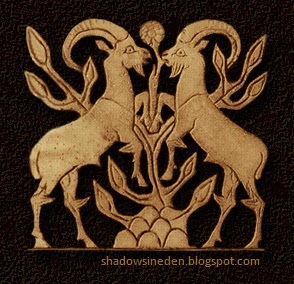
Asherah is traditionally associated with a stylised Tree of Life, which nurtures the animals (usually represented by two goats) portrayed feeding upon it. Asherah, Ashtoreth, Astarte, Ishtar and Inanna are all variant regional names for an enduring goddess who shared similar characteristics across different cultures and historical periods of the Near and Middle East. The Book of Genesis specifically tells us that, as well as the Tree of the Knowledge of Good and Evil, the Tree of Life also was in Eden. Since Asherah was the Tree of Life, and since the Lord (‘Baal’) also was ‘walking in the garden’ (Genesis 3:8), we have both Baal and Asherah present in Eden – which is exactly what that ‘has become as one of us’ phrase (Genesis 3:22) indicates.  

Wednesday, November 20, 2013

The Emperor and the Eye of Horus

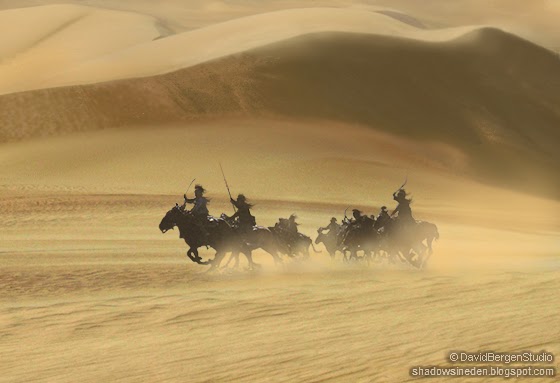
North Africa, sometime in the first half of the 6th-century. A contingent of horsemen clatters westward across the ochre wastes, the hooves of their mounts breaking the hard crust of surface sand. They approach an isolated [1]oasis, a settlement nestling among a green sea of date palms overlooking a lake, and dominated by a single building on a rocky knoll: their intended destination. They dismount below the knoll, ascend the path to the building and stride inside, confident in the authority vested in them by their emperor. Those at worship inside are forced out, the building is annexed, and its votive fires are quenched forever.

On a mission from the emperor..
This minor incident, one of many of its kind repeated across the empire, nevertheless resonates with a heavy significance. The building is the very last of the temples of Ammon: the only place where the gods of Dynastic Egypt are still actively worshipped. Its forced closure on the orders of Justinian, the Holy Roman Emperor, brings to a definitive end over 3,000 years of a religion which has been among the most enduring and stable of the Ancient World. In terms of an [2]end to a religion and its passing into myth, it is therefore not a natural death, but one which has been terminated by the historical forces which oppose it.

Isis-Aphrodite
The two foreign empires in Egypt which preceded Justinian’s own – the Greek and the Roman – both attempted to accommodate and absorb Egyptian beliefs. During the dynasty of the Ptolemy’s, the best-known of whom was the famed Cleopatra, the Greeks developed such crossover deities as Isis-Aphrodite and the ram-horned Zeus-Ammon.

Zeus-Ammon
The Romans also concocted their own curious hybrid deities. Anubis, jackal-headed guide of the underworld, would be fitted out in the garb of a Roman commander, and Isis, queen of the Egyptian pantheon, would be dressed as an aristocratic Roman lady, although still holding the sistrum – the jingling temple rattle – that was her distinctive symbol. In spite of these changes, it was perhaps an easier and even a logical transition, for all three of these empires were polytheistic, worshipping many gods, and the forces which these gods reflected could be recognised across beliefs.

The Roman Isis.
Justinian’s decision to close the temple might have been driven rather more by political astuteness than by fervent belief: he sought through such a gesture to appease the Christian Copts in North Africa, to demonstrate that he and they were ‘on the same side’. But it is also true that he was vigorously determined to Christianize his own empire. His subjects were given a stark choice: convert, or face exile or death. The Christianization of the early Holy Roman Empire was to prove as ruthless in its expediency as it would be in the following centuries in Europe under such monarchs as [3]Charlemagne. That the West rushed gratefully to embrace Christ is a historical fantasy. The iron will of a succession of men in positions of power, both secular and of the Church, is what history reveals.

The Greek goddess Eileithyia was the patroness of fertility and childbirth. Seen here against the backdrop of the Eileithyia cave in Crete, the aid of the goddess was called upon both by would-be mothers to grant fertility and to aid in a safe delivery. Caves have a long association with the womb of the earth mother.
But these old gods are, it seems, more resilient than the will of earthly emperors. The historian Bettany Hughes, while on Crete, reports encountering in an underground [4]cavern known as the Eileithyia Cave, votive offerings left to a goddess of fertility: a continuous use of the site spanning some five millennia. We might be living in the Christian era and date our calendar from the [5]birth of Christ, but the very days of our [6]week are named for Roman and Teutonic gods. When we wish our architecture to convey a civilized respectability, our role models are the marble edifices of pagan Grecian temples.

Names may change, but heroes endure across millennia. Perseus triumphantly holds the severed head of Medusa aloft, Theseus drags the slain Minotaur from the Labyrinth, Batman crouches darkly above Gotham City and a techno-armoured Iron Man does his palm-of-power thing.
And we might consign semi-divine heroes and their glorious deeds to a long-vanished antiquity, but we still nurture an apparent need for them. It’s just that instead of Perseus, Theseus, Hercules and Jason, we now call them Superman, Spiderman, Batman and Iron Man – and Thor has even resurfaced, still with his hammer and his original name intact.

The proportions might have drifted away from the original, but the Eye of Horus is still going strong in the form of tattoo designs, T-shirt symbols and other readily-available merchandise.
So did Justinian succeed in shutting down those Egyptian gods? Look around on the Web and you’ll find various sites dedicated to Isis and even to Sekhmet. And I do mean ‘dedicated’. These sites are not merely informational, but portals of worship, sincere in their intent. Eyes of Horus are now freely available to purchase as pendants, key rings, T-shirts, even as tattoos: take your pick. Whether you believe or not that gods are an invention of mortals, it seems that it is not up to mortals to decide when their time is up. Fifteen centuries after Justinian thought to close it, the eye of Horus is apparently still wide open and watchful.
Hawkwood


Notes:
[1] The incident which opens this post is briefly recounted in chapter 5 of Tom Holland’s book below. The author does not specify at which oasis the temple was located, but taking into account the location, setting and time frame, I’m assuming it to be the oasis of Siwa, then known as Ammon-Ra, now in Egypt but then a part of Libya, and it is this setting which my post describes.


Siwa has a remarkable-enough history. As a sacred site its use apparently stretches back many millennia. In the 4th-century BCE a Persian army of fifty thousand men were dispatched to commandeer the oasis. They never arrived. Having become lost among the dunes, the entire army perished in the North African desert. The Greek historian Herodotus, whose writings provide us with this incident, was thought to have been exaggerating, but the remains of this ill-fated army have recently been discovered. In the 2nd-century BCE, having conquered Egypt and founded the city of Alexandria, Alexander the Great visited the temple to consult the oracle there. Apparently as a result of this visit he henceforth believed in his own divinity, and that his mission of conquest was graced with divine will. To mark both his visit to the temple and his newly-acquired divinity, the megalomaniac conqueror thereafter had himself portrayed with ram horns (below left), elevating himself to the status of the god Zeus-Ammon (below right).


Following the forced closure of the temple, the settlement declined and its location was lost for some thousand years, only to be rediscovered in the 18th-century. Today its inhabitants live among the ruins (below), with most of the neighboring houses being occupied by the ghosts of history.


[2] Please see my post All Things Must Pass for more about the passing of religions into history.

[3] Please see note [5] of my post John Calvin's Tough Love for more about Charlemagne.

[4] Described in chapter 12 of Bettany Hughes’ book below. I myself remember visiting a Neolithic barrow in Denmark in which pagan offerings have been regularly left over a period of some ten millennia. Standing there in the semi-subterranean darkness of the burial chamber, surrounded by cold granite and with the musty compacted Danish soil underfoot, the line to my own ancestors felt like a very direct one indeed.

[5] No two historical sources agree on the actual year. As to the date: December 25th is actually the celebratory day of the sun god (often thought to be the day of the god Mithras, although this is not historically supported), the date being purloined by the early Church fathers, just as churches were built upon the foundations of the pagan temples which they had destroyed.

[6] Saturn’s Day, Sun Day, Moon Day, Tyr’s Day, Woden’s Day, Thor’s Day, Freya’s Day.


Sources:
Tom Holland: In the Shadow of the Sword –The Battle for Global Empire and the End of the Ancient World. Little, Brown, 2012. Few authors who write about history convey the great sweep of empire-changing events as vividly as Tom Holland. And few authors dig so deep and so fearlessly in their attempts to discover the historical truth behind the birth of the world religions (in this case, Islam) that are with us today. Since this title's publication Tom Holland has been forced to disappear as a Web presence - yet another indication of the way in which one religion's inability to shoulder criticism of any kind points only more tellingly to what are perhaps discomforting historical truths.    


Bettany Hughes: Helen of Troy – Goddess, Princess, Whore. Pimlico for Random House, 2005. Few books which I have read make the stuff of history as tangible as this one. It is at one and the same time a grand overview of the subject and an intimate portrait, both of Helen (insofar as that is possible for a figure who straddles both myth and history), and of the distant time in which she lived. In Bettany Hughes' title Helen also emerges as a mirror who reflects back to itself each successive age which has portrayed her in its own different way. We discover something about ourselves and our own time through the way in which we regard Helen, and through the way in which she is depicted by artists and writers both past and present.


Isis-Aphrodite and Zeus-Ammon: The Metropolitan Museum of Art, New York. Other Isis-Aphrodite statuettes from Christies Antiques. 2nd-century Roman Isis: Kunsthistorisches Museum, Vienna (sistrum from the statue of the Roman Isis in the Capitoline Museum, photo by Marie-Lan Nguyen). Eye of Horus tattoo from Lilz-eu-tattoo. Inlaid eye of Horus from the tomb of Tutankhamen, Cairo Museum. Renaissance statue of Perseus holding the head of Medusa by Benvenuto Cellini in the Logia del Lanzi, Florence, from a photo by Paolo del Reggio. Kylix of Theseus with the slain Minotaur in the National Archaeological Museum, Salamanca, photo by Marie-Lan Nguyen. Batman painted by Scott Hampton, from Batman: Night Cries, by Archie Goodwin and Scott Hampton, published by DC Comics Inc. 1992. Bat logo © Warner Bros, Legendary Pictures. Iron Man © Paramount Pictures, Marvel Enterprises. Alexander coin: British Museum. Zeus-Ammon coin: Kunsthistorisches Museum, Vienna. Photo of present-day Siwa Oasis by Heksamarre. On a Mission from the Emperor painted for this post by Hawkwood for the © David Bergen Studio, All Rights Reserved.
Friday, November 8, 2013

The Butcher of Canaan

What must be going through their minds? Dazed with defeat, dragged from their refuge and brought before the leader who had conquered them, these five men must have known that their future was as dark as the cave in which they had hidden, and which had become their prison when their enemy had blocked its only exit. If there is any hope in their thoughts at all, it must be in the wish that this man before whom they now stand would prove himself to be a man of honor, a principled leader who, guided by his [1]beliefs, would be magnanimous in victory, would display some measure of mercy as a gesture of true greatness.

Dragged from the cave which had become their prison.
It is not to be. Instead, they find themselves forced to the ground, are publicly humiliated as, at the prompting of their leader, each captain in his turn sets his foot upon their necks, grinding their faces into the dust of their own homeland. This grim ritualized humiliation over with, the leader himself then steps forward and personally beats them before finally killing them. He then hangs the five corpses on trees and leaves them hanging there until sundown. The corpses are then cut down and thrown unceremoniously into the cave which had been their refuge, and the entrance is sealed forever.

Each captain in his turn sets his foot upon their necks.
It is an incident shocking in its ruthlessness. If these five men were hostages of Al Qaida we would be howling our disgust. Instead, we know these details because all that I have described above can be read in the Old Testament’s Book of Joshua (Joshua 10:22-27), and it is Joshua himself who is the leader in question. My previous [2]post about Joshua dealt with the scriptural account of the defeat of Jericho and its apparent conflict with the archaeology on the ground. That post questioned the veracity of the scriptural account, but with this post I’m assuming these events to be true – not because I personally believe them to be, but because millions around the world accept that they are. This post is about the consequences of accepting that truth.

Historians might disagree about the exactness of the frontiers, but there is no disagreement that Canaan was a part of the Egyptian empire. This map shows the empires as they were during the reign of the heretic king Akhenaten in Egypt, which paralleled the historical situation during the scriptural account of the Israelite conquest of Canaan.
Joshua again presented himself as a subject for a post when I read in my King James Version that the editors describe Joshua’s life as being filled with [3]‘excitement, variety, success and honor’. It’s hard to argue with the first three. But honor? As I have come to realize, an Apologist will find a way to justify [4]anything – as long as that ‘anything’ is found in scripture. So justify this: the Book of Joshua provides us with a list of Canaanite cities conquered by Joshua, but only gives a figure for those slain for one of them – the city of Ai to the west of Jericho. Since, without exception, the entire populations of these cities are slaughtered by the Israelites, and we are given an initial list of ten cities and one battle, as the numbers slain in Ai are given as 12,000, then a low-end estimate for the total inhabitants of these cities slain could feasibly have been some 80-100,000 civilians.

Had Joshua’s Israelite forces existed they would have found the Canaanite battleground already occupied. Events above the timeline are confirmed and corroborated by history, and yet none of these events and the occupying forces which were involved in them are mentioned in the scriptural account of Joshua’s supposed conquest. The events in Joshua could have taken place sometime between 14-1300BCE. While these dates coincide with a period of relative weakness of Egyptian power in Canaan, it was the Hittites, not the Israelites, who took advantage of this.
But further along, we are told that the total number of Canaanite kings defeated by Joshua was thirty one (Joshua 12:24), so the number of field engagements, battles, sieges, kingdoms and other conquests would raise this total considerably. Let’s go with a reasonable estimate of a grand total of 180,000-200,000 Canaanites killed by the Israelites, both armed forces and civilians. Not a [5]soul was left alive in any of the Canaanite cities which fell to Joshua’s forces.  Men and women, children and the elderly: all were put to the sword without mercy. Again, it is scripture itself which tells us this.

Achan is brought before Joshua to face judgement. The sentence: death by stoning. 
So what about Israelite losses and defeats? Forget defeats, because none are mentioned. And losses? In the entire campaign, we are told only of 36 Israelite casualties (Joshua 7:5), slain by the men of Ai in an Israelite ruse that partly misfired. The following verses describe Joshua’s despair at these Israelite deaths, even to questioning the direction of his whole campaign. It turns out that a certain Achan, in violation of God’s stipulation, could not resist doing a little looting in defeated Jericho. This had angered God, which in turn had caused things to go against those 36 Israelites. Joshua gets back on God’s good side by having Achan stoned to death for his misdemeanour, and the campaign is back on track. Evidently a spot of looting by a single individual angered God considerably more than the Israelites’ unbridled slaughter of thousands of Jericho’s civilians. The total annihilation of the population of Ai is what follows, so we can conclude that God is again on Joshua’s side.

“And they utterly destroyed all that was in the city, both man and woman, young and old, and ox, and sheep, and ass, with the edge of the sword.” Joshua 6:21. This single verse from scripture graphically relates the fate of the civilian population of Jericho at the hands of the Israelites: a fate repeated for every Canaanite city which they were supposed to have conquered. It presents those who accept the Bible as the revealed word of God with a stark choice: either reject scripture and take responsibility for your own moral worth, or accept it as fact, and attempt to morally justify the slaughter of women, children and the elderly in the name of God.
But the Canaanites were not monsters who needed to be cleared out of the way as if Joshua were some dragon-slayer ridding the land of a curse. They were, it is worth remembering, ordinary folk concerned with gathering in their harvests, trading what they had to trade, keeping their families, living out their lives and paying due homage and respect to their [4][13]beliefs. And they were living on their own land. From the Canaanite side of things, Joshua and the Israelites must have seemed like agents of chaos: a devastating invasion force which wreaked havoc and destruction, slaughtering the families which they had struggled to raise, stealing their lands and turning their world into dust and ruin.

Akhenaten (left) and Ramesses II, both with very different attitudes to Egyptian interests in Canaan, and during whose reigns the region would become alternately more chaotic and more subservient. 
But there were other regional forces in Canaan at this time. Why is there no mention whatever in scripture of the Israelites encountering Egyptian military resistance? Tablet correspondences found in [6]Amarna and from the later reigns of the pharaohs Seti I, Thutmose III and Ramesses II actually mention Canaan, which was still a part of the Egyptian Empire. Egyptian forces were garrisoned there - and the Egyptians would later go to war to defend their Canaan territory against the fearsome Hittites. So what happened? Did they just sit back and watch as Joshua stole this part of their empire from under their noses? Why do scrupulous Egyptian records frequently mention Canaan but not the [7]Israelites? Is it because there were in reality no Israelite forces for Egypt to be concerned about?

A Canaanite khopesh (top) from the Late Bronze Age, with (below) a bronze Egyptian khopesh from the tomb of Tutankhamen. The fluting on the metal would have given the weapon extra strength. Canaanite weapons were often copies of weapons used by the Egyptian occupying forces. Very little is known about Israelite weapons from this period, although it is assumed that they also followed Egyptian precedents. The distinctive blade probably evolved from the shape of an axe, and in Dynastic Egypt the khopesh also had a ceremonial function. The Assyrian sword - the sapara - also followed this design.
Were we to read this exact same account of the conquest of Canaan in an [8]other-than-scriptural source, and were we to view Joshua simply as a figure from history in the light of these events, we surely would conclude (if we have any moral values) that here was a conqueror who truly gloried in slaughter, as ruthless in his nature and in his deeds as any Attila the Hun or Genghis Khan – or even any Babylonian despot from his own world. Instead, as we know, the Book of Joshua became canonical scripture, and its commander is looked upon as the worthy successor to Moses who led his people into the Promised Land. Normal human decency has been stood on its head, and a man who otherwise might have – with every deserved justification – become known to history as the Butcher of Canaan ends up instead being described as a man of honor.
Hawkwood


....................................................................................................................................................

Part Two: The Square Peg of Scriptural Genocide, the Round Hole of Moral Acceptability

Justifying the genocides: I am aware of the various Apologist (Wolterstorff, Copan, Flannagan, et al) justifications for the genocides in the Book of Joshua, which claim that they are intended to be taken symbolically in some way. But such Apologist explanations for this scriptural trail of death fail to address the moral premise that, real or not, these massacres are stated in scripture as being executed with the blessing of God. Whether the massacres were symbolic, allegorical, etc. becomes immaterial to the stark fact that in scripture God was okay with all this, and actually approved of it (hence the Israelites' sweeping victories with improbably negligible losses to themselves). Indeed, at the battle of Gibeon (Joshua 10:10 and 14) we are told that God personally joined in the slaughter. My point stands: what does this say about the Israelites as a people, and about the deity who guided them?

An ivory Canaanite game board with gold inlay, complete with counters or pegs of gold, Late Bronze Age. This is one of the few such boards to survive relatively intact. Such sophisticated craftsmanship and luxurious styling present a different picture from the one of an [3]‘idolatrous and dissolute’ people put forward by those who seek to demonize the Canaanites in order to justify scriptural genocide.
The historicity of the genocides: Because of the anthropological (linguistic) and archaeological discrepancies with the purported Israelite conquest of Canaan and lack of corroboration from other contemporary sources, I personally am not convinced that the Israelites conquered Canaan at all. The most likely historical scenario is that at the time of Joshua in the Late Bronze Age many of the Canaanite cities that were reported as being conquered by the Israelites were already in a state of semi-ruin (which is what the archaeology on the ground indicates) from the Egyptian conquest and occupation. Almost a full millennium later, the Israelites, who in all probability emerged from the Canaanite diaspora that was displaced by the Egyptians, saw the ruins and exploited them by contriving a conquest by their own forebears that never actually took place. The cities already were in a state of disrepair, and the writers of Joshua, penning their tale some eight to ten centuries after the time of the presumed Israelite conquest, drew their own colourful conclusions as to who did the conquering, thus providing themselves with a fallacious conquerors’ pedigree.

The Hittites: masters of war, and men of [9]iron. The notoriously bellicose Hittites were in northern Canaan during the time frame of Joshua's own purported incursion. And yet, as with the Egyptian military forces, no mention is made in scripture of any Hittite-Israelite encounter.
In the shadow of Beit She’an: If there is one thing which confronts us with the improbability of the scriptural account of the conquest of Canaan it is the existence of the fortress of Beit She’an (a.k.a. Beth-Shean). From the Book of Joshua we learn that, having conquered the southern Canaanite cities, Joshua regrouped his forces at Gilgal and then marched north: a route that would have taken him directly up the west bank of the Jordan River Valley. He defeats the near-impossible odds of a powerful Canaanite alliance at the waters of Merom, then swings east to sack and burn the city of Hazor. In scripture these events all move along swimmingly, but a map of that time frame suggests a very different scenario.

The Location of Beit She'an Fortress 
The command centre of the Egyptian occupying forces in Canaan, Beit She’an’s highly strategic location assured its control both of the east-west routes through the highlands to the coast, and the approach to the northern Jordan River Valley. The palace of the Egyptian governor of Canaan was also situated on its heights. The route of Joshua’s forces supplied by scripture would have left Joshua no option but to pass north in the very shadow of this stronghold – and yet in scripture it is as if it does not exist.

Beit She'an as it is today
Beit She’an was considered to be near-impregnable. Only after 1100BCE was it overrun – not by the Israelites, but by the Philistines. So what did Joshua and the Israelites do – sneak past the fortress while the Egyptian military was having lunch? One hardly can imagine the Egyptian governor leaning over the parapet and shouting, “Good luck in the north, lads!” as the Israelites tramped by. For the whole time frame of the supposed Israelite conquest, Canaan was controlled by the Egyptians. And yet the Book of Joshua never once mentions the presence of the then-resident Egyptian forces stationed in Canaan, or any Israelite-Egyptian military encounter.

The idea that the Egyptians just sat back and watched as those upstart Israelites snatched a swathe of their empire from under their noses is stretching all historical credulity – and strongly suggests the way in which the writers of the Book of Joshua had drifted out of touch with the historical situation on the ground of almost a thousand years before. Egypt, remember, was still powerfully in control of Canaan after the Israelites were supposed to have conquered it.

The approved portrayal of Joshua: a suitably heroic Bronze Age figure clad in glinting armour. But his armour is from the Iron Age of centuries later, and his helmet (which also is from the Iron Age) is that of the Assyrian cavalry - the future conquerors of Israel. Evidently this artist was somewhat hazy about historical time frames.
The Christian perception of Joshua: For me to read on a North Carolina minister’s [10]blog the continuing justifications which a Christian must produce to hammer the square peg of scriptural genocide into the round hole of moral acceptability (even after admitting, as this minister does, that the conquest of Canaan was ‘brutal’) is not merely sad: it is morally repugnant. And this particular Christian blog is by no means unique. Among others I have come across is the [11]Grace Communion International website, which actually states at the outset that “Joshua is one of the Bible’s great books of courage and faith.” – but then glosses perfunctorily over the Israelites’ multiple acts of mass slaughter. Yet another Christian [12]blog indulges in the usual [13]demonizing of the Canaanites, and explains that the genocides are not actually genocides but (quoting Calvinist pastor Mark Dever) “the expiration of God’s mercy” – which for me reading it provided another WTF moment. This blogger (who apparently is a Christian missionary) then goes on to explain that the mass slaughter in the Book of Joshua does not actually count as genocide because “God owns the land, and the people in it. They are his to do with as he pleases.”

What if Joshua was a Canaanite? I am left to reflect that had Joshua been a Canaanite, and had he committed all the various atrocities attributed to him in the book which bears his name, Christians would have painted him blacker-than-black. Instead, he indulges in acts of truly bestial carnage and, apparently merely because he is ‘on their side’ (whatever that means) Christians have him repeatedly emerging smelling like a rose garden, and as an individual who enjoys the respect of three world religions (Christianity, Judaism and Islam). Is such selective blindness to serial acts of callous inhumanity what faith and moral awareness are about?
Hawkwood

A special thank you to any reader who has stayed the distance over this, my longest post to date. Scripture cannot be divorced from the historical context in which it was written, any more than its moral values should be viewed as a special case, divorced from moral values which we otherwise would uphold. To endorse genocide merely because it happens in scripture is to uphold the ethics of despotism.


Notes:
[1] A god of genocide: The point here is that Joshua’s god – the God of the Bible and of Christianity – is supposed to be a morally superior and more humanly responsive deity than the beliefs of the lands which Joshua conquered. But we are in a bizarre situation in which events in the Book of Joshua make it manifestly clear that this is not so. The God in Joshua (and not just in this particular book of scripture) is palpably a deity, not of principles and values worthy of emulation, but of such gross moral standards that he actually approves of and appears to encourage acts of slaughter and even genocide which are committed in his name. This is not my personal opinion; it literally is the scenario which scripture presents to us.

[2] Joshua, Jericho, the Trumpets and the Wall.


[3] Demonizing the enemy: This is quoted from the Zondervan King James Study Bible, page 274. Incredibly, this Apologists’ Bible justifies even Joshua’s acts of mass slaughter by taking pains to describe the Canaanites as “idolatrous and dissolute” (demonizing one’s perceived enemies is a standard ploy for justifying the unjustifiable) and the bloody campaign against them as being part of “a history of redemption unfolding… with its interplay of divine grace and judgement” (page 272), which is, I believe, the most astonishingly callous way of justifying genocide that I have come across anywhere. If the Canaanites were so depraved, how is it possible that one of them became the architect of the very house of God? Yes, it was a northern Canaanite (Phoenicia to the Greeks) who designed Solomon’s temple (my painting of its reconstruction above) in Jerusalem.

[4] Gods of Canaan and Israel: The justification given in Joshua is a justification of belief and of territory: the territory of claiming Canaan for the Israelites in the name of their god, and the struggle between an emerging monotheistic faith and a resident polytheistic faith. The principal Canaanite god is named in scripture as Baal. Baal is however not a name, but a titular term of address meaning ‘Lord’. Since various deities were called by this term – including originally the Israelites’ own deity – isolating which ‘Baal’ is being referred to in scripture is down to region. The Baal of northern Canaan was a rain and weather deity – likely attributes for a people for whom rainfall and a good harvest were critical. The gods both of Canaan and Israel had animal sacrifices made to them; the life blood of those animals flowed in their name. So which god could reasonably claim the moral high ground: the god of the Canaanites who was petitioned for good harvests, or the god of the Israelites who encouraged mass slaughter?


[5] The solitary exception is the woman Rahab (right) and her family in Jericho, whose life was spared after she had provided refuge for two Israelite spies.

[6] Please see my post The Amarna Heresies. Ironically, it was the pharaoh Akhenaten’s self-absorbed preoccupation with art rather than with foreign policy which gave the Hittites their foot in the door of northern Canaan. 

[7] Please see note [2] in my post Joshua, Jericho, the Trumpets and the Wall. Ethnically, the Israelites were Canaanites, belonging to the same principal language group of Hebrew, which is often a determining factor in establishing a people’s origins. The Egyptians referred frequently to the Habiru, a stateless brigandage in Canaan. It is thought that ‘Hebrew’ stems from this term.

[8] Ah, but that is the problem: there seem to be no independent historical sources for the Israelites’ conquest, which surely would not have gone unnoticed by the other regional powers involved.

[9]  In Joshua 17:18 we are famously told that the Canaanites had 'iron chariots'. Since the only people in this time frame known to use iron were the Hittites, it can be taken as a further indication of the degree to which the writers of Joshua in the Iron Age had little historical perspective of the situation in Bronze Age Canaan of many centuries before.    

[10] The Mattrix - The Canon of Glory: Joshua

[11] Grace Communion International - Joshua: Conflict and Conquest

[12] Brance Gillihan's Blog - Devoted to Destruction

[13] 'Sinful': Quoted from Brance Gillihan’s blog: “The Canaanites were wicked people. They worship demon gods to whom they sacrificed their own children by burning them alive. They engaged in perverted sexual practices as part of their worship. God is judging them for their sins.”  This picture (right) is doing the rounds of the Internet as 'Baal worship'. But the massive bronze idol is an archaeological nonsense, and the child sacrifice is a dubious anthropological one. There is no substantive evidence for such Canaanite sacrifices (the classical source for these lurid stories is actually in Carthage, not Canaan), but let’s assume them to be true. In what way is this more ‘sinful’ than all the atrocities - including the scripturally recorded killing of children - committed by Joshua which God smiled upon?


Sources:
Beth Alpert Nakhai: Archaeology and the Religions of Canaan and Israel. The American Schools of Oriental Research, Boston, MA, 2001.
Michael Sugarman: Trade and Power in Late Bronze Age Canaan. Academia.edu PDF.
Ian Shaw (editor): The Oxford History of Ancient Egypt. Oxford University Press. 2000.
Jonathan M. Golden: Ancient Canaan and Israel: An Introduction. Oxford University Press, 2009.
Rivka Gonen: Burial Patterns and Cultural Diversity in Late Bronze Age Canaan. The American Schools of Oriental Research, Boston, MA, 1992.
Gregorio Del Olmo Lete: Canaanite Religion According to the Liturgical Texts of Ugarit. Eisenbrauns, Winona Lake, IN, 2004.

The three scenes from the Book of Joshua are painted by James Tissot, late 19th-early 20th-centuries. The artist of Joshua crossing the Jordan (incorrectly attributed on the Web to the author and minister J. W. McGarvey) and the artist of the imagined portrait of Rahab are both unidentified. The Canaanite khopesh is from Baidun Antiquities. The Egyptian khopesh is in the Cairo Museum, as is the statue of Akhenaten. The statue of Ramesses II is in the Turin Museum. The Canaanite board game is in the collection of the University of Chicargo. Reconstruction of Solomon's temple and the maps and timeline by Hawkwood, © David Bergen Studio, All Rights Reserved.