
Return here to the Shadows in Eden home page.....
Showing posts with label Polycarp. Show all posts

Wednesday, July 22, 2015

Matthew, Mark, Luke …and Mary?

The woman who sits quietly writing already has known the greatest love, and because of that love has also endured the greatest loss. She writes from the depths, both of her love and of her wisdom, which is the wisdom of the inner ways taught to her as the one worthy to receive such precious knowledge. And she also writes from her own first-hand experience as a witness to the events which she relates, and from the wellsprings of insight which are uniquely hers. The woman does not know, nor can she know, the cruel twists of the invented history about her that is to come. And perhaps that is as well, for were she to know these things, even her great spirit might falter.

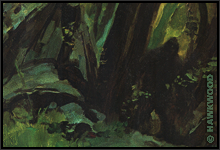
A yawning gulf stretches between the Mary Magdalene who shows us a wisdom and nobility of spirit as revealed in the original texts about – and possibly actually by – her, and the redeemed woman of former ill repute perpetuated by the Church. My imagined portrait of Mary features a fragment of the surviving Gospel of Mary in the background: a text which presents us with a radically different version from the Mary of the Church.
Mary, the Magdalene, writes in ink on papyrus the [1]Gnostic declaration: In the beginning was the Logos, and the Logos was with God, and the Logos was God. This text written in her own [2]hand has no title. It is simply a manuscript. But its spiritual clarity and emotional intensity, and the immediacy of the events which it describes will ensure that it remains one which is read, copied and circulated.

This original text will be lost to history, but some fifty years later other hands less tolerant, and perhaps more jealous, of a mere woman’s authorship of such wisdom will radically amend her text, altering it to seem as if a man had written her words – a simple matter for a copyist to alter ‘she’ to ‘he’, apparently to make it acceptable to the new orthodoxy. The text itself clearly tells us that it was written by the [3]‘disciple whom Jesus loved’, the orthodox assumption being that this is John. And there are indeed two points in the narrative where both Mary Magdalene and this unnamed ‘beloved disciple’ appear in the same scene: at the foot of the cross, and at the tomb following the Resurrection. Yet it is precisely at these points in the story that the narrative appears to stumble, [4]contradicting itself as to exactly who was where, and when. It is as if an unknown hand is shuffling the deck in the middle of the deal, attempting to shoehorn events to fit the changed context.

The weeping Magdalene outside the tomb, as portrayed in the 19th-century by Antonio Ciseri. In the fourth Gospel Mary is described as simultaneously running away from the tomb and remaining behind at the tomb alone: an impossibility of circumstance which only can be reconciled if the ‘disciple whom Jesus loved’ and John are not the same person. Mary’s luxuriant loose tresses were the traditional artistic means of signalling her status as a former prostitute.
And the Magdalene herself? Already ciphered away as the true author of the text, this most wise of the original disciples now becomes demoted and reinvented by the triumphant forces of orthodoxy to be portrayed, not as one of Jesus’ inner circle, but as a mere follower and a former whore. The fact that scripture never actually describes her in such terms seems of little consequence. Such tactics are not unknown to the Church, which already has reinvented such apparently pro-Gnostic writers as [5]Anthony, Clement of Alexandria and [6]Paul to become paragons of orthodox doctrine.

Not for nothing did Clement ironically caution that ‘not all true things are the truth.’ For almost two thousand years the image of Mary Magdalene as a [7]redeemed whore will persist. Artists down the centuries become willing and unwitting co-conspirators, seeing their chance to depict the Magdalene in her penitent scarlet woman guise as a pious pretext to reveal some vulnerable female flesh. But as it always does eventually, the tide of opinion and scriptural scholarship turns.

A staged photograph from the 1920’s portraying the penitent Magdalene. Even up to the previous century we see the loose hair and the element of suggestive nudity being used to denote Mary’s presumed repentance of her former profession: a lifestyle for which there is no evidence whatever anywhere in scripture. The unknown photographer nevertheless engages our sympathy with a dramatic simplicity of composition and by keeping the face of the model hidden from our view.
So what is the basis for our calling this particular book 'The Gospel According to St. John'? In the 2nd-century [8]Irenaeus, the bishop of Lyon, was considering what he should call the untitled manuscript. He seemed to recall that his mentor, Bishop Polycarp, had once mentioned to him that the manuscript was written by John the apostle. And so under the editorial hand of the bishop, the text became accepted into scripture with its new title. Incredibly, this tenuous boyhood memory of a single individual is the only basis we have for calling John the author. For impartial contemporary scholarship the text is anonymous.

This sympathetic 19th-century portrayal of the Magdalene by Mateo Cerezo, while still endowing her with a prostitute’s loose tresses, nevertheless creates around her an atmosphere of devotion and study. The skull was used as a memento mori – a reminder of human mortality – which the artist counterpoints with Mary’s tender gaze towards the promised immortality offered by the crucifix.
When the only reason we have for attributing the authorship of the fourth Gospel to the apostle John is based upon a hearsay boyhood memory, then tradition rests upon foundations of sand. But if John did not write it, then who did? The ‘beloved disciple’ remains unnamed, and yet entrenched tradition insists that it is John. But other [9]texts tell us specifically that the ‘beloved disciple’, the ‘disciple whom Jesus loved’, is Mary Magdalene. Remembering that the fourth Gospel originally was a [10]text belonging to these other writings, by restoring the inconsistencies and changes of gender we can read this fourth Gospel very much as it could be read in what perhaps was its original form, before the alterations were made which allowed the text to become an acceptable part of the orthodox canon.

If for you this all seems a little far-fetched, how differently would you feel about things if new evidence would come to light that the text was written by (for example) the disciple Bartholomew? Is it after all mere chauvinist bias which makes the idea of a female authorship implausible? And if you still resist the idea, then consider this: it is a cold fact that we have more circumstantial evidence for considering that Mary was the text’s author than ever existed for assigning the authorship to John.
Hawkwood 

Today, 22nd July, is traditionally the day of Mary Magdalene: a good day for redressing the outdated misconceptions which orthodox opinion has been only too prepared to allow to accrue around her name.
       

Notes:
[1] The term Logos (right) is essentially Gnostic, and this is the word used in the Gospel’s original Greek. The concept of the Logos actually has its origins in the pre-Christian Greek mystery schools (as does the concept of the Trinity). The author David Fideler describes the Logos as “the pre-Christian idea of ..the pattern of Harmony which was seen as underlying the order of the universe.” In subsequent translations of the fourth Gospel, the term ‘Logos’ has been exchanged for the more simplistic term ‘Word’, but ‘Logos’ and ‘Word’ are not interchangeable concepts.

[2] Such texts also could have been dictated to a scribe.

[3] John 21:20 and 21:24.
    
[4] During John 20:1-11, Mary’s location pops in and out of being both already at the entrance to the tomb and simultaneously running away from it. An assumption that it is she who is the ‘beloved disciple’ and not the separate figure of John makes this discrepancy disappear.
   
[5] Please see my post Anthony of the Desert: Life as Fiction.


[6] Just as the orthodox bishop Athanasius presented the life of Anthony as a fictionalized biography after his death to make it appear as if Anthony was a paragon of orthodoxy, the letters of Paul were altered and supplemented for the same reason. The letters appearing in Paul’s name in the New Testament as 1 Timothy, 2 Timothy and Titus are forgeries. 1 Timothy 2:9-15 notoriously emphasises the subservient role of women, but these are all chauvinist dictums put into the mouth of Paul by a later unknown hand. Please see my post "Behold This Woman" (left) for more about this subject. These writings attributed to Paul, but not by him, are the very letters which turned up (perhaps a little too coincidentally?) at the time that Irenaeus was writing his massive multi-volume work Against Heresies, attacking all that he judged to be non-orthodox. The rigorous anti-female stance of this forged letter has served the Church well ever since. So does the fact that we now know these letters to be forgeries mean that they will at last be dropped from the canon? Of course not. We have made scripture immutable. That is its weakness. 


[7] Please see my post The Gospel of Mary.

[8] Irenaeus himself tells us this in his writings. Please see my post The Gospel According to Somebody.

[9] This notably occurs in the Gospels of Philip and Mary. Stylistically, the Gospel of Mary is particularly comparable to the fourth Gospel. That the fourth Gospel is fundamentally different from the other three is signalled by the collective term Synoptic (meaning: ‘viewed together’) Gospels used for Matthew, Mark and Luke. The fourth Gospel has a specific spiritual and emotional intensity and didactic style which is mirrored in The Gospel of Mary, pointing to the possibility that these two texts, and perhaps also the Gospel of Philip, came from the same community, of which Mary could have been the spiritual leader, or at least in which she played an influential role. 


[10] In my post Vesica Piscis: The Tale of a Fish, I cite the author Margaret Starbird’s conclusion that the number 153, the number of fish in the disciples’ net in John 21:10-11, is actually the gematria equivalent of the name η Μαγδαληνή – The Magdalene – which opens the possibility that if Mary is indeed the author of the fourth Gospel, then the inclusion of this specific number can be viewed as her authorial signature – and one which was not recognised by orthodox powers for its true significance, hence its being included in scripture. And if this specific number is mere whimsy, why include it?


WTF?? This note has been added 23 July 2015, after reading a post on another blog which also chose Mary Magdalene as its theme for yesterday. The post which can be read here, written by Erik Richtsteig, a Catholic priest based in Ogden, Utah, provided me with one of those jaw-dropping moments of incredulity which I'm seriously considering for my 'WTF Moment of the Month' award. Here's why: Father Reichsteig acknowledges (as I do) that there is no evidence whatever in scripture for the baseless tradition by the Church that Mary Magdalene was a whore. He then immediately follows this with the assertion that he nevertheless "will go with tradition every time over the fads of academe." Put plainly: this particular priest prizes baseless Church tradition above actual scripture, above the Bible itself.


Sources:
Much of the basis for this post comes from the paper Mary Magdalene: Author of the Fourth Gospel?, by Ramon K. Jusino, 1998. The complete text may be read here. The proposition that Mary was the author of the fourth Gospel remains a hypothesis, although a credible and well-reasoned one. What is not in doubt is the vast and unfounded discrepancy between her depiction in these early contemporary and near-contemporary texts and her portrayal by the Church.

Elaine Pagels: The Gnostic Paul: Gnostic Exegesis of the Pauline Letters. Trinity Press International, 1975.
Hans-Josef Klauck: Ancient Letters and the New Testament: A Guide to Context and Exegesis. Baylor University Press, 2006.
David Fideler: Jesus Christ, Sun of God: Ancient Cosmology and Early Christian Symbolism. Quest Books, 1993.
Margaret Starbird: Magdalene’s Lost Legacy: Symbolic Numbers and the Sacred Union in Christianity. Inner Traditions, Bear and Company, 2003.

Statue of the weeping Magdalene (above) by Antonio Canova. Imagined portrait of Mary Magdalene (top image) created for this post by Hawkwood for the © David Bergen Studio, All Rights Reserved.

Thursday, January 24, 2013

"Behold This Woman"

As a woman, you should dress plainly and modestly. You should not braid your hair. You should not wear jewellery, and certainly not costly gold and pearls. You should remain silent, and learn submissively. You are not allowed to teach, neither must you question nor rise above the authority of a man. And do not forget: you must keep silent. Why must you do these things? Because it was Adam who was created first, and because it was Eve who was deceived by the serpent and transgressed.


No, the little manifesto of all-brakes-off male chauvinist piggery with which I began this post is certainly not my own. You can read it for yourself in the New Testament’s 1 Timothy, 2:9-14. Its anti-female stance has served the Church well ever since it was written in the 2nd-century, and it has been seen as a licence to keep women in a second-class citizen role with a scriptural seal of approval. This passage on which so much Church policy rests appears in one of the letters of Paul, and among more free-thinking minds it has earned that particular saint the dubious reputation of being a grade-A [1]misogynist. 

There is just one problem. It seems that the letter in which this passage appears is not by Paul at all. The three letters 1 Timothy, 2 Timothy and Titus, bear Paul’s name. But for various reasons, partly to do with discrepancies of language, dating and theme, a majority of scholastic opinion now considers these [2]three letters to be written, as it were, under a falsified signature.

Now consider this: a global corporate business has as strict company policy a blanket ban on women holding any positions of authority within the company. Here in the European Union that company would have its ass hauled into court so fast that its feet wouldn’t even touch the ground. And it would lose the case, because the EU is very specific in its directives about ensuring gender equality in the workplace. Now for ‘global corporate business’ read ‘Catholic Church’, and my point is made. Apparently it is because our society invests religion with respect by default, whether that respect is [3]deserved or not, that the Church can with [4]impunity get away with practicing discrimination against women on a global scale, and in so doing, is placing itself – literally – beyond the law.

“We declare that the Church has no authority whatsoever to confer priestly ordination on women and that this judgment is to be definitively held by all the Church's faithful.” The concluding [5]statement of the Apostolic Letter by John Paul II, May 22, 1994, entitled: “To the bishops of the Catholic Church on reserving priestly ordination to men alone.” The specific justification given in the letter – that Jesus chose only men as disciples – is a scriptural fallacy which it has become expedient for the Church to perpetuate.
Clearly on this example alone the law is a two-tiered structure: one for the Church, and another for the rest of us. Within the Catholic hierarchy the [6]glass ceiling is already reached at the lowly level of the mother superior of a local convent. Higher than that… forget it. Women within the Anglican community fare somewhat better, with Australia having recently appointed its [7]first female bishop. But as recently as November of last year, the Synod of the Church of England voted against the appointment of women as bishops.

This flagrant sexual discrimination which is both sanctioned and practiced by orthodox Christianity is tragic and demeaning for more than the reason of the obvious deep injustice to women. It is a brand of sexual prejudice which goes directly counter to the original egalitarian example of Jesus. Orthodoxy, in winning the 3rd-4th-century battle as the ‘official’ form of Christianity, ciphered away the original status of women’s spiritual equality which they had known in Gnostic communities. Female disciples were consigned to the background of history, and the sympathetically Gnostic Paul was redesigned by orthodoxy as both anti-Gnostic and anti-feminine with the aid of letters written in his name.


On the walls of a grotto in Ephesus, Turkey, is a mural depicting Paul with his companion Thecla. The way in which the two figures are portrayed indicates that, rather than being a mere disciple of Paul, Thecla shared [8]equal status as a wise teacher. It appears that Paul and his female companion wished to be a conscious mirror of the original Jesus-Mary Magdalene model. This does not imply a relationship in the way in which we might now view it, but was intended to reflect the greater cosmic harmonies of Spirit and Soul. Other Gnostics formed couples for the same reason, as did alchemists of later centuries: men and women who worked together at a transformation of the Self. Such partnerships of gender equality were therefore seen, not as ‘earthly’ relationships, but as mystic unions both in their nature and their objective.

Although the lower half of the Ephesus mural has been lost, what remains of the figure of Paul is in reasonable condition. But the figure of [9]Thecla who stands next to him has been vandalized at some time in antiquity: her eyes and her upraised hand have been gouged away. Blinded and mute, this defaced portrayal of a woman still communicates with us from out of her wounded silence.  
Hawkwood     


Notes:  
[1] Misogynist: a man who despises women. 

[2] Although not the only letters of Paul to have a suspect authorship, these specific three seem to be from the same hand. But if not Paul’s, then whose hand is it? One possible candidate is Bishop Polycarp, who apparently provided the role model for Bishop Irenaeus, a name not unknown on this blog as the editor of the four gospels which made it into the canon (my post The Gospel According to Somebody). And how suspect is it that 1 Timothy ends with a specific warning against following Gnostics and their beliefs, when that also happened to be Irenaeus’ favourite hobby horse? Add to this the fact that Paul himself expressed pro-Gnostic beliefs – and might even have been a Gnostic – and that these three letters could well have turned up (perhaps a little too conveniently?) around the time that Irenaeus was busy writing his massive anti-Gnostic work Against Heresies, then this would date the three letters to a period decades after Paul wrote those letters now accepted as authentic.

[3] Please see my post Respect. Catholic priests can be, and are, excommunicated even for just supporting the ordaining of women priests. Father Roy Bourgeois (right) was excommunicated after over 40 years of service to his church for speaking out against the injustice of this issue. The official papal stance is that the issue is beyond discussion (Apostolic letter of Pope John Paul II, 22 May, 1994). The phrasing of the letter - that the judgement will be 'definitively held' - ensures that the ruling is intended to be enforced in perpetuity, and that the Catholic Church will not allow the ordination of women as priests, not now, not ever. Oh, if only the Catholic hierarchy would show itself willing to punish its morally corrupt pedophile priests with the same robust vigor.

[4] Although it uses the euro currency, Vatican City State is not a member of the European Union and preserves its independent status; a status that clearly works to its advantage in such issues.


[5] This concluding phrase of the Apostolic Letter deserves close scrutiny. The adamant statement that the Church has "no authority whatsoever" is actually a subtly assumed negative. Think about it: the Church is in this sense not bound by civic law, and can - and does - assume whatever authority it chooses to invest itself with. If it decides that it has the authority to excommunicate someone (see note 3 above) then it does so. If the Vatican wanted to have the authority to invest women then it would grant itself that authority. So for the Church to claim that it has "no authority" to invest women is a pretense. Thus did Pilate wash his hands.

[6] The phrase 'glass ceiling' is taken to mean the invisible barrier which women encounter in organizations that thwart their further promotion upwards through management hierarchy.

[7] Bishop Kay Goldsworthy, appointed bishop of Perth in May, 2008. Anglican communities in New Zealand, Africa, the United States and Canada also have appointed women bishops.

[8] The author John Dominic Crossan points out that figures in a mural of this date (c.5th-6th-century), when depicted of the same height, as here, indicate equal social status, and the raised right hand denotes both teaching and leadership status – as would have been the norm for women in Gnostic communities. One Christian apologist assertion which I have come across attempts to explain this away with the claim that the woman is actually Thecla's mother: a strange claim to make when the name 'THECLA' (left) has been written alongside the figure.

[9] The Church has made Thecla a saint, but how many who already are familiar with Paul are as familiar with Thecla? And even the now-familiar Paul is the official Church version, which is not who Paul actually was in life, as this post indicates. Please see my post Anthony of the Desert: Life as Fiction for another example of the Church reinventing someone’s life to drive its own agenda. The events of Thecla's life are interwoven with legend. Condemned to be burned, she was saved by the timely intervention of a furious storm. On a later occasion, having fought off a nobleman who was attempting to rape her, she was herself charged with assault and condemned to be torn apart by lions. Again miraculous forces appeared to save her when the female beasts protected her from the aggressive males. No such miracles saved Polycarp. He was burned at the stake for refusing to make an offering to the Roman Emperor. This portrayal of Thecla (right) was painted by Sarah Paxton Ball Dodson in 1891. To read Thecla's story, please see my post Thecla: A Woman between Rain and Fire.


Sources:
Elaine Pagels: The Gnostic Paul.
John Dominic Crossan and Jonathan L. Reed: The Search for Paul.

Top image: “Behold This Woman”, published here under the terms of my Creative Commons Licence, original artwork created for this post by the ©David Bergen Studio, all rights reserved. Adapted from Emilio Franceschi's 19th-century bronze sculpture Eulalia Christiana in Rome's National Gallery of Modern Art. For those who would like to know more about Eulalia, the story of her defiant and tragic martyrdom is recounted on my other blog in the post The Sheltering Snow.


Stop Press added July 17, 2014: A year and a half after I wrote this post, this week has brought the news that the General Synod of the Church of England has voted by a majority of 351 to 72 (with a further 10 abstentions) to accept women as bishops, and so finally bringing it into line with other Anglican communities in the U.S., Canada, Africa and Australasia. The news is both welcome and shocking: welcome, because the approval is so many years overdue. But it is shocking and shameful that the question of whether or not women have equal rights before God is even an issue in the 21st-century. In an age which contains female Anglican bishops, female rabbis and female imams, the Catholic church shows every sign of continuing to hold on to its unrivaled position at the top of the religious male chauvinist piggery chart. What would Jesus say?