
Return here to the Shadows in Eden home page.....
Showing posts with label Alexander the Great. Show all posts

Thursday, November 5, 2015

Empires of Sand, Empires of Dust

Her wrists are shackled, not with iron, but with a chain of gold: an acknowledgement by her captors of her high status. The golden chains are perhaps a mixture both of respect and of irony: respect for this woman’s considerable achievements, and the underlying irony that chains are still chains, whether of [1]gold or of unyielding Roman iron. Queen Zenobia of Palmyra gazes for the last time over her beloved city before being escorted to Rome to be paraded through the streets prior to her [2]execution. The establishing of her own Palmyrene Empire and the revolt which she has led against the might of Rome has at last been crushed, and the sun will surely continue to shed its light upon the eternal empire of the Caesars for as long as the world lasts.

Queen Zenobia gazes for the last time upon her beloved city of Palmyra, as portrayed by Herbert Schmalz in the 19th-century. Her declaration of independence from Rome and the expansion of her empire as far north as Asia Minor and as far south as Egypt became a threat to Rome which could not be ignored.
Well, as we know, Roman rule proved to be rather less eternal than any Caesar preferred to imagine. Less than a century and a half after Zenobia was defeated, the [3]Christian Visigoth Alaric rode with his army into the forum of Rome and put an end to imperial Roman domination forever. The events of history should chasten us. In history, nothing is less certain than the status quo: change is always coming, and history contains constant reminders of the folly of imagining that things will simply go on being the way they are. The truth is of course that, human pride being what it is, we usually prefer to imagine (and probably firmly believe that) our values will endure, whether those values come in the form of political power, empire building, or a particular religious belief – or a mix of all three.

Palmyra in the last half of the 3rd-century. Zenobia extends her Palmyrene empire to become a serious rival to Roman rule. Palmyra occupied a privileged location at the junction of major trade routes connecting to the silk road eastward (shown above in red). These connections made the city affluent, sophisticated and cosmopolitan, with the harmonious blending of different cultures being reflected in the city’s art and architecture.
As recently as the end of last [4]month Islamic State militants continued their destruction of Zenobia’s Palmyra. Having already demolished with explosives the beautiful Baalshamin temple, the city’s elegant Roman arch and other sculptures and monuments, the militants switched to a new tactic by combining their two crimes – the one cultural, the other humanitarian – into one, by tying their captives to the city’s columns and then blowing up the columns. As with their destruction of other irreplaceable cultural treasures, IS justify their actions by claiming that such artefacts are ‘idolatrous’, and therefore an affront to their Islamic beliefs. It is an easy option to dismiss such a hollow justification with contempt and revulsion, but if such a course is taken, what tends to get overlooked in the heat of negative emotions is what ‘idolatrous’ actually means in practice.

The Baalshamin temple, the principal temple in Palmyra. Baalshamin was the principal deity of Palmyrene beliefs. Current status: destroyed by Islamic State militants.
In the context of religious belief we tend to think of ‘idols’ as being of carved wood and stone: actual objects of worship that we either bow down to or seek to destroy, depending upon the fervour of our own beliefs. But is an idol always a thing of stone or wood? Religious idols can take other forms. Consider a Christian Fundamentalist who believes unquestioningly that everything in scripture is the direct revealed word of God, and therefore is flawless and final. Scripture has in such a case shifted from being a thing of spiritual revelation to being uncritically and blindly accepted en bloc, with any scholarly assessment of such texts’ editorial compilation within a historical context being roundly disregarded or – perhaps even worse – dismissed as a subject of mere irrelevance. In such a blindly uncritical situation such texts have become an idol in themselves, with such fatuous fundamentalism becoming degraded from sincere religious belief to the level of mere idol worship, the idol in this case being, not of wood or stone, but of words.

The lion of Al-Lat, the most massive and imposing sculpture in Palmyra shown in its restored state. Current status: destroyed by Islamic State militants.
When seen in this light, Islamic militants are themselves idolatrous: the Quran, rather than being perceived as a religious text, has been degraded to the form of an idol that is blindly and uncritically glorified at the expense of their own humanity. For such militants, the Quran has been ‘idolized’. We might commonly refer to the religious extremists who carry out such inhuman acts as mass rape and beheadings as ‘barbarians’, but they have made themselves barbarians in a literal as well as in a metaphorical sense. There can be no such thing as ‘religious extremism’, because when religion takes such extreme forms it follows a darker god to become something other than religion – even when it is done in religion’s name. Religion without humanity is barbarism, and if you follow your religion to the point where you lose your humanity, then you have by default also lost your religion.

The Roman triumphal arch in Palmyra, an elegant example of Roman secular architecture. Current status: destroyed by Islamic State militants.
The recent destruction of the buildings in Palmyra by Islamic State is hardly the first time in history that opposing forces have targeted architecture. The invading Persians sacked the Acropolis in Athens. Under the political will of Pericles it was rebuilt the following generation, but when Alexander with his conquering army reached the beautiful Persian capital of Persepolis he exacted a terrible [5]retribution for the destruction of the Acropolis, ordering his troops to raze the city to the ground. They did, and one of the most treasured and comprehensive – and irreplaceable – libraries of that time was consigned to the flames. Unlike Persepolis, the Acropolis rose phoenix-like from the ashes – only to be sacked once more seven centuries later by [6]Christians who were all-too-eager to dismantle this seat of pagan worship.

Palmyra’s magnificent amphitheatre would have been used for staging oratory performances. Current status: now used as an execution ground by Islamic State militants. 
Palmyra itself, known as the Venice of the Sands, represented a perfect flowering of different cultures, with an aesthetically successful and unique blending both of Roman, Palmyrene and Persian influences in its architecture. What makes its destruction different is that almost two thousand years later, up until earlier this year, it existed as a partial yet still magnificent ruin in our contemporary world. Its special status as a UNESCO World Heritage site effectively means that it was being preserved in trust, as the collective cultural heritage of you who are reading this, and of future generations to come. But it is always so much easier to destroy something than to build it, and in this sense Islamic State has squarely chosen for the easy option.

Originally sculpted as a funerary bust, this carved limestone portrait of a Palmyrene noblewoman speaks of all the refinement and sophistication of Palmyrene arts and the citizens who created them. Current status: in the collection of the British Museum, London.
So what happens now? Having survived for almost two thousand years, the most beautiful buildings of Zenobia’s beloved Palmyra have been reduced to dust and rubble, and the sand of its [7]amphitheatre is stained with the blood of those executed by the will of IS extremists. IS might rise further in its own brutalising attempt at empire building, or it could collapse internally, with no stable political or bureaucratic infrastructure in place to consolidate what has been gained by blood and terror. History can at times seem very impatient to introduce change, with rapidly-moving events appearing to happen at whirlwind speed – and it also can bide its time, and change can seem slow in coming. But change will come eventually as day follows night. In a hundred, or a thousand, or [8]six thousand years, historians will record the dim memory of half-forgotten and long-obsolete beliefs, and the pages of the Quran will have long blown away on the indifferent desert winds.
Hawkwood


Khaled Asaad and Kayla Mueller
THE HUMANITARIAN CRIMES OF ISLAMIC STATE: This post focuses generally upon the cultural crimes of Islamic State with relation to the buildings in Palmyra, but mention must also be made of its humanitarian crimes. Khaled Asaad, the 82 year-old Director of Antiquities at Palmyra, was tortured for several weeks in an attempt by IS to force him to reveal the whereabouts of cultural treasures hidden at the site. He refused and was subsequently beheaded, after which his body was hung from the ruins which he had spent a lifetime’s career preserving. The selling of such cultural artefacts on the black market has been a way for IS to fund its operations. IS treats systematic rape almost as a doctrine, the captured U.S. aid worker Kayla Mueller being just one of many such victims of the IS leader Abu Bakr al-Baghdadi before he murdered her. The Palmyra amphitheatre has since May of this year been used as a place of execution by IS. Shortly after they overran Palmyra IS executed three hundred local men whom they considered to be ‘pro-government’. This mass execution was followed by a second: the massacre of another four hundred local residents, most of them women and children. With the exception of the murder in Iraq of Ms Mueller, all of the above atrocities by Islamic State took place in Palmyra. Similar atrocities have taken place in Iraq and elsewhere.

In the Palmyra amphitheatre teenage members of Islamic State stand behind soldiers of the Syrian army who were executed by them moments after this photo was taken.
A QUESTION OF RESPECT: A bizarre echo of what is happening in Palmyra is taking place right now in the very heart of the Muslim world. Since the mid-1980’s the Saudi authorities have seen fit to destroy some 95% of all historic buildings in Mecca (including several important mosques) dating from the time of the prophet Muhammad to make way for new hotels, apartments, shopping malls and parking lots. The question has to be asked: how can a religious culture be expected to respect the historic value of other cultures when it clearly does not even respect its own?

The most holy place in all of Islam is now dominated by a colossal brooding hotel.
PALMYRA AND ECONOMIC REALITY: In terms of the tourist economy of the country, Palmyra was a golden egg for the Syrian government and a local source of income. But for the future to come, in whatever form it takes, who is going to want to visit a sad and bloodstained pile of rubble? Even given a worst-case scenario in which Islamic State actually introduces its ruling caliphate in the region, it has now effectively cut itself off from this lucrative source of income. It does not take an economic genius to figure out that alienating governments, both regional and beyond, is a short-term road to long-term economic disaster. Religious fundamentalism and myopic idiocy are horns on the same goat: a lesson of history which fortunately seems to be lost on the militants of Islamic State.


Notes:
[1] Zenobia’s gold shackles are not a fictional fancy: a contemporary account mentions her wearing such chains when she was paraded through Rome.

[2] Zenobia’s fate in Rome is uncertain, with one account having her marry a Roman senator and becoming a familial matriarch. But Roman punishment for insurrection and the need to set an example to others being the ruthless beast that it was, it does seem more likely that she was executed. Unlike the political puppet masters of our own world, Zenobia belonged to an age when the person who opened hostilities was the same person who led the troops into battle. Zenobia seems to have been a true amazon, accompanying her troops on foot during marathon marches.

[3] Alaric seems to have kept a foot in both camps, adopting Christian practices while still finding room to follow pagan beliefs.

[4] BBC News report of 27 October, 2015: ‘IS blows up Palmyra columns to kill three captives’.

[5] Alexander’s ruthless destruction of the Persian capital would seem to be the very definition of the ‘what goes around comes around’ dictum. It could be that in an indeterminate future some new fanatical religious sect will desecrate the Kaaba in a long-deserted Mecca. The famous Black Stone set into the Kaaba already has been smashed to pieces in medieval times, which is why it is now encased in a silver mount (right). Not unsurprisingly, those who carried out this destruction were members of an extreme Muslim sect. Also unsurprisingly, IS have threatened to destroy the Kaaba as an 'idol of stone'.

[6] I have no illusions about this incident in history. Had explosives been available at that time the Parthenon would have been reduced to dust and rubble indistinguishable from the dust and rubble that once was the Baalshamin temple in Palmyra. 

[7] Teenage boys belonging to IS execute prisoners in the Palmyra amphitheatre.

[8] This time frame of 6,000 years in the future I have borrowed from my post All Things Must Pass (left). I have chosen this specific time frame because it is as distant from our own time as we are from the beginnings of civilization in Sumer. Such a span of time is clearly beyond our imagination. What once were living religions (the gods of Olympus, Odin and Valhalla, etc.) are now seen by us as mythologies, so it is only reasonable to presume that the religions of our own world will become the mythologies of an unimaginable distant future.


Sources:
New York Times, 14 August, 2015: ISIS Held Kayla Mueller, U.S. Aid Worker, as Sex Slave Before Fatal Air Strike, by Rukmini Callimachi. Retrieved 3 November, 2015. (IS had previously claimed that Ms Mueller had been killed in an allied air strike, before the truth of what had happened was learned from two other young women who had managed to escape.)

The Independent, 19 August 2015: Isis executes Palmyra antiquities chief and hangs him from ruins he spent a lifetime restoring, by Adam Withnall. Retrieved 3 November, 2015.

BBC News, 5 October, 2015: Islamic State ‘blows up Palmyra Arch’. Retrieved 1 November, 2015.

BBC News, 27 October, 2015: IS ‘blows up three columns to kill three captives’. Retrieved 29 October, 2015.

Mail Online, 24 May 2015: ISIS slaughters 400 mostly women and children in ancient Syria city of Palmyra where hundreds of bodies line the streets, by Kate Pickles. Retrieved 4 November 2015.

The Independent, 17 February 2014: Mecca for the Rich: Islam’s holiest site ‘turning into Vegas’, by Jerome Taylor. Retrieved 4 November, 2015.

Photo of the Palmyrene funerary bust by PHGCOM. Photo of Kayla Mueller by Matt Hinshaw for the Daily Courier via Associated Press. Photo of Khaled Asaad, the lion of Al-Lat and executions in the amphitheatre from Getty Images. Other photos from uncredited sources. Map prepared for this post by Hawkwood for the David Bergen Studio © All Rights Reserved.

For an excellent virtual tour of Palmyra you can visit Tito Dupret's site here and wander around the city as it was before Islamic State occupation. Such comprehensive documentation of these monuments which no longer exist has now become doubly valuable, and historic in itself.

Saturday, March 7, 2015

Jesus in India

Even the staunchest Christian has to concede that what scripture tells us about the life of Jesus hardly amounts to a comprehensive biography. For any details at all we rely almost solely upon the four gospels. These collectively (and at times conflictingly) inform us of his birth, his early childhood (but even this only partially), and his ministry, which effectively took place over the last two years of his life. All texts are strangely silent about what happened in between – a hiatus of almost twenty years.

Did Jesus once walk in the shadow of the mountains of the Hindu Kush, perhaps to seek new forms for the Spirit that were then unknown in his native Galilee?
In other words: most of Jesus’ life, and what he did during those many years, is a total unknown. Why are all the gospels so strangely silent about those intervening years? Or perhaps more to the point: why is this stark fact so summarily brushed aside within Christianity itself? It is as if this yawning void of non-information is considered to be a minor inconvenience in our knowledge of the Saviour: something perfunctorily acknowledged before swiftly moving on to more familiar events. Jesus, the young boy encountered in Luke’s gospel going [1]‘about his Father’s business’ in the temple, a few verses later emerges as the adult Jesus being baptized by John in the waters of the Jordan. It is as if a biographer of the Duke of Wellington were to describe his early boyhood in a brief introductory chapter – and then begin the next chapter by describing his victory against Napoleon at the battle of Waterloo.

This timeline graphically illustrates how little is known about the life of Jesus. The gospels collectively describe only the light areas on the line; the rest of the intervening years are a total unknown. Conflicting dates make the exact span of Jesus’ life uncertain, although it is usually taken to be 32-33 years.

So whether or not we care to address this issue of Jesus’ missing years, whether we choose to sweep it under the carpet as being ‘unimportant’ or ‘not the point’, the issue is still there. And the existence of the issue leaves us free to speculate upon what he might have done, and where he might have been. He might, of course, simply have spent those years in Galilee as an itinerant sage and healer, perhaps performing local exorcisms (‘casting out devils’, to use the scriptural phrase), or just keeping a low profile in preparation for the momentous final years of his life. Or perhaps he journeyed farther afield, even as far as India.

Seeking an answer to whether the footsteps of Jesus ever were imprinted in Indian soil must begin with the question: how feasible would the journey itself have been? Just how do-able was it at the time to get from Galilee to the distant Hindu Kush? It seems a long way, but startlingly, the answer is: entirely possible, even plausible. If we follow the trade routes of the time, we ourselves can plot a likely route on the map. The Silk Road had principal connecting points in the port city of Antioch and in Damascus. From Damascus the Silk Road then went eastward via Palmyra to Ctesiphon in Mesopotamia, where two alternative routes presented themselves. Either by a river and sea voyage, first down the Euphrates and then by sea to Hormuz in Persia, or farther south to the Indian port of Barbaricon. Either option would have allowed for a direct connection inland to northern India along principal known trade routes.

Following the Silk Road and other major trade routes, either overland or by land and sea, would have made a journey from Galilee to India entirely feasible.
The second alternative would have been overland, journeying east from Ctesiphon along the Silk Road to Bactra northwest of the Hindu Kush, then southeast through the Khyber Pass to [2]Taxila in the foothills. These alternatives all followed time-tested trade routes. Join a caravan, and off you go. After all, Alexander the Great trod the same route in his conquests of three centuries before, and we know that Alexander at any rate left his own footprints in Taxila. So for Jesus the journey itself was entirely feasible, and would have needed no arduous trailblazing as such. The next question should be: can we detect any signs of such a sojourn accounting for his [3]missing years, both in his teachings, which thereafter presumably would have been Eastern-influenced, and in [4]India itself? Again the answer, startling perhaps for some, could be: yes.

The mountains of the Hindu Kush. Mountains have always exhorted us to reach out for the Divine. Often they have been seen as the dwelling places of gods and spirits, and for many, treading their snowy fastness feels like walking on sacred ground.
For those long unaccounted-for years, Jesus simply vanishes from the record. If at least part of that time was spent in India, then we would expect his own ministry to be informed by [5]Buddhist influence. It has been [6]suggested that Jesus’ lifestyle resembled that of a Cynic philosopher. Cynicism (not to be confused with our own contemporary use of the term) was a Greek school of philosophy, a lifestyle, which urged its adherents to live a simple life, to wear simple garments and not pay heed to worldly possessions, and peaceably to live in harmony with their surroundings. Galilee and regions northward were subject to Hellenist influence (Paul’s first language was Greek), and Jesus actually urges his apostles to embrace such a [7]lifestyle.

A lake in Srinagar, Kashmir. Did these same contemplative reflections offer their silent mirror to Jesus two millennia ago? Places far from home often invite us to gain new insights. When we return from such sojourns we might view the familiar in unexpected ways, and discover our own native soil anew.
But Cynicism in its turn, however coincidentally, closely resembled the lifestyle of Buddhist monks. Such a monk as well lived a life of utter simplicity and devotion, depending for his or her existence on the charity of others. The precepts of Jesus to a way of non-violence, to loving your neighbour, to placing yourself in the service of others, which were revolutionary for and otherwise unknown to other teachings in Palestine, and which otherwise seem mysteriously to have emerged from a social milieu utterly foreign to them, were the very fabric of Buddhism. Buddha also healed the sick and fed multitudes with a few loaves of bread, not as magic tricks, but as manifestations of his divine Buddha nature. Were these ideas, so novel for the near East, imported from a farther East by Jesus himself? Did Jesus sojourn in a Buddhist monastery in the very shadow of the Hindu Kush? 

We are left to wonder. The ease of travelling the trade routes, and the quietly-spoken and deeply-human teachings of Jesus himself, so radically different for his social environment, makes such speculation at least plausible. As to any protests that Jesus never visited India because there is no firm proof that he did, the only reasoned response must be that there also is no proof that he did not.
Hawkwood 


Notes:
[1] Luke 2: 41-49. In this passage relating the boy Jesus’ visit to the temple in Jerusalem, his age is given as twelve (Luke 2: 42). The following chapter mentions that Jesus is ‘about thirty years of age’ (Luke 3: 23). The few intervening verses between these two quotes concern themselves with John the Baptist. No mention whatever is made of Jesus’ activities or whereabouts in the intervening eighteen years of his life.

[2] The city of Taxila is now within the borders of present-day Pakistan.

[3] There is the further claim that Jesus was in India – but travelled (or perhaps returned) there after his presumed resurrection, living as a respected foreigner in the community as ‘Yuz Asouf’. This person lived into old age, and was buried in a tomb according to the Jewish tradition (that is: orientated east-west) in Srinagar, Kashmir (left): a tomb which still exists and can be visited. The clear implication is that Jesus did not die on the cross, but passed into coma before being taken down and was secretly revived in the tomb provided by Joseph of Arimathea. Accepting this possibility means that the ‘resurrection’ in Christian terms never actually happened, which if true would undermine the very cornerstone of Christian belief. This heretical idea is too complex to be examined here, and will be covered in a future post.

[4] There are two further issues which I have chosen not to cover in the body of this post. The first is the claim by the 19th-century Russian adventurer Nicolas Notovitch (right) that he discovered a manuscript in a northern Indian monastery relating the deeds of a certain foreigner named as ‘Issu’ who healed others, which at face value seems to hint at evidence of Jesus’ presence in that monastery. But this story is too clouded by controversy and accusations of hoax to be included in a post in which I have concentrated only on ‘plausibles’. The second issue is the Hindu manuscript known as the Bhavishya Maha Purana, which mentions a Messiah-like individual named as Issa Masih, who had taught a doctrine of peace, and who had fled east from his homeland due to persecution. Being therefore post-resurrection, this also relates to my ‘resurrection’ point in note [3] above.

[5] Buddhism was founded some five hundred years before the time of Jesus.

[6] The idea that Jesus actually was a Cynic philosopher is mentioned (among others) by Paula Fredriksen in her book Jesus of Nazareth, King of the Jews. Professor Fredriksen points out that dressing in simple garb was one of the features of the Cynics. So if you tend to picture Jesus in a humble coarsely-woven garment, rather than in the tassel-fringed robes that were normal Jewish attire, then you are picturing him as a Cynic philosopher. But the hints are not in appearance alone. The at-times enigmatic and koan-like wisdom of Jesus, which is so in evidence in that source for the canonical gospels of the teachings of Jesus, the Gospel of Thomas, and which predates them, is also typical of the Cynic style of teaching – and also of Eastern mysticism.

[7] Mark 6: 7-9. “And he called unto him the twelve, and began to send them forth by two and two; and gave them power over unclean spirits; and commanded them that they should take nothing for their journey, save a staff only; no *scrip, no bread, no money in their purse: but be shod with sandals; and not put on two coats.” K.J.V. (*‘Scrip’: a bag.)


Sources:
Paula Fredriksen: Jesus of Nazareth, King of the Jews. Alfred A. Knopf, New York, 1999.
Hindu Kush mountains photo by Hindu Kush Adventure. Srinagar lake adapted from a photo by Singh Suninder Jeet. 'Jesus in the Hindu Kush' painting, Silk Road map and Life of Jesus timeline by Hawkwood for the ©David Bergen Studio.

Tuesday, January 21, 2014

Coming of Age in Sparta

How do we learn about our own past? If we are interested enough, we can read books, or attend lectures and study courses, or – as I have just done – watch documentaries. This particular documentary was long – an hour and a half of detailed information about society in ancient Sparta by the History Channel. The program explained the way in which this society was structured around the arduous military training known as the agoge which each Spartan male must undergo to become the ultimate product of this Ancient Greek city-state: the peerless invincible warrior.


Having sat through the whole documentary, had I not known better I would have considered that I had received a fair grounding in the things of central importance to this ancient society of two and a half millennia ago. As it was, I sat bewildered and bemused, wondering how it was possible that a documentary which purported to be an examination of Spartan society could manage to go the whole ninety minutes without once mentioning what I already knew to be the central tenet of that society: that homosexuality was not merely encouraged – it was mandatory.


And the warrior training was not some month-long boot camp. At the tender age of seven a boy was taken away from his family home and sent to the [1]agoge, where he remained until he was thirty. In that time he was required to have a full relationship with his older mentor. The conditioning was so complete that although he was allowed back home for his wedding night, his Spartan [2]bride (presumably to ease the trauma of this first intimate encounter with female flesh) dressed as a man, and the encounter took place in a darkened room. The couple would thereafter see each other once every few months: Sparta must endure, after all, and new warriors needed to be begotten.


If you have seen the film 300 about the [3]battle of Thermopylae, in which a token force of three hundred Spartans stand against an overwhelming invading force of several hundred thousand Persians, you might now see all those rippling six-pack abs dripping with testosterone so prominently on display in the film in a slightly new light. Although an early sequence depicted the agoge, the film did not once mention this central aspect of Spartan society either. To be supplied with all the nitty-gritty details of how Spartan society really functioned, you will need to watch another documentary by the historian Bettany Hughes, aired by Britain’s Channel 4, and even longer than the History Channel’s offering.


What are we to conclude from this discreet manipulating of history? I find myself hesitating to do so, but it’s hard to ignore the simple fact that both 300 and the History Channel are American produced and financed, while Bettany Hughes’ scholarly and engaging account is as British as they come. Do American studio bosses with an eye on possible adverse financial consequences nervously shy away from including such material, however historically factual? Apparently so.


This conscious selecting of facts, of deliberately omitting material which you find either distasteful or discomforting, or weakening to a case which you wish to make, is known as ‘cherry picking’. It happens, not just in the occasional [4]documentary, but in many spheres of human activity. It certainly happens in [5]religious belief, and even at times in the [6]sciences. That all those strapping heroes who withstood the [7]Persian onslaught at Thermopylae turn out to be gay is apparently not a detail that the studio bosses in Hollywood (and at the History Channel) were prepared to digest, and history was cherry picked. Indeed, 300 appears to go out of its way to reassure us that those tough-guy Spartans were as straight as the long spears which were their principal weapons of choice.


But however strange Spartan society might seem to our own standards and values, surely it hardly matters. We might examine the methods Spartans employed to produce their much-feared warrior class, and we might find them distasteful and even shocking. But paradoxically they seem to have worked, for Spartans were indeed the most feared and formidable warriors in all of Ancient Greece – and even now we all of us owe them a profound debt for being so. It is sobering indeed to reflect that, had Persia defeated Greece at that time – and that so very nearly [8]happened – the fragile new social idea which the Greeks were then experimenting with would have been snuffed out. They called it ‘democracy’.
Hawkwood


On a small hillock at Thermopylae where the last Spartans fell is a memorial stone. The present stone replaces the one in antiquity found at the same spot, and repeats the preserved words of the original – one of the most famous epigraphs ever written:

Ὦ ξεῖν', ἀγγέλλειν Λακεδαιμονίοις ὅτι τῇδε
κείμεθα, τοῖς κείνων ῥήμασι πειθόμενοι.

“Go tell the Spartans, stranger passing by,
that here obedient to their laws we lie.”

The poignancy of the wording is in the implication that the Spartans must rely on a stranger to bring news of the outcome of the conflict to their homes, for none are left alive to bear the news themselves. And the ‘laws’ are the Spartans’ warrior code: to offer their lives, if that is what is required of them.


Notes:
[1] The training process of turning a boy into a Spartan warrior was so ruthlessly brutal that young lives could be – and were – lost before their training was concluded.

[2] Intriguingly, Spartan women enjoyed a degree of power and autonomy unknown in the other city-states of Ancient Greece. In contrast, Athenian women enjoyed (or endured) a gender-restricted status akin to women in today’s strictly Islamic states. This also accounts for why Hollywood depictions of Helen of Troy as a wafting young thing fall so short of the mark. Helen was in reality a feisty queen of Sparta.

[3] To the film’s credit, and in spite of the inclusion of some flamboyant fantasy elements, much of what was depicted on the screen was historically accurate, even to some of the actual dialogue which history has recorded and preserved. This includes the celebrated exchange between the Persian and Spartan emissaries: Persian: “Our arrows will blacken the sun...”  Spartan: “Then we will fight in the shade!” Stirring stuff indeed.

[4] Not just the History Channel documentary mentioned here has been cherry picked. A few years ago there were cries of outrage here in the Netherlands when it was discovered that the Dutch Christian Evangelical network was airing David Attenborough’s commendable Life of Mammals series with all specific references to evolution discreetly edited out.

[5] Please see the opening paragraph of my post Frontier Justice in the Promised Land for specific examples of this.

[6] When this is discovered in science – perhaps a scientist has loaded lab results to favour a specific outcome – such adverse publicity can destroy a scientist’s credibility and curtail a career without the need for further punitive action.

[7] A Tale of Two Cities: The eventual Greek victory was as much due to the brilliant strategy of Themistocles’ command of the Greek naval forces against those of the Persian fleet at the Straits of Salamis as to the heroic sacrifice of the Spartans at the pass of Thermopylae under the command of Leonidas. And although the invading Persians razed the Athenian Acropolis to the ground, it was rebuilt a generation later by the will of the politically adroit Pericles. Guarded by stone gryphons (below), the ruins of Persepolis, the once-glorious capital of the Persian Empire, are now a World Heritage Site. 


When in his turn Alexander the Great reached Persepolis on his eastward trail of conquest, he exacted retribution for the destruction of the Acropolis: his troops reduced the mighty Persian capital to smoldering ruins, and cultural treasures and manuscripts of incalculable price were lost to the flames. Persia apparently possessed no Pericles, and, unlike the Acropolis, Persepolis is a ruin still. Some seven centuries later the Parthenon (below) on the Acropolis was again sacked, this time by Christians eager to destroy this most important shrine to the goddess Athena. The Parthenon, even as a ruin, is still regarded as one of the greatest masterpieces of architecture ever built, and probably has influenced Western architecture more than any other single building. Take a walk around such cities as London and Washington D.C. if you want to see how far the influence of this pagan temple has reached.


[8] If you would like to read an exceptional you-are-there account of the Battle of Thermopylae, with both its build-up and aftermath, I can recommend no better title than Tom Holland’s vivid Persian Fire. This title also recounts the fragile birth of Western democracy in Athens and the vanquishing of the Persian Empire, the most powerful force in the world at that time. Typically for this author, this title offers sobering reminders that even the mightiest of world powers eventually fade from the stage of history, and the survival of our most treasured social institutions at times turns on mere chance.


Sources:
The History Channel documentary is: This is Sparta!

Bettany Hughes’ documentary is: The Spartans.

Images for this post are from 300, directed by Zack Snyder from the graphic novel by Frank Miller. Released by Warner Bros. and Legendary Pictures. Maps by Hawkwood for the David Bergen Studio © All Rights Reserved.


Wednesday, November 20, 2013

The Emperor and the Eye of Horus

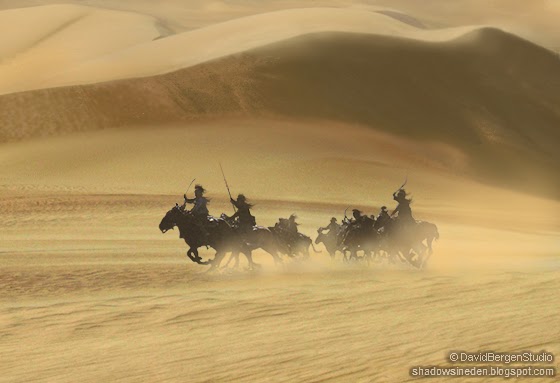
North Africa, sometime in the first half of the 6th-century. A contingent of horsemen clatters westward across the ochre wastes, the hooves of their mounts breaking the hard crust of surface sand. They approach an isolated [1]oasis, a settlement nestling among a green sea of date palms overlooking a lake, and dominated by a single building on a rocky knoll: their intended destination. They dismount below the knoll, ascend the path to the building and stride inside, confident in the authority vested in them by their emperor. Those at worship inside are forced out, the building is annexed, and its votive fires are quenched forever.

On a mission from the emperor..
This minor incident, one of many of its kind repeated across the empire, nevertheless resonates with a heavy significance. The building is the very last of the temples of Ammon: the only place where the gods of Dynastic Egypt are still actively worshipped. Its forced closure on the orders of Justinian, the Holy Roman Emperor, brings to a definitive end over 3,000 years of a religion which has been among the most enduring and stable of the Ancient World. In terms of an [2]end to a religion and its passing into myth, it is therefore not a natural death, but one which has been terminated by the historical forces which oppose it.

Isis-Aphrodite
The two foreign empires in Egypt which preceded Justinian’s own – the Greek and the Roman – both attempted to accommodate and absorb Egyptian beliefs. During the dynasty of the Ptolemy’s, the best-known of whom was the famed Cleopatra, the Greeks developed such crossover deities as Isis-Aphrodite and the ram-horned Zeus-Ammon.

Zeus-Ammon
The Romans also concocted their own curious hybrid deities. Anubis, jackal-headed guide of the underworld, would be fitted out in the garb of a Roman commander, and Isis, queen of the Egyptian pantheon, would be dressed as an aristocratic Roman lady, although still holding the sistrum – the jingling temple rattle – that was her distinctive symbol. In spite of these changes, it was perhaps an easier and even a logical transition, for all three of these empires were polytheistic, worshipping many gods, and the forces which these gods reflected could be recognised across beliefs.

The Roman Isis.
Justinian’s decision to close the temple might have been driven rather more by political astuteness than by fervent belief: he sought through such a gesture to appease the Christian Copts in North Africa, to demonstrate that he and they were ‘on the same side’. But it is also true that he was vigorously determined to Christianize his own empire. His subjects were given a stark choice: convert, or face exile or death. The Christianization of the early Holy Roman Empire was to prove as ruthless in its expediency as it would be in the following centuries in Europe under such monarchs as [3]Charlemagne. That the West rushed gratefully to embrace Christ is a historical fantasy. The iron will of a succession of men in positions of power, both secular and of the Church, is what history reveals.

The Greek goddess Eileithyia was the patroness of fertility and childbirth. Seen here against the backdrop of the Eileithyia cave in Crete, the aid of the goddess was called upon both by would-be mothers to grant fertility and to aid in a safe delivery. Caves have a long association with the womb of the earth mother.
But these old gods are, it seems, more resilient than the will of earthly emperors. The historian Bettany Hughes, while on Crete, reports encountering in an underground [4]cavern known as the Eileithyia Cave, votive offerings left to a goddess of fertility: a continuous use of the site spanning some five millennia. We might be living in the Christian era and date our calendar from the [5]birth of Christ, but the very days of our [6]week are named for Roman and Teutonic gods. When we wish our architecture to convey a civilized respectability, our role models are the marble edifices of pagan Grecian temples.

Names may change, but heroes endure across millennia. Perseus triumphantly holds the severed head of Medusa aloft, Theseus drags the slain Minotaur from the Labyrinth, Batman crouches darkly above Gotham City and a techno-armoured Iron Man does his palm-of-power thing.
And we might consign semi-divine heroes and their glorious deeds to a long-vanished antiquity, but we still nurture an apparent need for them. It’s just that instead of Perseus, Theseus, Hercules and Jason, we now call them Superman, Spiderman, Batman and Iron Man – and Thor has even resurfaced, still with his hammer and his original name intact.

The proportions might have drifted away from the original, but the Eye of Horus is still going strong in the form of tattoo designs, T-shirt symbols and other readily-available merchandise.
So did Justinian succeed in shutting down those Egyptian gods? Look around on the Web and you’ll find various sites dedicated to Isis and even to Sekhmet. And I do mean ‘dedicated’. These sites are not merely informational, but portals of worship, sincere in their intent. Eyes of Horus are now freely available to purchase as pendants, key rings, T-shirts, even as tattoos: take your pick. Whether you believe or not that gods are an invention of mortals, it seems that it is not up to mortals to decide when their time is up. Fifteen centuries after Justinian thought to close it, the eye of Horus is apparently still wide open and watchful.
Hawkwood


Notes:
[1] The incident which opens this post is briefly recounted in chapter 5 of Tom Holland’s book below. The author does not specify at which oasis the temple was located, but taking into account the location, setting and time frame, I’m assuming it to be the oasis of Siwa, then known as Ammon-Ra, now in Egypt but then a part of Libya, and it is this setting which my post describes.


Siwa has a remarkable-enough history. As a sacred site its use apparently stretches back many millennia. In the 4th-century BCE a Persian army of fifty thousand men were dispatched to commandeer the oasis. They never arrived. Having become lost among the dunes, the entire army perished in the North African desert. The Greek historian Herodotus, whose writings provide us with this incident, was thought to have been exaggerating, but the remains of this ill-fated army have recently been discovered. In the 2nd-century BCE, having conquered Egypt and founded the city of Alexandria, Alexander the Great visited the temple to consult the oracle there. Apparently as a result of this visit he henceforth believed in his own divinity, and that his mission of conquest was graced with divine will. To mark both his visit to the temple and his newly-acquired divinity, the megalomaniac conqueror thereafter had himself portrayed with ram horns (below left), elevating himself to the status of the god Zeus-Ammon (below right).


Following the forced closure of the temple, the settlement declined and its location was lost for some thousand years, only to be rediscovered in the 18th-century. Today its inhabitants live among the ruins (below), with most of the neighboring houses being occupied by the ghosts of history.


[2] Please see my post All Things Must Pass for more about the passing of religions into history.

[3] Please see note [5] of my post John Calvin's Tough Love for more about Charlemagne.

[4] Described in chapter 12 of Bettany Hughes’ book below. I myself remember visiting a Neolithic barrow in Denmark in which pagan offerings have been regularly left over a period of some ten millennia. Standing there in the semi-subterranean darkness of the burial chamber, surrounded by cold granite and with the musty compacted Danish soil underfoot, the line to my own ancestors felt like a very direct one indeed.

[5] No two historical sources agree on the actual year. As to the date: December 25th is actually the celebratory day of the sun god (often thought to be the day of the god Mithras, although this is not historically supported), the date being purloined by the early Church fathers, just as churches were built upon the foundations of the pagan temples which they had destroyed.

[6] Saturn’s Day, Sun Day, Moon Day, Tyr’s Day, Woden’s Day, Thor’s Day, Freya’s Day.


Sources:
Tom Holland: In the Shadow of the Sword –The Battle for Global Empire and the End of the Ancient World. Little, Brown, 2012. Few authors who write about history convey the great sweep of empire-changing events as vividly as Tom Holland. And few authors dig so deep and so fearlessly in their attempts to discover the historical truth behind the birth of the world religions (in this case, Islam) that are with us today. Since this title's publication Tom Holland has been forced to disappear as a Web presence - yet another indication of the way in which one religion's inability to shoulder criticism of any kind points only more tellingly to what are perhaps discomforting historical truths.    


Bettany Hughes: Helen of Troy – Goddess, Princess, Whore. Pimlico for Random House, 2005. Few books which I have read make the stuff of history as tangible as this one. It is at one and the same time a grand overview of the subject and an intimate portrait, both of Helen (insofar as that is possible for a figure who straddles both myth and history), and of the distant time in which she lived. In Bettany Hughes' title Helen also emerges as a mirror who reflects back to itself each successive age which has portrayed her in its own different way. We discover something about ourselves and our own time through the way in which we regard Helen, and through the way in which she is depicted by artists and writers both past and present.


Isis-Aphrodite and Zeus-Ammon: The Metropolitan Museum of Art, New York. Other Isis-Aphrodite statuettes from Christies Antiques. 2nd-century Roman Isis: Kunsthistorisches Museum, Vienna (sistrum from the statue of the Roman Isis in the Capitoline Museum, photo by Marie-Lan Nguyen). Eye of Horus tattoo from Lilz-eu-tattoo. Inlaid eye of Horus from the tomb of Tutankhamen, Cairo Museum. Renaissance statue of Perseus holding the head of Medusa by Benvenuto Cellini in the Logia del Lanzi, Florence, from a photo by Paolo del Reggio. Kylix of Theseus with the slain Minotaur in the National Archaeological Museum, Salamanca, photo by Marie-Lan Nguyen. Batman painted by Scott Hampton, from Batman: Night Cries, by Archie Goodwin and Scott Hampton, published by DC Comics Inc. 1992. Bat logo © Warner Bros, Legendary Pictures. Iron Man © Paramount Pictures, Marvel Enterprises. Alexander coin: British Museum. Zeus-Ammon coin: Kunsthistorisches Museum, Vienna. Photo of present-day Siwa Oasis by Heksamarre. On a Mission from the Emperor painted for this post by Hawkwood for the © David Bergen Studio, All Rights Reserved.