Return here to the Shadows in Eden home page.....
Showing posts with label Emperor Constantine. Show all posts

Thursday, April 9, 2015

Helena and the True Cross

However the events of her life played out, Helena has to be one of the more ambivalent and contentious figures from history. Revered as a saint by the Church, she also is implicated in the murder of her daughter-in-law Fausta, the wife of her son Constantine the Great, the first Christian emperor. Contention seems to have run in this particular family: Constantine himself not only orchestrated the [1]death of his wife at his mother’s instigation, but for good measure also murdered his own son, Crispus.

An alleged fragment of the True Cross mounted as a crucifix and presented as a relic. Such religious relics challenge us to accept their worth at face value or not. When all other means of proving their veracity are lacking, believing in what is claimed for them is a matter of individual faith.
These dark family doings apparently are outweighed in (or perhaps conveniently [2]overlooked by) the eyes of the Church by what Helena accomplished in her later years. Considerably later, as it turns out. Helena was reputed to be eighty years old when she journeyed to the [3]Holy Land, there to found churches on the sites of the Nativity and the sepulchre of the crucifixion. But it was what Helena brought back with her to Constantinople that resonated with an aura of legend. In her baggage was a sizable remnant of the True Cross.

In this 15th-century fresco by Piero della Francesca, Helena (far left) supervises the unearthing of the True Cross from the place of its secret burial in Jerusalem. The sincere intentions of the artist are not in themselves enough to convince us of the incongruous improbability of laying bare the perfectly-intact cross after three centuries of burial in the earth.
We can better understand the full import of the acquiring of this precious wood if we view it from the perspective of Helena’s own time and the centuries which immediately followed. For new churches, the acquisition of a holy relic meant status for an individual church, and such status carried with it an enhanced legitimacy – and additionally acted as a draw card for a potential swelling of that church’s [4]congregation. Inspired by such early examples as Helena’s, the acquiring of holy relics reached its peak in the Middle Ages.

With Helena’s help Constantine ruthlessly disposed of his wife, then having installed his mother in his palace to be his consort in all but name he underscored her status to the populace by having this coin struck in her honor: a state of affairs which we now would view as bizarrely Freudian.
Many churches claimed to possess fragments of the True Cross – enough wood, as it was wonderingly remarked at the time, from which to fashion several houses. Seven churches across the Empire boasted the only genuine skull of Mary Magdalene, and no less than thirteen churches laid claim to possess the tiny (and presumably much desiccated) foreskin of the Saviour. Perhaps there was a sense that things in this direction had gone a bridge too far when one nun insisted upon wearing the bizarre trinket as a fleshy ring on her finger to symbolize her marriage to Christ.

This [5]excess of holy relics seems in the end to have become an embarrassment of riches for these early churches, with a growing common-sense awareness of the impossibility of them all being genuine. But if at least some of these relics, and perhaps even most of them, must have been spurious, could any of them be what was claimed for them? Just how historically likely would it have been for Helena, the apparent initiator of this fevered craze for holy relics, to have both found and possessed a portion of the actual cross upon which Jesus had been crucified? To use the contemporary term: how sure can we be of the provenance of Helena’s prize?

An artistic curiosity fashioned by different hands over time, this statue of the seated Helena was originally carved as a portrait statue of an unknown Roman noblewoman. Some two hundred years later the face was re-carved to transform it into a likeness of Helena.
Helena set foot upon the soil of the Holy Land some three hundred years after the events of the crucifixion. We now view those events as momentous because we see them through the lens of the faith which has grown up around them. But this clearly is not how they would have been perceived at the time. Jesus received the sentence which the occupying Roman authorities reserved for those who were tried for sedition. Such offenders could be made to carry the heavy crossbeams to the place of execution, where the wooden uprights, held fast in the ground by large wedges front and back, awaited them. The wood was then reused for other such executions. There would have been no keeping portions of such crosses as mementos, and no recognition at the time that such keepsakes might have been worth preserving.

The crucifixion of insurrectionist slaves, as portrayed by the artist Fyodor Bronnikov. The tau (‘T’-shaped) cross would have been the most likely form of cross for execution because of the readily-changed crossbeam and the way in which the crossbeam supported the weight of the condemned. Death was mainly caused by slow and prolonged asphyxiation due to pressure on the lungs.
This is history applied with common-sense. Even had followers of Jesus, who would have had reason to regard him as special, requested such a keepsake, would the Roman authorities have allowed them to do so? A man charged with sedition against those very authorities needed to be swiftly forgotten for the sake of civic order, not have his memory and his principles [6]kept alive in the form of such a treasured memento by his followers.

This fanciful painting by Paolo Veronese portrays Helena contemplating a vision of the True Cross, which is here helpfully supported by a winged cherub. Fanciful, because the artist depicts the serene Helena of legend who went to the Holy Land in search of Christian truth, rather than the ruthless Helena of history, who conspired with her son to murder his wife and take her place at his side.
Whatever it was that Helena [7]brought back with her to Constantinople a full three centuries later, it hardly could have been what she claimed for it. Neither will we ever know what the wood actually was. Eager-to-please locals could just as easily have supplied her with a lintel from an old door frame or some such piece of worn building material no longer in use. Or perhaps given her dubious and ruthless past, Helena herself might not have been above knowing that what she brought back with her to Constantinople was not the real deal. Her own status as the mother of the emperor would have served as guarantee for the wood’s shady provenance. But faith – true faith – is not in things. All the relics in all the churches in all the world cannot amount to a truth which is experienced in the heart, and it is there that for many the True Cross may be found.
Hawkwood


Notes:
[1] Fausta (right), the wife and consort of Constantine, apparently was murdered by the bloodless yet gruesomely cruel method of confining her in an overheated bath. Constantine's son Crispus was poisoned.

[2] In its entry on ‘Saint’ Helena, the Catholic Encyclopedia makes no mention whatever of her implication in her daughter-in-law’s murder.

[3] The church historian Eusebius, while writing in detail about the deeds of Helena in Jerusalem, curiously makes no mention of her discovery of the cross, which was said to have been found intact and complete with nails at the site of the Holy Sepulchre.

[4] This marble bust of the principal Roman god Jupiter (left, housed, perhaps ironically, in the collection of the Vatican) would not have been viewed by the Romans as the god himself, any more than statues of the Virgin are by Catholicism. This makes the line between the veneration of statues and holy relics on the one hand, and idolatry on the other, a hazy one, if it exists at all. From a Catholic point-of-view the argument tends to be looked at backwards: that it was assumed that the so-called idols of indigenous and non-Christian cultures were true idols, that these images made by human hands literally were the actual gods. In reality such pagan and indigenous images functioned in the same way as their Church counterparts: as a focus for acts of veneration. The gods themselves remained discreetly invisible, as gods tend to.

[5] The hand of a 16th-century Jesuit missionary (right), severed from his corpse in India and brought to Rome to be lavishly displayed under glass as a holy relic. As the obsession to harvest such relics gathered pace during the Middle Ages, eager pilgrims actually exhumed the corpses of supposed saints and martyrs to be dismembered and distributed as relics, with the trade in such lugubrious remains being practiced on an almost industrial scale. The theft of relics from one church to be exhibited in another, with the returning successful thieves being greeted as heroes, also became common practice. Whether we regard such relics as objects of veneration or the morbid and distastefully ostentatious displaying of human remains is a matter of individual faith.

[6] The story which Helena is said to have encountered while in Jerusalem, that the cross was deliberately buried by Jews to prevent it becoming an object of Gentile veneration, is clearly a historical nonsense. For one thing, the Roman overlords would not have permitted such an act for the reasons explained in this post. The cross, or any cross used for execution purposes, was in this sense Roman property. For another, there was at this time no concept of separation between Jewish and Gentile beliefs among Jesus’ followers, which seems to have been an idea advocated later by Paul.

[7] According to the account, most of the recovered cross was erected in the Basilica of the Holy Sepulchre in Jerusalem, with Helena taking back smaller pieces to Constantinople and Rome. We must wonder why such a massive sacrilege of faith as carving up the True Cross by Helena for distribution as relics went apparently unquestioned. Again the common-sense answer must be: because Helena knew that it was not what it was purported to be. The cross (or whatever the wood actually was) was removed from the Basilica in a Persian invasion, later to be recovered and returned, only to be broken up still further and widely distributed as individual relics. The last remaining Jerusalem fragment was captured by Saladin (left) during the crusades and defiled by his Muslim forces, after which it disappears from history.


Sources:
Thomas F. Madden: The New Concise History of the Crusades. Rowman & Littlefield Inc. 2005.

Susan Haskins: Mary Magdalen: Myth and Metaphor. Harcourt Brace and Company for Harper Collins, 1993. Chapter IV of this title comprehensively covers the phenomenon of relic collection and acquisition by the early Church. It is perhaps difficult for us now to comprehend the bizarre and often macabre nature of this phenomenon, and the sheer scale on which it was practiced. A variety of objects, individual items, corpses and body parts were exhumed, traded and stolen to supply market demands, with scant attention being given to bona fidé provenance.

Fyodor Andreyevich Bronnikov: Cursed Field.
Click on the image to view the full-sized version.
True Cross fragment relic in  the collection of the Weltliche Schatzkammer, Vienna. Fresco of the Recovery of the True Cross by Piero della Francesca in the Church of San Francesco, Arezzo. Coin of Helena from the Classical Numismatic Group, Inc. Helena statue in the Capitoline Museums, Palazzo Nuovo, Rome. The painting Cursed Field: The place of execution in Ancient Rome, painted in 1878 by Fyodor Andreyevich Bronnikov. The painting The Vision of Saint Helena, painted in 1580 by Paolo Veronese.

Thursday, June 19, 2014

Are You Ready for The Rapture?

From 13th-century Europe comes the legend of the Wandering Jew: a hapless figure who, according to the story, mocked Jesus as he was being led to the place of crucifixion. For this ultimate lack of compassion this individual was cursed to walk the earth until the Second Coming. Later embellishments of this story give the man’s name as Ahasuerus – although why Ahasuerus was singled out from the [1]mocking multitudes who lined the way to Golgotha is something which the legend leaves unclear.

At the limits of his strength, Ahasuerus is himself mocked by the very Death which is denied to him.
What the story contains, and what concerns us here, is the unspecified time for Jesus’ triumphal return. Assuming the legend to be true, and with no Second Coming yet in sight, we must also assume that Ahasuerus is wandering still. How unimaginably strange and alienating the experience of witnessing the past two millennia must have been for him. He would have witnessed the growth of a religion which, for all its strength of numbers, has become deeply factionalized into thousands of different denominations, all with their own doctrines which differ from each other - sometimes radically so.

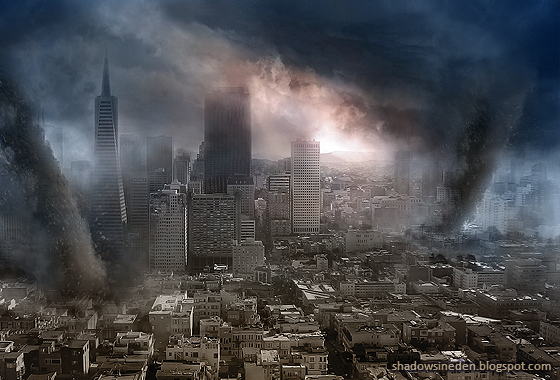
Twisted city: tornadoes demolish San Francisco.
But when will the Second Coming happen? At the time, it was fervently believed that this momentous event would take place within a [2]generation of the events of the crucifixion, in which case Ahasuerus would have lived a reasonably normal if rather lengthy life-span. There were many texts then in circulation about the coming end times, many revelations, all with appropriate signs to watch for that would signal the imminence of the event. As it turned out, only [3]one of these doom-laden texts finally made it into the canon. We know it as the Book of the Revelation of St. John the Divine.

Los Angeles slides into the Pacific Ocean.
That John’s text originally was only one of many such [4]eschatological texts then in circulation says as much about our preoccupation with such scenarios as it does about any specifically religious context. How else to explain our hunger for the sort of graphic scenes that we eagerly watch in any number of blockbuster disaster movies? We look on spellbound (but nevertheless safely nestled in our armchairs) as whole cities are engulfed by mega-tsunamis, by planet-rupturing earthquakes, by collision-course asteroids, by super-volcanoes, or even by out-of-control unreasoning monsters, all of it presented in the convincing fidelity of detail which state-of-the-art [5]CGI technology can now conjure forth.

That something in our nature actually seems to relish these images is evidenced by the box office takings of such films. And human nature being what it is, it’s a hop-skip-and-jump away from placing these things in a religious context – as in a pre-disaster movie age John of Patmos and others of his time actually did. We still have these hankerings for a spiritual disaster scenario. In our own time such a scenario is known as The Rapture.

Yellowstone Park heads skywards as the supervolcano erupts from beneath it.
The Rapture, the bodily ascent of believers into heaven which heralds the Second Coming, is an evangelical Christian concept, the details of which, inevitably, are contested between different evangelical groups. Is The Rapture concurrent with the Second Coming, or will the loyal faithful be raptured up into the realms celestial to greet the returning Christ? There can be no certainties for an event which, by its very definition, is supernatural. Not that certainties are not claimed, of course. Any number of signs for the end times are proposed, and any number of predictions of the precise time and date have been made in the last century and a half. As you are reading this, you can comfortably conclude that all such predictions have proven to be inaccurate.

A contemporary version of John's beast from the sea: the Cloverfield monster attacks New York. 
I will make a modest prediction of my own: The Rapture is like the future. It is and always will be something that is about to happen. I have, you see, a basic objection to the concept itself, and that objection crystalizes in the word ‘selectivity’. Any idea which smacks of spiritual elitism is an idea that needs to be questioningly scrutinized. If only believers who have [6]prepared themselves (specifically: Christian evangelical believers) are going to get raptured up, where does that leave the rest of us? Are all the non-evangelical Christians, Jews, Hindus, Bahais, neo-Pagans, Jains, Taoists, atheists, Buddhists, Sikhs, animists, you name it, going to be cut loose to roam a post-apocalyptic [7]dystopia, guarding precious fuel dumps like they were Fort Knox and praying that Mad Max is out there somewhere?

The bleak highway which Mad Max rides. The future, it seems, is a road to nowhere.
There is another side to this. With me, there always is. In the hypothetical situation of me being offered a ticket to ride (I said it was hypothetical), I assure you that I would turn it down. Somewhere inside me there lives a [8]bodhisattva. I would elect to stay behind and do what I could on earth. And if you are one of those who is getting ready for The Rapture, knowing that in so doing you are preparing yourself to be among the chosen elite who will leave so many of your fellows behind to suffer, then I would suggest that you might discover that heaven could well apply rather different criteria for selection than mere denominational doctrine and Rapture-ready preparedness. Ahasuerus, the Wandering Jew who must wait for the Second Coming, could be continuing his wanderings for quite a while yet.
Hawkwood      


Notes:
[1] Using the same rationale we must also wonder why Pontius Pilate, the soldiery who scourged Christ, and the entire cynically derisive crowd who chose to free the thief Barabbas were not also visited by the same curse which condemned Ahasuerus. Curses in legend, apparently, are irrationally selective. Another example of such a selective curse is Samuel Taylor Coleridge’s Ancient Mariner (left), whose worldly sufferings seem out of all proportion to his original act of shooting the albatross and thus precipitating the curse against him. Such curses in stories and legends can be devices for both driving a narrative forward and underscoring a moral point.

[2] In Matthew 24:34 Jesus says: "Verily I say unto you, This generation shall not pass, till all these things be fulfilled".

[3] At the Council of Nicaea, presided over by Emperor Constantine, The Book of Revelation only just scraped through the selection process to become canonical. With its intense visions both wondrous and bizarre, it has been inspiring artists (myself included), writers and End-of-Days conspiracy theorists ever since.

[4] Eschatology is the study of end-of-the-world-as-we-know-it scenarios from all cultures.

[5] CGI: computer generated image.

[6] A Rapture-Ready Check List: What being Rapture-ready actually entails can involve a whole check list of do's and don't's requirements, with the don't's including: don't sleep around with your girlfriend or boyfriend, don't work on Sunday, don't put the needs of your wife or husband and family before your faith, don't fail to truly repent of your sins, don't commit idolatry (which, as the website Divine Revelations makes clear, includes praying to saints, just to cut out all those idolatrous Catholics) and, rather mysteriously, you apparently can forget about being raptured up if you are merely ‘Worldly or Lukewarm’ (whatever that might mean).

All the stringent requirements (and the Divine Revelations website lists many more than the six I have mentioned here) when taken together would ensure that a negligible minority (if any) of evangelicals would pass muster. And human fallibility being what it is, this in turn prompts the curious scenario of The Rapture happening – and no one actually being raptured up. All in all, this laundry list of requirements catalogued by the Divine Revelations website, which would seem impossible to fulfill by all but the most neurotically stringent and religiously obsessed individuals (who presumably would be considered too unstable to be suitable Rapture candidates anyway), is merely another example of that perennially favourite ploy: a reward-and-punishment system of faith through fear, the ‘fear’ part in this case being the dire consequences of being one of the multitudes who will be left behind in a world which will descend into the stuff of nightmares.

[7] Dystopia: a future dysfunctional society in which the social order has broken down, which is the opposite of the ideal society as originally envisaged in the 16th-century book Utopia by Sir Thomas More.

[8] The Buddhist term bodhisattva has evolved in Western interpretations to mean a soul who declines to enter the bliss of Nirvana, electing instead to remain behind and help other sentient beings.


Sources:
Elaine Pagels: Revelations: Visions, Prophesy, and Politics in the Book of Revelation. Viking, 2012. Professor Pagels’ book puts John’s text in the context of the times in which he was writing: in the despairing aftermath of the crushed Jewish Revolt, and pointing out that each succeeding generation has seen its own sufferings and trials reflected in John’s visionary writings. The book also makes clear what I have mentioned here: that John’s text was only one of many of its kind then in circulation.


The top image is a detail of the painting Ahasuerus at the End of the World, by the Hungarian artist Adolf Hiremy-Hirschl, 1888. Left behind by the angel of Hope, mocked by an indifferent Death, Ahasuerus struggles on through an icy and forbidding wilderness as scavenging crows scatter around a comotose woman - the desperate epitome of all of fallen humanity. Other images are taken from the feature films: The Day After Tomorrow, 2012, Cloverfield, and the Mad Max online game.


Thursday, November 22, 2012

The Gospel According to Somebody

In my contacts with them I have often-enough been taken aback by the apparent lack of knowledge shown by Christians about the background of their own faith. Much seems to be taken for granted, and there is a general acceptance that ‘things are the way they are’. So if you who are reading this consider yourself a Christian, can you (for example) say why there are four gospels, and who wrote them? Well, this is not a quiz – although you might ask yourself whether or not you know the answer. After all, it does concern the very foundations of the beliefs which you hold. Let’s first mention what the respective answers are not. There are not four gospels because these were the four that were written, and neither are they by Matthew, Mark, Luke or John.


The four gospels were certainly not written as part of a cohesive Testament. They were among a whole collection of many such texts from the 1st- and 2nd-centuries, and in their day were not even the most popularly read, as is often presumed. No, the reason why there are now just four gospels in the New Testament is because of the vigorously-enforced personal opinions of a single individual.

Irenaeus of Lyons
In the 2nd century, Irenaeus, the Bishop of Lugdunum (now Lyons) in what was then Roman Gaul, wrote a massive multi-volume work with the no-nonsense title Against Heresies. For this particular bishop, there were rather too many gospels for his liking, and so he set about doing some judicious canonical pruning. Out went all the gospels and other texts that he personally considered to be wanting, until just four remained: the four canonical gospels as we know them today. Why four? Irenaeus himself tells us his reason: [1]“…for there are four zones in the world and four principal winds.” Yes, that really was this man’s logic behind his decision.

So of course the burning question has to be: who decided that Irenaeus had the necessary authority single-handedly to make these sweeping root-and-branch changes which virtually remodelled Christianity at that time? Well.. he did, actually. He was, after all, a bishop. And only a religious experience by either a bishop, a priest or a deacon carried any spiritual weight. Because bishops, priests and deacons were directly descended from, and therefore had the authority of, the original disciples (a process formally known as Apostolic Succession), which is why only these three hierarchies of the Church were qualified to know about such things. So all authority rested with orthodox them, and you as a member of the laity had to toe the party line.

An English translation of the opening words of Against Heresies, which shows clearly enough the style of Irenaeus’ invective. I have read enough to know that his text continues in the same emotive style.
So it’s a no-brainer that all beliefs which did not accept this hierarchical structure of the Church were branded by Irenaeus as heretical. Now, a cynical soul might think that Irenaeus was driven by motives that perhaps had as much to do with preserving his own power base as they had to do with any religious fervour. Because if all had equal rights before God, and if all individual spiritual experiences were equally valid, then what need for a bishop? And indeed, Irenaeus directed his most toxic invective against such groups as the [2]Christian Gnostics, who openly advocated this egalitarian approach to their faith, and who certainly did not need a bishop to tell them where things were at.

So if you insisted on sidestepping this religious chain of command, and believed passionately that all souls are free and equal, that you had the right to take the responsibility for your personal spiritual life and development, and that your own spiritual experience counted for as much as anyone else's.. well, then you were thinking the thoughts of a dangerous mind, because to Irenaeus this is what marked you out as a [3]heretic.  

And who wrote those four gospels? We simply do not know. Tradition attributes them to the eponymous four apostles, but tradition is not supported by scholarship. Some [4]sources, glimpsed indirectly through the lines of these texts, remain as shadowy unknowns, their identities lost to history. We can only say with certainty that the gospels were written by somebody. But Irenaeus we do know about, as the arbiter of the four gospels now in the New Testament. But the bending of others to his iron will came at a terrible human price, and that price was paid by the thousands of persecuted Gnostics, who thanks to Irenaeus’ unrelenting diatribes found themselves on the wrong side of what he personally had decided was correct to believe. Predictably, this man who directed such toxic invective against all whom he saw fit to disagree with, duly received sainthood, and is still regarded by many as a worthy father of the church.

And the eventual outcome of history? Scholarship now points to the fact that it was the [5]Gnostics’ version of Christianity that could have been closer to the original form of Christian beliefs, and it seems that Irenaeus merely created things in his own image.
Hawkwood 


PLEASE NOTE:
The top image has been created digitally to convey the idea of an unknown authorship for the Gospels. No Bible was actually defaced. I have various editions of the Bible on my bookshelf, and treat all of them with due respect.


Notes:
Eusebius of Caesarea
[1] J. Stevenson: A New Eusebius, 1957. Eusebius of Caesarea was a 3rd- to 4th-century chronicler of the early church, his Ecclesiastical History being his best-known work. Its reliability is now questioned by scholarship, and it is suspected that at least to some extent he fictionalised events. See also my previous post Anthony of the Desert: Life as Fiction for another example of fictionalised history created by another church father (Athanasius). Commissioned by Emperor Constantine to produce fifty Bibles, Eusebius took it upon himself either to include or exclude texts of his own choosing, based upon a shaky 'genuine to dubious' rating system of his own devising. Which, beyond the selection by Irenaeus, has had its influence upon the twenty seven books which now comprise the New Testament. As is the case with both Irenaeus and Athanasius (with whom Eusebius had contact regarding copied volumes of scripture), Eusebius was also elevated to sainthood.

[2] Even right here in the 21st-century, I read on a website (http://mb-soft.com/believe/txn/gnostici.htm) which purports to give an impartial account of the history of Gnosticism such florid (and distinctly unscholarly) invective as: "As Christianity grew within and without the Roman Empire, Gnosticism spread as a fungus at its root." and: "So rank was its poisonous growth that there seemed danger of its stifling Christianity altogether, and the earliest Fathers devoted their energies to uprooting it." It seems that the purging emotive rhetoric of Irenaeus lives on. And the use of the term 'Christianity' for the 2nd-century is a misnomer. At that time, the form of belief advocated by Irenaeus, which eventually became Catholicism, was neither more nor less legitimate than any other kind. But for the reasons given here (and for other reasons to which I shall be returning on this blog) it was the form which won, through sheer force of will - and also through the often relentless persecution and extermination of those other Christian beliefs which it perceived as its rivals.  

[3] Language can become a weapon, and purges and persecutions can result from labels. The word heresy simply means ‘choice’, meaning one’s personal right to choose one’s own beliefs, but Irenaeus effectively evolved the term negatively to imply something false and evil. Even now, thanks to Irenaeus, the term heretic has pejorative connotations to many, and the 4th-century eventually saw the criminalization of heresy punishable by death, with the Church in effect having the authority to pronounce sentence.

[4] A lost gospel text known as ‘Q’ (from the German Quelle, meaning ‘source’) can be inferred from the unknown authors of Matthew and Luke, who drew upon this lost text for their own writings.

[5] It is worth remembering that in it’s beginnings, Christianity had no church, no Bible, and it was not even called ‘Christian’. There were many, many different forms, some belonging more to the Hebraic tradition of the prophets, others more to the gentile authority of the apostles, and still others taking their inspiration from a broader base of spirituality which included the pre-Christian mystery schools. None of these was more ‘right’ than the other: they were just different. In scholastic terms, we have no reason to think that a Gnostic form of proto-Christianity was not the base out of which the early form of the religion grew. But history, as they say, is written by the victors, and it was the domineering and authoritarian will of early church fathers such as Irenaeus that triumphed to become the Catholic (meaning ‘universal’) church.