
Return here to the Shadows in Eden home page.....
Showing posts with label Helena. Show all posts

Tuesday, November 24, 2015

Mary of Egypt: A Heart in the Wilderness

Whatever the monk Zosimas expected to encounter when he [1]ventured into the Jordanian wilderness, what he discovered instead was something he could not have anticipated. There among the rocks and sand in front of him squatted a woman, emaciated and completely naked with dark leathery skin, her matted, straggling hair making her barely recognizable as anything human. Apparently reassured by the fact that her unexpected visitor was a monk, the woman gestured to Zosimas that she wished to use his cloak to cover herself. Then having wrapped herself in this makeshift garment, the woman asked the astonished monk to sit down with her, and she began to tell her story.

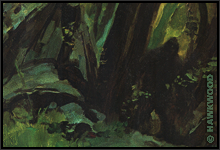
My painting of Mary portrays her as she might have appeared some ten years into her solitary retreat. Rather than portraying the Saint Mary of the Church, I wanted to be true to Mary’s humanity, to grant her the dignity of a very human soul living in harsh self-imposed exile from her own kind.
What we know of the woman’s story, and what she told to the monk Zosimas, we can learn in the account of her life written down by Sophronius, the Patriarch of Jerusalem during the 7th-century. Her name was Mary, and she had run away from her home in Egypt at the young age of twelve to journey to Alexandria. In the city she had lived a dissolute life, selling her sexual favours on the streets for the next seventeen years, or simply giving herself away for the sake of the experience. Apparently driven by a need to satisfy a carnal craving in new surroundings, she boarded a ship carrying pilgrims bound for Jerusalem. The pilgrims, both during the voyage and in Jerusalem itself, proved to be as willing as the residents of Alexandria, and she continued her wanton lifestyle within the city walls. Until the day that she found herself at the door of the Church of the Holy Sepulchre.

Sophronius’ account of Mary’s life does not provide us with the details of her journey, but using maps of the period it is possible to surmise that the ship on which she embarked from Alexandria would have sailed for the port of Joppa, which had a well-trodden connecting road to Jerusalem. The actual location of Zosimas’ monastery is unknown, but calculating its distance from Jerusalem and its location near the west bank of the River Jordan gives us its likely location. From the monastery Mary would have crossed the Jordan and travelled eastwards into the trans-Jordanian desert. 
Intending to enter in the hope of finding more clients among the congregation, she felt her way barred by some unseen force. Interpreting her impure lifestyle as the cause of her being unable to set foot in the church, she experienced a deep inner remorse. At this the withholding force seemed to vanish, and she entered the church and prayed by the relic of the [2]True Cross. Emerging once more into the sunlight, she felt that she heard a voice say to her: “If you cross the Jordan you will find glorious rest.” Renouncing the life which she had led, she journeyed to a monastery by the Jordan to receive Holy Communion before crossing the river to begin the life of a [3]recluse – a life that she would follow for the rest of her days.

Having related her story to Zosimas, Mary asked the monk to meet her in a year’s time to give her Holy Communion. At the appointed time Zosimas arrived at the banks of the Jordan to see Mary walking towards him across the waters. A further meeting was arranged for the following year, and this time Zosimas returned to the place where he had first encountered Mary, only to find her dead. It is said that a lion helped him to bury her, digging with its claws into the dry desert earth which had been Mary’s home for so many years, and which now would be her last resting place.

Two traditional icons of Mary. An anonymous Russian artist has surrounded Mary with scenes from her life (left), beginning with her kneeling in prayer before the relic of the True Cross, and ending with her burial by the lion. Gregory of Sinai monastery has chosen to depict the moment (right) when Mary walks across the River Jordan to meet Zosimas.
This, briefly, is the story of Mary – Mary of Egypt as she became known. It was preserved as an oral tradition by the monks of Zosimas’ monastery before being recorded by Sophronius a century later. In it we recognize elements similar to the life of [4]Thecla: a remarkable life of a turn to faith interwoven with the supernatural elements of legend. For the orthodox faithful, it provides a textbook example of repentance and redemption, and the mercies of the Spirit which such redemption ensures. But because these aspects of her story are the focus for the faithful, what is glossed over in such orthodox accounts is another central aspect of Mary’s story. It is a story of astonishing practical survival.

A popular 13th-century account of the lives of the saints apparently confused Mary’s story with that of Mary Magdalene. The story that Mary Magdalene spent her final years as a solitary naked penitent is wholly erroneous, but it nevertheless was seized upon by artists who were willing enough to portray the penitent naked Magdalene, as in this romanticised 19th-century version by Alfredo Valenzuela Puelma, which depicts an improbably healthy-looking Magdalene swooning before the cave in which she was supposed to have lived.
We do not know the exact years of Mary’s life, but if we assume that she must have been almost thirty when she crossed the Jordan, then her death in her late seventies means that she still must have lived for some forty-seven years in the wilderness. The legend relates that when she left for the desert she took only three loaves of bread with her. For the rest, she lived on whatever her unforgiving surroundings provided her with. This is a feat of endurance which leaves the achievements of even the most radical hard-core survivalists looking like a Sunday afternoon picnic. Given that the basic practical events of Mary’s story actually happened, we must marvel at the survival skills which she must have developed just to stay alive, and with them the mental and emotional commitment needed to sustain her existence of utter solitude. Zosimas mentions that she prayed in a near-unintelligible whisper, with all her words running together. And yet she apparently retained enough of her language skills to communicate her story to the monk.

The unforgiving harshness and haunting grandeur of the Jordanian desert. Mary somehow managed not only to survive, but to live in this hostile landscape, and not just for months or for years, but for several decades. Faith is a wondrous thing in itself. To add miracles to her story perhaps diminishes what she achieved on a human level.
We might or might not accept the supernatural elements of the story – the unseen force at the doors of the church, Mary walking on the waters of the Jordan, and the [5]helpful lion – for such elements remain a matter for individual faith. Such miraculous occurrences were needed to confirm Mary’s sainthood by the Church, and in any case remain a distant and unverifiable hearsay. My painting of Mary which heads this post does not need them: I find Mary’s commitment of faith and feat of survival sufficient marvels in themselves. The Church might have need of such miracles and mysteries, but there in the wilderness beyond the Jordan beat a heart in quiet solitude, and the human heart holds mysteries far greater than these.
Hawkwood    

Between Truth and Legend: Is Mary's story true? The circumstances of her life existed as an oral tradition before being set down in writing a century after the events. Faith is the criterion for us accepting the supernatural elements of her story, but what of the story itself? We know from documented examples that ten years is enough time for a human to revert to a feral state and lose the faculty of speech. And yet after some forty-seven years Mary was articulate enough to relate her story to Zosimus, even though the monk described her manner of praying as near-incoherent. I personally believe the substance of Mary's story, although that substance might have been embroidered upon over the years, as stories typically are.


Notes:
[1] It was expected of each monk at the monastery that he should make an annual sojourn into the desert to fast in prayerful contemplation.

[2] Please see my post Helena and the True Cross to read more about the veracity of this holy relic.

[3] A medieval tradition seems to have confused Mary Magdalene with Mary’s story. This tradition has a post-Resurrection Magdalene also living for many years as a repentant naked recluse, for which there is no evidence whatever. The source of this erroneous tradition was The Golden Legend, a 13th-century compilation of the lives of saints. The Legend freely mixed historical facts with fanciful fiction and hearsay miracles: a dubious literary cocktail which only increased its popularity. Later scholasticism treated the Legend more critically – although even up to the 19th-century artists were still portraying Mary Magdalene as a naked recluse (left, by Hans Olaf Heyerdahl) in the style of Mary of Egypt. Please see my post The Gospel of Mary.   

[4] Please see my post Thecla: A Woman between Rain and Fire to read Thecla’s remarkable story.

[5] Whether the intervention of the helpful lion could be considered as miraculous is perhaps questionable. I tend to think of it as a typical storybook element: unlikely and improbable, but not actually defying the laws of physics and nature, as miracles appear to do. 


Sources:
The original account by Sophronius on which my post is based can be read here. My post necessarily condenses or omits many of the details purportedly related by Mary to Zosimas, including the fact that she prostituted herself on board the vessel bound for the Holy Land specifically as a way of paying for her passage, and also includes an extended and detailed account of her first meeting with Zosimas, which is moving in itself.

Jordanian desert adapted from a photo by criscris1. Map and portrayal of Mary created for this post by Hawkwood for the David Bergen Studio © All Rights Reserved.

Thursday, April 9, 2015

Helena and the True Cross

However the events of her life played out, Helena has to be one of the more ambivalent and contentious figures from history. Revered as a saint by the Church, she also is implicated in the murder of her daughter-in-law Fausta, the wife of her son Constantine the Great, the first Christian emperor. Contention seems to have run in this particular family: Constantine himself not only orchestrated the [1]death of his wife at his mother’s instigation, but for good measure also murdered his own son, Crispus.

An alleged fragment of the True Cross mounted as a crucifix and presented as a relic. Such religious relics challenge us to accept their worth at face value or not. When all other means of proving their veracity are lacking, believing in what is claimed for them is a matter of individual faith.
These dark family doings apparently are outweighed in (or perhaps conveniently [2]overlooked by) the eyes of the Church by what Helena accomplished in her later years. Considerably later, as it turns out. Helena was reputed to be eighty years old when she journeyed to the [3]Holy Land, there to found churches on the sites of the Nativity and the sepulchre of the crucifixion. But it was what Helena brought back with her to Constantinople that resonated with an aura of legend. In her baggage was a sizable remnant of the True Cross.

In this 15th-century fresco by Piero della Francesca, Helena (far left) supervises the unearthing of the True Cross from the place of its secret burial in Jerusalem. The sincere intentions of the artist are not in themselves enough to convince us of the incongruous improbability of laying bare the perfectly-intact cross after three centuries of burial in the earth.
We can better understand the full import of the acquiring of this precious wood if we view it from the perspective of Helena’s own time and the centuries which immediately followed. For new churches, the acquisition of a holy relic meant status for an individual church, and such status carried with it an enhanced legitimacy – and additionally acted as a draw card for a potential swelling of that church’s [4]congregation. Inspired by such early examples as Helena’s, the acquiring of holy relics reached its peak in the Middle Ages.

With Helena’s help Constantine ruthlessly disposed of his wife, then having installed his mother in his palace to be his consort in all but name he underscored her status to the populace by having this coin struck in her honor: a state of affairs which we now would view as bizarrely Freudian.
Many churches claimed to possess fragments of the True Cross – enough wood, as it was wonderingly remarked at the time, from which to fashion several houses. Seven churches across the Empire boasted the only genuine skull of Mary Magdalene, and no less than thirteen churches laid claim to possess the tiny (and presumably much desiccated) foreskin of the Saviour. Perhaps there was a sense that things in this direction had gone a bridge too far when one nun insisted upon wearing the bizarre trinket as a fleshy ring on her finger to symbolize her marriage to Christ.

This [5]excess of holy relics seems in the end to have become an embarrassment of riches for these early churches, with a growing common-sense awareness of the impossibility of them all being genuine. But if at least some of these relics, and perhaps even most of them, must have been spurious, could any of them be what was claimed for them? Just how historically likely would it have been for Helena, the apparent initiator of this fevered craze for holy relics, to have both found and possessed a portion of the actual cross upon which Jesus had been crucified? To use the contemporary term: how sure can we be of the provenance of Helena’s prize?

An artistic curiosity fashioned by different hands over time, this statue of the seated Helena was originally carved as a portrait statue of an unknown Roman noblewoman. Some two hundred years later the face was re-carved to transform it into a likeness of Helena.
Helena set foot upon the soil of the Holy Land some three hundred years after the events of the crucifixion. We now view those events as momentous because we see them through the lens of the faith which has grown up around them. But this clearly is not how they would have been perceived at the time. Jesus received the sentence which the occupying Roman authorities reserved for those who were tried for sedition. Such offenders could be made to carry the heavy crossbeams to the place of execution, where the wooden uprights, held fast in the ground by large wedges front and back, awaited them. The wood was then reused for other such executions. There would have been no keeping portions of such crosses as mementos, and no recognition at the time that such keepsakes might have been worth preserving.

The crucifixion of insurrectionist slaves, as portrayed by the artist Fyodor Bronnikov. The tau (‘T’-shaped) cross would have been the most likely form of cross for execution because of the readily-changed crossbeam and the way in which the crossbeam supported the weight of the condemned. Death was mainly caused by slow and prolonged asphyxiation due to pressure on the lungs.
This is history applied with common-sense. Even had followers of Jesus, who would have had reason to regard him as special, requested such a keepsake, would the Roman authorities have allowed them to do so? A man charged with sedition against those very authorities needed to be swiftly forgotten for the sake of civic order, not have his memory and his principles [6]kept alive in the form of such a treasured memento by his followers.

This fanciful painting by Paolo Veronese portrays Helena contemplating a vision of the True Cross, which is here helpfully supported by a winged cherub. Fanciful, because the artist depicts the serene Helena of legend who went to the Holy Land in search of Christian truth, rather than the ruthless Helena of history, who conspired with her son to murder his wife and take her place at his side.
Whatever it was that Helena [7]brought back with her to Constantinople a full three centuries later, it hardly could have been what she claimed for it. Neither will we ever know what the wood actually was. Eager-to-please locals could just as easily have supplied her with a lintel from an old door frame or some such piece of worn building material no longer in use. Or perhaps given her dubious and ruthless past, Helena herself might not have been above knowing that what she brought back with her to Constantinople was not the real deal. Her own status as the mother of the emperor would have served as guarantee for the wood’s shady provenance. But faith – true faith – is not in things. All the relics in all the churches in all the world cannot amount to a truth which is experienced in the heart, and it is there that for many the True Cross may be found.
Hawkwood


Notes:
[1] Fausta (right), the wife and consort of Constantine, apparently was murdered by the bloodless yet gruesomely cruel method of confining her in an overheated bath. Constantine's son Crispus was poisoned.

[2] In its entry on ‘Saint’ Helena, the Catholic Encyclopedia makes no mention whatever of her implication in her daughter-in-law’s murder.

[3] The church historian Eusebius, while writing in detail about the deeds of Helena in Jerusalem, curiously makes no mention of her discovery of the cross, which was said to have been found intact and complete with nails at the site of the Holy Sepulchre.

[4] This marble bust of the principal Roman god Jupiter (left, housed, perhaps ironically, in the collection of the Vatican) would not have been viewed by the Romans as the god himself, any more than statues of the Virgin are by Catholicism. This makes the line between the veneration of statues and holy relics on the one hand, and idolatry on the other, a hazy one, if it exists at all. From a Catholic point-of-view the argument tends to be looked at backwards: that it was assumed that the so-called idols of indigenous and non-Christian cultures were true idols, that these images made by human hands literally were the actual gods. In reality such pagan and indigenous images functioned in the same way as their Church counterparts: as a focus for acts of veneration. The gods themselves remained discreetly invisible, as gods tend to.

[5] The hand of a 16th-century Jesuit missionary (right), severed from his corpse in India and brought to Rome to be lavishly displayed under glass as a holy relic. As the obsession to harvest such relics gathered pace during the Middle Ages, eager pilgrims actually exhumed the corpses of supposed saints and martyrs to be dismembered and distributed as relics, with the trade in such lugubrious remains being practiced on an almost industrial scale. The theft of relics from one church to be exhibited in another, with the returning successful thieves being greeted as heroes, also became common practice. Whether we regard such relics as objects of veneration or the morbid and distastefully ostentatious displaying of human remains is a matter of individual faith.

[6] The story which Helena is said to have encountered while in Jerusalem, that the cross was deliberately buried by Jews to prevent it becoming an object of Gentile veneration, is clearly a historical nonsense. For one thing, the Roman overlords would not have permitted such an act for the reasons explained in this post. The cross, or any cross used for execution purposes, was in this sense Roman property. For another, there was at this time no concept of separation between Jewish and Gentile beliefs among Jesus’ followers, which seems to have been an idea advocated later by Paul.

[7] According to the account, most of the recovered cross was erected in the Basilica of the Holy Sepulchre in Jerusalem, with Helena taking back smaller pieces to Constantinople and Rome. We must wonder why such a massive sacrilege of faith as carving up the True Cross by Helena for distribution as relics went apparently unquestioned. Again the common-sense answer must be: because Helena knew that it was not what it was purported to be. The cross (or whatever the wood actually was) was removed from the Basilica in a Persian invasion, later to be recovered and returned, only to be broken up still further and widely distributed as individual relics. The last remaining Jerusalem fragment was captured by Saladin (left) during the crusades and defiled by his Muslim forces, after which it disappears from history.


Sources:
Thomas F. Madden: The New Concise History of the Crusades. Rowman & Littlefield Inc. 2005.

Susan Haskins: Mary Magdalen: Myth and Metaphor. Harcourt Brace and Company for Harper Collins, 1993. Chapter IV of this title comprehensively covers the phenomenon of relic collection and acquisition by the early Church. It is perhaps difficult for us now to comprehend the bizarre and often macabre nature of this phenomenon, and the sheer scale on which it was practiced. A variety of objects, individual items, corpses and body parts were exhumed, traded and stolen to supply market demands, with scant attention being given to bona fidé provenance.

Fyodor Andreyevich Bronnikov: Cursed Field.
Click on the image to view the full-sized version.
True Cross fragment relic in  the collection of the Weltliche Schatzkammer, Vienna. Fresco of the Recovery of the True Cross by Piero della Francesca in the Church of San Francesco, Arezzo. Coin of Helena from the Classical Numismatic Group, Inc. Helena statue in the Capitoline Museums, Palazzo Nuovo, Rome. The painting Cursed Field: The place of execution in Ancient Rome, painted in 1878 by Fyodor Andreyevich Bronnikov. The painting The Vision of Saint Helena, painted in 1580 by Paolo Veronese.