
Return here to the Shadows in Eden home page.....
Showing posts with label Mary Magdalene. Show all posts

Tuesday, November 24, 2015

Mary of Egypt: A Heart in the Wilderness

Whatever the monk Zosimas expected to encounter when he [1]ventured into the Jordanian wilderness, what he discovered instead was something he could not have anticipated. There among the rocks and sand in front of him squatted a woman, emaciated and completely naked with dark leathery skin, her matted, straggling hair making her barely recognizable as anything human. Apparently reassured by the fact that her unexpected visitor was a monk, the woman gestured to Zosimas that she wished to use his cloak to cover herself. Then having wrapped herself in this makeshift garment, the woman asked the astonished monk to sit down with her, and she began to tell her story.

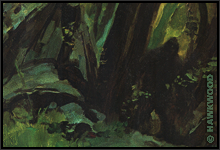
My painting of Mary portrays her as she might have appeared some ten years into her solitary retreat. Rather than portraying the Saint Mary of the Church, I wanted to be true to Mary’s humanity, to grant her the dignity of a very human soul living in harsh self-imposed exile from her own kind.
What we know of the woman’s story, and what she told to the monk Zosimas, we can learn in the account of her life written down by Sophronius, the Patriarch of Jerusalem during the 7th-century. Her name was Mary, and she had run away from her home in Egypt at the young age of twelve to journey to Alexandria. In the city she had lived a dissolute life, selling her sexual favours on the streets for the next seventeen years, or simply giving herself away for the sake of the experience. Apparently driven by a need to satisfy a carnal craving in new surroundings, she boarded a ship carrying pilgrims bound for Jerusalem. The pilgrims, both during the voyage and in Jerusalem itself, proved to be as willing as the residents of Alexandria, and she continued her wanton lifestyle within the city walls. Until the day that she found herself at the door of the Church of the Holy Sepulchre.

Sophronius’ account of Mary’s life does not provide us with the details of her journey, but using maps of the period it is possible to surmise that the ship on which she embarked from Alexandria would have sailed for the port of Joppa, which had a well-trodden connecting road to Jerusalem. The actual location of Zosimas’ monastery is unknown, but calculating its distance from Jerusalem and its location near the west bank of the River Jordan gives us its likely location. From the monastery Mary would have crossed the Jordan and travelled eastwards into the trans-Jordanian desert. 
Intending to enter in the hope of finding more clients among the congregation, she felt her way barred by some unseen force. Interpreting her impure lifestyle as the cause of her being unable to set foot in the church, she experienced a deep inner remorse. At this the withholding force seemed to vanish, and she entered the church and prayed by the relic of the [2]True Cross. Emerging once more into the sunlight, she felt that she heard a voice say to her: “If you cross the Jordan you will find glorious rest.” Renouncing the life which she had led, she journeyed to a monastery by the Jordan to receive Holy Communion before crossing the river to begin the life of a [3]recluse – a life that she would follow for the rest of her days.

Having related her story to Zosimas, Mary asked the monk to meet her in a year’s time to give her Holy Communion. At the appointed time Zosimas arrived at the banks of the Jordan to see Mary walking towards him across the waters. A further meeting was arranged for the following year, and this time Zosimas returned to the place where he had first encountered Mary, only to find her dead. It is said that a lion helped him to bury her, digging with its claws into the dry desert earth which had been Mary’s home for so many years, and which now would be her last resting place.

Two traditional icons of Mary. An anonymous Russian artist has surrounded Mary with scenes from her life (left), beginning with her kneeling in prayer before the relic of the True Cross, and ending with her burial by the lion. Gregory of Sinai monastery has chosen to depict the moment (right) when Mary walks across the River Jordan to meet Zosimas.
This, briefly, is the story of Mary – Mary of Egypt as she became known. It was preserved as an oral tradition by the monks of Zosimas’ monastery before being recorded by Sophronius a century later. In it we recognize elements similar to the life of [4]Thecla: a remarkable life of a turn to faith interwoven with the supernatural elements of legend. For the orthodox faithful, it provides a textbook example of repentance and redemption, and the mercies of the Spirit which such redemption ensures. But because these aspects of her story are the focus for the faithful, what is glossed over in such orthodox accounts is another central aspect of Mary’s story. It is a story of astonishing practical survival.

A popular 13th-century account of the lives of the saints apparently confused Mary’s story with that of Mary Magdalene. The story that Mary Magdalene spent her final years as a solitary naked penitent is wholly erroneous, but it nevertheless was seized upon by artists who were willing enough to portray the penitent naked Magdalene, as in this romanticised 19th-century version by Alfredo Valenzuela Puelma, which depicts an improbably healthy-looking Magdalene swooning before the cave in which she was supposed to have lived.
We do not know the exact years of Mary’s life, but if we assume that she must have been almost thirty when she crossed the Jordan, then her death in her late seventies means that she still must have lived for some forty-seven years in the wilderness. The legend relates that when she left for the desert she took only three loaves of bread with her. For the rest, she lived on whatever her unforgiving surroundings provided her with. This is a feat of endurance which leaves the achievements of even the most radical hard-core survivalists looking like a Sunday afternoon picnic. Given that the basic practical events of Mary’s story actually happened, we must marvel at the survival skills which she must have developed just to stay alive, and with them the mental and emotional commitment needed to sustain her existence of utter solitude. Zosimas mentions that she prayed in a near-unintelligible whisper, with all her words running together. And yet she apparently retained enough of her language skills to communicate her story to the monk.

The unforgiving harshness and haunting grandeur of the Jordanian desert. Mary somehow managed not only to survive, but to live in this hostile landscape, and not just for months or for years, but for several decades. Faith is a wondrous thing in itself. To add miracles to her story perhaps diminishes what she achieved on a human level.
We might or might not accept the supernatural elements of the story – the unseen force at the doors of the church, Mary walking on the waters of the Jordan, and the [5]helpful lion – for such elements remain a matter for individual faith. Such miraculous occurrences were needed to confirm Mary’s sainthood by the Church, and in any case remain a distant and unverifiable hearsay. My painting of Mary which heads this post does not need them: I find Mary’s commitment of faith and feat of survival sufficient marvels in themselves. The Church might have need of such miracles and mysteries, but there in the wilderness beyond the Jordan beat a heart in quiet solitude, and the human heart holds mysteries far greater than these.
Hawkwood    

Between Truth and Legend: Is Mary's story true? The circumstances of her life existed as an oral tradition before being set down in writing a century after the events. Faith is the criterion for us accepting the supernatural elements of her story, but what of the story itself? We know from documented examples that ten years is enough time for a human to revert to a feral state and lose the faculty of speech. And yet after some forty-seven years Mary was articulate enough to relate her story to Zosimus, even though the monk described her manner of praying as near-incoherent. I personally believe the substance of Mary's story, although that substance might have been embroidered upon over the years, as stories typically are.


Notes:
[1] It was expected of each monk at the monastery that he should make an annual sojourn into the desert to fast in prayerful contemplation.

[2] Please see my post Helena and the True Cross to read more about the veracity of this holy relic.

[3] A medieval tradition seems to have confused Mary Magdalene with Mary’s story. This tradition has a post-Resurrection Magdalene also living for many years as a repentant naked recluse, for which there is no evidence whatever. The source of this erroneous tradition was The Golden Legend, a 13th-century compilation of the lives of saints. The Legend freely mixed historical facts with fanciful fiction and hearsay miracles: a dubious literary cocktail which only increased its popularity. Later scholasticism treated the Legend more critically – although even up to the 19th-century artists were still portraying Mary Magdalene as a naked recluse (left, by Hans Olaf Heyerdahl) in the style of Mary of Egypt. Please see my post The Gospel of Mary.   

[4] Please see my post Thecla: A Woman between Rain and Fire to read Thecla’s remarkable story.

[5] Whether the intervention of the helpful lion could be considered as miraculous is perhaps questionable. I tend to think of it as a typical storybook element: unlikely and improbable, but not actually defying the laws of physics and nature, as miracles appear to do. 


Sources:
The original account by Sophronius on which my post is based can be read here. My post necessarily condenses or omits many of the details purportedly related by Mary to Zosimas, including the fact that she prostituted herself on board the vessel bound for the Holy Land specifically as a way of paying for her passage, and also includes an extended and detailed account of her first meeting with Zosimas, which is moving in itself.

Jordanian desert adapted from a photo by criscris1. Map and portrayal of Mary created for this post by Hawkwood for the David Bergen Studio © All Rights Reserved.

Wednesday, July 22, 2015

Matthew, Mark, Luke …and Mary?

The woman who sits quietly writing already has known the greatest love, and because of that love has also endured the greatest loss. She writes from the depths, both of her love and of her wisdom, which is the wisdom of the inner ways taught to her as the one worthy to receive such precious knowledge. And she also writes from her own first-hand experience as a witness to the events which she relates, and from the wellsprings of insight which are uniquely hers. The woman does not know, nor can she know, the cruel twists of the invented history about her that is to come. And perhaps that is as well, for were she to know these things, even her great spirit might falter.

A yawning gulf stretches between the Mary Magdalene who shows us a wisdom and nobility of spirit as revealed in the original texts about – and possibly actually by – her, and the redeemed woman of former ill repute perpetuated by the Church. My imagined portrait of Mary features a fragment of the surviving Gospel of Mary in the background: a text which presents us with a radically different version from the Mary of the Church.
Mary, the Magdalene, writes in ink on papyrus the [1]Gnostic declaration: In the beginning was the Logos, and the Logos was with God, and the Logos was God. This text written in her own [2]hand has no title. It is simply a manuscript. But its spiritual clarity and emotional intensity, and the immediacy of the events which it describes will ensure that it remains one which is read, copied and circulated.

This original text will be lost to history, but some fifty years later other hands less tolerant, and perhaps more jealous, of a mere woman’s authorship of such wisdom will radically amend her text, altering it to seem as if a man had written her words – a simple matter for a copyist to alter ‘she’ to ‘he’, apparently to make it acceptable to the new orthodoxy. The text itself clearly tells us that it was written by the [3]‘disciple whom Jesus loved’, the orthodox assumption being that this is John. And there are indeed two points in the narrative where both Mary Magdalene and this unnamed ‘beloved disciple’ appear in the same scene: at the foot of the cross, and at the tomb following the Resurrection. Yet it is precisely at these points in the story that the narrative appears to stumble, [4]contradicting itself as to exactly who was where, and when. It is as if an unknown hand is shuffling the deck in the middle of the deal, attempting to shoehorn events to fit the changed context.

The weeping Magdalene outside the tomb, as portrayed in the 19th-century by Antonio Ciseri. In the fourth Gospel Mary is described as simultaneously running away from the tomb and remaining behind at the tomb alone: an impossibility of circumstance which only can be reconciled if the ‘disciple whom Jesus loved’ and John are not the same person. Mary’s luxuriant loose tresses were the traditional artistic means of signalling her status as a former prostitute.
And the Magdalene herself? Already ciphered away as the true author of the text, this most wise of the original disciples now becomes demoted and reinvented by the triumphant forces of orthodoxy to be portrayed, not as one of Jesus’ inner circle, but as a mere follower and a former whore. The fact that scripture never actually describes her in such terms seems of little consequence. Such tactics are not unknown to the Church, which already has reinvented such apparently pro-Gnostic writers as [5]Anthony, Clement of Alexandria and [6]Paul to become paragons of orthodox doctrine.

Not for nothing did Clement ironically caution that ‘not all true things are the truth.’ For almost two thousand years the image of Mary Magdalene as a [7]redeemed whore will persist. Artists down the centuries become willing and unwitting co-conspirators, seeing their chance to depict the Magdalene in her penitent scarlet woman guise as a pious pretext to reveal some vulnerable female flesh. But as it always does eventually, the tide of opinion and scriptural scholarship turns.

A staged photograph from the 1920’s portraying the penitent Magdalene. Even up to the previous century we see the loose hair and the element of suggestive nudity being used to denote Mary’s presumed repentance of her former profession: a lifestyle for which there is no evidence whatever anywhere in scripture. The unknown photographer nevertheless engages our sympathy with a dramatic simplicity of composition and by keeping the face of the model hidden from our view.
So what is the basis for our calling this particular book 'The Gospel According to St. John'? In the 2nd-century [8]Irenaeus, the bishop of Lyon, was considering what he should call the untitled manuscript. He seemed to recall that his mentor, Bishop Polycarp, had once mentioned to him that the manuscript was written by John the apostle. And so under the editorial hand of the bishop, the text became accepted into scripture with its new title. Incredibly, this tenuous boyhood memory of a single individual is the only basis we have for calling John the author. For impartial contemporary scholarship the text is anonymous.

This sympathetic 19th-century portrayal of the Magdalene by Mateo Cerezo, while still endowing her with a prostitute’s loose tresses, nevertheless creates around her an atmosphere of devotion and study. The skull was used as a memento mori – a reminder of human mortality – which the artist counterpoints with Mary’s tender gaze towards the promised immortality offered by the crucifix.
When the only reason we have for attributing the authorship of the fourth Gospel to the apostle John is based upon a hearsay boyhood memory, then tradition rests upon foundations of sand. But if John did not write it, then who did? The ‘beloved disciple’ remains unnamed, and yet entrenched tradition insists that it is John. But other [9]texts tell us specifically that the ‘beloved disciple’, the ‘disciple whom Jesus loved’, is Mary Magdalene. Remembering that the fourth Gospel originally was a [10]text belonging to these other writings, by restoring the inconsistencies and changes of gender we can read this fourth Gospel very much as it could be read in what perhaps was its original form, before the alterations were made which allowed the text to become an acceptable part of the orthodox canon.

If for you this all seems a little far-fetched, how differently would you feel about things if new evidence would come to light that the text was written by (for example) the disciple Bartholomew? Is it after all mere chauvinist bias which makes the idea of a female authorship implausible? And if you still resist the idea, then consider this: it is a cold fact that we have more circumstantial evidence for considering that Mary was the text’s author than ever existed for assigning the authorship to John.
Hawkwood 

Today, 22nd July, is traditionally the day of Mary Magdalene: a good day for redressing the outdated misconceptions which orthodox opinion has been only too prepared to allow to accrue around her name.
       

Notes:
[1] The term Logos (right) is essentially Gnostic, and this is the word used in the Gospel’s original Greek. The concept of the Logos actually has its origins in the pre-Christian Greek mystery schools (as does the concept of the Trinity). The author David Fideler describes the Logos as “the pre-Christian idea of ..the pattern of Harmony which was seen as underlying the order of the universe.” In subsequent translations of the fourth Gospel, the term ‘Logos’ has been exchanged for the more simplistic term ‘Word’, but ‘Logos’ and ‘Word’ are not interchangeable concepts.

[2] Such texts also could have been dictated to a scribe.

[3] John 21:20 and 21:24.
    
[4] During John 20:1-11, Mary’s location pops in and out of being both already at the entrance to the tomb and simultaneously running away from it. An assumption that it is she who is the ‘beloved disciple’ and not the separate figure of John makes this discrepancy disappear.
   
[5] Please see my post Anthony of the Desert: Life as Fiction.


[6] Just as the orthodox bishop Athanasius presented the life of Anthony as a fictionalized biography after his death to make it appear as if Anthony was a paragon of orthodoxy, the letters of Paul were altered and supplemented for the same reason. The letters appearing in Paul’s name in the New Testament as 1 Timothy, 2 Timothy and Titus are forgeries. 1 Timothy 2:9-15 notoriously emphasises the subservient role of women, but these are all chauvinist dictums put into the mouth of Paul by a later unknown hand. Please see my post "Behold This Woman" (left) for more about this subject. These writings attributed to Paul, but not by him, are the very letters which turned up (perhaps a little too coincidentally?) at the time that Irenaeus was writing his massive multi-volume work Against Heresies, attacking all that he judged to be non-orthodox. The rigorous anti-female stance of this forged letter has served the Church well ever since. So does the fact that we now know these letters to be forgeries mean that they will at last be dropped from the canon? Of course not. We have made scripture immutable. That is its weakness. 


[7] Please see my post The Gospel of Mary.

[8] Irenaeus himself tells us this in his writings. Please see my post The Gospel According to Somebody.

[9] This notably occurs in the Gospels of Philip and Mary. Stylistically, the Gospel of Mary is particularly comparable to the fourth Gospel. That the fourth Gospel is fundamentally different from the other three is signalled by the collective term Synoptic (meaning: ‘viewed together’) Gospels used for Matthew, Mark and Luke. The fourth Gospel has a specific spiritual and emotional intensity and didactic style which is mirrored in The Gospel of Mary, pointing to the possibility that these two texts, and perhaps also the Gospel of Philip, came from the same community, of which Mary could have been the spiritual leader, or at least in which she played an influential role. 


[10] In my post Vesica Piscis: The Tale of a Fish, I cite the author Margaret Starbird’s conclusion that the number 153, the number of fish in the disciples’ net in John 21:10-11, is actually the gematria equivalent of the name η Μαγδαληνή – The Magdalene – which opens the possibility that if Mary is indeed the author of the fourth Gospel, then the inclusion of this specific number can be viewed as her authorial signature – and one which was not recognised by orthodox powers for its true significance, hence its being included in scripture. And if this specific number is mere whimsy, why include it?


WTF?? This note has been added 23 July 2015, after reading a post on another blog which also chose Mary Magdalene as its theme for yesterday. The post which can be read here, written by Erik Richtsteig, a Catholic priest based in Ogden, Utah, provided me with one of those jaw-dropping moments of incredulity which I'm seriously considering for my 'WTF Moment of the Month' award. Here's why: Father Reichsteig acknowledges (as I do) that there is no evidence whatever in scripture for the baseless tradition by the Church that Mary Magdalene was a whore. He then immediately follows this with the assertion that he nevertheless "will go with tradition every time over the fads of academe." Put plainly: this particular priest prizes baseless Church tradition above actual scripture, above the Bible itself.


Sources:
Much of the basis for this post comes from the paper Mary Magdalene: Author of the Fourth Gospel?, by Ramon K. Jusino, 1998. The complete text may be read here. The proposition that Mary was the author of the fourth Gospel remains a hypothesis, although a credible and well-reasoned one. What is not in doubt is the vast and unfounded discrepancy between her depiction in these early contemporary and near-contemporary texts and her portrayal by the Church.

Elaine Pagels: The Gnostic Paul: Gnostic Exegesis of the Pauline Letters. Trinity Press International, 1975.
Hans-Josef Klauck: Ancient Letters and the New Testament: A Guide to Context and Exegesis. Baylor University Press, 2006.
David Fideler: Jesus Christ, Sun of God: Ancient Cosmology and Early Christian Symbolism. Quest Books, 1993.
Margaret Starbird: Magdalene’s Lost Legacy: Symbolic Numbers and the Sacred Union in Christianity. Inner Traditions, Bear and Company, 2003.

Statue of the weeping Magdalene (above) by Antonio Canova. Imagined portrait of Mary Magdalene (top image) created for this post by Hawkwood for the © David Bergen Studio, All Rights Reserved.

Wednesday, June 17, 2015

The Mermaid of Haarlem

The year 1430 was one of turmoil and strangeness. In France Joan of Arc was captured by Burgundian forces and burnt at the stake. Further to the north in the Lowlands, within the borders of what was then the Holy Roman Empire, terrible storms were raging. The gales were so strong that the dykes which protected West Friesland were breached, and the North Sea broke through and flooded the farmlands. But these storms were not all that visited the country. Among the many fish left stranded on the farmlands (if we believe the wondering [1]accounts written at the time) was a mermaid.

The mermaid painted by 19th-century English artist Annie Louisa Swynnerton. The artist was active in the Women’s Rights movement of the time, and her mermaid seems to embody those positive qualities of female empowerment, so different in approach to the winsome and youthfully-sweet mermaids painted by her Victorian male contemporaries John William Waterhouse and Herbert Draper. This mermaid knows who she is, where she is going, and how to get there.
A group of women gathering the stranded fish for an easy meal apparently discovered the unfortunate creature floundering in the shallow waters. Astonished (as well they might be), they somehow managed to carry the marvel to dry land, where she was eventually transported to the city of Edam (presumably by boat to the western coast of the Zuider Zee - see my map below), and from Edam to the city of Haarlem.

The mermaid’s journey. Following her capture in the flooded farmlands of Friesland, the mermaid was taken first to Edam and then to Haarlem. The coastlines are those of the 15th-century, before the extensive land reclamation from the sea of later centuries, with the names of the then-Lowlands provinces shown in green. The Zuider Zee is now a large lake known as the Ijsselmeer, and reclaimed polderlands have diminished its size still further.
The Mermaid of Haarlem, as she became known, was provided with good Christian clothes with which to suitably cover her heathen nakedness, and seems to have settled down to this new life away from her watery home. She also seems to have adapted her diet to one of cooked meat, and was taught to spin yarn, and to pray and to make the sign of the crucifix. In short: the mermaid was provided with the essentials for a life in the Christian community in which she now found herself.

This portrayal of Mary Magdalene reading by Rogier van der Weyden is contemporary with the mermaid’s story. In Mary’s resigned features and in her dress of the artist’s period and place we might glimpse a vision of how the mermaid could have appeared during her new life on land. Unable to read, the mermaid could only have looked wonderingly at the unfamiliar pictures in such scriptural texts. The inset shows a small personal crucifix of the type that would have been presented to the mermaid.
But these outward trappings of her surroundings do not seem to have erased her essential nature. Apparently she always retained a longing for her watery home, and every attempt to teach her even the essentials of human language resulted only in stubborn silence. How many years she spent as a half-reluctant member of her adopted community is not recorded, although we are told that on her death she was given a full Christian burial. Ah: if only we knew of her burial place! Would an exhumation reveal a marvel, or merely a prosaic disappointment?

Let us suppose (because it is what we would like to believe) that the story is true. Did the mermaid truly have some sense of Christian reverence when she crossed herself, or was she merely mimicking the actions of those around her? And how strangely alien and awkward the wearing of clothes must at first have seemed to her. And what apparently was her resistance to human speech might have been more to do with her inability to speak at all, for who knows the ways in which mermaids communicate with each other when swimming in their watery home?

Religions in Europe during the mid-15th-century. Martin Luther’s Protestant Reformation was still a century in the future, as was the reign of Henry VIII in England, whose rejection of Papal authority would shrink the borders of Catholicism still further. The Lowlands, yet to become the nation of the Netherlands, was part of the Holy Roman Empire, whose defined borders are shown here. The Iberian Peninsula was divided up into its own kingdoms, but Islam in the shape of Moorish culture and belief still had a foothold in the south of Spain. At this time the areas of the Ottoman Empire shown on the map had a majority Christian population ruled by an Islamic minority. 
Now let us suppose (because we also need to embrace prosaic probability) that the mermaid’s story, although perhaps having some basis in fact, was not what it seemed. In a [2]previous post I mention the likelihood of stories originating from something, which confronts us with the possibility that the ‘mermaid’ existed – but that she was not actually a mermaid. Such stories do not grow out of a vacuum, and perhaps the ‘mermaid’ was in reality a feral human. Significantly, no mention is made of the woman actually having that distinguishing feature of her kind: a fish’s tail in the place of human legs. She was not found swimming at sea, but rather was rescued from the flooded farmland. Her wild and naked appearance would have been enough for the mindset of the time to see her floundering in the watery shallows and think: ‘mermaid!’ Stories of such feral humans in Europe and elsewhere have been [3]documented, so to my mind this scenario is certainly a likely possibility.

A feral girl as imagined by contemporary Belgian artist René Hausman. The painting echoes such cases as the life of 18th-century Marie-Angélique Memmie le Blanc, known as the Wild Child of Sogny. Born Native American, Memmie came to France as a young girl and became lost in the French forests when she was nine, only to be discovered by villagers ten years later in a state of feral wildness.
How we interact with these feral humans confronts us, not so much with their wildness, as with our own civilized selves. Our first impulse is to clothe them, to teach them the rules of modesty and [4]shame which have filtered down to us from Eden. We next seek to make them, in whatever ways are necessary, adopt our own standards, beliefs and moral codes. In short: what we recognize in the mermaid’s story is the desire, however [5]well-intentioned, to want to change someone to be like us.

We resist that otherness which makes someone special, which makes them the unique individual that they truly are. We want someone to share our own beliefs, because that is a way of confirming to ourselves that the things in which we believe must be ‘right’. We misguidedly imagine that we can improve someone by persuading them to believe what we believe, and to think as we think. But is such persuasion a form of conversion, or a form of coercion? We might excuse the actions of her captors towards the mermaid as belonging to the attitudes of 15th-century Catholic Europe, but such attitudes persist. [6]Mormons or Jehovah’s Witnesses who come [7]knocking on your door are in their intention no different from the goodwives of Haarlem who taught the mermaid how to make the sign of the cross.

A mermaid, as imagined in the 19th-century by Danish-Polish artist Elisabeth Jerichau-Baumann. This mermaid seems sculpted from the very ocean. Serene and impassive, self-assured and yet detached from and seemingly-indifferent to us, her observers, she defies us to deny her existence.
Almost six centuries is a long time: long enough for us to wish that the story of the mermaid might just be true: long enough for us to hope that the story perhaps has a grain of substance. We seem to need mermaids and other fantastic creatures, but what also touches us about her story is the notion of exile. The mermaid of Haarlem was a stranger in a strange land. We need not ignore such differences in others. Strangers are not different from us, but are merely a different us. And it is a sad truth that, if ever we did discover a real stranded mermaid, it seems that the very last thing that we would do, the least likely thing that might occur to us, would simply be to promptly help her to return to her own ocean home.
Hawkwood

    
My grateful thanks to Emma for allowing me to borrow substantially from her own post on this subject. Emma’s blog Sophia's Mirror can be visited here.


Notes:
[1] This is the original story of the mermaid as described in a 19th-century journal, which itself is a copy of other earlier accounts. There is something unnerving about the account’s referring to the mermaid as ‘it’ instead of ‘she’: “So, also, the Mermaid reported by Johannes Hondius, as taken by some women in the meadows at Edam, in West Friesland, where it had been brought by the sea which entered through the broken dykes, during the great tempests in 1430. That Mermaid was taught to spin. Moreover, it was dressed in female attire, fed on cooked meat, had some notion of a deity, made its reverences when it passed a crucifix, lived some years at Haarlem (though it ever retained an inclination for the water), and was allowed at its death a christian burial; and yet all efforts to teach even that Mermaid to speak proved ineffectual. It is this Haarlem Mermaid only (though without her clothes) that is represented upon our signs and in our coat-armour.” ~ Abridged extract from: The Asiatic Journal and Monthly Register for British India and its Dependencies, vol. XV, January to June, 1823. London.

[2] Please see my post Renaissance Snuff.

[3] Please see Michael Newton’s title below.

[4] Please see my post Shame.

[5] And "the road to Hell is paved with good intentions" - a pearl of wisdom that apparently originated in the 12th-century, and was therefore even current in the mermaid's day.

[6] Formally known as the Church of Jesus Christ of Latter-day Saints, which is their  own preferred title, but which, it must surely be admitted, is not one which trips readily off the tongue. Hence: Mormons, after the father of the angel alleged to have appeared to their founder, Joseph Smith.

[7] Please see my Pocket Guide to Proselytizing.


Sources:
Michael Newton: Savage Girls and Wild Boys: A History of Feral Children. Faber & Faber, 2002. Michael Newton’s commendable and sympathetic book documents various cases, and critically examines both the discoveries of such cases and the attitudes of those into whose care they are received. Spanning several centuries, the author demonstrates that social and scientific methods might change, but basic attitudes do not, with inter-departmental social welfare rivalries, the quest for scientific accolades, and academic concerns often-enough taking precedent over simple human compassion.

The painting by René Hausman appears on the flyleaf of the hardcover edition of the graphic novel Laïyna, written by Pierre Dubois and illustrated by René Hausman. Published by Dupois in France, 1987, and published in Belgian and Dutch editions the same year. The book was subsequently re-issued in the Netherlands under a different title, although only the first edition features this painting. Hausman’s loose watercolour style is unique in the genre, and positively crackles with life and energy.

The painting of Mary Magdalene by Rogier van der Weyden is in the National Gallery, London. The small 15th-century crucifix is in the collection of the Museum of London. All referenced graphic novels are in my collection.

I soon discovered that different maps of the period tended to conflict with each other, and a variety of different sources were used to create the two maps featured in this post. The map of Religions in Europe in particular needed a lot of deft rechecking, which is understandable when one considers the labile shifting political alliances of the time (and I swiftly jettisoned one map as reference which claimed a swathe of Europe for Protestantism a century before it happened!). Nevertheless I feel that my maps accurately depict what their titles claim. 

A Footnote: The title page of this 18th-century songbook (left) printed in Haarlem continues to get mileage out of portraying one of Haarlem’s most famous citizens, however fictitious she might prove to be. The translation is: “The entertaining OUTDOOR LIFE, or the Singing and Playing FARMER’S JOY, Enriched with the art of Singing, and for the ease of the Players tuned to the key of G.”

Saturday, March 21, 2015

The Gospel of Mary

Sometime in the late 6th-century a misconception about certain passages in scripture came to be seen as an entrenched truth. What happened seems simple enough: Pope Gregory I, known as Gregory the Great, made a confused assumption that in Luke’s gospel the [1]unnamed ‘repentant sinner’ who washed Jesus’ feet with her tears was Mary Magdalene. Exactly why the pope might have thought this is unclear, as there is no indication whatever in the gospel that connects the woman in the story with Mary Magdalene. But things did not stop there.

Mary Magdalene. The image of Mary in the gospel which bears her name is of a woman of great dignity, leadership, personal courage and deep spiritual insight: a view of the Magdalene as remote from her misguided portrayal down the centuries as is possible.
Mary the sister of Martha, the ‘woman with the alabaster jar’ who anoints Jesus’ feet as related in [2]Luke's and John’s gospel, was also assumed by the pope to be Mary Magdalene, although Luke’s retelling of Jesus’ visit to the house of these two sisters in the town of Bethany makes it clear that the woman referred to is Martha’s sister, and not Mary Magdalene. Even given the possible misattribution caused by two women having the same name (Mary was then one of the most frequently-encountered of women’s names) it is the gospels themselves which clear up any possible confusion about the separate identities of these three women: the unnamed ‘repentant sinner’, Mary the sister of Martha, and Mary Magdalene.

Mary Magdalene, as envisaged in the 15th-century by Rogier van der Weyden: a Magdalene holding the alabaster jar of ointment but nevertheless very much of the artist’s own time, and set in a landscape of rolling Flemish hills. What our own age might miss, but what would have been apparent to the artist’s audience, is that the elaborate dress with its embroidered red sleeves, and the hair flowing loosely over her shoulders, would have been clear signals that this Magdalene was portrayed as a high-class prostitute.
And yet Pope Gregory decided that these different women actually were one and the same. These passages in Luke’s and John’s gospels, according to the pope, all describe Mary Magdalene. So why is it that such an obvious misreading of the gospels has survived for fourteen long centuries? Contemporary scholarship now recognizes the pope’s error, but the image of Mary Magdalene as the repentant sinner who washed the feet of Jesus still endures in the popular imagination.

Why does the Church of Rome not correct such an obvious fallacy by a previous pope in some sort of official edict? Perhaps because countermanding this mistake would undermine the dogma of papal infallibility? Or alternatively, perhaps because it has been expedient for the Church to perpetuate, and in doing so, to exploit, such a female stereotype? I’ll leave you to decide. What is the case is that the image of Mary Magdalene as a redeemed whore has been the subject of countless depictions in art and popular culture ever since. Images are powerful things. They influence the way we think about something, even if we might not be aware that they are doing so. Mary Magdalene, as the woman who holds the alabaster jar which contains the precious [3]ointment used to anoint the feet of Jesus, also has been a much-portrayed figure in art – all on account of Pope Gregory’s mistaken assumption.

The penitent Magdalene, by Paul Jacques Aimé Boudry. By the 19th-century portrayals of the Magdalene had descended into mawkish picture-postcard sentiment, and the unfounded legend that she had spent her last years as a [4]naked recluse was seized upon by such artists as an excuse to portray some pseudo-classical nudity disguised as lofty religious ideals.
Where there can be no doubt is when Luke actually mentions Mary Magdalene by name, as being the woman from whom Jesus casts out ‘seven devils’. Luke specifies her as being ‘Mary called Magdalene’. But what does this curious verse mean? Was Mary possessed in some way? Did Jesus perform a kind of exorcism? It is a passage from Luke’s gospel which has caused much speculation. To find an answer, and also to reach beyond Pope Gregory’s misunderstandings, we need to push back even further in time, to three centuries before that particular pope went astray in his assumptions.

This fragment in Greek of the Gospel of Mary was discovered along with many other texts in an ancient refuse dump near Oxyrhynchus in Egypt. It gives an indication as to how much painstaking restoration work has been necessary to make these texts live again after so many centuries of obscurity.
We have three surviving fragmentary copies of the text known as the Gospel of Mary, all of them from Egypt. One discovered near the town of Akhmim is from the 5th-century and written in Coptic, and the other two from the 3rd-century and written in Greek were discovered in an ancient refuse dump at Oxyrhynchus – a valuable archaeological site which also has yielded some of the poetry of Sappho. It is perhaps an irony of history that both the writings of Mary and Sappho have been discovered in the same location. In a man’s world Sappho was widely regarded as the [5]greatest poet of her age, and history confirms her identity. The Gospel of Mary is the only known gospel to be attributed to a woman. Unlike the verses of Sappho, we cannot know who wrote it, any more than we can ascertain who really wrote the four canonical gospels. What we can say is that its unknown author wrote from a viewpoint that is so sympathetic to a woman’s perspective, so insightful, that it could indeed have been written by a woman, which would have been entirely feasible in an early Christian Gnostic community.

Oxyrhynchus and Akhmim: the two discovery sites of the three copies which we have of the Gospel of Mary.
In this gospel it is Mary who rallies the fearful and demoralized disciples after Jesus takes leave of them following his last resurrection appearance. It is Mary who then is forced to defend herself in the face of accusations by Peter that, being the disciple whom Jesus loved the most, Jesus told her things to which only she was privy. And it is the disciple Levi who comes to her defence against the ‘wrathful’ and hot-headed Peter. But other passages in the text describe Mary’s deep understanding of the visions of the mind, the perceptions of the spirit, and the ascent of the soul. It is Mary who offers this profound wisdom to the other disciples (who notably are addressed by her as her ‘brothers and sisters’, making it clear that [6]female disciples also were present, and therefore also were among this inner circle of followers). Reading this text as a whole, it is difficult to avoid the impression that Peter reacts out of mere jealous pique and bruised male ego.

Magdala (Migdal), the birthplace of the Magdalene, was in Galilee, and Bethany, the location of the house of the sisters Martha and Mary, was to the south in Judea. Between these two lay Samaria, which needed to be traversed when making journeys to Jerusalem for the Jewish feast days.
And what of those ‘seven devils’? It is ironic that it is a non-canonical text which supplies us with the answer to the identity of these ‘devils’ which otherwise would be left unexplained. Ascending through the various levels or ‘powers’, Mary describes the soul as encountering the power which has “…seven forms. The first form is darkness; the second is desire; the third is ignorance; the fourth is zeal for death; the fifth is the kingdom of the flesh; the sixth is the foolish wisdom of the flesh; the seventh is the wisdom of the wrathful person. These are the seven powers of Wrath.” Jesus’ action towards Mary can now be seen for what it truly is: not some trivial and all-too-literal exorcism, but an indoctrination into the inner mysteries, which Mary in her turn masters. It is known that Luke drew upon older texts for some of his material, and the ‘seven devils’ episode would seem to be a scrambled version of these older mysteries whose true meaning was lost on Luke, remembering that the Gospel of Mary would itself have been copied from older texts. 

These texts were in circulation before the Bible as we know it existed. There were no ‘right’ or ‘wrong’ texts as orthodoxy later labelled them. And the Gospel of Mary was of course written long before Pope Gregory muddied the waters with his misconceptions. Being closer to the source, it offers us perhaps a more authentic Mary: a Mary who is indeed a wise and profound teacher, and even the closest to Jesus and most deserving of his disciples. This Mary is a very long way indeed from the redeemed whore perpetuated by the Church, and the time for her overdue and deserved reinstatement is now.
Hawkwood 

  
Notes:
[1] See Luke 7:36-50 for the passage about the unnamed ‘sinner’ who washes Jesus’ feet with her tears, then wipes them with her hair before anointing them with ointment from an ‘alabaster box’.

[2] See Luke 10:38-42 for the passage in which Jesus is received in the house of Martha and Mary, and John 11:1-2 for a further mention of the woman who anointed Jesus’ feet.

[3] The ointment was probably spikenard, one of the costliest of all the spices.

[4] This legend seems to have arisen out of more confusion with yet another Mary: Mary of Egypt, who did indeed spend her life living as a repentant naked hermit in the desert around the Jordan. Please see my post Mary of Egypt: A Heart in the Wilderness.

[5] No less a person than Plato even described Sappho as ‘the tenth muse’. To read more about Sappho and the remarkable ways in which her works have been rescued from obscurity, please see my post Sappho.

[6] Among its other themes, the book below tackles the question of the Vatican’s total refusal to admit that women (therefore also Mary) were among the disciples, quoting a letter by Pope John Paul II to the then Archbishop of Canterbury that the pope was “firmly opposed to this development.” Well, of course he was. The entrenched sexist policies of the Church of Rome must be held to, even if this means flying in the face both of what scripture itself says and what is now accepted scholarship. The pope ends his letter by stating that he views it “as a break with tradition of a kind we have no competence to authorise.” But if the pope himself has no competence to authorise it, then who in the Vatican does?


Sources:
Susan Haskins: Mary Magdalen: Myth and Metaphor. Harcourt Brace and Company for Harper Collins, 1993. This title gives a detailed overview of the many ways in which our image and perceptions of Mary have changed over the centuries. 

Complete translations of both the Coptic and Greek versions of the Gospel of Mary, introduced and translated by Karen L. King, together with comprehensive annotations, can be found in The Nag Hammadi Scriptures, edited by Marvin Meyer. Harper Collins, 2008. This gospel is also available separately as: The Gospel of Mary of Magdala: Jesus and the First Woman Apostle, by Karen L. King. Polebridge Press, 2003.

Mary Magdalene, by Rogier van der Weyden, is in the Rijksmuseum, Amsterdam. The Oxyrhynchus fragment is from the Oxyrhynchus website. My imagined portrait of Mary Magdalene which heads this post is intended to express the Magdalene as she is portrayed in the Gospel of Mary. The maps have been created for this post by the © David Bergen Studio.

Friday, August 15, 2014

The Mystic Marriage

Is all which I now see around me truly the result of my brief presence on Earth? Has all this truly been done in my name? I came among you with a single intent. Not, as you seem to think, to win redemption for all of you for the sin in Eden (how could you imagine such a thing?). There was no Fall in Eden. The Man and the Woman remained unblemished. So how could there be such a thing as universal redemption when there is no such thing as universal sin? No, the only sin is the personal sin of not being true to one’s own self. That is the greatest betrayal, for if we betray ourselves, then we also betray our true Selves.


But you do not need me to redeem you, for I tell you truly that each and every one of you has the spirit to redeem yourself, because each and every one of you is me, and I am each and every one of you. Why have you forgotten this? I will tell you why: you have forgotten this because you have placed me outside of yourselves. In your frenzy to banish bronze idols you have merely replaced them with another idol. And the idol which you have created is a monster, not of bronze, but of ideas, of doctrines and of dogmas which have served only to divide you against yourselves, and therefore from me also. That idol is myself as you have created me. You have so occupied yourselves with building a towering plinth for me to stand on that you have forgotten that if I am standing high above you then we no longer can look each other in the eye.

And this is not the only idol which you have created in my name. You have built another idol to worship: an idol of words. You have transformed something that shone with the light of my being, something bright with radiant change, into something harder than stone. For even stone, which seems unyielding, changes its form over time. You have taken it upon yourselves to decide what is or is not ‘holy’, and yet I say to you now that all which is thought or said or written with a pure heart is holy in my eyes, and whether something is or is not holy to me is not something for you to decide. And yet this is what you have done. I speak with many voices, and yet how many of my voices have lain in the dust of centuries, or which you even have consigned to the flames, because of the choices which you have claimed to make on my behalf, because of your folly in believing that such choices were yours to make?


Look at the footprints I leave behind in the soil. They are the footprints left by a mortal form who wore only simple woven sandals. And yet many of the footprints left by those who deign to place themselves nearer to me have sunk deep into my earth, weighed down by the finery of their wearers. Their footprints are heavier than my own, and I tell you that their weighty apparel, their jewelled rings and resplendent robes, distances them from me more than the pure of heart who must walk barefoot, for such earthly show is a greater barrier to drawing close to me than the simplest garments worn by those who leave footprints as light as my own. The footprints of the meek have trodden where I also have trodden, and their footprints and mine are therefore the same. Lightness is a virtue, and a crown of thorns weighs less than a crown of jewels and gold, both in this world and in the one to come.


But these robes of earthly glory are not all that in my eyes truly weighs down mortal flesh. If the blood of even one individual is shed in my name, I say to you that the death of that single individual is a matter of greater weight to me than my own mortal death, which was no death but a mere revealing of my true nature, as it is for you all. And yet the lives of millions have been offered up in my name. Where is the kingdom of heaven for those who have swung the sword, or caused conversion in my name by fear or by force, or torched the pyre beneath the stake? How can it ever be attained when all which I truly am has become so misshapen?

How could it have come to pass that so many innocent young souls so precious to me have been damaged by those who actually make claim to represent me, but who in truth only represent their own darkness? I, who have entrusted to the Woman the most difficult and the most sacred task of all, and who should only be honoured, now find Her damned by you. Do you seriously imagine that I will return in triumph when so much that has been done in my name has served only to create damage and division, and even a loss of life itself? Only a fool would think that I one day shall return. The pure of heart know that I have never left.


But why did I come to you at all, if not to redeem a sin of your own imaginings? If redemption exists in each and every moment (and it does), then my descent to earth, my entry into this world of coarse matter, must have been for another reason. And it was. Such events move on a stage greater than your imaginings. They arc across all of time and space, and from time to time these events emerge into your world, become momently visible to your histories, and you create messiahs and mythologies: stories and writings which are mere faint echoes of far larger truths.


So why did I come? Why, if not to redeem, did I descend into this flesh? I had been waiting. I had been waiting for my beloved Other Self, waiting for her arrival in the world so that I might join her and so on earth complete the sacred union of soul and spirit. I came, not for all, but only for one. You, my beloved one, who in these greater realities take the form of the clear voice of wisdom, my bride Sophia, were that One. You, who are the Ocean holding all life within your sacred womb. You, who trod the soil in the same place and at the same time as my own brief sojourn. You, who witnessed my mystic death and resurrection. You, who took me as husband at Cana in a marriage that was the earthly echo of our union which already had found place in the luminous Beyond. Mary, I came for you.
Hawkwood


Sources:
The drawings and paintings in this post have been adapted from the late 19th-early 20th-century works of Odilon Redon. From the top: Closed Eyes, Reflection, Christ, The Golden Cell, and Melancholy.