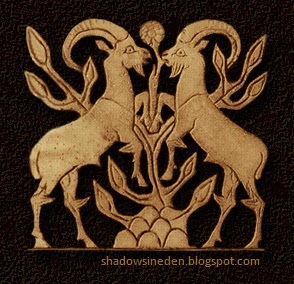

Return here to the Shadows in Eden home page.....
Showing posts with label Ancient Egyptian beliefs. Show all posts

Wednesday, January 13, 2016

The Greatest Blasphemy

What is blasphemy, and what would you consider to be blasphemous? When considering such a question, most of us might first think about the old adage of ‘taking the Lord’s name in vain’, that is: using the Deity or the forms of that Deity as an oath. But such oaths have become so common that they have passed into the language. Even an atheist will mutter ‘My God!’ or ‘Jesus Christ!’ in a moment of exasperation. No, the real blasphemies are to be found elsewhere. The blasphemies considered here are far more insidious, because they probably would not even be thought of as blasphemies by those who practice them, and because such blasphemies are committed within the context of, and in the guise of, religious practices.

A Muslim woman wearing a niqab. I have yet to find a single instance in which it can conclusively be demonstrated that such a religious dress code was instituted by a woman. In patriarchal societies it is patriarchal religions, patriarchal traditions and patriarchal values which predominate, it is men who decide on God’s behalf what either is correct or unacceptable to wear, and it is men who therefore grant themselves the greater freedoms of dress.
It is a human conceit to imagine that we know the preferences of God. And yet such a conceit is practiced on a daily basis in religious communities. We decide on God’s behalf what God either would or would not approve of. The hate mongering of the now notorious Westboro Baptist Church with their infamous slogan ‘God hates fags’ is such an instance. How do they know? Do they have God’s private cell phone number? From a standpoint of simple logic one could equally argue that God actually likes gays, because so many good and decent and loving [1]people on this planet are gay. And it serves little purpose to point out that such ‘ungodly’ practices are forbidden by scripture, because that only counts for something if those specific scriptural texts are universally accepted as being the actual word of God, and that is far, very far, from being the case.

I have not been able to identify the church where this notice appears, but it does incongruously seem to suggest that the request for silence potentially applies to only two of these six items. In reality, of course, all six are prohibited for the congregation. But who’s to know if God doesn’t actually like smoking, has a cell phone, keeps a dog, and smiles benignly upon sassy dresses, baseball caps and hamburgers with milkshakes?
Another field rich in human assumptions about God’s preferences is religious dress codes. Perhaps a distinction should be made here between those styles of dress which are intended as outward expressions of religious adherence and community, such as the turbans worn by Sikhs, and those which we presume actually have God’s nod of approval, or even meet God’s demands. We now know that the dress codes for women as prescribed by Paul in his first letter to Timothy (1 Timothy, 2:9-14) are not actually by Paul at all, but were [2]appended under Paul’s name much later by an unknown hand. Even though this passage of scripture is now known to be an anonymous appendage, it still goes on serving the Church’s needs enough to keep it in scripture, and in turn to cite scriptural precedent for keeping women in a subservient role.

A Sikh girl wearing the distinctive turban or dastaar. One of the younger world religions, Sikhism is in its outlook and conduct altruistic and egalitarian, does not seek to convert others, believes that no one religion has a monopoly on the truth, and shuns religious rites and rituals including all forms of circumcision and cutting, believing such rituals to be ‘blind spirituality’.
Here two streams of assumptions come together: The assumption that God requires us to dress in a specific way, and the assumption that God approves of dress codes which undermine gender equality. God wants you to cover your head in a place of worship. God thinks that you should conceal your hair/face/body in public. The list goes on. But such statements say more about us and the ways in which we seek to control others in subtle and in not-so-subtle ways. In a patriarchal society it is patriarchal beliefs which hold sway, and those in power will do what they can to make sure things stay that way.

When such gender-directed religious dress codes are taken to their most extreme expression, women are cyphered away to the point of being non-entities, and the burka becomes the order of the day. And when congregations in a place of worship are segregated according to gender it is as if we are sending a clear signal to God, not only that those men present cannot trust themselves to keep their lustful thoughts in check, but that those same men seek to please God by banishing half of the congregation to an inferior, non-visible status while they themselves maintain an all-too-visible centre-stage profile. ‘Look at me, God, I’m worshipping you!’ Male ego, apparently, demands God’s attention as much as anyone else’s.

The all-covering head-to-toe Islamic burka. Only a fabric mesh allows the wearer a limited window on her surroundings. We hide away that which we most fear, and a more graphic expression of men’s fear of women is difficult to imagine. It has been pointed out that such practices are nowhere mentioned in the Quran, although they apparently are mentioned in auxiliary texts.
It is not clear where or when circumcision originated, but we have wall reliefs from Ancient Egypt depicting the [3]practice. It is therefore likely that it was a custom exported from that country from the years of Israelite exile, and is now customary in two of the world’s religions: Judaism and Islam. There’s another assumption right there: God wants your sons and/or your daughters to be circumcised. As with any of the other above assumptions, we cannot know the mind of God. It is the crucial difference between what God thinks we should do (which we cannot know), and what we think God thinks we should do. Male [4]circumcision is practiced on infants too young to have a voice of their own, and who therefore are legal minors who have no choice in the decision to have non-reversible modifying surgery performed on their genitals. We deny our own children any say in the matter: a state of affairs that in another context would otherwise be looked upon as a particularly bizarre form of [5]child abuse.

A wall relief from Saqqara in Egypt dating from 2,400 BCE. The origins of the practice of male circumcision are uncertain, although they certainly pre-date the two world religions which practice it. Circumcision is therefore a custom inherited from a pagan past, and the scriptural assertion that it originated as a demand by God of the Israelites has no anthropological foundation.
But even male circumcision is neither as drastic nor has the same intent as female circumcision. Even to call it circumcision is misleading. If the equivalent operation were to be performed on a [6]male child, then the entire glans – the head of the penis – would be cut off. The term used by those opposing this practice – female genital mutilation, or simply FGM – is therefore an accurate one, the more so when considering the additional factor that the procedure is generally carried out using unsterilized blades and without anaesthetic on young girls who are denied a voice of their own about what is happening to them and the bodies which will carry them through the rest of their life. Such radical cruelty inflicted upon those young girls who have no [7]say of their own is not about religion. It is about [8]power and control and a misplaced sense of [9]tradition – and about the fear that is generated by male insecurity. In a society in which men fear women’s sexual autonomy, the clitoris is perceived as a threat that needs to be removed.

The girl in this photo was told by her mother (at right) that the mother was taking her to a party with her young friends. “Circumcision is a noble act to do to women. There’s nothing wrong with doing it.” This quote comes from Sheikh Mohamad Alarefe, Saudi Arabian theologian and professor at King Saud University. I would suggest that if there is ‘nothing wrong with doing it’, then the sheikh leads by example and has the same procedure performed upon himself.
This to me is the greatest blasphemy: to presume to know the mind of God. Whether that concerns dress or other religious customs, it is the subterfuge that we either seriously believe or are fooling ourselves into believing that such things are done ‘in God’s name’. Now that is taking the Lord’s name in vain, if ever anything is. And think about it: is it not a shocking blasphemy to think that we have the right to modify, that we can [10]‘improve upon’, what God already has created? And yet we do just this when we surgically modify the genitals of those who are too young to resist. Instead, we wield the knife and presume to play God, and then let ourselves off the moral hook by sanctimoniously saying that it is ‘for religious reasons’.

And when it comes to religious dress codes, maybe you see things differently, but I was always taught that God sees what is in our hearts, not what is on our heads, or what is covering our bodies. So if religious constraints require you to wear a hat in church, or to wear a skirt instead of slacks, or to hide your hair or even your face in public, then maybe it’s because your fellow man is demanding more of you than God is.
Hawkwood


Since no one really knows anything about God, those who think they do are just troublemakers.
~ Rabia Basri, 8th-century female Sufi mystic and Muslim saint.


Notes:
[1] Please see my post Sex and Trust.

[2] Please see my posts It's Real! It's Fake! and "Behold This Woman" for more about these spurious letters written in Paul's name. To save you looking them up, the verses are: “...Also that women should adorn themselves modestly and sensibly in seemly apparel, not with braided hair or gold or pearls or costly attire but by good deeds, as befits women who profess religion. Let a woman learn in silence with all submissiveness. I permit no woman to teach or to have authority over men; she is to keep silent. For Adam was formed first, then Eve; and Adam was not deceived, but the woman was deceived and became the transgressor.” (Revised Standard Version)  

[3] Greek accounts by Strabo (left) from the 1st-century BCE mention that Egyptians practiced both male and female circumcision, which confirms that Islam adopted these practices from a pre-existing pagan culture. 19th-century accounts from both Europe and America document secular cases of surgical removal of the clitoris ‘to prevent hysteria and masturbation’. Young boys, apparently, could go at it like a steam hammer, but the idea that females had their own autonomous sexual identity apparently was – and in many circles still is – too much of a threat to the male ego to be tolerated.   

[4] The story that circumcision might help to prevent lower prostate cancer is worth mentioning, although it turns out that this could be more a matter of simple personal hygiene. The story can be read here. The other story that intercourse with a circumcised male reduces the risk of cervical cancer in the female seems to have a number of variables, including the promiscuity of males with monogamous partners, the age at which circumcision is carried out (the younger the age, the less likely circumcision appears to be an influencing factor), and again, personal hygiene-related issues. That story can be read here.

[5] The map at left shows the global prevalence of male circumcision. Blue is above the 50% threshold: the lighter the blue, the more prevalent the practice. Red is below that threshold. While with a country such as the United States the prevalence might be due to social factors, in north and central Africa, the Middle East and Indonesia the predominant religion combined with societal traditions is the determining factor. I would suggest that it is only the fact that circumcision has become so widespread, also outside of religious traditions, which makes it so broadly acceptable. It is only by stepping back and considering the practice more objectively that it might be seen for the bizarre practice which it is. And my point made in this post that it is practiced on legal minors, on those too young to voice their own objections, is what tips it over the line into child abuse. It is. For a father to say ‘if it was good enough for me then it’s good enough for my son’ is the same argument as a father saying ‘I was beaten by my dad and it never did me any harm, so I beat my son too’.

[6] The map at right shows the global prevalence of female genital mutilation, with those areas of greatest prevalence shown in light blue. Egypt and Somalia have the highest rate, with 91% to 98% of all females undergoing some form of genital cutting. There are different types of FGM procedures, from excision (cutting off) of the clitoris to infibulation, the most extreme form, which also involves excision of the inner and outer labia and almost stitching shut the vaginal opening. To read and/or download a fact sheet about FGM please visit The Clarion Project

[7] When interviewed by the BBC (BBC HARDtalk, 11 January 2016) pro-FGM activist Fuambai Sia Ahmadu (left) claimed that type 1 FGM (excision of the clitoris) “is equivalent to male circumcision”. It is not. As mentioned above, the male equivalent would be to cut off the head of the penis. Ms Ahmadu said that the lack of a clitoris had not made any difference to her sex life. But with no comparision to draw upon, how could she possibly know? Ms Ahmadu also claimed that a woman feels more feminine without her clitoris because of its resemblance to the male penis: a statement which finely demonstrates my point about the human hubris of presuming to know better than God what is ‘correct’ for us. Human sexuality is a shifting thing. In early embryonic development all human genitalia are identical.

[8] The so-called Islamic State militant group has declared their intention that if (as far as they are concerned, when) they create their caliphate, then all women in Iraq between the ages of 11 and 46 will be forced to undergo FGM. I remarked in a previous post (Isis in Paris) that IS is deeply misogynist in its intentions. This news is a further confirmation of that, although IS now deny the story. A report can be read here.

[9] The Question of Tradition: Tradition is the usual defence offered by those who seek to maintain these practices: ‘It’s an important part of our tradition’ is what we hear. Anthropologically, tradition is a primitive mechanism inherited from our distant past, most probably as a survival mechanism. ‘We did such-and-such this way, and nothing bad happened to us, so we’d better do it the same way from now on, just in case.’ I recently heard a leader of a religious community expressing his concern about the possible disappearance of circumcision as a (to him) valued religious tradition. “If such an essential tradition disappears” he wondered, “what would we be left with?” Hmm... just a wild idea on my part, but maybe… God? 

[10] It is worth making the point that I am drawing a distinction between such procedures which are carried out on minors as a religious practice and those body modification procedures which are carried out in a secular context by adults who have chosen such procedures for themselves. If you choose to have a stud in your tongue (or anywhere else) that is really up to you.


Sources:
Niqab photo from the Huffington Post. Photo of Sikh girl from Michael Freeman Photography. Photo of FGM being performed on a young girl from The Clarion Project. Other photos from uncredited sources. Global map of male circumcision prevalence adapted from a work by AHC300. Global map of FGM prevalence by Woman Stats Project.

Tuesday, December 8, 2015

Isis in Paris

In the year 1514 the archbishop of the abbey of [1]Saint-Germain-des-Prés, then situated on the outskirts of the city of Paris, ordered a statue in the abbey to be removed and destroyed. The statue must have seemed innocuous enough, for it had the appearance of a typical Madonna and Child. The statue was known to be old – dating from the time when Paris was largely a Roman city. And that seems to have been the problem – at least in the eyes of the archbishop. The statue’s age dated it to pre-Christian pagan times, and there was no place for a pagan statue in a Christian house of worship, however much it might resemble the Holy Mother. And so the offending statue was duly removed and smashed to pieces.

The Roman Isis. The sheaf of corn on her crown links her to Ceres/Demeter. The sistrum which she holds, a jingling temple rattle unique to this goddess, is missing from this statue and has here been recreated digitally from a similar statue of Isis.
And that is how the last known remaining relic that once was housed in the temple of the goddess Isis came to meet its end. Churches in Europe were often built upon the pagan places of worship which the new faith destroyed, and so it was with the abbey. Fourteen years before the abbey existed there was a previous church on the site, and thirty-three years before that – as late as the year 509 – there stood a temple dedicated to the goddess Isis. The foundations of the abbey rested upon the remains of this ancient temple, and the statue closely resembling the Madonna and Child which the archbishop ordered to be destroyed was actually a Romanized version of the goddess Isis nursing her infant son, the god [2]Horus.

Spot the difference. At left: a Romanized version of Isis with the infant Horus. The statue which the archbishop ordered to be destroyed would have been very similar to this one. Centre: the present statue of the Madonna and Child in the abbey of Saint-Germain-des-Prés which would have replaced the destroyed statue. At right: the original Egyptian  'Isis and Horus' version of this theme, the archetypal template ‘Mother and Child’ from which all subsequent versions could have been derived.
Unlike the forces of Christian orthodoxy, the empire-building Romans apparently were happy-enough to absorb the deities of other religions into their own pantheon. Under Roman rule, Anubis, the Egyptian jackal-headed god of the dead, sported the armour of a Roman general, and Isis, the great mother goddess, took on the appearance of a Roman [3]noblewoman. But this Romanized version of Egyptian Isis also absorbed something of the culture of Ancient Greece, having some of the attributes of the Roman goddess [4]Ceres, whom the Greeks knew as Demeter.

The ugly face of iconoclasm. The granite tomb in the Dom church in Utrecht which is - or was - the effigy of Guy van Avesnes, bishop of Utrecht in the 14th-century, defaced by Dutch anti-papal Calvinists in the 17th-century. Iconoclasts might destroy an image, but the idea behind the image lives on.
Iconoclasm – the deliberate destruction of the objects of a belief to which the destroyers are opposed – is nothing new. It was practiced here in the Netherlands during an event in 1566 known as the [5]beeldenstorm’, in which supporters of the new anti-papal Calvinist-Protestantism stormed Catholic churches and destroyed the ‘idolatrous’ statues of the Virgin, saints, and any other items which they considered even to vaguely fall into this ‘blasphemous’ category. And it continues to be practiced in our own contemporary world with the destruction by Islamic State of the irreplaceable cultural treasures of [6]Syria and Iraq, which it also regards as ‘blasphemous’. But what does iconoclasm actually achieve? If you destroy a statue, do you also destroy the idea which that statue represents? Hardly. The physical statue, even the building, might lie in pieces, but the idea still exists, and ideas, like the gods themselves, have proven astonishingly resilient over time. And so it has been with Isis.

The nurturing Isis of the Bastille is hailed by an enthusiastic crowd at her inauguration in 1793. At right: Isis holding her sistrum as she appears on the façade of the Louvre. 
As an underground river continues to flow unseen, so the spirit of the goddess Isis apparently has continued to flow through the city of Paris. How else to explain the wealth of symbols associated with the goddess which insistently push their way to the surface? In August of 1793 a huge statue known as the Isis of the Bastille was inaugurated. The seated female figure spouted water from her breasts to symbolize the nourishment provided by the goddess to her citizens. A bass relief statue of Isis which faces the rising sun decorates the façade of the Louvre. The Louvre itself is orientated along an axis which extends towards a point on the horizon from which rises the star Sirius, the star sacred to Isis. The city’s coat-of-arms commissioned by Napoleon featured a ship with Isis being led by that same star.

The colossal pyramid proposed by the French architect Éttiene-Louis Boullée. Boullée’s genius produced projects that were more visionary than practical, and this towering structure was never realized.
And signs of the original culture from which the goddess sprang are ubiquitous in the city. There is the actual obelisk brought from the Egyptian sacred site of Luxor. There have at various times been pyramids. The unique genius of the architect Éttiene-Louis Boullée proposed a monumental pyramid ‘in the Egyptian style’. The pyramid was never realized – although the elegant [7]glass pyramid at the Louvre by architect Ming Pei has become a familiar landmark. During the Napoleonic era the rage for all things Egyptienne was in full swing. And the city plan itself is modelled on that of Luxor, with the same axes of alignment as its sacred counterpart. Significantly, the city has a specific gender. Paris is not an ‘it’. Paris is definitely a ‘she’.

Yet another grand pyramid, this time designed to be built in the grounds of the Louvre for the centenary celebrations of the Republic in 1889. A hundred years later the glass pyramid for the Louvre by Ming Pei has become a familiar landmark.
Terrorism is the bluntest of blunt instruments. It ranges itself against forces which it has little to no hope of ever actually defeating. The machineries of state are simply too powerful, too overwhelming, with all the massive resources and information, both covert and conspicuous, that governments and their armed forces have at their command. That is why terrorism is as it is: it can only ‘achieve’ some sort of an impact through the brutally crude tactics of shock and human grief. I doubt that anyone reading this post down to this paragraph will now be unaware of the irony that an acronym for Islamic State is ISIS – the Islamic State of Iraq and Syria. The title Islamic State is itself a misnomer. It is of course anything but a ‘state’, and the inclusion of that word in its title is more of a wishful dream for its dubious future than an indication of anything which it has actually achieved.

French armed forces patrol in front of the glass pyramid in the grounds of the Louvre following the November 2015 attacks by Islamic State.
So why, of all the major European cities, did Islamic State last month choose to target Paris? There clearly was an active terrorist cell there with connections to other such cells in Brussels, and that cell laid its plan and followed through with that plan, and innocent men and women, many of them with most of their lives still ahead of them, were killed. In Paris the outcome was multiple murder. In the Middle East, Islamic State also have included torture in their ‘doctrine’. But apart from their iconoclasm and [8]torture, what tends to be overlooked is how deeply misogynist Islamic State is: Islamic terrorism is also specifically a campaign of violence against women.

Rape has been a consistent weapon used against the women who have been the victims of Islamic State. Violence against women is as much of a practice by IS as any of its other crimes. Knowing the above history and connections which Paris has to the goddess, what does emerge is that there is a lingering sense that, however unconsciously, the Paris attacks were a violation, certainly against the innocent citizens there, but also against the ‘she’ that is Paris.

A single rose placed in a bullet hole in a pane of glass fronting one of the restaurants that were attacked. The bullet hole has itself been enclosed by a painted heart. The simple but expressive gestures hint at a force which the brute power of mere bullets can neither comprehend nor withstand. 
Smashing a statue to pieces might have satisfied the archbishop’s affront at such a ‘pagan’ presence in his abbey. But what subsequent history establishes is that it is as if the goddess herself has arisen as a presence in the city even more assertively than when her temple stood on the south bank of the Seine. Whether you believe in gods and goddesses or not, whether you hold a belief in a deity – any deity – or not, what circumstances reveal to us is that there would seem to be forces – archetypes, if you will – so powerful, so assertive, that they will push their way through to our consciousness and manifest themselves in whatever forms they choose to adopt. The goddess Isis was not a statue. She was not banished by a mere archbishop, but lived on, creating new forms for herself in the hearts of her citizens. And Parisians are no more likely to bend a knee to terrorism than a goddess would deign to bend a knee to a mere mortal.

A sea of candles in a Paris street lights the faces of those paying tribute to the victims. The delusion of terrorists is to imagine that they are in control of the forces which they unleash, and that their actions will lead to a specific goal. But when the blunt instrument that is terrorism lashes out, the perpetrators are no more capable of foreseeing the eventual consequences than their innocent victims.
[9]Terrorism, it seems, is fighting against some power which makes all other forces pale by comparison. It is not the entrenched power of installed governments and the armed forces which those governments deploy. It is greater even that that. It is an ineffable, invisible something, and you cannot fight what you cannot see. Whatever that something might be, it evidently has survived for thousands of years, and has outlived all attempts by mere archbishops and others to subdue it. So perhaps you had better hope that you have the goddess on your side, because her anger is as dark as her heart is loving.
Hawkwood 

But I, I am compassionate and I am cruel.
Be on your guard!
I am the one whose image is great in Egypt
and the one who has no image among the barbarians.

~ from the text [10]Thunder, Perfect Mind


Notes:
[1] Literally: Saint-Germain-in-the-Fields.

[2] The Greek name for Horus was Harpocrates, known as the god of silence. The name derives from an approximate Greek version of the Egyptian phrase Horus the Child. 

[3] Please see my post The Emperor and the Eye of Horus for more examples of these hybrid deities and the way in which they persist and continue to exist in our culture.

[4] Ceres, the goddess of harvests and the fertile earth, still survives in our own world when we use the term ‘cereal’.

[5] Freely translated as: ‘Storm against statues’.

[6] Please see my post Empires of Sand, Empires of Dust for a more comprehensive coverage of these events.

[7] The urban legend fuelled by Dan Brown’s The Da Vinci Code that the pyramid contains 666 panes of glass – the ‘number of the beast’ in the Book of Revelations – is a fallacy. The pyramid contains exactly 673 panes.

[8] To name just one instance: the ringleader of the Paris attacks, Abdelhamid Abaaoud, who was later shot dead by French special forces, had in Iraq dragged people to death behind his vehicle.

[9] Terrorism in the context of this post means Islamic terrorism. In fact, terrorism these days does mean Islamic terrorism: a pointer, if any were needed, to the single major achievement of terrorism in our 21st-century world: that it has succeeded in making its religion synonymous with acts of terrible inhumanity which are perpetrated in the name of that same religion. In so doing, it has given decent Muslims the unenviable task of dragging the Quran out of the moral gutter where it has been dumped by those criminals acting in its name. Clearly the most effective way of achieving this is for all other Muslims vociferously and robustly to condemn such acts and those who perpetrate them, and it is heartening that many, including the legendary Muhammad Ali, are now doing so. When inhumanity in the name of a religion reaches such extremes, to keep silent is tacitly to condone such extremes, and a tacit silence can only further undermine the foundations of that religion. Misguided demonstrations such as the one seen at left might not be keeping silent, but the damage they are doing to the image of their own faith is real enough. 

[10] As translated by George W. MacRea. This powerful text remains unique among those found at Nag Hammadi in Egypt in 1945, the find which has given us access to many Gnostic and proto-Christian texts which had been lost for 1,600 years. The first-person narrator is unspecified, but the context and style allows us to assume a connection both with Isis and with Sophia, the female embodiment of Wisdom. 


Sources:
Graham Hancock and Robert Bauval: Talisman: Sacred Cities, Secret Faith. The Penguin Group for Michael Joseph, 2004. Most of the examples cited in this post of Isis the goddess and Ancient Egyptian culture in the city of Paris are taken from this title, which itself cites many more, complete with detailed expositions which this post only briefly mentions. It is difficult to over-emphasise the importance of this book for me personally. My first reading of it some ten years ago was my own wake-up call that history – more specifically, Church history – was not as I had imagined it. Reading for the first time about the atrocities perpetrated by the rising forces of Catholicism, and directly instigated by the papacy, against the Gnostics, and a millennium later also against the Cathars (please see my post A Dark Crusade), which were on the scale of a Holocaust, came as a shock that was mind-numbing to experience.

This is bearing in mind that the authors are dealing, not with a mere personal interpretation of events, but with what actually is part of recorded history, and whose events are related in many other titles dealing with these subjects. That sense of shock reverberated on, and eventually would give rise to this blog, which itself attempts to be a serious investigation into why we believe what we believe, who gets to decide what is ‘correct’ for us to believe, and ultimately, what ‘faith’ actually is.

Friday, January 10, 2014

Gold, Frankincense and Myrrh

This month is traditionally the time in which the [1]‘wise men from the east’ brought their gifts to the new-born [2]Jesus. Scripture is low on specifics about them: any details beyond the above brief phrase – that they were kings, that there were three of them and what their names were – are all details added by later hands, but not mentioned in scripture.

The third eye - follow the star.
The assumption that these ‘wise men’ were a trio originated with the 2nd-3rd-century theologian Origen, who took his lead from the number of gifts mentioned. And it is here that the Gospel, so vague about these distinguished visitors up till now, suddenly becomes very specific. Each gift is carefully named in turn, as if there should be no mistake to the record. The gifts were gold, frankincense and myrrh. When scripture glosses over apparently otherwise-important circumstances, and then appears to become suddenly specific on [3]details, we can take it as a signal that something beyond the surface text is being conveyed: an extra layer of knowledge which more receptive minds would recognise and know how to access. Such specific details are, as it were, knowledge travelling in disguise. 

'Wise men from the east'.
I remember learning in Sunday School that these three gifts were ‘very precious’. Well, I knew that gold was valuable, and I took it on trust that the other two things with the strange names must therefore also have great value as well. And although the scriptural term ‘wise men’ is brief, it still tells us something about these men: that they were not just ‘wise’ in the sense of ‘being wise’, but in the sense of being men of knowledge. That is: knowledge of those things that in the Ancient World seamlessly blended art and science – astronomy, astrology, alchemy and the healing arts. And they were from ‘the east’ – the traditional lands (Persia, India, and other trade route countries) where these subjects were studied and practiced. Later tradition strengthened this idea by referring to these men as ‘magi’, from which comes the term ‘magic’, not in the sense of mere stage illusion, but in its original sense of practicing these ‘secret arts’.

Medieval stargazers. Astronomy and astrology were for centuries interchangeable subjects.
So we have three specifically-named gifts bestowed by ‘men of knowledge’ – men who would have known very well the true nature of what they were giving. All three gifts were certainly valuable commodities in the currency of the time. Gold still is, and there has been recent speculation about the possible healing properties of the other two. Gold is still so prized that it is a marketable currency which never tarnishes – literally and figuratively. The other two are resins obtained from two different trees. But the ‘gold’ given as a gift by the magi could have been more precious even than the gold of jewellery and bullion…

Gold in purported white powder and original nugget form.
Gold has long been associated with kings. It is the metal of royalty, and is found in every crown worthy of the name from the Ancient World onwards. We might infer that the magis’ gift of this metal was a recognition of the infant’s status as ‘king of kings’, and leave it at that. But supposing that this particular ‘gold’ was even more special? Supposing that this magis’ gift was pure alchemical gold? This mysterious substance apparently does exist. Under specific conditions gold is transformed – transmuted – into a different ‘monatomic’ structure, when it becomes a fine white powder. This remarkable alchemical powder, which apparently could extend life, promote good health, and even alter time and states of visibility, was known to the Dynastic Egyptians, and was ingested by the Pharaoh (and only by the Pharaoh) to prolong life. Even in Renaissance times and later it was believed that possession of alchemical gold would prolong life – even confer bodily immortality. Was this the true gift of the magi – an alchemical gold that would confer immortality and even miraculous changes of state? Even symbolically, the idea of this most precious form of gold as a gift now gathers a real power.

The resin and plant of frankincense.
Frankincense is a resin extruded by the Boswellia sacra tree. It has associations with the hormone melatonin manufactured by the pineal gland in the brain – a gland long associated with the ‘third eye’ of consciousness-expanding experiences and enlightenment. For this reason frankincense has been associated with the priesthood, with the ceremonies of an inner sanctum, whether that place is the inner shrine of a temple or within the individual initiate. Knowing this about the frankincense resin allows us to see this second gift of the magi in a very different light from the mere ‘precious’ gift of my Sunday School days. Frankincense was ‘precious’ for a good reason – and that reason lay beyond its material value of the time.

The resin and plant of myrrh.
Myrrh is also a resin, this time from the thorny Commifora myrrha tree. This particular resin has soporific properties, and for this reason is associated with a [4]death-like state – even with death itself. It has been found among the wrappings of Egyptian mummies, and its use in the mummification process is indicative of its associations with an apparent death – apparent, because the state was believed to be only the appearance of death. For how could death be real when the rich afterlife awaited? In many cultures and beliefs, death is merely the door to the other side: a necessary bridge that needs to be crossed. And that bridge was represented by the resin myrrh. This third gift of the magi, this ‘shamanic death’, was therefore indicative of death as a state that, however seemingly-powerful, nevertheless could be transcended.

In this detail from the painting, the artist - perhaps intuitively - has chosen to show a jewel embedded in the magi's forehead in the position of the third eye. 
In these specifically-named [5]three gifts we have the symbolic – perhaps even the actual – qualities of a priestly ‘kingship’ beyond mere earthly royalty, and mystical, symbolic death. For in resurrection even death is transcended, and true and glorious immortality awaits. The gifts of the magi together suggest a biography of their recipient’s life to come, even up to the crucifixion and beyond. Intriguingly, after their mention in this single verse in Matthew, these three extraordinary gifts then disappear completely from scripture. What became of them? Perhaps their symbolic use had now been served. And if actual, then their practical use would be applied in the infant’s life to come.
Hawkwood


Notes:
[1] Matthew 2:1-11. Contrary to tradition, the ‘wise men’ did not visit the infant at his place of birth, but some considerable time (weeks or even months) later at his ‘house’ (annotation on page 1354 to Matthew 2:11 in the Zondervan King James Study Bible).

[2] Jesus’ place of birth was not a ‘stable’, there was no census at that time held by the Roman authorities, there was no ‘inn’, and there certainly was no ‘massacre of the innocents’. The personal agendas of the original unknown writers of the Gospel texts (supplying the apparent fulfilment of Hebraic prophesies) together with accreted folklore growing around mistranslations of the original text has entrenched itself into a tradition which comprises the elements of the Nativity tableau as we know it today.

[3] Another classic example of this scriptural ‘knowledge travelling in disguise’ is in the 153 fishes of John 21:10-11, discussed in my post Vesica Piscis: The Tale of a Fish. Disguising such Gnostic teachings as details in stories became a way of slipping them under the radar of those who sought to eradicate such teachings from scriptural texts, and thus a way of preserving such knowledge.

[4] The symbolism of myrrh is particularly telling: the tree’s large thorns echo the crown of thorns of Jesus’ crucifixion, and the myrrh resin is harvested by deliberately ‘wounding’ the tree. A stake is driven into the tree deeper than bark level, which forces the tree to ‘bleed’ its precious resin.

[5] If you remain unconvinced by the symbolism which I describe here, then consider the words of the famous American carol We three Kings of Orient Are, written in 1857 by Rev. John Henry Hopkins. The relevant verses (sung in turn by each ‘king’ and then in chorus) are:

Born a King on Bethlehem's plain
Gold I bring to crown Him again
King forever, ceasing never
Over us all to reign

Frankincense to offer have I
Incense owns a Deity nigh
Prayer and praising, all men raising
Worship Him, God most high

Myrrh is mine, its bitter perfume
Breathes of life of gathering gloom
Sorrowing, sighing, bleeding, dying
Sealed in the stone-cold tomb

Glorious now behold Him arise
King and God and Sacrifice
Alleluia, Alleluia
Earth to heav'n replies


Sources:
Laurence Gardner: Genesis of the Grail Kings. Bantam Press, 1999. The idea for this post comes from a brief paragraph in chapter 13 of this title. While I might not always agree with this author’s conclusions, his collating of information and his insights into such material have been exemplary, and his researches in this field have become his legacy. Those wishing to know more about monatomic gold (a.k.a. white powder gold, the philosopher’s stone, manna, among other terms) can find much information in this and the author’s other title Lost Secrets of the Sacred Ark, Element Books, 2003.

The 19th-century painting is The Star of Bethlehem, by Edward Burne-Jones. It was the largest watercolour painted at that time - a remarkable accomplishment of technique in an unforgiving medium which allows little latitude for correction or alteration. The artist has here followed the traditional Nativity interpretation, folkloric rather than scriptural, of the 'kings' visiting the infant in a stable. But the created scene is of such verve that in this case passionate belief counts for more than scriptural accuracy.  

Tuesday, December 10, 2013

God, Single, Seeks Consort

A single omnipotent god is an oddity. To be sure, three of the world’s current major religions – Judaism, Christianity and Islam – have such a god, but such a god dominates our thoughts, is accepted as the ‘normal’ state of affairs, simply because of the numbers of today’s adherents. In terms of overall frequency in human history, such a single god is more rarely encountered.

A God without a consort.
Unless we live in India with the vast majority of its people endorsing the polytheistic Hindu faith, or unless we live in a politically atheist country, the idea of a single deity will be all around us, whether we ourselves are religious or not. And if you who are reading this belong to one of these three monotheistic faiths and find my opening sentence unreasonable, let me explain further:

It is a natural spiritual solution to share over a number of deities the widely differing situations which we as humans experience. This god will favour your coming sea voyage, that god has dark mood swings and needs to be kept on the right side of, another god will help you with a successful harvest. One goddess will ease your difficult labour pains, another will watch over your household, and yet another will smile on your fortunes in love and help you to find your partner. Such gods and goddesses have defined roles, and reflect our earthly trials and fortunes. But what happens when all these widely-varying aspects of our hopes and dreams are rolled into one single deity?

His realm, his rules. If you were planning a sea voyage, moody Poseidon needed to be respected. 
What happens is what scripture reveals. We end up with a deity who is magnanimous, jealous, loving, vindictive, creative, destructive, benevolent, picky about which sacrifices are made in his name, chooses (almost) to destroy his entire creation, and chooses to redeem it as well. This God who is the Prince of Peace is also the God who joins in the action on the field of battle. This infinitely merciful God who will grant you [1]eternal bliss in heaven is the very same God who will decide that you shall suffer the torments of the damned forever. All the widely-varying and contradictory characteristics which normally would be distributed over a number of different gods and goddesses are now all bundled into one deity – with all the inherent paradoxes which that inevitably produces.

Sekhmet unleashed.
In a recent [2]post I have described the dark savagery of the God who sanctions the many acts of mass slaughter which are chronicled in the Book of Joshua. If you are a Christian you will believe that this is the same compassionate God who redeems the world several Books and a Testament later. On the face of it, a God who creates the world and all the creatures in it, only to destroy it (and them) a few scant [3]generations later, holds less logic than the parallel version from Dynastic Egyptian religion in which the [4]creator god Re dispatches the ruthless lioness goddess Sekhmet to Earth to do the same. The destruction is wrought by a deity whose business is destruction, not by the creator himself. With each god and goddess assigned his or her specific task, no obvious deific logic has been breached.

Zeus and Hera: storms on Olympus for a wayward god with all-too-earthly desires.
There is another side to this train of thought. When many gods are in the pantheon, ‘god’ is not a bachelor. Osiris had his Isis, Shiva has his Shakti, Odin had his Freya, Jupiter had his Juno, Zeus had his Hera. And Hera had to cope with the various extra-marital shenanigans in which her oversexed husband Zeus indulged – although I’m pretty sure that a few deific pots and pans went sailing through the air when he got back to Olympus, having had his way (in a suitably disguised form) with some lonely mortal shepherdess. Although married life even for a god might at times have seemed a lot like the married life of mortals in the world below, bachelordom for a deity is, it seems, not the usual order of things. But is the god – certainly of Judaism and of Christianity – a ‘bachelor’ in the sense that this deity never actually had a partner?

Asherah: Tree of Life
Israelite religion evolved from the beliefs out of which the Israelite culture itself grew. In the Eden of Genesis, God refers to the plural forms of [5]’our’ and ‘us’. Clearly there is more than one God present on the scene. This other deity, who is referred to in scripture only obliquely, was later expunged from scriptural texts until only her shadowy ghost remained in the diction of these plural terms. Her name is Asherah, the Canaanite goddess in the [6]pantheon from which Israelite religion evolved. When the Israelites, who likely emerged from the Canaanite diaspora displaced by the Egyptian conquest of Canaan, made a drive to define their own distinctive religious forms, this new God of the Israelites was left in a state, not so much of bachelordom, but of forced separation. Deprived of his consort, answerable to no-one but himself, he was free to let rip with all the guy-stuff so prominently in evidence in such books as Joshua.

A male-dominated heaven creates its counterpart on earth.
In such a male-only godhead setup, women were left with little voice. Several millennia later they still are. It’s all ‘God the father’ and ‘God the Son’, with the soothing feminine restraints of a consort being painfully lacking. So does all this deific testosterone have a knock-on effect? Of course it does. We respectfully address ourselves to [7]His Holiness’, ‘His Eminence’ and ‘His Grace’. And let’s not even mention all those [8]imams, mullahs and ayatollahs. It’s more than high time that some healthy balance was restored to our deity’s bachelor boy existence. It’s time that ad was placed in the singles’ columns: “God, Single, Seeks Consort”.
Hawkwood 


Notes:
[1] It is a strident moral paradox that God redeems the world through the sacrifice of Christ, but nevertheless shows himself to be fully-committed to having souls suffer the torments of Hell forever with no hope of redemption. The mere existence of Hell in Christian doctrine negates the purpose of Christ’s mission, for what end has been served by Christ’s sacrifice if after death God negates the reason for his sacrifice for so many? The whole point of Hell is that there is no redemption – but according to Christian doctrine any and all souls already have been redeemed through Christ. This makes sense… not. L


[3] For a critical look at the vessel featured in this story please see my post The Lost Ark of Noah.

[4] Dynastic Egyptian religion begins with a single creator god – Re – but then becomes polytheistic with succeeding generations of gods. Isis and Osiris are the second generation, preceded by the earth and sky god and goddess Geb and Nut. Re himself emerges from a cosmic egg out of Nun, the primordial ocean which is the creative female principle.

[5] As in Genesis 1:26: “And God said, Let us make man in our image, after our likeness..” and Genesis 3:22: “And the LORD God said, Behold, the man is become as one of us, to know good and evil.” The phrase “as one of us” is particularly telling, clearly implying “as one of us gods”. That is: being able to determine all aspects of the moral spectrum, to have the same knowledge and insight as one of the immortal gods.

[6] From clay tablets it is possible to determine an evolution of deities. The supreme Canaanite god was El, with Asherah being his consort. When El eventually became the Israelite god Yahweh, Asherah endured as his consort until she was suppressed by the new monotheism. Both El and Yahweh were initially known as Baal, a titular term meaning ‘Lord’. In later texts which eventually became scriptural, Baal came to be confused with the name for the Canaanite god.

[7] In an Apostolic Letter of May 22 1994 by Pope John Paul II, the Catholic Church has banned women from holding positions of authority in the Church forever. The reason given? Christ chose only male disciples: a fallacy which scripture itself refutes. You can read more about this issue (and find a link to this Papal letter in note 3) in my post "Behold This Woman".

[8] I am aware that there are female holders of these titles in Islam, as there are female rabbis and female Anglican bishops. But all these are notable for their minorities, not because there is an even balance of gender in these religious hierarchies.


Sources:
The top and last images of God creating the sun and moon and God creating the plants are from Michelangelo Buonarroti’s frescoes for the ceiling of the Sistine Chapel. Although I have added my own background of clouds, the figure of God is unaltered from Michelangelo’s originals. If it has ever crossed your mind to wonder why God is companioned by a naked boy instead of a conventional angel, my post Fear and Loathing in the Sistine Chapel will be of interest to you. Michelangelo’s homosexuality (which is also much in evidence in his homoerotic poetry) is considerably more on display in his famous chapel frescoes than is generally realised. Yes, you do see what you think you see in this male nude from the fresco (click on the image right), and I’m not going to point it out – except to say that these are not the only ‘acorns’ on view in these frescoes. And if you find any of this offensive then I suggest that you take your objections to the offices of His Holiness, under whose jurisdiction these frescoes fall.

Portrayals of Sekhmet and Asherah painted for this post by Hawkwood for the ©David Bergen Studio, All Rights Reserved. Lioness adapted from photos by Mitsuaki Iwago.


Sekhmet: In the traditional myth, having been let loose into the world Sekhmet slips beyond Re’s control and rampages through a lake of the blood of her human victims. Unable to halt the killing, and fearing that humankind will become extinct, the gods conspire to trick her by mixing red ochre with beer and pouring it over the earth. Thinking it to be blood, Sekhmet gorges herself until she falls into a soporific stupor and the mayhem finally ends. The other lioness goddess was Bastet of Lower Egypt. Together with Sekhmet of Upper Egypt they were known as the lionesses of Yesterday (the East) and Tomorrow (the West). Both goddesses were initially forces of destruction, although Bastet later evolved into a tamer cat goddess, and Sekhmet, while remaining a lioness, seems to have curbed her aggressive ways. 

Asherah is traditionally associated with a stylised Tree of Life, which nurtures the animals (usually represented by two goats) portrayed feeding upon it. Asherah, Ashtoreth, Astarte, Ishtar and Inanna are all variant regional names for an enduring goddess who shared similar characteristics across different cultures and historical periods of the Near and Middle East. The Book of Genesis specifically tells us that, as well as the Tree of the Knowledge of Good and Evil, the Tree of Life also was in Eden. Since Asherah was the Tree of Life, and since the Lord (‘Baal’) also was ‘walking in the garden’ (Genesis 3:8), we have both Baal and Asherah present in Eden – which is exactly what that ‘has become as one of us’ phrase (Genesis 3:22) indicates.