Return here to the Shadows in Eden home page.....
Showing posts with label Asherah. Show all posts

Thursday, August 7, 2014

Adam: The God who Failed

The story of the Garden of Eden in the Book of Genesis, as with all such texts, was inherited from earlier oral traditions: stories that were handed down by word-of-mouth. And since all stories begin somewhere, and must have varied with subsequent retellings before they were committed to writing, we need not be so surprised if we come across variations of these now-familiar stories.


We might consider this or that version of a story definitive, as being the ‘right’ version, simply because it might be the version which has become the most familiar to us. In reality, definitive versions of these stories seldom exist. With the stories in scripture, the reasons behind why one is accepted into scripture and another is left by the wayside have had more to do with the arbitrary happenstances of history and individual opinion than is usually realized. So it is with the story of Eden.

In the morning of the world, on the slopes of Ararat, the gods El and his consort Asherah live in an idyllic garden. All is peaceable, and would have gone on being so were it not for the dark ambitions of the evil god Horon. The dark god has his sights set on El’s position as the supreme creator god, and might have made his ambitions a reality were his schemes not discovered by El. Horon finds himself cast out and hurled down the mountain. Seething with jealous rage and thwarted ambition, the dark god cloaks the world in a poisonous fog, and turns the beautiful Tree of Life that grows on the lower slopes into a black and twisted Tree of Death. As a final measure, he transforms himself into a terrible serpent and twines his glittering coils around the Tree’s branches.

Horon. Jealousy and thwarted ambition can poison the mind. When that mind belongs to a god the world as well can become poisoned.
Seeing the terrible transformation, and wishing only to restore his creation to its former pristine state, El dispatches the god Adam to set things to rights. Accompanied by his wife Eve, Adam journeys down into the world to confront Horon. Reaching the Tree of Death, Adam, it seems, seriously underestimates the evil serpent’s intent. Instead of persuading Horon to leave, Adam finds himself attacked and bitten by the serpent, and so relinquishes his immortality in the tree’s twisted shadow. The precious task entrusted to the god Adam by El has failed, and the world is changed forever. From that moment, Adam and Eve must live in the world as mortals, knowing death as the end of their days.

We recognize the principal characters and elements in this story. What we experience as its strangeness emerges from those other elements unfamiliar to us. Whether the story is more or less ‘true’ than the [1]version in Genesis is a question with little hope of an answer. It is, after all, a story, not a historical event. What we instead can say is that, being centuries older than the Genesis version, and therefore having gone through fewer retellings, it is closer to the [2]original source. The story is found on recently-deciphered clay tablets from the site of the Canaanite city of Ugarit, and the tablets have been dated to the [3]late 13th-century BCE.

The influential port city of Ugarit was centrally situated among the surrounding kingdoms and empires.
But how could this be a story of the Canaanites and not the Israelites? In a previous [4]post I mention the likelihood of the Israelites emerging from the Canaanite diaspora displaced by the Egyptian conquest of Canaan. In other words: the Israelites originally were the Canaanites. When the Israelites made a drive to assert their own identity as a people, they changed the name of El to Yahweh (Jehovah). But this happened over an extended period of time. The word appearing in the original Genesis text as [5]elohim is plural: ‘gods’, referring to El (the first syllable of Elohim) and Asherah. Thus the first words of Genesis correctly read:

“In the beginning the gods created the heaven and the earth.”

As with all goddesses, Asherah was eventually banished from the Israelite pantheon to be replaced by a single male-only deity, although her shadowy presence survives in these plural terms. Through our familiarity with Genesis we are aware of the similarities in the older Canaanite version of the Eden story. It is the differences which are momentous.

The goddess Asherah, mother of life. The rise of the new all-male monotheism left no room for any female presence of authority, and Asherah - and Eve the goddess - were among its victims.
In this world of gods and goddesses no blame falls upon Eve. Eve the goddess is not a woman who succumbs to temptation and taints the whole of humanity with sin. Rather, she is a victim of her husband’s reckless mishandling of the situation. It is Adam who drops the ball. But in the all-male preserve of later Israelite beliefs, such a scenario would not wash, and the story was subsequently changed to become the scriptural version which has damned womankind ever since.
Hawkwood


Notes:
[1] Two Creations in Scripture: In fact, there are two different versions of the creation in the first two chapters of Genesis. The first chapter has an unnamed first man and woman being created simultaneously from the same prima materia. This unnamed couple appear after the creation of the animals. The second chapter contains the familiar version of Eve being created from a rib of the sleeping Adam, with Adam now being created before all the animals. From a scholastic perspective, this is a clear indication that the texts of Genesis were compiled from at least two different sources. Unlike science, there are no mechanisms in place within scripture which allow for correction and revision. Scripture is immutable, and contradictions and discrepancies in these texts, however obvious, remain unchanged for centuries.

[2] Stories from Exile: Original sources of scriptural stories often-enough lie in the lands of Hebrew exile, which principally were Egypt and Babylonia. Such stories would have been exported from these lands with the exiles’ return. The story of Noah’s Ark is Babylonian, the original version, as with the Ugaritic Eden story, pre-dating the scriptural version by several centuries. The clay tablets which relate the Babylonian epic of Gilgamesh contain the story of Ut-napishtim, who is chosen with his family by the gods to be the sole survivor of a great flood. He builds a huge vessel and takes his animals on board with him. To discover whether the waters have abated, he releases in turn a dove and a raven to find signs of dry land. Coincidence? I think not. 

[3] As current scholarship dates the texts of Genesis to the 6th-5th-centuries BCE, the Ugaritic version of the Eden story is twice as old as these.

[4] Please see my post The Butcher of Canaan.

[5] Preserving Belief: In their annotation to Genesis 1:1, the editors of my King James Study Bible (pub. Zondervan) acknowledge the plural term, but explain that it indicates “intensification rather than number”. No, I don’t really understand what they mean by this either. Attempts to demonstrate the term as singular by coupling it to the singular verb (as the Zondervan editors further mention) offer little traction, as the term would then still refer to 'the god El'. Since academic opinion now accepts that early Hebrew beliefs, having been derived from Canaanite beliefs, were polytheistic, the Zondervan editors provide an unintentional example of the way in which a belief can at times only be preserved by wilfully omitting known evidence. 


Sources:
Marjo Korpel & Johannes de Moor: Adam, Eve, and the Devil: A New Beginning. Sheffield Phoenix Press, 2014. The text of Professors’ Korpel and de Moor’s book provides the basis for this post. This earlier version of the Eden story, deciphered by these authors, and retold by myself here, is not a ‘what if?’ situation. The clay tablets exist, they have been deciphered, and they say what is said here.
The 'Horon' serpent is based upon a photo by Steve Gooch. The 'Tree of Death' background is my own. The map has been compiled from various sources. Other images of the gods Adam and Eve and Asherah are painted by Hawkwood for the © David Bergen Studio. All Rights Reserved.

Tuesday, December 10, 2013

God, Single, Seeks Consort

A single omnipotent god is an oddity. To be sure, three of the world’s current major religions – Judaism, Christianity and Islam – have such a god, but such a god dominates our thoughts, is accepted as the ‘normal’ state of affairs, simply because of the numbers of today’s adherents. In terms of overall frequency in human history, such a single god is more rarely encountered.

A God without a consort.
Unless we live in India with the vast majority of its people endorsing the polytheistic Hindu faith, or unless we live in a politically atheist country, the idea of a single deity will be all around us, whether we ourselves are religious or not. And if you who are reading this belong to one of these three monotheistic faiths and find my opening sentence unreasonable, let me explain further:

It is a natural spiritual solution to share over a number of deities the widely differing situations which we as humans experience. This god will favour your coming sea voyage, that god has dark mood swings and needs to be kept on the right side of, another god will help you with a successful harvest. One goddess will ease your difficult labour pains, another will watch over your household, and yet another will smile on your fortunes in love and help you to find your partner. Such gods and goddesses have defined roles, and reflect our earthly trials and fortunes. But what happens when all these widely-varying aspects of our hopes and dreams are rolled into one single deity?

His realm, his rules. If you were planning a sea voyage, moody Poseidon needed to be respected. 
What happens is what scripture reveals. We end up with a deity who is magnanimous, jealous, loving, vindictive, creative, destructive, benevolent, picky about which sacrifices are made in his name, chooses (almost) to destroy his entire creation, and chooses to redeem it as well. This God who is the Prince of Peace is also the God who joins in the action on the field of battle. This infinitely merciful God who will grant you [1]eternal bliss in heaven is the very same God who will decide that you shall suffer the torments of the damned forever. All the widely-varying and contradictory characteristics which normally would be distributed over a number of different gods and goddesses are now all bundled into one deity – with all the inherent paradoxes which that inevitably produces.

Sekhmet unleashed.
In a recent [2]post I have described the dark savagery of the God who sanctions the many acts of mass slaughter which are chronicled in the Book of Joshua. If you are a Christian you will believe that this is the same compassionate God who redeems the world several Books and a Testament later. On the face of it, a God who creates the world and all the creatures in it, only to destroy it (and them) a few scant [3]generations later, holds less logic than the parallel version from Dynastic Egyptian religion in which the [4]creator god Re dispatches the ruthless lioness goddess Sekhmet to Earth to do the same. The destruction is wrought by a deity whose business is destruction, not by the creator himself. With each god and goddess assigned his or her specific task, no obvious deific logic has been breached.

Zeus and Hera: storms on Olympus for a wayward god with all-too-earthly desires.
There is another side to this train of thought. When many gods are in the pantheon, ‘god’ is not a bachelor. Osiris had his Isis, Shiva has his Shakti, Odin had his Freya, Jupiter had his Juno, Zeus had his Hera. And Hera had to cope with the various extra-marital shenanigans in which her oversexed husband Zeus indulged – although I’m pretty sure that a few deific pots and pans went sailing through the air when he got back to Olympus, having had his way (in a suitably disguised form) with some lonely mortal shepherdess. Although married life even for a god might at times have seemed a lot like the married life of mortals in the world below, bachelordom for a deity is, it seems, not the usual order of things. But is the god – certainly of Judaism and of Christianity – a ‘bachelor’ in the sense that this deity never actually had a partner?

Asherah: Tree of Life
Israelite religion evolved from the beliefs out of which the Israelite culture itself grew. In the Eden of Genesis, God refers to the plural forms of [5]’our’ and ‘us’. Clearly there is more than one God present on the scene. This other deity, who is referred to in scripture only obliquely, was later expunged from scriptural texts until only her shadowy ghost remained in the diction of these plural terms. Her name is Asherah, the Canaanite goddess in the [6]pantheon from which Israelite religion evolved. When the Israelites, who likely emerged from the Canaanite diaspora displaced by the Egyptian conquest of Canaan, made a drive to define their own distinctive religious forms, this new God of the Israelites was left in a state, not so much of bachelordom, but of forced separation. Deprived of his consort, answerable to no-one but himself, he was free to let rip with all the guy-stuff so prominently in evidence in such books as Joshua.

A male-dominated heaven creates its counterpart on earth.
In such a male-only godhead setup, women were left with little voice. Several millennia later they still are. It’s all ‘God the father’ and ‘God the Son’, with the soothing feminine restraints of a consort being painfully lacking. So does all this deific testosterone have a knock-on effect? Of course it does. We respectfully address ourselves to [7]His Holiness’, ‘His Eminence’ and ‘His Grace’. And let’s not even mention all those [8]imams, mullahs and ayatollahs. It’s more than high time that some healthy balance was restored to our deity’s bachelor boy existence. It’s time that ad was placed in the singles’ columns: “God, Single, Seeks Consort”.
Hawkwood 


Notes:
[1] It is a strident moral paradox that God redeems the world through the sacrifice of Christ, but nevertheless shows himself to be fully-committed to having souls suffer the torments of Hell forever with no hope of redemption. The mere existence of Hell in Christian doctrine negates the purpose of Christ’s mission, for what end has been served by Christ’s sacrifice if after death God negates the reason for his sacrifice for so many? The whole point of Hell is that there is no redemption – but according to Christian doctrine any and all souls already have been redeemed through Christ. This makes sense… not. L


[3] For a critical look at the vessel featured in this story please see my post The Lost Ark of Noah.

[4] Dynastic Egyptian religion begins with a single creator god – Re – but then becomes polytheistic with succeeding generations of gods. Isis and Osiris are the second generation, preceded by the earth and sky god and goddess Geb and Nut. Re himself emerges from a cosmic egg out of Nun, the primordial ocean which is the creative female principle.

[5] As in Genesis 1:26: “And God said, Let us make man in our image, after our likeness..” and Genesis 3:22: “And the LORD God said, Behold, the man is become as one of us, to know good and evil.” The phrase “as one of us” is particularly telling, clearly implying “as one of us gods”. That is: being able to determine all aspects of the moral spectrum, to have the same knowledge and insight as one of the immortal gods.

[6] From clay tablets it is possible to determine an evolution of deities. The supreme Canaanite god was El, with Asherah being his consort. When El eventually became the Israelite god Yahweh, Asherah endured as his consort until she was suppressed by the new monotheism. Both El and Yahweh were initially known as Baal, a titular term meaning ‘Lord’. In later texts which eventually became scriptural, Baal came to be confused with the name for the Canaanite god.

[7] In an Apostolic Letter of May 22 1994 by Pope John Paul II, the Catholic Church has banned women from holding positions of authority in the Church forever. The reason given? Christ chose only male disciples: a fallacy which scripture itself refutes. You can read more about this issue (and find a link to this Papal letter in note 3) in my post "Behold This Woman".

[8] I am aware that there are female holders of these titles in Islam, as there are female rabbis and female Anglican bishops. But all these are notable for their minorities, not because there is an even balance of gender in these religious hierarchies.


Sources:
The top and last images of God creating the sun and moon and God creating the plants are from Michelangelo Buonarroti’s frescoes for the ceiling of the Sistine Chapel. Although I have added my own background of clouds, the figure of God is unaltered from Michelangelo’s originals. If it has ever crossed your mind to wonder why God is companioned by a naked boy instead of a conventional angel, my post Fear and Loathing in the Sistine Chapel will be of interest to you. Michelangelo’s homosexuality (which is also much in evidence in his homoerotic poetry) is considerably more on display in his famous chapel frescoes than is generally realised. Yes, you do see what you think you see in this male nude from the fresco (click on the image right), and I’m not going to point it out – except to say that these are not the only ‘acorns’ on view in these frescoes. And if you find any of this offensive then I suggest that you take your objections to the offices of His Holiness, under whose jurisdiction these frescoes fall.

Portrayals of Sekhmet and Asherah painted for this post by Hawkwood for the ©David Bergen Studio, All Rights Reserved. Lioness adapted from photos by Mitsuaki Iwago.


Sekhmet: In the traditional myth, having been let loose into the world Sekhmet slips beyond Re’s control and rampages through a lake of the blood of her human victims. Unable to halt the killing, and fearing that humankind will become extinct, the gods conspire to trick her by mixing red ochre with beer and pouring it over the earth. Thinking it to be blood, Sekhmet gorges herself until she falls into a soporific stupor and the mayhem finally ends. The other lioness goddess was Bastet of Lower Egypt. Together with Sekhmet of Upper Egypt they were known as the lionesses of Yesterday (the East) and Tomorrow (the West). Both goddesses were initially forces of destruction, although Bastet later evolved into a tamer cat goddess, and Sekhmet, while remaining a lioness, seems to have curbed her aggressive ways. 

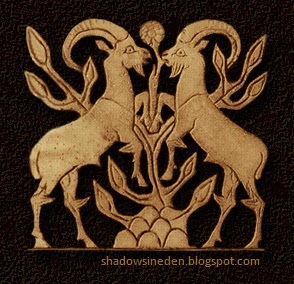
Asherah is traditionally associated with a stylised Tree of Life, which nurtures the animals (usually represented by two goats) portrayed feeding upon it. Asherah, Ashtoreth, Astarte, Ishtar and Inanna are all variant regional names for an enduring goddess who shared similar characteristics across different cultures and historical periods of the Near and Middle East. The Book of Genesis specifically tells us that, as well as the Tree of the Knowledge of Good and Evil, the Tree of Life also was in Eden. Since Asherah was the Tree of Life, and since the Lord (‘Baal’) also was ‘walking in the garden’ (Genesis 3:8), we have both Baal and Asherah present in Eden – which is exactly what that ‘has become as one of us’ phrase (Genesis 3:22) indicates.  

Friday, August 16, 2013

Eve’s Story

She will be born of the newly-formed flesh of man. The first rains in creation have fallen, turning the dry earth into malleable clay, and into that clay the breath of life has been infused. Adam, the first man, emerges from the primal soil. Adam, the giver of names. But naming the beasts of the field and tending to Paradise are surely not the only tasks for which he is destined. Adam needs the companionship of another self.

And Adam called his wife's name Eve; because she was the mother of all living. Gen.3:20
Deep, deep into an inner void Adam descends, unaware of the momentous event which unfolds while he remains in that place of unknowing, unaware of the way in which his own flesh is being moulded and shaped, as the soil had in turn been shaped for his own creation. Flesh of his flesh, Adam, the namer of all things, calls her Woman, and she is intended to be his companion in Paradise. But it is not to be.

But there went up a mist from the earth, and watered the whole face of the ground. Gen.2:6
Enter the silver-tongued serpent, whispering words that slither into Woman’s very soul: words which meet with no resistance, for resistance is not in the cosmic plan. To know good and evil, to tread a realm intended only for the footfalls of gods: this, and nothing less, is on offer. How sweet the fruit, but how bitter the aftertaste. The serpent ensnares Woman, Woman ensnares Adam, and a new awareness emerges. It is not the glorious pathway to the gods. It is the stony road to a soul-deforming shame.

And the LORD God formed man of the dust of the ground, and breathed into his nostrils the breath of life; and man became a living soul. Gen.2:7
Eden is home no more, a cold world awaits, and a bright sword of flame bars any return. Only at the last moment, before being driven from the gates of Paradise, before the world beyond this perfect sanctuary is entered, before time and mortality become new realities, does Adam perform one more act of naming. He calls his wife ‘Eve’.

But of the tree of the knowledge of good and evil, thou shalt not eat of it: for in the day that thou eatest thereof thou shalt surely die. Gen.2:17
My brief [1]retelling of the Eden story in Genesis touches on elements which can be found in many folk tales and stories, from the hills of ancient Celtic lands to the walled gardens of Isfahan, which in their glory days were themselves modelled upon Paradise. The [2]template of such stories is a familiar one: the hero or heroine finds themselves in an enchanted, idyllic place. All is well, and their sojourn may be an indefinite one – as long as they refrain from one forbidden act. That act typically involves plucking a forbidden flower, or eating a forbidden food, or drinking a forbidden beverage, which would cause the spell to be broken. Inevitably, what is forbidden proves ultimately irresistible. As soon as the flower is plucked, or the food is ingested, the world around them dissolves, the idyll shatters as glass, and they find themselves back in the world of the everyday.

And the LORD God caused a deep sleep to fall upon Adam, and he slept; and he took one of his ribs, and closed up the flesh instead thereof. And the rib, which the LORD God had taken from man, made he a woman, and brought her unto the man. Gen.2:21-22
At first all seems normal and familiar. Then through some occurrence, or some encounter with a former acquaintance, they realise the terrible truth: within the idyll, time has stood still. But in the world itself, a hundred years (or some other expansion of time) have passed. Time in such [3]tales is as relative as it is in science. The Eden story is as powerful a story as has been written, and reflects all the elements embedded in the template. It is by means of this template, which transcends any religious faith, that we can unlock the door back into Paradise and discover the true meaning beyond the outward appearance of the Genesis story.

And the woman said unto the serpent, We may eat of the fruit of the trees of the garden: but of the fruit of the tree which is in the midst of the garden, God hath said, Ye shall not eat of it, neither shall ye touch it, lest ye die. Gen.3:2-3
The story of Eden has proven to be as tragic in its consequences as it is powerful in its telling. Tragic, not in the incidents of the story, but because of the way in which the story in scripture, and its subsequent cementing into doctrine by [4]Augustine, [5]Tertullian and others, has burdened the human psyche with shame and with sin – and worse.

And when the woman saw that the tree was good for food, and that it was pleasant to the eyes, and a tree to be desired to make one wise, she took of the fruit thereof, and did eat, and gave also unto her husband with her; and he did eat. Gen.3:6
The story of the Fall in Genesis is a certificate of guaranteed second-class citizenship for womankind, and so it has been applied down through all the centuries. The Book of Genesis tells us that Eve disobeyed God, corrupted Adam, and ever since that fateful sampling of the fruits of Eden womankind has been picking up the tab. The very wording of the text puts the seal on Eve’s blame for man’s loss of paradise, and underscores God’s terrible punishment to woman: “Unto the woman he said, I will greatly multiply thy sorrow and thy conception; in sorrow thou shalt bring forth children; and thy desire shall be to thy husband, and he shall rule over thee.” Which makes it crystal clear that the woman is to be subject to the man, and shall be considered as his inferior.

And the eyes of them both were opened, and they knew that they were naked. Gen.3:7
Eve heeds the words of the serpent, succumbs to temptation, and eats the [6]forbidden fruit of the tree of the knowledge of good and evil. There was a dire consequence pronounced by God should this act take place: that on that day humans would surely die. The serpent whispered its own enticement in Eve’s wondering ear: that humans also would become as [7]gods. Detractors of scripture are keen to point out that God lied, because even after eating the fruit, Adam and Eve lived on. But if we remember the template, they did not, and God was as good as his word.

And the LORD God said unto the woman, What is this that thou hast done? And the woman said, The serpent beguiled me, and I did eat. Gen.3-13
What the Eden couple sacrificed was their immortality. The first man and woman are expelled from Eden before they can eat of the fruit of the other tree – the tree of life – and so regain that immortality. For them the clock was now ticking, and a day in Eden was as a hundred years in the world beyond those guardian walls, with death waiting at the end.

Unto the woman he said, I will greatly multiply thy sorrow and thy conception; in sorrow thou shalt bring forth children; and thy desire shall be to thy husband, and he shall rule over thee. Gen.3:16
How to redeem Eve? How to undo millennia of injustice in the scriptural laying of blame at the feet of all womankind? It is possible, but to do that we will need to go deeper into the template. We will need to let go of all literal readings of this text, all the pedantry which down the centuries has been responsible for shaping scriptural doctrine. We will need to enter the very matrix where myths are born.

…and he placed at the east of the garden of Eden cherubim, and a flaming sword which turned every way, to keep the way of the tree of life. Gen.3:24
In the state of constancy, in the eternal Now which exists beyond the material world of the everyday, the Soul (Adam) is content. The Soul has no distractions – but also no experience – and is quite happy to let things continue in that way. But the wise Spirit (Eve) knows more. The Spirit knows that in order to progress, in order to truly fulfil itself, the Soul must gain experience of the world beyond which exists in time, of the long progression from past to future, of the mortality of the flesh, and of all the joys and sorrows which come with an earthly existence. The catalyst (the serpent) is the Need To Know. The Spirit, in her wisdom, causes the Soul to fall.

And ye shall be as gods, knowing good and evil. Gen.3:5
But this is no mere fall into sin, or even a fall from grace. It is the fall into an earthly life, the fall into all which the Soul needs to experience. It is the fall into time. But the Soul does not make the journey alone. Clothed in an unfamiliar [8]flesh, the Soul still has its companion Spirit to guide it on its journey through life. And while death comes as the end, that death is not obliteration, but a return which the wise Spirit has always known would come, and Eden will open its gates once more.
Hawkwood


Notes:
[1] The complete story of the Fall, and all of the scriptural quotations used in this post, are to be found in chapters 2 and 3 of the Book of Genesis. Chapter 1 has a more succinct and significantly different recounting of the creation of the first two humans. In the first account, the couple remain unnamed, and appear to have been created simultaneously. As my present post focuses on the story of the Fall, I’ll discuss these intriguing differences in a future post. (Please see my subsequently-written post: Lilith: Spirit of the Night.)

[2] My use of the term ‘template’ is intended to express the idea of an original pattern – a form – which exists, and from which all subsequent versions of such a ‘proto-story’ are derived. Think of it as existing in the collective unconscious, if that is what works for you, or in some external creative matrix. A parallel would, for example, be the way in which we think about an automobile. There are many different specific models of automobiles, but if we simply use the term ‘automobile’, we still have a generic picture in mind as to what an automobile is, and how it looks.

[3] Washington Irving’s Rip Van Winkle is a classic example of such a story, and there are many stories in folklore about those who are rash enough to enter a fairy ring and are spirited away to the fairy realm. In both of these examples time becomes relative, and appears to stand still while the protagonists remain enchanted, and a surprising number of such stories involve the partaking of forbidden food or drink of some description. In Arthur Rackham's illustration (left), the naive Rip rashly samples a clandestine draught of the dwarfs' liquor. True to folk tradition, the artist depicts Rip standing within a fairy ring of toadstools: the borders of enchantment. 

[4] Writing in the 4th-5th-centuries, Augustine concluded that the original sin of the Fall actually was present in the seed at the moment of conception, and that a child was therefore born already corrupted with the taint of sin. His writings, which have much to say on the subject, have influenced Christian doctrine for centuries. Please see my posts Sin and Other Illusions and Shame.

[5] in his writings of the 2nd-3rd-centuries, the Christian Apologist Tertullian says of womankind: ‘Do you not know that you are Eve? …You are the gateway of the devil; you are the one who unseals the curse of that tree...’.

[6] Please see my post Forbidden Fruit for a specific identification of the fruit of Eden.

[7] There are several intriguing examples in these two chapters of Genesis in which there is an apparent referring to the plurality of gods, as in Genesis 3:22. ‘And the LORD God said, Behold, the man is become as one of us, to know good and evil..’ The serpent tells Eve as much when it says that humans would ‘become as gods’ were they to taste the forbidden fruit. My post A Simple Misunderstanding mentions the influence of polytheism on early Hebrew beliefs, and this runs as an undercurrent through these first chapters of scripture. There are other hints in the Mosaic Old Testament that the texts originally were written specifically naming a female deity (Asherah, the consort of Yahweh, depicted in the figurine, right), who later was edited out to leave a single male creator god in the texts. Intriguingly, Asherah (not to be confused with Ashtoreth, the goddess derived from Ishtar/Astarte) seems to have been a tree goddess - the tree in question being a 'tree of knowledge'. Hmm...

[8] Genesis itself is specific in its pointing to the deeper meaning of the Fall. In Genesis 3:21 we read: ‘Unto Adam also and to his wife did the LORD God make coats of skins, and clothed them.’ The ‘coats of skins’ are their new corporeal bodies. For a more complete discussion of this phrase (and more examples by artists of the expulsion of the first couple from Eden) please see my post Coats of Skins. Always radically original, the artist Max Klinger (left) gets the details right.


Sources:
‘Adam’ adapted from public domain photos by Josef Zrzavy. All original ‘Eve’ photography by Hawkwood, © David Bergen Studio. Rainbow boa by Steve Gooch. ‘First rains’ photo by Hawkwood, © David Bergen Studio. Tamarind fruit: source unidentified. Fig leaf: rgbphoto. ‘Cherubim’ adapted from a painting by Edwin Howland Bashfield. Images incorporate symbols and illustrations from the 16th-century works of Heinrich Cornelius Agrippa, including (on the creation of Adam) characters for the planet Mars, and (on the creation of Eve) characters for the planet Venus. Foliage adapted from Albrecht Dürer’s 16th-century engraving The Fall of Man. ‘Good and Evil’ symbols are the geomantic signs for Caput Draconis (auspicious, head of the dragon, right arm) and Cauda Draconis (malevolent, tail of the dragon, left arm), redrawn from the 19th-century works of Francis Barrett. ‘Angel of Death’ adapted from a sculpture by Louis Barrias. ‘Asherah’ figurine from the Metropolitan Museum of Art, New York. All artwork created for this post by Hawkwood for the David Bergen Studio © All Rights Reserved.

The captions beneath the images are for the benefit of those viewing this post in a non-English language!