
Return here to the Shadows in Eden home page.....
Showing posts with label Heaven and Hell. Show all posts

Saturday, November 19, 2016

Cherry Pie

I might not literally have sprayed my coffee over my keyboard, but my reaction was as near as doing so. The 2016 American presidential election campaign was still in full swing, and I was listening to a reporter on the BBC World Service gather public opinions on the candidates. A woman in Colorado Springs was quizzed about her reaction to Donald Trump’s now-notorious ‘locker room’ tape in which he allegedly bragged about his sexual groping activities. An ardent Trump supporter, she breezily admitted with a laugh that she “tended to quickly forget about such things”.

Now Colorado Springs, I know, is regarded as a bastion of good Christian values, but here was someone who in a moment was entirely prepared to betray both her own gender and what she presumably regarded as her God-given sense of moral worth. This woman simply turned a blind eye to what by any yardstick were gloatingly smutty and demeaning sexual remarks made by her favoured candidate. Since the woman already had declared both her political and her religious allegiance to the reporter, I was left scratching my head. How could she possibly reconcile her political stance with her religious one? Clearly she did not form her political opinion on what was morally right, but on what was expedient. And if this was so, then by extension this presumably also applied to her religious beliefs. And then the penny dropped.

‘Cherry picking’ is a term used, usually in the context of a debate, to describe the glossing-over or outright omission of facts which you know would weaken the case that you are presenting. It is a form of deliberate self-censorship designed to bolster your beliefs or world view, and its effect is one of self-deceit. [1]Cherry picking keeps you in your comfort zone, and although the practice can apply generally, it is often found in the sphere of religious beliefs. I would even suggest that a religious belief might not actually survive were it not subjected to cherry picking, however overtly or subtly the practice is deployed.


If we need to hear that God is love, then we prefer not to be reminded that this same God intends to force us to suffer terrible and agonizing torments without hope of reprieve forever merely for [2]blaspheming against Him. The two concepts are directly contradictory, for love – and certainly the magnanimity of deific love – can surely have nothing to do with the eternal torturing of the souls which are its own creation? Such an act, or even just the stipulation of it, would make God, not a god of love, but a god who would take all the prizes for sheer unbridled sadism: a god whom anyone with even a stroke of moral decency would reject out-of-hand.


We are rescued from this impasse by cherry picking. We might gloss over this darker side of God (and it is a very dark side indeed) to instead concentrate our thoughts upon the love and redemption aspects of our beliefs, and thus reassured, move swiftly on. We might even attempt to excuse it by claiming that this simply proves that God is a ‘just’ god, which is the apologist’s stance. But if this is justice, then it is the ruthless justice of the lynch mob, of the kangaroo court – or of the Inquisition. It is justice devoid of compassion. It is as if religion, by its very nature, contains paradoxes which overwhelm us. And perhaps they do.

The paradoxes in scripture are indeed overwhelming. I have read many passages which give every indication of positively reveling in the slaughter of ‘God’s enemies’, and demand the grimmest of [3]punishments, such as the stoning to death of your own son for mere wayward disobedience. How about making a human sacrifice of your daughter? Absolutely, if you have vowed to God to do just that. Since this is Late Bronze Age/Early Iron Age tribalism, such rough justice need not surprise us. What should rightly appall us is that we still regard such writings as ‘holy scripture’ right here in our own 21st-century.


Ah, but that’s the problem with scripture: it’s all in, or all out. If you want love and redemption, you also have to have stoning to death, slavery, forcing a rape victim to marry her rapist, and other horrors sanctioned by its assorted texts. Redaction of these texts already has taken place, so if you want to change something to which you might object then you’re already too late. Which is what makes cherry picking a near-indispensable activity. If you cannot discretely edit out the less palatable passages, then just brush over them, because no man of the cloth is going to mount his pulpit to deliver an uplifting sermon on how Moses ordered the massacre of the women and children who already had surrendered to his soldiery.

And this, as I finally understood, is what presumably prompted my good Christian citizen of Colorado Springs to react as she did to [4]Donald Trump’s unsavory and uncouth remarks. Her religious beliefs already had put her in cherry picking mode. It must have been an easy switch to apply that same activity to her political affiliations. Moral or not, cherry picking is an entrenched and much-used practice, and when it comes to religious beliefs, cherries, apparently, are always in season.
Hawkwood


Notes:
[1] The term apparently derives from the idea that if someone sees a basket of freshly-picked and delicious-looking cherries, they might assume that all the cherries still on the tree are just as good, whereas the fruit that is left on the tree might actually be too inferior to harvest.

[2] This is specifically stated in Mark 3:29 – “But he that shall blaspheme against the Holy Ghost hath never forgiveness, but is in danger of eternal damnation.” Good luck to anyone who has ever muttered “Jesus Christ!” as an expletive.

[3] It is usual for me to give chapter-and-verse citations in any post where they apply, but as the citations for the various scriptural incidents mentioned in this post already are given in full on previous posts, I’ll link to those posts here. For misdeeds by Moses, and ‘cruel and unusual’ punishments in scripture, please see my post Frontier Justice in the Promised Land. For the full story of the sacrifice of his daughter to God, please see my post Jephthar's Daughter: Darkness in Gilead. For the God of scripture’s own dubious morality, please see my post Profiling a Psychopath. For scriptural approval of the wholesale massacre of ‘God’s enemies’, please see my post The Butcher of Canaan.

[4] Making America great again? It is interesting that, in addition to his cavalier dismissal of the importance of climate change issues during his campaign (as witnessed by his ‘climate is just weather’ remark: apparently he does not even understand the vital difference between the two), Donald Trump chose for his campaign slogan the phrase: “Make America great again!” which itself is an example of presupposition. Presupposition, like cherry picking, is a debating ploy in which a statement ‘pre-supposes’ that something is true without providing further evidence to support that statement. To say ‘make America great again’ is to presuppose that America is not great now. You can agree or disagree that it might not be great anymore, but such sleight-of-hand word trickery can so easily go unnoticed and unchallenged.

What is neo-Fascism? The 'Make America great again' slogan expresses core neo-Fascist sentiments: that of a preoccupation with the perceived or actual regeneration of a nation, the running of a country as if it were a business venture, repression by bullying or intimidation in some form of any opposing voices, the encouragement of a personality cult towards the leader, and the promotion of go-it-alone xenophobic isolationism.

Attacking the person: A third debating ploy was self-evident during the campaign: that of ad hominem attacks. That is: you attack the person, rather than the issues or principles for which that person stands.


Pro-life? I will not sit on my hands on the issue supported by born-again Christian Mike Pence, soon to be the new vice president, when it comes to ‘pro-life’, or as it is less coyly and more realistically called: anti-abortion. Outlawing abortion does little to wholly prevent the practice (as we know from the example of Ireland). All it really does is drive women either over a border to a country with different legislation, or into back alleys where other women are waiting for them with one hand outstretched for cash and with a metal knitting needle clutched in the other. In practice, outlawing abortion at best makes having an abortion a medically unsupervised and traumatic experience, and at worst can endanger young women's lives. Taking this stance does not make me a rabid pro-abortion liberal; it just makes me a realist, and I for one would question whether faith-driven pro-life protesters who voice their righteous indignation have even seriously thought through such practical considerations.

A recent actual Russian billboard.
Are Donald Trump and Vladimir Putin really such strange bedfellows? I have written these notes in the time before Donald Trump is sworn in as president, and the following year inevitably will bring more clarity as to which way the wind is really blowing. 'Fascist' is a term that tends to be loosely slung around in a pejorative sense, which is why I tend to be careful about using it. But I do find that in considering whether Donald Trump's views really are 'Fascist' that it's possible to tick all the boxes. It's worth repeating here that one of the central tenets of Fascism is the perceived regeneration of a nation. The slogan 'Make America great again' fits this tenet like a glove.

A kindred spirit? The man himself, I am sure, does not see himself in this way, but calling a duck an eagle doesn't mean that it stops being a duck. Trump's views are essentially Fascist, and the ultra-right wing stance of Fascism (witness the white supremacist Ku Klux Klan and the American Nazi Party, both of whom firmly endorsed Trump's candidacy) have previously in history made bedfellows of the ultra-left wing ideology of communism. Hence Trump's apparent perception of Vladimir Putin as a kindred spirit.

The chink in America's armour? My own view is that in reality Putin, the ex-KGB master of manipulation, is already playing Trump like a violin. Trump's Achilles' heel is his vast vanity, so that is what Putin plays on, and it's working. Trump's political world stage naivety and inexperience has him thinking that Putin is, after all, a pretty okay guy, but history might well record that Trump was the chink in America's armour through which Putin managed to wriggle, and America will be left anything but 'great again'.

Living in hope? As someone who can remember all the presidents (and their election campaigns) as far back as Eisenhower, I can never recall feeling so apprehensive about a coming presidency, both for my friends in America and on the global stage. All we can really do now is hope and trust that 'President Trump' will turn out to be a more civilized person than the uncouth, obnoxious, racist, misogynist, xenophobic, disability-mocking bully so shockingly visible on the campaign trail.
Hawkwood


Stop press: Make China great again! Today, 22 November 2016, carries the news that on his first day in office Donald Trump will pull America out of the TPP (Trans-Pacific Partnership). Since the partnership of Pacific nations allowed America to have an influence in the region at the expense of China, it doesn't take rocket science to predict that China will now rush in to fill the vacuum left by the U.S. and expand its influence in the region. My own comfortable prediction based on this one myopic decision is that the coming Trump presidency will see a considerable weakening and even a reduction in America's power as a player on the world stage.


Sources:
All photos have been adapted from uncredited sources. The vision of Hell is adapted from a painting by Hans Memling. The sacrifice of Jephthar’s daughter is adapted from a painting by Edwin Longsden Long.

Tuesday, December 10, 2013

God, Single, Seeks Consort

A single omnipotent god is an oddity. To be sure, three of the world’s current major religions – Judaism, Christianity and Islam – have such a god, but such a god dominates our thoughts, is accepted as the ‘normal’ state of affairs, simply because of the numbers of today’s adherents. In terms of overall frequency in human history, such a single god is more rarely encountered.

A God without a consort.
Unless we live in India with the vast majority of its people endorsing the polytheistic Hindu faith, or unless we live in a politically atheist country, the idea of a single deity will be all around us, whether we ourselves are religious or not. And if you who are reading this belong to one of these three monotheistic faiths and find my opening sentence unreasonable, let me explain further:

It is a natural spiritual solution to share over a number of deities the widely differing situations which we as humans experience. This god will favour your coming sea voyage, that god has dark mood swings and needs to be kept on the right side of, another god will help you with a successful harvest. One goddess will ease your difficult labour pains, another will watch over your household, and yet another will smile on your fortunes in love and help you to find your partner. Such gods and goddesses have defined roles, and reflect our earthly trials and fortunes. But what happens when all these widely-varying aspects of our hopes and dreams are rolled into one single deity?

His realm, his rules. If you were planning a sea voyage, moody Poseidon needed to be respected. 
What happens is what scripture reveals. We end up with a deity who is magnanimous, jealous, loving, vindictive, creative, destructive, benevolent, picky about which sacrifices are made in his name, chooses (almost) to destroy his entire creation, and chooses to redeem it as well. This God who is the Prince of Peace is also the God who joins in the action on the field of battle. This infinitely merciful God who will grant you [1]eternal bliss in heaven is the very same God who will decide that you shall suffer the torments of the damned forever. All the widely-varying and contradictory characteristics which normally would be distributed over a number of different gods and goddesses are now all bundled into one deity – with all the inherent paradoxes which that inevitably produces.

Sekhmet unleashed.
In a recent [2]post I have described the dark savagery of the God who sanctions the many acts of mass slaughter which are chronicled in the Book of Joshua. If you are a Christian you will believe that this is the same compassionate God who redeems the world several Books and a Testament later. On the face of it, a God who creates the world and all the creatures in it, only to destroy it (and them) a few scant [3]generations later, holds less logic than the parallel version from Dynastic Egyptian religion in which the [4]creator god Re dispatches the ruthless lioness goddess Sekhmet to Earth to do the same. The destruction is wrought by a deity whose business is destruction, not by the creator himself. With each god and goddess assigned his or her specific task, no obvious deific logic has been breached.

Zeus and Hera: storms on Olympus for a wayward god with all-too-earthly desires.
There is another side to this train of thought. When many gods are in the pantheon, ‘god’ is not a bachelor. Osiris had his Isis, Shiva has his Shakti, Odin had his Freya, Jupiter had his Juno, Zeus had his Hera. And Hera had to cope with the various extra-marital shenanigans in which her oversexed husband Zeus indulged – although I’m pretty sure that a few deific pots and pans went sailing through the air when he got back to Olympus, having had his way (in a suitably disguised form) with some lonely mortal shepherdess. Although married life even for a god might at times have seemed a lot like the married life of mortals in the world below, bachelordom for a deity is, it seems, not the usual order of things. But is the god – certainly of Judaism and of Christianity – a ‘bachelor’ in the sense that this deity never actually had a partner?

Asherah: Tree of Life
Israelite religion evolved from the beliefs out of which the Israelite culture itself grew. In the Eden of Genesis, God refers to the plural forms of [5]’our’ and ‘us’. Clearly there is more than one God present on the scene. This other deity, who is referred to in scripture only obliquely, was later expunged from scriptural texts until only her shadowy ghost remained in the diction of these plural terms. Her name is Asherah, the Canaanite goddess in the [6]pantheon from which Israelite religion evolved. When the Israelites, who likely emerged from the Canaanite diaspora displaced by the Egyptian conquest of Canaan, made a drive to define their own distinctive religious forms, this new God of the Israelites was left in a state, not so much of bachelordom, but of forced separation. Deprived of his consort, answerable to no-one but himself, he was free to let rip with all the guy-stuff so prominently in evidence in such books as Joshua.

A male-dominated heaven creates its counterpart on earth.
In such a male-only godhead setup, women were left with little voice. Several millennia later they still are. It’s all ‘God the father’ and ‘God the Son’, with the soothing feminine restraints of a consort being painfully lacking. So does all this deific testosterone have a knock-on effect? Of course it does. We respectfully address ourselves to [7]His Holiness’, ‘His Eminence’ and ‘His Grace’. And let’s not even mention all those [8]imams, mullahs and ayatollahs. It’s more than high time that some healthy balance was restored to our deity’s bachelor boy existence. It’s time that ad was placed in the singles’ columns: “God, Single, Seeks Consort”.
Hawkwood 


Notes:
[1] It is a strident moral paradox that God redeems the world through the sacrifice of Christ, but nevertheless shows himself to be fully-committed to having souls suffer the torments of Hell forever with no hope of redemption. The mere existence of Hell in Christian doctrine negates the purpose of Christ’s mission, for what end has been served by Christ’s sacrifice if after death God negates the reason for his sacrifice for so many? The whole point of Hell is that there is no redemption – but according to Christian doctrine any and all souls already have been redeemed through Christ. This makes sense… not. L


[3] For a critical look at the vessel featured in this story please see my post The Lost Ark of Noah.

[4] Dynastic Egyptian religion begins with a single creator god – Re – but then becomes polytheistic with succeeding generations of gods. Isis and Osiris are the second generation, preceded by the earth and sky god and goddess Geb and Nut. Re himself emerges from a cosmic egg out of Nun, the primordial ocean which is the creative female principle.

[5] As in Genesis 1:26: “And God said, Let us make man in our image, after our likeness..” and Genesis 3:22: “And the LORD God said, Behold, the man is become as one of us, to know good and evil.” The phrase “as one of us” is particularly telling, clearly implying “as one of us gods”. That is: being able to determine all aspects of the moral spectrum, to have the same knowledge and insight as one of the immortal gods.

[6] From clay tablets it is possible to determine an evolution of deities. The supreme Canaanite god was El, with Asherah being his consort. When El eventually became the Israelite god Yahweh, Asherah endured as his consort until she was suppressed by the new monotheism. Both El and Yahweh were initially known as Baal, a titular term meaning ‘Lord’. In later texts which eventually became scriptural, Baal came to be confused with the name for the Canaanite god.

[7] In an Apostolic Letter of May 22 1994 by Pope John Paul II, the Catholic Church has banned women from holding positions of authority in the Church forever. The reason given? Christ chose only male disciples: a fallacy which scripture itself refutes. You can read more about this issue (and find a link to this Papal letter in note 3) in my post "Behold This Woman".

[8] I am aware that there are female holders of these titles in Islam, as there are female rabbis and female Anglican bishops. But all these are notable for their minorities, not because there is an even balance of gender in these religious hierarchies.


Sources:
The top and last images of God creating the sun and moon and God creating the plants are from Michelangelo Buonarroti’s frescoes for the ceiling of the Sistine Chapel. Although I have added my own background of clouds, the figure of God is unaltered from Michelangelo’s originals. If it has ever crossed your mind to wonder why God is companioned by a naked boy instead of a conventional angel, my post Fear and Loathing in the Sistine Chapel will be of interest to you. Michelangelo’s homosexuality (which is also much in evidence in his homoerotic poetry) is considerably more on display in his famous chapel frescoes than is generally realised. Yes, you do see what you think you see in this male nude from the fresco (click on the image right), and I’m not going to point it out – except to say that these are not the only ‘acorns’ on view in these frescoes. And if you find any of this offensive then I suggest that you take your objections to the offices of His Holiness, under whose jurisdiction these frescoes fall.

Portrayals of Sekhmet and Asherah painted for this post by Hawkwood for the ©David Bergen Studio, All Rights Reserved. Lioness adapted from photos by Mitsuaki Iwago.


Sekhmet: In the traditional myth, having been let loose into the world Sekhmet slips beyond Re’s control and rampages through a lake of the blood of her human victims. Unable to halt the killing, and fearing that humankind will become extinct, the gods conspire to trick her by mixing red ochre with beer and pouring it over the earth. Thinking it to be blood, Sekhmet gorges herself until she falls into a soporific stupor and the mayhem finally ends. The other lioness goddess was Bastet of Lower Egypt. Together with Sekhmet of Upper Egypt they were known as the lionesses of Yesterday (the East) and Tomorrow (the West). Both goddesses were initially forces of destruction, although Bastet later evolved into a tamer cat goddess, and Sekhmet, while remaining a lioness, seems to have curbed her aggressive ways. 

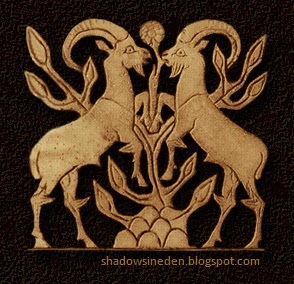
Asherah is traditionally associated with a stylised Tree of Life, which nurtures the animals (usually represented by two goats) portrayed feeding upon it. Asherah, Ashtoreth, Astarte, Ishtar and Inanna are all variant regional names for an enduring goddess who shared similar characteristics across different cultures and historical periods of the Near and Middle East. The Book of Genesis specifically tells us that, as well as the Tree of the Knowledge of Good and Evil, the Tree of Life also was in Eden. Since Asherah was the Tree of Life, and since the Lord (‘Baal’) also was ‘walking in the garden’ (Genesis 3:8), we have both Baal and Asherah present in Eden – which is exactly what that ‘has become as one of us’ phrase (Genesis 3:22) indicates.  

Saturday, September 21, 2013

John Calvin's Tough Love

School diaries are a big deal here in the Netherlands, with many commercially available themed variations, from pop idols to teen trends. Those religion-based schools protective of their pupils’ moral standards even print their own student-designed ones. And so it was with the Calvinist Pieter Zandt school in the heart of the Netherlands Bible Belt. But with this month’s commencement of the new school year something went seriously awry.

The statue of John Calvin in Geneva, Switzerland. Man presumes to know the mind of God, and presumptions become set-in-stone doctrine. 
This particular school made the columns of the national newspapers when it recalled three thousand of its own self-printed school diaries. The reason: one postage stamp-sized photo on the front pictured a boy sporting a familiar peace sign on his T-shirt (below). This sign (so the school board reasoned) had associations with the occult and with the [1]‘Cross of Nero’. [2]Emperor Nero, of course, was infamous for his persecution of early Christians. Clearly, the offending diaries had to go.

A detail of the cover of the destroyed Pieter Zandt school diary. The offending peace sign is just visible on the white T-shirt in the back row.
And go they did. All three thousand copies of the newly-issued school diary were destroyed. Now, it might be easy to scoff at such over-sensitivity (not to mention the sheer waste of time, resources and €20,000 costs involved), certainly when we consider that, whatever associations the symbol might have had in the past, what it conveys now is a simple message of peace. But censorship through an act of destruction has a way of focusing on who is doing the destroying, and scrutiny turns around to face the scrutinizer.

For John Calvin, only the Chosen Few would hear the choirs of Heaven. But it was Calvin who decided this. For wiser (and less presumptuous) mortals, the mind of God remains as inscrutable as ever.
In destroying the diaries, the school board strove to uphold its own faith-based standards. But what are these standards? They are those of Calvinism, that branch of Protestantism promulgated in the 16th-century by Frenchman John Calvin. Calvin was as anti-Catholic as Martin Luther, the founder of Protestantism, but he deviated from the teachings both of Luther and the Papacy in that he advocated a doctrine which he called [3]predestination. The doctrine is simple enough: Christ did not die for all humankind, but only for the Elect – the Chosen Few – who would be saved and ascend to Heaven. All others are damned and will spend eternity separated from God in the unquenchable fires of Hell.

Hell in the 2005 film Constantine appears as our own world in fiery devastation, with eternally gridlocked freeways and highrises in ruins.  Hell can always be found within ourselves, and the human imagination can supply what our direct experience lacks, even to the most terrifying of places. 
Calvin chose the term ‘predestination’ for a reason: all humanity, according to Calvin’s doctrine, was already predestined. Which is to say that before the Fall in Eden, before humankind was even created, God had decided who was going to Heaven and who would roast in the Eternal Fire. Calvinism and its doctrine is therefore a kind of extreme religious fatalism: if God already has you on his blacklist, then you are predestined to burn in Hell. There is no free will, there is no chance to change the outcome, and there is no redemption. Your fate for eternity has already been sealed, with God dispensing a sort of omnipotent tough love with brutal finality.

John Calvin’s deity is therefore a being who treats his own creations with a form of refined fatalistic sadism: this deity already has decided who is going to be tortured for eternity – and then goes ahead and has them tortured anyway. In which case, God moves in ways that are more than just mysterious. If you endorse Calvin’s doctrine, then you additionally accept that he also moves in ways that apparently have an edge of calculated cruelty. The question is: does believing in such a ruthless reward-and-punishment god have an adverse effect upon the human psyche?

Peace is a fragile thing, subject to the tides of human affairs and differences of faith.
The school board strove to protect its students from what it perceived as un-Christian symbolism, and its objections to the cover of the diary were specifically to do with the peace symbol’s alleged original association with the persecution and deaths of Christians. Alas for humanity, the accumulated deaths by [4]persecution, [5]slaughter, [6]warfare or acts of [7]genocide in the name of the Christian faith, whether by [8]Catholics, [9]Protestants, or any other Christian [10]denominations, are all too real, and can be reckoned in the millions. These persecutions and deaths by – not of – Christians are documented history, although I rather suspect that the events (and others like them) related in my notes below do not feature prominently in the history lessons of the Pieter Zandt school.

So in the light of the destruction of their school diaries, and the reasons behind that destruction, here is my own history lesson for the pupils of that school: the Christianization of Europe is estimated to have cost some ten million pagan lives – [11]one hundred times more than the number of Christians executed under the Emperor Nero and for three centuries afterwards – remembering that this was before all the various Christian-against-Christian wars, conflicts and persecutions between the different denominations which followed in the centuries that came after.
Hawkwood 


Notes:
[1] The now-familiar peace symbol (right) has a more chequered history than is generally realised. Ostensibly it was created in 1958 by the London designer Gerald Holtom, initially for the anti-nuclear weapons movement of that time. It is formed from the two superimposed semaphore letters ‘ND’ for ‘nuclear disarmament’. But the symbol was allegedly in use before this, apparently as an inverted cross associated with the crucifixion of the apostle Peter. The tradition that Peter was crucified on an inverted cross originated in an apocryphal Latin text of the 2nd-century known as the Acts of Peter. But since this text also has the apostle bringing smoked fish back to life and making dogs talk, it seems reasonable to doubt the veracity of the account of his death. 

[2] Please see note [5] in my post 666: The Number of the Beast. In Nero's day the term 'Christian' had not yet been coined. There were groups of different beliefs loosely centred around Christ's teachings, no one of which had more or less validity than another. 

[3] Calvin also vigorously endorsed the ‘sin and guilt’ teachings of Augustine (please see my post Shame). 

[4] Please see my post The New Church. Catholicism emerged as the dominant Christian force by ruthlessly eliminating other beliefs such as the Gnostics, Manichaeans and Paulicians

[5] In the 8th-century the Christian monarch Charlemagne (left) decreed the death penalty for anyone who refused conversion and baptism. In the year 782, at Verden to the north of Paris, four thousand five hundred pagan Saxons were rounded up and beheaded in a single day, at the end of which Charlemagne retired from the scene of the slaughter and attended Mass. In this single horrific afternoon the Christian monarch had therefore put to death as many pagans as there had been Christians executed during the entire reign of Emperor Nero. But worse was to follow: the following thirty years left two thirds of the entire pagan population dead.


[6] The death toll in the 17th-century Thirty Years’ War is estimated to have been some seven and a half million lives (source: necrometrics.com, retrieved on September 14, 2013), with Europe being left largely in a state of devastation. The conflict, which literally did last for thirty years, was essentially a religious one, with Catholics fighting to keep the Holy Roman Empire intact, and with Protestants equally determined to break the power of the Papacy. The scene (above) by Henri Motte portrays full-scale religious warfare: wearing the armour of war beneath his cardinal’s scarlet, Cardinal Richelieu surveys the approaching English fleet which supported the Protestant French Hugenot forces at the siege of La Rochelle. The siege took place between 1627 and 1628, and ended in defeat for the Hugenots, although the tide of the war would eventually turn against the Papal forces.

[7] Please see my post A Dark Crusade for an account of actual genocide instigated by the Papacy.

[8] In February of 1658 the entire population of the Netherlands – then some three million people – was sentenced to death for heresy by the Papal Inquisition. The Duke of Alva (right), commanding the occupying Spanish forces, managed to formally execute some eighteen thousand six hundred  Dutch citizens over a six year period, although the numbers massacred by his troops added considerably to this total. Again it was a situation of Protestants defying Papal authority, with the Papacy yet again demonstrating that it was prepared to wade through blood to hold onto power. Today Catholicism in the Netherlands is generally confined to regions in the southern provinces adjoining the Belgian border.

[9] Please see my post Martin Luther's Final Solution for a documented account of an act of genocide instigated by Martin Luther.

[10] In the 17th-century four Quakers known as the Boston martyrs – three men and a woman (left, Mary Dyer being led to execution) – were hanged in Boston by Puritans for professing other-than Puritan beliefs. The Puritans were a sort of right-wing version of the Calvinists, although it is largely a fallacy that the Puritans sailed for the New World to avoid persecution for their beliefs. The truth is nearer to being that they were so intolerant of the beliefs of others that they sought a land where Puritanism would be the only practicing and tolerated religion. As events showed, they were prepared to kill their fellow Christians to make that happen.

[11] This is based upon a maximum high-end estimate of 100,000 over the first three centuries. The actual number of executions specifically of Christians under Nero is unknown, but might have been between three to five thousand. These would not have been Christians as we would have recognized them, as many would either have been Gnostics, or Apostolic (subscribing to the doctrines of Paul), or adhering more to the traditions of the Hebrew prophets (subscribing to the doctrines of James), or other interpretations of the new faith, which was still thought of by the occupying Roman authorities as having a variety of cult followings.

Sources:
Deborah J. Shepherd: The Convergence of Paganism and Christianity in Northern Europe: The Conversion and Archaeology. Program for Interdisciplinary Archaeological Studies, 1996, University of Minnesota. Published in PDF by Academia.edu. The transition in Europe from pagan religions to Christianity was neither smooth nor benevolent. At times it was an uneasy collision between two differing world views, with a compromised merging of customs and traditions. At other times, as under Charlemagne, the transition was mandatory, bloody and abrupt. In Britain, Scandinavia and elsewhere many sites of pagan worship were forcibly annexed and destroyed, and churches were built upon their foundations. Our word 'bigot', used to describe someone who is arrogantly intolerant of others, actually comes from 'Bei Gott' ('By God'), used by the Frankish and Germanic pagans to imitate the exclamation of aggressive conversion activity practiced against them by Christian missionaries. This metal 'Hammer of Thor' Viking talisman (right) has been disguised as a Christian cross, allowing its wearer outwardly to acknowledge token allegiance to the new religion while retaining loyalty to still-familiar gods.


PLEASE NOTE:
Discussions of these topics which I have had in the past with others have turned with apparent grinding inevitability in the direction of some Christian soul who has been only too keen to point out to me the millions who perished under the rule of Stalin (or some other suitably atheist tyrant from history). But playing the ‘atheists versus believers’ death count numbers game achieves nothing. The whole point is that religion by its nature is supposed to invest a believer with some intrinsic altruism, some basic humanity. History shows that in practice this is not what happens. Subscribing to this or that faith or denomination clearly no more equips someone to behave more tolerantly, more altruistically – or even more morally – than a confirmed atheist. So what end does religion serve?

Sunday, December 23, 2012

Profiling a Psychopath

Here is a profile: the subject is petulant, petty-minded and vengeful: someone who demands attention, and becomes darkly jealous as soon as he thinks that anyone else is getting more attention than he is. He also lays down impossible demands which he insists that others follow, but does not follow them himself. Oh, yes: I should also mention that this man is a mass murderer responsible for thousands of deaths. Who is he? Some despotic Idi Amin-style tyrant? Some brutal Pol Pot dictator ruling through fear? No, this dangerously psychotic individual is of course the god of the Old Testament described in human terms. I can now add that this god also appreciates blood sacrifices made in his name (as the [1]Cain and Abel story dramatically underscores), up to and including [2]human sacrifice.


Any and all of the above character traits and actions can be read in [3]scripture. This god even describes himself as a [4]jealous god. He is an appropriately primitive Bronze Age deity with all-too-human emotions and failings. Although surely being ‘God’ excuses all of these things, right? I mean, being God means you get to make up the rules as you go along, doesn’t it? Being God means that everything you do must be inherently ‘right’, because, well… you’re God, after all. And if you’re God, then everything you do apparently can be excused on the grounds that you have this inscrutable and mystical thing called a ‘plan’.

No, not in my book. Following such a god means that you have lowered the bar of your own moral values down to those of this petulant and jealous dictator god. This god who demands that ‘thou shalt not kill’, and then proceeds to lay down a hatfull of transgressions for which the punishment is cruel and bloody death, either by [5]stoning or by being [6]burned alive. Not to mention that he decides to rub out his entire creation (with the exception of a single extended family and the animals they take on board), apparently for no better reason than that [7]‘the wickedness of man was great in the earth’ – as if things are any different now.

Of course, being omniscient as well as omnipotent, God would have known that he’d be destroying his creation a little way down the road even at the time that he brought it into existence. But trying to plot the twisted logic of a psychopath is a dangerous road to tread. Or to paraphrase what [8]Clarise Starling’s FBI boss advised her prior to her interview with the intellectually brilliant but barkingly psychotic Hannibal Lecter: inside this god’s head is not a place that you want to be.


I remember once remarking to someone who bought into all this that if the scriptural God were a person, he would be incarcerated in an institution for the criminally insane. That was several years ago. I dearly wish that I could write here that I have changed my mind, that I now have come round to seeing things in a different light, and that I now understand the god of scripture more. But I cannot. And I do not. Because scripture has that writ-in-stone immutability, and what is in there cannot be changed or spun in some other more acceptable way. It is as it is. And the actions of God are as they are described there, as anyone who doubts me can check for themselves through my chapter-and-verse citations below. 

Faith is not something that you can cherry-pick. If for you it governs your moral compass and the very fabric of your life, then it’s way too important for that. Unless, of course, you view your faith on an only-choose-the-nice-bits basis. In which case it must be something other than the faith which you claim it to be. Because with true faith, it’s all in, or all out. And when all’s said and done, a Bronze Age god is and remains a Bronze Age god. 

But what is a Bronze Age god doing in the 21st-century?
Hawkwood


From Ken Russell's Altered States
PLEASE NOTE:
I am aware that I have not even touched on the God of the New Testament, where the concepts of Heaven and Hell hold sway. A New Testament god who actually uses such savagely crude reward-and-punishment mind games to keep things in line, who subjects any souls who refuse to bend a knee to him to agonizing torments which last for all eternity with neither hope nor possibility of any reprieve or relief, lays claim to being….... ...a god of love?


Notes:
[1] Genesis 4:1-5

[2] Judges 11:29-40.

[3] Please see my post Frontier Justice in the Promised Land.

[4] Exodus 20:5, and Deuteronomy 4:24. 

[5] Deuteronomy 21:18-21 and numerous other instances.

[6] Leviticus 20:14.

[7] Genesis 6:5.

[8] In Jonathan Demme’s The Silence of the Lambs – of course!


Sources:
Images of Anthony Hopkins in the role of Hannibal Lecter from The Silence of the Lambs, from the novel by Thomas Harris, distributed by Orion Pictures Corporation.

Wednesday, June 20, 2012

The Happy Planet

Somewhere in the vastness of space there is a planet. On this planet (which is far from our own) there is no strife, no war, no civil unrest, no family feuds. The inhabitants go peaceably about their business, and all is blissful contentment. This state of being creates no apathetic boredom (as we on our own strife-torn world might imagine it would), because no other state is known to them. In our own earthly terms, the inhabitants of this happy planet are living in paradise and dining on milk and honey, and their times are a perpetual golden age.


This blissful existence has continued for generations, with nothing to disturb it. Then one day: catastrophe. Voices raised in anger are heard as two neighbours squabble over some petty difference of opinion. Shocking enough among such tranquillity. But worse is to follow. The next day a horrified couple discover a body in long grass beside a river bank, bloody and beaten: clearly the victim of a murder. In the days and weeks to come the traumatised inhabitants are drawn deeper into a scenario of escalating violence. What had begun as local disputes about whose property ended exactly where extends to whole territories, as communities vie for control of what up till then had been regarded as worthless tracts of unwanted land. Differences of belief (especially those which sanctify life) become reasons for massacre. Wars flare, creating misery and reasons for resentment for generations yet unborn. What has happened to this once-happy planet?


Back here on planet Earth, it's a politically popular wish expressed by Miss South Carolina (and almost every other aspiring beauty pageant queen). What is wished for? World peace. A final end to all the suffering and strife which so plagues our earthly existence. A simple desire that for once we would all just get along with each other, respect each others' beliefs, territory, property, whatever. And then, amazingly, it actually happens. Differences are resolved, theft becomes meaningless and redundant, war becomes obsolete. Peace prevails at last, and Miss South Carolina's expressed desire for a new and peaceful world becomes an astonishing and precious reality.


The universe keeps its own checks and balances. A star explodes in incandescent death, another star bursts into life. A planet of turmoil becomes a planet of peace, and another planet, far distant, whose existence up till then had known no strife is plunged into turmoil. Perhaps our strife-torn world has a greater cosmic value - even a function - beyond our own understandable longing for tranquillity. Be careful what you wish for, Miss South Carolina...
Hawkwood

Top image: Robert Duncanson: Land of the Lotos Eaters (detail), 19th century
Second image: Pieter Bruegel: The Triumph of Death (detail), 16th century
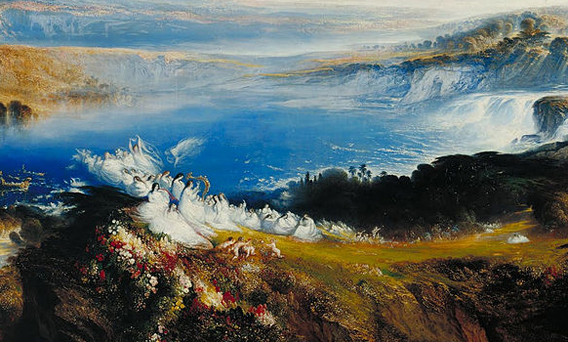
Third image: John Martin: The Plains of Heaven (detail), 19th century