
Return here to the Shadows in Eden home page.....
Showing posts with label Hinduism. Show all posts

Thursday, April 2, 2015

The Pope's Exorcist

Gabriele Amorth is perhaps not a name which springs readily to mind when considering the pastoral affairs of the church, but he has a clearly-defined function nevertheless. Father Amorth is exorcist-in-residence to the Vatican, and in this capacity he is reputed to have performed over one hundred and sixty thousand exorcisms in the decades-long practice of his office. The notion of an official exorcist is intriguing in itself, but the mere existence of such an office in the Catholic Church raises questions whose answers are perhaps disturbing.

Whatever their nature, demons belong to the realm of the supernatural. It follows, then, that any claims to know what is actually happening to someone who is possessed, and who is therefore allegedly ‘cured’ by the act of exorcism, falls within the bounds of personal belief. We take these things on trust, and depending on our own beliefs, exorcism is either a first option or a last resort.
As soon as the existence of demons is acknowledged as a literal fact, which it must be in Father Amorth’s case, then we have crossed over a line which separates our everyday reality from the realm of the supernatural. We are in a place which science shuns, for the evidence for such things is not in a form acceptable to science. You cannot put a demon under a microscope. You cannot classify a demon as a species or subspecies. You cannot visit a museum and see a demon with a descriptive label in a glass showcase.

This is not to say that such supernatural entities do not exist; just that rational scientific method is not equipped to deal with them. In short: all such things lie in the realm of belief. As this also includes religious belief, demons would indeed seem to belong in the same province as Father Amorth. Indigenous beliefs would concur with the Vatican: these are worlds in which spirits both good and bad are an accepted part of reality. There are some spirits who wish to help you, there are some who might be uppity and need to be placated with offerings to persuade them to treat you right, and there are others who just want to yank your chain in pursuit of their own dark and inscrutable agendas.

Father Gabriele Amorth, the appointed exorcist to the Vatican. When demons become part of one’s job description it is easy to overlook the fact that, as denizens of the supernatural realm, their actual nature remains an unknown to us. Some cases of attempted exorcism actually seem to exacerbate the situation, leaving the apparently afflicted person worse off than before.
Even this simple comparison is enough to indicate that Father Amorth’s world and the world of (for example) an Amazon Basin tribal community are not as far removed from each other as we might at first assume. The differences are in the trappings of external appearances, but the interactions with such forces, and what those interactions involve, are much the same. Both priest and shaman petition a higher power for aid in such a situation, and communicate directly with these lower forces during the exorcism. During his term in office Pope John Paul II allegedly performed three exorcisms, and his successor Pope Benedict XVI increased the number of Catholic-sponsored exorcists globally. An exorcist is still an exorcist, and an exorcist functions as an intermediary between these realities, whether in the rain forest or in the marble corridors of the Vatican.

 Taita Querubin Queta. As the widely-respected spiritual leader and shaman healer of the Cófan people of Colombia, Taita Querubin Queta not only acts as intermediary on behalf of his people to the world of the spirits, but also to global representatives at the United Nations and other institutions, where he speaks to raise awareness of the pressures which the Cófan face from outside cultures.
Apparently Father Amorth also instructs bishops on how to distinguish cases of genuine possession from those individuals in need of psychiatric help, and refuses to perform an exorcism upon those whom he considers to be faking the symptoms. As far as I have been able to determine, and for all his dealings with these claimed supernatural entities, Father Amorth himself has no credentials whatever that would allow him to make such a professional judgement call. Even a qualified and experienced [1]psychiatrist whom I have seen interviewed admitted that it is at times extremely easy to be persuaded by someone who is afflicted with some form of mental psychopathy that they are in fact entirely reformed. Many such individuals can – and do – go their whole lives functioning in society to a greater or lesser degree. We have to wonder how many of those who have needed an entirely different sort of treatment have slipped through the net to be blessed with holy water rather than with symptom-reducing medication.

The first card used in the series of the Rorschach inkblot psychology test. There are no right or wrong answers to what these randomly created images might be. As with religious belief, individuals will see their own truth, and the evaluation of that subjective truth might indicate some form of emotional dysfunction or psychosis.
The Vatican’s resident exorcist certainly has his opinions about other matters. He has stated that he considers the Harry Potter stories harmful because of their magic elements, giving his reason as making no distinction between white and black magic, because all magic is “…a turn to the Devil”. It strikes me that the line between true magic and exorcism, if it exists at all, is a distinctly blurred one, although the priest seems not to be aware of this particular irony. Harry Potter is perhaps a relatively harmless target, but where things become several shades less politically (and morally) correct are his views on Hindu beliefs and yoga. These beliefs and practices are, says the priest, “Satanic”, because “…all Eastern religions are based on a false belief in [2]reincarnation.” I would suggest to Father Amorth in particular, and to the offices of the Vatican in general, that widespread and endemic pedophilia by the Catholic priesthood is somewhat more likely to be weighed as the heavier evil when the Last Trump sounds than these sincere expressions of another faith.

Meditation as a form of yoga. Studies have indicated that consistent meditation appears to increase emotional empathy and compassion, with the appropriate areas of neural activity in the brain showing increased sensitivity. The practice of yoga is reported to have multiple health benefits, on the heart, on blood pressure, and on regular sleep patterns.
Acknowledging the existence of demons, and therefore of Satan, opens up an ethical question over which philosophers and theologians have furrowed their brows for centuries, namely: does evil exist of itself? Are some people just ‘bad’, or is there darker stuff involved? We must each decide for ourselves what the answer might be, but the problem about accepting these things as real, whether they are so or not, is that our beliefs make them real to us individually. Father Gabriele Amorth claims to have performed in excess of 160,000 exorcisms during the course of his long term of office. Assuming that all those circumstances were and are real, there could well be a small army of seriously disgruntled demons waiting on the other side just jumping for the chance to even the score with the man who gave them all the push. In Father Amorth’s shoes, I for one would not fancy such a prospect.  
Hawkwood 


1st Postscript: In concluding this post I feel the necessity to emphasize that it is often the things we take for granted which are the least understood. We confidently use such terms as 'demon', 'spirit', 'ghost', 'poltergeist', 'elemental', etc. as if we know what these entities are, how they differ from each other, and what their precise nature and purpose is. We do not. Any attempts to define what the supernatural is, and the various forms in which it appears to manifest itself, remain speculative. It is our beliefs which lend these things an aura of familiarity, of belonging to phenomena that we can classify, as if they were different types of lightning or clouds or other phenomena of the natural world. But the paranormal, like death, is an unknown. Who knows what Father Amorth and others like him have been dealing with, and who knows what truly takes place during an exorcism, and what the real consequences are?

2nd Postscript: Twenty months after this post was written, on 16 September, 2016, Father Gabriele Amorth died. He was aged 91. 


Notes:
[1] Dr. Tom Powell in an interview with the BBC in the documentary Psychopath.

[2] The Eastern belief that the reincarnating soul occupies a succession of corporeal bodies, known as saṃsāra, is also found in Ancient Greece in the writings of Plato, where it is known as transmigration, and in many indigenous cultures as well as in some contemporary beliefs such as Theosophy. The orthodox forms of Christianity, Judaism and Islam reject the concept of reincarnation, although individuals within these religions accept it, and the mystic forms of these religions such as the Kabbalah, Gnosticism, Catharism and some branches of Sufism also accept the concept. 

Sources:
David Goldenberg: 10 Secrets of the Vatican Exposed, in The Week, March 13, 2013. Retrieved March 31, 2015.
Nick Pisa: Hitler and Stalin were possessed by the Devil, says Vatican exorcist, in The Mail Online, August 2006. Retrieved March 31, 2015.
Nick Squires: Harry Potter and yoga are evil, says Catholic Church exorcist, in The Telegraph, November 25, 2011. Retrieved March 31, 2015.
Ron Dicker: Gabriele Amorth, Catholic Priest And Exorcist, Says He’s Done More Than 160,000 Exorcisms, in The Huffington Post, May 21, 2013. Retrieved March 31, 2015.

Image of Father Gabriele Amorth adapted from a photo by Stephen Driscoll for CNA. Images of Taita Querubin Queta and yoga meditation adapted from photos from uncredited sources. The Rorschach test card is in the public domain. Demon painted for this post by Hawkwood for the ©David Bergen Studio.

Saturday, March 7, 2015

Jesus in India

Even the staunchest Christian has to concede that what scripture tells us about the life of Jesus hardly amounts to a comprehensive biography. For any details at all we rely almost solely upon the four gospels. These collectively (and at times conflictingly) inform us of his birth, his early childhood (but even this only partially), and his ministry, which effectively took place over the last two years of his life. All texts are strangely silent about what happened in between – a hiatus of almost twenty years.

Did Jesus once walk in the shadow of the mountains of the Hindu Kush, perhaps to seek new forms for the Spirit that were then unknown in his native Galilee?
In other words: most of Jesus’ life, and what he did during those many years, is a total unknown. Why are all the gospels so strangely silent about those intervening years? Or perhaps more to the point: why is this stark fact so summarily brushed aside within Christianity itself? It is as if this yawning void of non-information is considered to be a minor inconvenience in our knowledge of the Saviour: something perfunctorily acknowledged before swiftly moving on to more familiar events. Jesus, the young boy encountered in Luke’s gospel going [1]‘about his Father’s business’ in the temple, a few verses later emerges as the adult Jesus being baptized by John in the waters of the Jordan. It is as if a biographer of the Duke of Wellington were to describe his early boyhood in a brief introductory chapter – and then begin the next chapter by describing his victory against Napoleon at the battle of Waterloo.

This timeline graphically illustrates how little is known about the life of Jesus. The gospels collectively describe only the light areas on the line; the rest of the intervening years are a total unknown. Conflicting dates make the exact span of Jesus’ life uncertain, although it is usually taken to be 32-33 years.

So whether or not we care to address this issue of Jesus’ missing years, whether we choose to sweep it under the carpet as being ‘unimportant’ or ‘not the point’, the issue is still there. And the existence of the issue leaves us free to speculate upon what he might have done, and where he might have been. He might, of course, simply have spent those years in Galilee as an itinerant sage and healer, perhaps performing local exorcisms (‘casting out devils’, to use the scriptural phrase), or just keeping a low profile in preparation for the momentous final years of his life. Or perhaps he journeyed farther afield, even as far as India.

Seeking an answer to whether the footsteps of Jesus ever were imprinted in Indian soil must begin with the question: how feasible would the journey itself have been? Just how do-able was it at the time to get from Galilee to the distant Hindu Kush? It seems a long way, but startlingly, the answer is: entirely possible, even plausible. If we follow the trade routes of the time, we ourselves can plot a likely route on the map. The Silk Road had principal connecting points in the port city of Antioch and in Damascus. From Damascus the Silk Road then went eastward via Palmyra to Ctesiphon in Mesopotamia, where two alternative routes presented themselves. Either by a river and sea voyage, first down the Euphrates and then by sea to Hormuz in Persia, or farther south to the Indian port of Barbaricon. Either option would have allowed for a direct connection inland to northern India along principal known trade routes.

Following the Silk Road and other major trade routes, either overland or by land and sea, would have made a journey from Galilee to India entirely feasible.
The second alternative would have been overland, journeying east from Ctesiphon along the Silk Road to Bactra northwest of the Hindu Kush, then southeast through the Khyber Pass to [2]Taxila in the foothills. These alternatives all followed time-tested trade routes. Join a caravan, and off you go. After all, Alexander the Great trod the same route in his conquests of three centuries before, and we know that Alexander at any rate left his own footprints in Taxila. So for Jesus the journey itself was entirely feasible, and would have needed no arduous trailblazing as such. The next question should be: can we detect any signs of such a sojourn accounting for his [3]missing years, both in his teachings, which thereafter presumably would have been Eastern-influenced, and in [4]India itself? Again the answer, startling perhaps for some, could be: yes.

The mountains of the Hindu Kush. Mountains have always exhorted us to reach out for the Divine. Often they have been seen as the dwelling places of gods and spirits, and for many, treading their snowy fastness feels like walking on sacred ground.
For those long unaccounted-for years, Jesus simply vanishes from the record. If at least part of that time was spent in India, then we would expect his own ministry to be informed by [5]Buddhist influence. It has been [6]suggested that Jesus’ lifestyle resembled that of a Cynic philosopher. Cynicism (not to be confused with our own contemporary use of the term) was a Greek school of philosophy, a lifestyle, which urged its adherents to live a simple life, to wear simple garments and not pay heed to worldly possessions, and peaceably to live in harmony with their surroundings. Galilee and regions northward were subject to Hellenist influence (Paul’s first language was Greek), and Jesus actually urges his apostles to embrace such a [7]lifestyle.

A lake in Srinagar, Kashmir. Did these same contemplative reflections offer their silent mirror to Jesus two millennia ago? Places far from home often invite us to gain new insights. When we return from such sojourns we might view the familiar in unexpected ways, and discover our own native soil anew.
But Cynicism in its turn, however coincidentally, closely resembled the lifestyle of Buddhist monks. Such a monk as well lived a life of utter simplicity and devotion, depending for his or her existence on the charity of others. The precepts of Jesus to a way of non-violence, to loving your neighbour, to placing yourself in the service of others, which were revolutionary for and otherwise unknown to other teachings in Palestine, and which otherwise seem mysteriously to have emerged from a social milieu utterly foreign to them, were the very fabric of Buddhism. Buddha also healed the sick and fed multitudes with a few loaves of bread, not as magic tricks, but as manifestations of his divine Buddha nature. Were these ideas, so novel for the near East, imported from a farther East by Jesus himself? Did Jesus sojourn in a Buddhist monastery in the very shadow of the Hindu Kush? 

We are left to wonder. The ease of travelling the trade routes, and the quietly-spoken and deeply-human teachings of Jesus himself, so radically different for his social environment, makes such speculation at least plausible. As to any protests that Jesus never visited India because there is no firm proof that he did, the only reasoned response must be that there also is no proof that he did not.
Hawkwood 


Notes:
[1] Luke 2: 41-49. In this passage relating the boy Jesus’ visit to the temple in Jerusalem, his age is given as twelve (Luke 2: 42). The following chapter mentions that Jesus is ‘about thirty years of age’ (Luke 3: 23). The few intervening verses between these two quotes concern themselves with John the Baptist. No mention whatever is made of Jesus’ activities or whereabouts in the intervening eighteen years of his life.

[2] The city of Taxila is now within the borders of present-day Pakistan.

[3] There is the further claim that Jesus was in India – but travelled (or perhaps returned) there after his presumed resurrection, living as a respected foreigner in the community as ‘Yuz Asouf’. This person lived into old age, and was buried in a tomb according to the Jewish tradition (that is: orientated east-west) in Srinagar, Kashmir (left): a tomb which still exists and can be visited. The clear implication is that Jesus did not die on the cross, but passed into coma before being taken down and was secretly revived in the tomb provided by Joseph of Arimathea. Accepting this possibility means that the ‘resurrection’ in Christian terms never actually happened, which if true would undermine the very cornerstone of Christian belief. This heretical idea is too complex to be examined here, and will be covered in a future post.

[4] There are two further issues which I have chosen not to cover in the body of this post. The first is the claim by the 19th-century Russian adventurer Nicolas Notovitch (right) that he discovered a manuscript in a northern Indian monastery relating the deeds of a certain foreigner named as ‘Issu’ who healed others, which at face value seems to hint at evidence of Jesus’ presence in that monastery. But this story is too clouded by controversy and accusations of hoax to be included in a post in which I have concentrated only on ‘plausibles’. The second issue is the Hindu manuscript known as the Bhavishya Maha Purana, which mentions a Messiah-like individual named as Issa Masih, who had taught a doctrine of peace, and who had fled east from his homeland due to persecution. Being therefore post-resurrection, this also relates to my ‘resurrection’ point in note [3] above.

[5] Buddhism was founded some five hundred years before the time of Jesus.

[6] The idea that Jesus actually was a Cynic philosopher is mentioned (among others) by Paula Fredriksen in her book Jesus of Nazareth, King of the Jews. Professor Fredriksen points out that dressing in simple garb was one of the features of the Cynics. So if you tend to picture Jesus in a humble coarsely-woven garment, rather than in the tassel-fringed robes that were normal Jewish attire, then you are picturing him as a Cynic philosopher. But the hints are not in appearance alone. The at-times enigmatic and koan-like wisdom of Jesus, which is so in evidence in that source for the canonical gospels of the teachings of Jesus, the Gospel of Thomas, and which predates them, is also typical of the Cynic style of teaching – and also of Eastern mysticism.

[7] Mark 6: 7-9. “And he called unto him the twelve, and began to send them forth by two and two; and gave them power over unclean spirits; and commanded them that they should take nothing for their journey, save a staff only; no *scrip, no bread, no money in their purse: but be shod with sandals; and not put on two coats.” K.J.V. (*‘Scrip’: a bag.)


Sources:
Paula Fredriksen: Jesus of Nazareth, King of the Jews. Alfred A. Knopf, New York, 1999.
Hindu Kush mountains photo by Hindu Kush Adventure. Srinagar lake adapted from a photo by Singh Suninder Jeet. 'Jesus in the Hindu Kush' painting, Silk Road map and Life of Jesus timeline by Hawkwood for the ©David Bergen Studio.

Wednesday, January 14, 2015

Possession

What is possession? The several months of work which I have just spent creating a video of my own version of Bram Stoker’s Dracula gave me time enough to ponder this question while I was occupied with this project. To be clear: I do not mean ‘possession’ in the exorcist casting-out-devils sense, which I regard as a separate issue. I mean: the will to possess another, to gain mastery over someone else’s independence, even over that person’s life.

Lucy Westenra: the ghostly pallor of a life unnaturally sustained beyond death itself.
In Stoker’s classic tale of the struggle against evil, despite the heroic efforts of the Dutch vampire hunter Abraham Van Helsing to prevent the encounter, the notorious Count stalks and finally overcomes the hapless Lucy Westenra, and she wastes away and dies. Van Helsing and his associates visit the place of her interment only to discover that her coffin lies empty. Having been bitten by Dracula, Lucy has herself become one of the ‘Un-Dead’: has herself become a vampire, neither alive nor truly dead.

Dracula's letter of welcome to Jonathan Harker containing instructions for his journey to the Count's castle - instructions that Harker would come to regret acting upon.
Dracula, the supreme vampire, is also the supreme possessor. In contemporary profiler terms, he is a pathological control freak. He is ‘evil’ in the context of the story’s classic Gothic theme, but (again in contemporary terms) his pathological nature leaves him merely indifferent to the sufferings which he causes to others, including the loved ones of his victims, who are left to cope with the loss of their dear departed who become stranded in a terrible no-man’s-land between life and death.

In my video, Transylvania, while initially being an actual place on the map to which the characters journey, becomes ultimately, not so much a geographical location as a state of mind. ‘Transylvania’ is where you find yourself as a victim of a predator, and it is a frightening place to be. And if you are in that place, two choices lie open to you: the first is to remain aware of your situation, and attempt an escape (as the story’s young realty agent Jonathan Harker actually does). The second choice is to succumb, to (again in contemporary terms) go over to the dark side: to surrender your own will to that of your possessor.

The grim edifice of Dracula's "...vast ruined castle, from whose tall black windows came no ray of light."
Does all this talk about vampires and Transylvania seem rather remote from the usual themes which my posts here address? Think about the many religious and quasi-religious cults and the ways in which they manipulate and control their followers. Cult leaders often-enough have a ‘Dracula’ profile: they can be intensely [1]charismatic, and that charisma at times can have a sexual tint. Cult leaders (almost invariably male) may demand – and receive – sexual favours from their female followers, whether or not those followers have partners. And the news will at times carry stories of the openly pedophile activities of such leaders. It’s not really about sex. It’s about feeding off the energy of one’s victims during such encounters, and perhaps also about cementing their loyalty and drug-like dependence upon the leader. And when true and sincere love finds no place in the act, the transfer of bodily fluids becomes vampiric, an expression of mere brute mastery and power. Ask any victim of rape or sexual abuse.

Transylvania as a place on the map. Using maps of the story's 19th-century period in tandem with Stoker's text, it was possible for me to plot Dracula's overland route to the Black Sea port of Varna, and thence by schooner to the English harbour town of Whitby. For the Count, as for voyagers of today, the Bay of Biscay was a place of storms.
It is typical of cults that the leaders will encourage or even insist upon their followers severing contacts with their past lives, including with their families. This is usually demanded under the pretext that the cult is their new ‘family’, and the leader is their new father and mother rolled into one. The true reason, as the cult leader well knows, is that any such contacts, were they to be sustained, would undermine the new ‘reality’ which the leader has constructed. But all this manipulation need not be confined to religious cults.

‘Transylvania’ also can exist within an individual relationship. A person with a particularly possessive nature might move to ensure that a partner’s family contacts are damaged or even destroyed. The means to accomplish this might vary, but the result is the same: that partner (perhaps out of a misguided love) will become isolated from his/her own family or parents, and become encased within the new ‘reality’ – and dependent upon the possessive partner – in the way that such a possessive relationship demands. To more-aware others, such a relationship might have the outward appearance of a cult, and itself might actually function using the manipulative emotional mechanisms similar to a cult – but with one [2]leader and one member. It is possible that you might even know of someone in such a situation.

Once on English soil the Count uses his shapeshifting abilities to transform into both a wolf and a bat: metaphors for the subtle and not-so-subtle masks of human predators in our own reality.
It is likely that at some time you have had on your doorstep the members of one or other church denomination who proselytize from door-to-door in the hopes of making a new conversion. Such proselytizing activity might actually be a requirement of one’s faith, as it is for the Church of Jesus Christ of Latter-day Saints (known as the Mormons), or for Jehovah’s Witnesses. But is trying to persuade someone (in such cases, a complete stranger) to believe the same things in which you believe an act of conversion, or an act of possession? We find it reassuring when someone else believes the same things that we do, simply because it provides us with a confirmation that what we believe must be ‘right’, and gives us a sense of communal belonging. But however well-intentioned it might be, such persuasive attempted conversion by its very nature and intent is also spiritually predatory – and doubly so when forced conversion is involved, as it has been both in [3]history and in our [4]present-day world.

The eyes of a predator mirror the same intentions, whether that predator is animal or human.
Transylvania, it seems, is far from being just a place on the map. As a state of mind it can be anywhere and everywhere, and is real enough. If ever we find ourselves in that terrible place, like Stoker’s young hero Jonathan Harker we need to resist the easy option to succumb and instead struggle to stay awake and alert, and escape if we can to seize our own life back – although we might need the help of loyal friends and loved ones on the 'outside' to accomplish this. And they might not always have fangs and wear swirling black cloaks, but vampires as well are real enough.
Hawkwood 


Notes:
[1] Eastern faiths will caution novices about the dangers of becoming beguiled by and ‘stuck’ in the charismatic stage of spiritual development, which is recognized for what it truly is: a mere doorway to further spiritual progress. In the West there are no such cautionary restraints, and you can see the results on any evangelical television network: many such preachers become enamoured of their own charismatic powers, and so stay at that stage rather than moving on into calmer and more humble spiritual waters.

[2] Such a pathologically possessive partner can be a consummate actor. A casual contact with such a type might well leave you concluding that the person is friendly and sincere. I have even seen an interview with an experienced psychiatrist who admitted that, had he not previously read his patient's unnerving case file, he would have been totally fooled into concluding that the man was entirely compliant and normal. If you have seen the film, think of Clarice Starling's first meeting with the courteous and considerate Hannibal Lecter in The Silence of the Lambs. Anthony Hopkins' performance was accurate to type - and the more chilling for being so.  

[3] The occupying Roman forces in the Near East and Europe famously executed those locals (either Christians or pagans) who refused to make an offering to their gods. In later centuries, during the Christianization of Europe, the dubious favour was returned by such Christian rulers as Charlemagne, who had 4,500 pagans who refused to convert to the faith beheaded in a single afternoon, after which he retired to attend mass. During the Papal-instigated Albigensian crusade, Christian Cathars were given the choice either to convert to Catholicism or be burned alive. Many chose for the flames.

[4] The recent terrible case of the kidnapping of 200 Nigerian Christian schoolgirls by Muslim radicals carries the news by those radicals that, not only had the schoolgirls ‘embraced’ Islam, but they had ‘decided’ to take Muslim husbands. The girls' whereabouts are still unknown.


Sources:
All images are the copyright of the © David Bergen Studio, and are taken from my video which can now be seen on YouTube here: Dracula: Darkness Rising.

Tuesday, December 10, 2013

God, Single, Seeks Consort

A single omnipotent god is an oddity. To be sure, three of the world’s current major religions – Judaism, Christianity and Islam – have such a god, but such a god dominates our thoughts, is accepted as the ‘normal’ state of affairs, simply because of the numbers of today’s adherents. In terms of overall frequency in human history, such a single god is more rarely encountered.

A God without a consort.
Unless we live in India with the vast majority of its people endorsing the polytheistic Hindu faith, or unless we live in a politically atheist country, the idea of a single deity will be all around us, whether we ourselves are religious or not. And if you who are reading this belong to one of these three monotheistic faiths and find my opening sentence unreasonable, let me explain further:

It is a natural spiritual solution to share over a number of deities the widely differing situations which we as humans experience. This god will favour your coming sea voyage, that god has dark mood swings and needs to be kept on the right side of, another god will help you with a successful harvest. One goddess will ease your difficult labour pains, another will watch over your household, and yet another will smile on your fortunes in love and help you to find your partner. Such gods and goddesses have defined roles, and reflect our earthly trials and fortunes. But what happens when all these widely-varying aspects of our hopes and dreams are rolled into one single deity?

His realm, his rules. If you were planning a sea voyage, moody Poseidon needed to be respected. 
What happens is what scripture reveals. We end up with a deity who is magnanimous, jealous, loving, vindictive, creative, destructive, benevolent, picky about which sacrifices are made in his name, chooses (almost) to destroy his entire creation, and chooses to redeem it as well. This God who is the Prince of Peace is also the God who joins in the action on the field of battle. This infinitely merciful God who will grant you [1]eternal bliss in heaven is the very same God who will decide that you shall suffer the torments of the damned forever. All the widely-varying and contradictory characteristics which normally would be distributed over a number of different gods and goddesses are now all bundled into one deity – with all the inherent paradoxes which that inevitably produces.

Sekhmet unleashed.
In a recent [2]post I have described the dark savagery of the God who sanctions the many acts of mass slaughter which are chronicled in the Book of Joshua. If you are a Christian you will believe that this is the same compassionate God who redeems the world several Books and a Testament later. On the face of it, a God who creates the world and all the creatures in it, only to destroy it (and them) a few scant [3]generations later, holds less logic than the parallel version from Dynastic Egyptian religion in which the [4]creator god Re dispatches the ruthless lioness goddess Sekhmet to Earth to do the same. The destruction is wrought by a deity whose business is destruction, not by the creator himself. With each god and goddess assigned his or her specific task, no obvious deific logic has been breached.

Zeus and Hera: storms on Olympus for a wayward god with all-too-earthly desires.
There is another side to this train of thought. When many gods are in the pantheon, ‘god’ is not a bachelor. Osiris had his Isis, Shiva has his Shakti, Odin had his Freya, Jupiter had his Juno, Zeus had his Hera. And Hera had to cope with the various extra-marital shenanigans in which her oversexed husband Zeus indulged – although I’m pretty sure that a few deific pots and pans went sailing through the air when he got back to Olympus, having had his way (in a suitably disguised form) with some lonely mortal shepherdess. Although married life even for a god might at times have seemed a lot like the married life of mortals in the world below, bachelordom for a deity is, it seems, not the usual order of things. But is the god – certainly of Judaism and of Christianity – a ‘bachelor’ in the sense that this deity never actually had a partner?

Asherah: Tree of Life
Israelite religion evolved from the beliefs out of which the Israelite culture itself grew. In the Eden of Genesis, God refers to the plural forms of [5]’our’ and ‘us’. Clearly there is more than one God present on the scene. This other deity, who is referred to in scripture only obliquely, was later expunged from scriptural texts until only her shadowy ghost remained in the diction of these plural terms. Her name is Asherah, the Canaanite goddess in the [6]pantheon from which Israelite religion evolved. When the Israelites, who likely emerged from the Canaanite diaspora displaced by the Egyptian conquest of Canaan, made a drive to define their own distinctive religious forms, this new God of the Israelites was left in a state, not so much of bachelordom, but of forced separation. Deprived of his consort, answerable to no-one but himself, he was free to let rip with all the guy-stuff so prominently in evidence in such books as Joshua.

A male-dominated heaven creates its counterpart on earth.
In such a male-only godhead setup, women were left with little voice. Several millennia later they still are. It’s all ‘God the father’ and ‘God the Son’, with the soothing feminine restraints of a consort being painfully lacking. So does all this deific testosterone have a knock-on effect? Of course it does. We respectfully address ourselves to [7]His Holiness’, ‘His Eminence’ and ‘His Grace’. And let’s not even mention all those [8]imams, mullahs and ayatollahs. It’s more than high time that some healthy balance was restored to our deity’s bachelor boy existence. It’s time that ad was placed in the singles’ columns: “God, Single, Seeks Consort”.
Hawkwood 


Notes:
[1] It is a strident moral paradox that God redeems the world through the sacrifice of Christ, but nevertheless shows himself to be fully-committed to having souls suffer the torments of Hell forever with no hope of redemption. The mere existence of Hell in Christian doctrine negates the purpose of Christ’s mission, for what end has been served by Christ’s sacrifice if after death God negates the reason for his sacrifice for so many? The whole point of Hell is that there is no redemption – but according to Christian doctrine any and all souls already have been redeemed through Christ. This makes sense… not. L


[3] For a critical look at the vessel featured in this story please see my post The Lost Ark of Noah.

[4] Dynastic Egyptian religion begins with a single creator god – Re – but then becomes polytheistic with succeeding generations of gods. Isis and Osiris are the second generation, preceded by the earth and sky god and goddess Geb and Nut. Re himself emerges from a cosmic egg out of Nun, the primordial ocean which is the creative female principle.

[5] As in Genesis 1:26: “And God said, Let us make man in our image, after our likeness..” and Genesis 3:22: “And the LORD God said, Behold, the man is become as one of us, to know good and evil.” The phrase “as one of us” is particularly telling, clearly implying “as one of us gods”. That is: being able to determine all aspects of the moral spectrum, to have the same knowledge and insight as one of the immortal gods.

[6] From clay tablets it is possible to determine an evolution of deities. The supreme Canaanite god was El, with Asherah being his consort. When El eventually became the Israelite god Yahweh, Asherah endured as his consort until she was suppressed by the new monotheism. Both El and Yahweh were initially known as Baal, a titular term meaning ‘Lord’. In later texts which eventually became scriptural, Baal came to be confused with the name for the Canaanite god.

[7] In an Apostolic Letter of May 22 1994 by Pope John Paul II, the Catholic Church has banned women from holding positions of authority in the Church forever. The reason given? Christ chose only male disciples: a fallacy which scripture itself refutes. You can read more about this issue (and find a link to this Papal letter in note 3) in my post "Behold This Woman".

[8] I am aware that there are female holders of these titles in Islam, as there are female rabbis and female Anglican bishops. But all these are notable for their minorities, not because there is an even balance of gender in these religious hierarchies.


Sources:
The top and last images of God creating the sun and moon and God creating the plants are from Michelangelo Buonarroti’s frescoes for the ceiling of the Sistine Chapel. Although I have added my own background of clouds, the figure of God is unaltered from Michelangelo’s originals. If it has ever crossed your mind to wonder why God is companioned by a naked boy instead of a conventional angel, my post Fear and Loathing in the Sistine Chapel will be of interest to you. Michelangelo’s homosexuality (which is also much in evidence in his homoerotic poetry) is considerably more on display in his famous chapel frescoes than is generally realised. Yes, you do see what you think you see in this male nude from the fresco (click on the image right), and I’m not going to point it out – except to say that these are not the only ‘acorns’ on view in these frescoes. And if you find any of this offensive then I suggest that you take your objections to the offices of His Holiness, under whose jurisdiction these frescoes fall.

Portrayals of Sekhmet and Asherah painted for this post by Hawkwood for the ©David Bergen Studio, All Rights Reserved. Lioness adapted from photos by Mitsuaki Iwago.


Sekhmet: In the traditional myth, having been let loose into the world Sekhmet slips beyond Re’s control and rampages through a lake of the blood of her human victims. Unable to halt the killing, and fearing that humankind will become extinct, the gods conspire to trick her by mixing red ochre with beer and pouring it over the earth. Thinking it to be blood, Sekhmet gorges herself until she falls into a soporific stupor and the mayhem finally ends. The other lioness goddess was Bastet of Lower Egypt. Together with Sekhmet of Upper Egypt they were known as the lionesses of Yesterday (the East) and Tomorrow (the West). Both goddesses were initially forces of destruction, although Bastet later evolved into a tamer cat goddess, and Sekhmet, while remaining a lioness, seems to have curbed her aggressive ways. 

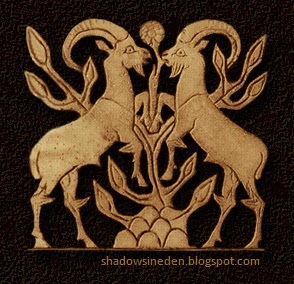
Asherah is traditionally associated with a stylised Tree of Life, which nurtures the animals (usually represented by two goats) portrayed feeding upon it. Asherah, Ashtoreth, Astarte, Ishtar and Inanna are all variant regional names for an enduring goddess who shared similar characteristics across different cultures and historical periods of the Near and Middle East. The Book of Genesis specifically tells us that, as well as the Tree of the Knowledge of Good and Evil, the Tree of Life also was in Eden. Since Asherah was the Tree of Life, and since the Lord (‘Baal’) also was ‘walking in the garden’ (Genesis 3:8), we have both Baal and Asherah present in Eden – which is exactly what that ‘has become as one of us’ phrase (Genesis 3:22) indicates.  

Thursday, April 18, 2013

All Things Must Pass

The lioness-headed goddess Sekhmet of Ancient Egypt, mighty Odin of the Vikings, the amorous Zeus of Ancient Greece seeking mortal women to seduce: we now think of these gods and goddesses as the deities of mythology, and the surviving stories in which they feature as mythological tales. But all of these deities, and all of their stories, were once a part of living, breathing religions. All of these deities once were worshipped and believed in as surely, and with as much passion and conviction, as those deities of the religions which are with us today.

Zeus and Danae: Incarcerated in a tower of bronze, Danae is visited by Zeus in the form of a shower of gold. The result of this encounter is the hero Perseus, whose story lives on, even though the once-great Zeus has become a figure of mythology.
It is only through the lens of time that we view these beliefs as ‘mythology’, because as vibrant religions they have with passing time, and for various reasons of history, become a spent force. This being so, then by logical extension it must follow that if the religions of the past have for us turned into mythology, then the religions of today must be the mythologies of the future. Does this thought make you howl in protest? Do you believe that your religion will be eternal? In history, there is no such thing. Ra, the creator sun god of dynastic Egypt, was worshipped as a principal deity for almost three thousand years before he too had his day.

A god also rises and sets.
Christianity has now been with us as a practicing religion for two thousand years. Will it still be here in that same form a thousand years from now, in the year 3013? How about 4013 – or even 8013? The year 8013 (for convenience and clarity I’m assuming the Common Era calendar) is more remote from our own time than our own time is from the building of ancient Babylon. I’m not making bets on anything six thousand years into the future – but I am prepared to make reasonable assumptions. And reasonable assumptions tell us that all things must pass.

The Roman Forum: The present contains the ruins of the past, and the future will contain the ruins of the present.
The historian Edward Gibbon sat down among the ruins of the once-great Forum in the city of Rome and, overwhelmed by the finality of this great truth, and surrounded by the echoing remains of temples and roofless columns, conceived his plan to write his multi-volume classic on the decline and fall of the Roman Empire. Empires are in a sense the secular versions of religions – although it is true enough that empires and religions are at times inextricably intertwined.  The Holy Roman Empire (which the ever-philosophical Voltaire dryly described as being neither holy, nor Roman, nor an empire) carried its religious convictions to the New World, there to lay waste the then-existing indigenous pre-Columbian cultures in a frenzy of conversion by conquest.

Burnt by the fires of a new faith: Of the thousands of Pre-Columbian sacred books that were destroyed during the 16th-century Spanish conquest of the New World, the damaged Codex Borgia is one of less than ten to survive.
The three great religions of today known as the Religions of the Book – Christianity, Judaism and Islam – are all monotheistic. From within those religions there is probably a tendency to view the belief in a single omnipotent deity as a progression beyond the primitive polytheistic religions of the past, with their head-spinning diversity of gods, goddesses and semi-divine heroes and heroines. Monotheism is therefore perhaps viewed as an evolution beyond such ancient mindsets, as being  ‘the way to go’. But Hinduism makes a nonsense of such an idea – and Hinduism, with its rich pantheon of gods and goddesses, is still well-and-truly with us after some four thousand years. And Taoism, dating from the same era as the beginnings of Judaism in the Near East, and with no gods to its name, has successfully put down new roots in the West – as has Buddhism. The message from history is clear: one supreme god, or many, or even none, have no bearing on the staying power of a belief.

Wise Ganesha: With his distinctive broken tusk, the Hindu elephant god is widely worshipped as the remover of obstacles from the paths of the faithful, and as the patron of the arts and sciences.
Voltaire (yes, Voltaire again!) said that if God did not exist, it would be necessary to invent him. Atheist cultures, which by default seem to be politically atheist, merely replace the gods of religion with gods of political and revolutionary heroism. Towering bronze and stone statues of ‘the great helmsman’ Mao and other communist luminaries, some as massive as the statue of Christ which watches over the city of Rio, and as sterile as the vast and soulless city squares in which they stand, serve as substitutes for the missing supernatural deities of other countries. Inspiring and consoling their subjects from the lofty heights of apotheosis, these mortals are revered in a way that is only nominally secular. 

Chairman Mao: New gods rush in to fill the vacuum left by those banished by politically atheist regimes.
But if, as it seems history wishes to demonstrate to us, all religions sooner or later pass into mythology, is there any belief anywhere which has gone the distance? Yes, there is. Cave art and other Paleolithic artifacts depict forms of fertility, hunting and other visionary rituals. Shamanism, and its practices and beliefs, stretches back some thirty five thousand years into our distant past. It has consistently been a part of the heritage of human spirituality, and is still with us today, both in indigenous communities and in a new urban renewal.

Ancient ceremonies: Hunting, fertility and other rituals strove to tip the balance of fortune in the favour of those who practiced them.
The names of the protagonists in these shamanic stories may shift with the telling, but their roles remain consistent. The hero (often-enough setting out on a quest of some kind), the heroine, the mischievous trickster, the spirits who need to be kept on the right side of:  such stories have been told for as many millennia as human culture has had language. And such stories can be instructive, or explanatory of the natural order of things, or just plain entertaining. Shamanism never actually passed into myth. It just kept right on going.

The year 8013: New rituals for a new world in which as-yet unborn heroes will create mythologies for a future even more remote from their own times, and our gods will have become their mythologies.
Given its staying-power, perhaps in our distant future a form of neo-shamanism will endure, and humans may themselves appear as creatures of myth: future Valkyries, harpies and sphinxes against which unknown heroes will pit themselves: new rituals for a new world which will have become unrecognisable to us. Or maybe – just maybe – the human species will have outgrown its need for religion as such, and spirituality and secularism will have blended seamlessly into one indistinguishable whole, and all that is around us will be infused with a startling new magic.
Hawkwood  


Images:
ZEUS & DANAE: Incarcerated in a bronze tower, the mortal woman Danae was visited by Zeus in the form of a shower of gold. The result of this amorous encounter was the hero Perseus, who went on to slay the gorgon and rescue the fair princess Andromeda from a terrifying sea monster. If you would like to read and see more about the story of Perseus and Andromeda, you are welcome to visit the post on my other blog Beautiful, Naked and Chained to a Rock. Original artwork © David Bergen Studio, all rights reserved.

A GOD ALSO RISES AND SETS:  A pendant in gold, carnelian and lapis lazuli from the tomb of Tutankhamen. Enfolded by the wings of the rising sun, the scarab beetle pushes the sun’s disc into the heavens at dawn. Adapted from a photo at the online Global Egyptian Museum.

THE ROMAN FORUM: The overgrown ruins of the Forum as they appeared in the 1920’s, with the columns of the temples of Vesta and Castor. The forces of the Christian Visigoth King Alaric overran Rome to enter the Forum in 410 CE, putting a definitive end to over four centuries of Roman domination. The quote paraphrases that of the Japanese architect Arata Isozaki: “Only one thing is certain: the future will contain the ruins of the present.”

BURNT BY THE FIRES OF A NEW FAITH: Image adapted from the facsimile edition of the Codex Borgia restored by Gizele Díaz and Alan Rodgers, issued by Dover Publications. This particular page has been fire damaged as shown, and depicts the sun god Tonatiuh (lower left) and Tláloc, the god of rain and storms (lower right), with the central frieze showing signs for the various days. Although almost all such codices were burnt in huge bonfires by the Spanish priests who accompanied the conquistadores, a handful were kept for curiosity value. Please see my post The Stone from Satan's Crown for another story of the Conquest.

WISE GANESHA: The symbol on his forehead is known as a tilaka. Ganesha has a human body, and is sometimes depicted holding his broken-off tusk in one hand. Yes, I realise that this is actually an African, not an Indian elephant, but its broken tusk made an irresistible reference for my painting. Original photographer unknown.

CHAIRMAN MAO: The apparent need which the human mind has for a deity of some description is dramatically expressed in the statuary of Communist public places. If this need is abolished, it merely pops up in a disguised form. Statue of Mao Zedong adapted from a photo by Andreas Schreiber. In the background is the national emblem of the People’s Republic of China, with the title of Mao’s famed 'little red book’ of quotations superimposed.

ANCIENT CEREMONIES: A hunting ritual presided over by a shaman taking place in the famed cave of Lascaux, as imagined by that master of such scenes, Zdeněk Burian. The Lascaux cave paintings in the Dordogne region of France have been dated to some 17,300 years ago. Now closed to the public for conservation reasons, the climate of the cave – and the limited number of scientists who are allowed access – is strictly controlled.

8013: NEW RITUALS FOR A NEW WORLD: DNA and electron sequencing from the world of science combine with occult and other symbols in an imagined future in which these two worlds merge to become indistinguishable from each other. Original artwork © David Bergen Studio, all rights reserved.