



School diaries are a big deal here in the Netherlands, with many commercially available themed variations, from pop idols to teen trends. Those religion-based schools protective of their pupils’ moral standards even print their own student-designed ones. And so it was with the Calvinist Pieter Zandt school in the heart of the Netherlands Bible Belt. But with this month’s commencement of the new school year something went seriously awry.
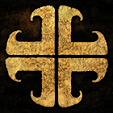
This particular school made the columns of the national newspapers when it recalled three thousand of its own self-printed school diaries. The reason: one postage stamp-sized photo on the front pictured a boy sporting a familiar peace sign on his T-shirt (below). This sign (so the school board reasoned) had associations with the occult and with the [1]‘Cross of Nero’. [2]Emperor Nero, of course, was infamous for his persecution of early Christians. Clearly, the offending diaries had to go.
 |
| The statue of John Calvin in Geneva, Switzerland. Man presumes to know the mind of God, and presumptions become set-in-stone doctrine. |
 |
| A detail of the cover of the destroyed Pieter Zandt school diary. The offending peace sign is just visible on the white T-shirt in the back row. |
And go they did. All three thousand copies of the newly-issued school diary were destroyed. Now, it might be easy to scoff at such over-sensitivity (not to mention the sheer waste of time, resources and €20,000 costs involved), certainly when we consider that, whatever associations the symbol might have had in the past, what it conveys now is a simple message of peace. But censorship through an act of destruction has a way of focusing on who is doing the destroying, and scrutiny turns around to face the scrutinizer.
 |
| For John Calvin, only the Chosen Few would hear the choirs of Heaven. But it was Calvin who decided this. For wiser (and less presumptuous) mortals, the mind of God remains as inscrutable as ever. |
In destroying the diaries, the school board strove to uphold its own faith-based standards. But what are these standards? They are those of Calvinism, that branch of Protestantism promulgated in the 16th-century by Frenchman John Calvin. Calvin was as anti-Catholic as Martin Luther, the founder of Protestantism, but he deviated from the teachings both of Luther and the Papacy in that he advocated a doctrine which he called [3]predestination. The doctrine is simple enough: Christ did not die for all humankind, but only for the Elect – the Chosen Few – who would be saved and ascend to Heaven. All others are damned and will spend eternity separated from God in the unquenchable fires of Hell.
 |
| Hell in the 2005 film Constantine appears as our own world in fiery devastation, with eternally gridlocked freeways and highrises in ruins. Hell can always be found within ourselves, and the human imagination can supply what our direct experience lacks, even to the most terrifying of places. |
Calvin chose the term ‘predestination’ for a reason: all humanity, according to Calvin’s doctrine, was already predestined. Which is to say that before the Fall in Eden, before humankind was even created, God had decided who was going to Heaven and who would roast in the Eternal Fire. Calvinism and its doctrine is therefore a kind of extreme religious fatalism: if God already has you on his blacklist, then you are predestined to burn in Hell. There is no free will, there is no chance to change the outcome, and there is no redemption. Your fate for eternity has already been sealed, with God dispensing a sort of omnipotent tough love with brutal finality.
John Calvin’s deity is therefore a being who treats his own creations with a form of refined fatalistic sadism: this deity already has decided who is going to be tortured for eternity – and then goes ahead and has them tortured anyway. In which case, God moves in ways that are more than just mysterious. If you endorse Calvin’s doctrine, then you additionally accept that he also moves in ways that apparently have an edge of calculated cruelty. The question is: does believing in such a ruthless reward-and-punishment god have an adverse effect upon the human psyche?
 |
| Peace is a fragile thing, subject to the tides of human affairs and differences of faith. |
The school board strove to protect its students from what it perceived as un-Christian symbolism, and its objections to the cover of the diary were specifically to do with the peace symbol’s alleged original association with the persecution and deaths of Christians. Alas for humanity, the accumulated deaths by [4]persecution, [5]slaughter, [6]warfare or acts of [7]genocide in the name of the Christian faith, whether by [8]Catholics, [9]Protestants, or any other Christian [10]denominations, are all too real, and can be reckoned in the millions. These persecutions and deaths by – not of – Christians are documented history, although I rather suspect that the events (and others like them) related in my notes below do not feature prominently in the history lessons of the Pieter Zandt school.
So in the light of the destruction of their school diaries, and the reasons behind that destruction, here is my own history lesson for the pupils of that school: the Christianization of Europe is estimated to have cost some ten million pagan lives – [11]one hundred times more than the number of Christians executed under the Emperor Nero and for three centuries afterwards – remembering that this was before all the various Christian-against-Christian wars, conflicts and persecutions between the different denominations which followed in the centuries that came after.
So in the light of the destruction of their school diaries, and the reasons behind that destruction, here is my own history lesson for the pupils of that school: the Christianization of Europe is estimated to have cost some ten million pagan lives – [11]one hundred times more than the number of Christians executed under the Emperor Nero and for three centuries afterwards – remembering that this was before all the various Christian-against-Christian wars, conflicts and persecutions between the different denominations which followed in the centuries that came after.
Hawkwood
Notes:

 [2] Please see note [5] in my post 666: The Number of the Beast. In Nero's day the term 'Christian' had not yet been coined. There were groups of different beliefs loosely centred around Christ's teachings, no one of which had more or less validity than another.
[3] Calvin also vigorously endorsed the ‘sin and guilt’ teachings of Augustine (please see my post Shame).
[4] Please see my post The New Church. Catholicism emerged as the dominant Christian force by ruthlessly eliminating other beliefs such as the Gnostics, Manichaeans and Paulicians.
[5] In the 8th-century the Christian monarch Charlemagne (left) decreed the death penalty for anyone who refused conversion and baptism. In the year 782, at Verden to the north of Paris, four thousand five hundred pagan Saxons were rounded up and beheaded in a single day, at the end of which Charlemagne retired from the scene of the slaughter and attended Mass. In this single horrific afternoon the Christian monarch had therefore put to death as many pagans as there had been Christians executed during the entire reign of Emperor Nero. But worse was to follow: the following thirty years left two thirds of the entire pagan population dead.
[5] In the 8th-century the Christian monarch Charlemagne (left) decreed the death penalty for anyone who refused conversion and baptism. In the year 782, at Verden to the north of Paris, four thousand five hundred pagan Saxons were rounded up and beheaded in a single day, at the end of which Charlemagne retired from the scene of the slaughter and attended Mass. In this single horrific afternoon the Christian monarch had therefore put to death as many pagans as there had been Christians executed during the entire reign of Emperor Nero. But worse was to follow: the following thirty years left two thirds of the entire pagan population dead.

[6] The death toll in the 17th-century Thirty Years’ War is estimated to have been some seven and a half million lives (source: necrometrics.com, retrieved on September 14, 2013), with Europe being left largely in a state of devastation. The conflict, which literally did last for thirty years, was essentially a religious one, with Catholics fighting to keep the Holy Roman Empire intact, and with Protestants equally determined to break the power of the Papacy. The scene (above) by Henri Motte portrays full-scale religious warfare: wearing the armour of war beneath his cardinal’s scarlet, Cardinal Richelieu surveys the approaching English fleet which supported the Protestant French Hugenot forces at the siege of La Rochelle. The siege took place between 1627 and 1628, and ended in defeat for the Hugenots, although the tide of the war would eventually turn against the Papal forces.
[7] Please see my post A Dark Crusade for an account of actual genocide instigated by the Papacy.

[8] In February of 1658 the entire population of the Netherlands – then some three million people – was sentenced to death for heresy by the Papal Inquisition. The Duke of Alva (right), commanding the occupying Spanish forces, managed to formally execute some eighteen thousand six hundred Dutch citizens over a six year period, although the numbers massacred by his troops added considerably to this total. Again it was a situation of Protestants defying Papal authority, with the Papacy yet again demonstrating that it was prepared to wade through blood to hold onto power. Today Catholicism in the Netherlands is generally confined to regions in the southern provinces adjoining the Belgian border.
[9] Please see my post Martin Luther's Final Solution for a documented account of an act of genocide instigated by Martin Luther.
[9] Please see my post Martin Luther's Final Solution for a documented account of an act of genocide instigated by Martin Luther.

[10] In the 17th-century four Quakers known as the Boston martyrs – three men and a woman (left, Mary Dyer being led to execution) – were hanged in Boston by Puritans for professing other-than Puritan beliefs. The Puritans were a sort of right-wing version of the Calvinists, although it is largely a fallacy that the Puritans sailed for the New World to avoid persecution for their beliefs. The truth is nearer to being that they were so intolerant of the beliefs of others that they sought a land where Puritanism would be the only practicing and tolerated religion. As events showed, they were prepared to kill their fellow Christians to make that happen.
[11] This is based upon a maximum high-end estimate of 100,000 over the first three centuries. The actual number of executions specifically of Christians under Nero is unknown, but might have been between three to five thousand. These would not have been Christians as we would have recognized them, as many would either have been Gnostics, or Apostolic (subscribing to the doctrines of Paul), or adhering more to the traditions of the Hebrew prophets (subscribing to the doctrines of James), or other interpretations of the new faith, which was still thought of by the occupying Roman authorities as having a variety of cult followings.
Sources:
 Deborah J. Shepherd: The Convergence of Paganism and Christianity in Northern Europe: The Conversion and Archaeology. Program for Interdisciplinary Archaeological Studies, 1996, University of Minnesota. Published in PDF by Academia.edu. The transition in Europe from pagan religions to Christianity was neither smooth nor benevolent. At times it was an uneasy collision between two differing world views, with a compromised merging of customs and traditions. At other times, as under Charlemagne, the transition was mandatory, bloody and abrupt. In Britain, Scandinavia and elsewhere many sites of pagan worship were forcibly annexed and destroyed, and churches were built upon their foundations. Our word 'bigot', used to describe someone who is arrogantly intolerant of others, actually comes from 'Bei Gott' ('By God'), used by the Frankish and Germanic pagans to imitate the exclamation of aggressive conversion activity practiced against them by Christian missionaries. This metal 'Hammer of Thor' Viking talisman (right) has been disguised as a Christian cross, allowing its wearer outwardly to acknowledge token allegiance to the new religion while retaining loyalty to still-familiar gods.
Sources:

PLEASE NOTE:
Discussions of these topics which I have had in the past with others have turned with apparent grinding inevitability in the direction of some Christian soul who has been only too keen to point out to me the millions who perished under the rule of Stalin (or some other suitably atheist tyrant from history). But playing the ‘atheists versus believers’ death count numbers game achieves nothing. The whole point is that religion by its nature is supposed to invest a believer with some intrinsic altruism, some basic humanity. History shows that in practice this is not what happens. Subscribing to this or that faith or denomination clearly no more equips someone to behave more tolerantly, more altruistically – or even more morally – than a confirmed atheist. So what end does religion serve?


