Return here to the Shadows in Eden home page.....
Showing posts with label Scientific heresies. Show all posts

Monday, September 19, 2016

Ark Encounter: The Boat Don’t Float

To say that it would have been a rough voyage is an understatement. The weather on our planet owes all of its fluctuating patterns, its calms and its storms, to the variations in barometric pressure which its land masses produce. So what would happen to the Earth’s weather if we were to submerge these great continents, these many islands large and small, and cover the planet with water?

The reality of weather conditions during the Flood. My painting of the Ark Encounter’s ark bravely riding the monster waves is a fantasy. In reality, engineering principles for such an enormous wooden hull dictate that the vessel would inevitably have broken its back before even the first wave struck.
We do not need to speculate, because we can see the results by studying the other planets in our own solar system. Dry Venus and Mars have no surface water, and while both are certainly subject to [1]storms, to find a closer model to weather on our hypothetical water-covered Earth we need to look at such planets as Jupiter and Neptune. With lower cloud levels compressed by atmospheric pressure to a fluid-like [2]turbulence, massive storm systems rage unrelentingly around these planets. Why? Simply because there are no continental land masses to stop them. Once a wind picks up it is free to tear its way around every line of longitude a planet possesses – and with a planet’s rotation as its power source, it does.

Belts of storms rage around Jupiter. Removing Earth’s land masses from the equation to create a flooded world would generate such proportionally powerful and long-lived storms as these, and would have been the dismaying weather forecast for the ark’s seven-month voyage. 
This frightening weather scenario is the factor which seems to be most often overlooked – perhaps at times conveniently – when considering the feasibility of the story of Noah’s Ark. I was drawn back to this topic after learning that the Creation Museum in Kentucky has now opened its Ark Encounter theme park with its full-sized ark to the public. When I first discussed the feasibility of Noah’s Ark in my [3]previous post, plans by the [4]‘Museum’ to build a full-sized ark as a theme park attraction had just been made public. Now the ark is there, as large as life – or at least, as large as the dimensions provided by scripture.

The organizers of the Ark Encounter attraction claim their ark to be the most accurate ‘reconstruction’ ever. So let’s see what sort of description the Book of Genesis provides as a working blueprint. It is, in fact, so brief that I can quote it here in full. In Genesis 6 God instructs Noah as follows: “14: Make thee an ark of gopher wood; rooms shalt thou make in the ark, and shalt pitch it within and without with pitch. 15: And this is the fashion which thou shalt make it of: The length of the ark shall be three hundred cubits, the breadth of it fifty cubits, and the height of it thirty cubits. 16: A window shalt thou make to the ark, and in a cubit shalt thou finish it above; and the door of the ark shalt thou set in the side thereof; with lower, second, and third stories shalt thou make it."

This version of the Ark Encounter’s ark at sea from the creationist website Answers in Genesis promises calm seas and a prosperous voyage. Apart from the fact that the vessel is sitting far too high in the water for the combined weight of its live cargo and the vessel itself, the difference between their version and mine is clearly in the weather conditions. But let’s face it: creationists never were that big on the science.
That’s all there is. Unless I have missed something, there is nothing whatever in this description about the [5]ark being like a boat, or even like a sea-going vessel of any kind. And although precise dimensions are given, the fact is that we simply do not know exactly how long a ‘cubit’ was. It is usually thought of as being the length of the human forearm, but it turns out that different [6]cultures all had their own ‘cubits’, with each one differing from another.

The interior of the Ark Encounter’s ark. Imagine this scene, not well-lit and filled with curious visitors, but rolling and pitching in semi-darkness at sea in storm conditions. The lateral stress on all those massive beams, the combined  cacophony of noise produced by the groaning timbers and the cries of hundreds of frightened animals fouling their cages with fear, and Shem, Ham and Japheth frantically trying to stuff rags into ever-more-serious leaks presents a rather less cosy picture than is suggested here.
And what is ‘gopher wood’? The term is virtually unique to this single verse of scripture – and unknown anywhere else. We are left to speculate. It might have been cedar wood, or cypress, or even reeds. Or it might simply refer to wood which has been treated in some way: either planed smooth or treated with pitch. We simply do not know. So if we cannot exactly calculate its dimensions, and if we do not know the type of wood from which it was constructed, and if we are not even told what form or shape it took… on what basis can we assert that any given reconstruction of the ark is ‘the most accurate’?

This drone view of the ark under construction shows a row of thirty skylight windows per side. That’s fifty-nine more than are specified in scripture. Even for creationists the answers, apparently, are not all in Genesis.
The Genesis description specifies that the ark had one door and one window. But look at the Ark Encounter ark in the scale diagram below. It certainly has one door – but that door has been placed below the waterline. Draw your conclusions. And it certainly does not have ‘one window’. In fact, it has a whole row of skylight windows running almost full length on either side of the roof (or deck, if you’re of a seafaring nature). I have counted thirty windows on each side, making sixty in all. They’re certainly not mentioned in scripture, so where did they all come from?

The two largest historically documented wooden vessels ever built were the U.S.S. Dunderberg, renamed the Rochambeau, and the schooner Wyoming. The Rochambeau saw only brief service before being decommissioned due to constant serious leakage. The Wyoming sank in sheltered waters with the loss of all hands, also due to serious leakage. The Ark Encounter ark shown here is half again as large as these two ill-fated vessels – and the door is below the waterline!
Now consider the Ark Encounter hull shape. The forward-raking bow is clearly modelled, not upon any [7]vessel of the time, but upon the hull of a contemporary cargo ship. Why? And those wooden planks are clearly laid upon some sort of synthetic (insulation?) cladding. Rather than being structural to the vessel, they literally are a mere veneer. You might argue that the ark, which additionally rests upon concrete piles, was never actually intended as a serious Bronze Age reconstruction of a possible vessel. You might indeed, but then you should not make any claims for its ‘accuracy’. Still, creationist claims have time and again proven, both in their [8]‘Museum’ and with the Ark Encounter exhibit, that showmanship is prized above intellectual honesty. For all its size, this particular ark is a mere theme park attraction, and any pretence at Biblical ‘accuracy’ is exactly that: a pretence, and a dishonest one at that.

The Ark Encounter ark under construction. The hull planking is laid over a synthetic cladding. Bronze Age construction methods these are not. And where is the coating of pitch so specifically mentioned in scripture? A black ark, apparently, was deemed to be not such an aesthetic crowd-puller, and even this brief passage in Genesis was cherry-picked in the name of showmanship. 
My previous post on this subject covers in detail exactly why a wooden hull with the proportions of a contemporary steel cargo vessel (that is: the ark’s dimensions as specified in Genesis) would lead to inevitable disaster. To sum things up in a single sentence: the inescapable engineering rule states that the larger a wooden vessel is, the weaker its structural integrity becomes. With its keel of necessity being made from several individual trunks of timber the vessel would break its back under its own weight and the combined weight of its biomass cargo (all those dinosaurs sure won’t help) as soon as it became waterborne. Why are these points important? Because of the other claim about the Ark Encounter ark: as stated on its [9]website, it is claimed to be ‘amazingly seaworthy’.

Dinosaurs in their enclosures on board the Ark Encounter ark. There is much that I could say about this, but I think I’ll just sit on my hands and refer you to my extended ‘caption’ about it here.
There is one relevant factor which I did not mention in my previous post, and that is the dangerous phenomenon known as ‘freewater’. It was [10]freewater which caused the Herald of Free Enterprise tragedy in 1987. It was freewater which caused the sudden sinking of Henry VIII’s flagship Mary Rose in 1545, and which sealed the fate of the newly-launched magnificent Swedish warship Vasa in 1628. Freewater is a shallow layer of water (it need not be deeper than a few inches at most) which can enter through any opening and fatally compromise a vessel’s equilibrium. Wave action will cause an ever more severe side-to-side rocking motion until the vessel inevitably rolls over. The frightening thing about the phenomenon is just how little water in a vessel it takes to cause disaster.

Creationists seem to labour under the delusion that saying something loud enough somehow makes it more true. The irony which seems to escape them is that this billboard’s statement actually is true: you cannot sink a ship which has never been launched in the first place. And apparently they encourage their own siege mentality by branding all who disagree with them as ‘intolerant liberals’. Basically, that means anyone who uses their common-sense, whether they believe that faculty is God-given or not.
I trust the point has been made: it is the very size of the Ark Encounter’s ark (and we’ll assume that it is at least within a reasonable margin of Biblical accuracy) which so counts against it as a credible seaworthy vessel. We tend to equate large size with security and a greater degree of safety, but with a [11]wooden hull the opposite is true. Maybe half the size and the ark just might have been a going concern. But half the size is not Biblical size, and in Biblical literalism scripture has to be adhered to, even if that means that all credibility is jettisoned. Great size, then, does not equal greater safety and stability. In fact, it fatally compromises both if the vessel is made, not of steel, but of wood.

And what of those huge storm systems that would have swept around the planet during the Biblical Flood? They would have created an unrelenting series of perfect storms through which the Ark would have had to struggle, and my painting of the Ark Encounter ark battling monster waves which heads this post is anything but overdramatised. And with the weight of immutable engineering principles to back me up, and with professional experience in the field of marine archaeology, I figure I’d be just as likely to survive in a rusty bathtub.
Hawkwood


Notes:
[1] In the case of these waterless planets, it is principally the variations in land contours which provide the weather. Any planet with an atmosphere will generate weather of some description.

[2] That is: the compressed lower atmospheric levels of these gas planets become analogous to a water-covered planet.

[3] Please see my post: The Lost Ark of Noah.

[4] As I always relish pointing out: in an apparent attempt to imbue their institution with an aura of respectability, the very Christian creationists have named their building after a pagan temple. The original Museum was actually the temple of the Muse in Ancient Greece.

[5] The translated word ‘ark’ in the original Hebrew text is ‘tebah’, which implies any sort of protective container whose contents are precious. Thus: the Ark of the Covenant. The basket in which the baby Moses was found is also referred to as a ‘tebah’.

[6] The Biblical cubit is generally thought to have been almost 46 centimetres or around 18 inches, but clearly the greater the distance measured, the wider the margin of error becomes – and over the length of the Ark that is clearly considerable.

[7] The only vessels of the time which had such a water-cleaving prow were modestly-sized Bronze Age Greek ships. Such a hull design did not reappear on ships until comparatively late in the modern era.

A side-by-side comparison between these three hulls clearly shows the influence upon the Ark Encounter’s ark of modern supertanker design. There is no mention whatever in scripture of such a forward-raking prow for the ark, or even that the vessel was boat-shaped as such, so where did these ideas come from?
[8] Please see my post: How do Creationists know what Dinosaurs looked like? for a particularly dubious  example of creationist hypocrisy.

[9] Ark Encounter. Bring a life vest.

[10] In the tragic case of the Herald, the loading ramp of the car ferry apparently had not been fully closed before the ferry cast off, and the vessel sank in calm weather within sight of the harbour which it had just left. With the Mary Rose and the Vasa, water appears to have entered through the open lower gun ports, although the Vasa already was a flawed top-heavy design. In all cases, witnesses report the shocking speed at which such a freewater-endangered vessel will roll over and sink – literally within minutes.

[11] What makes the ark so vulnerable? To clarify this point for any reader who is still wondering (or who might doubt what I say here!): steel can be welded to itself. Once a weld is made, two sheets of steel effectively become one large sheet, and so on over a whole hull. Wood is wood, and the size of the continuity of construction is limited by the plank or beam from the original tree. You cannot weld wood to itself. You can only join it using carpenter's joinery methods.

Rolling and pitching: So the larger the wooden hull, the more such joints it will contain. Every single joint represents a potential stress point which at sea is subject to wave action, and this action comes from multiple directions: both from the roll (side-to-side rocking) movement of lateral wave action, and from the pitch (up-and-down) bow to stern movement when the vessel is directly facing a wave. In rough weather these forces come from various directions at once, placing each and every joint under greater stress.

Why more joints equals greater risk: In heavy or even moderate seas most of the joints in the whole vessel will be subject to the added stress of water pressure from the sea itself, and every joint, no matter how perfectly-fitted it might be to its adjoining beam or plank, will move, and leakage is inevitable. The larger the hull size the more this factor is multiplied. For the ark, the factor is not so much how large it is overall, but how many joints its many timbers contain. So the engineering formula is:

The larger the wooden hull, the more joints there are, and the more joints there are the weaker and more vulnerable the overall structure becomes in waterborne conditions.

What is broaching? The ark has no steering means whatever. It would be completely at the mercy of the prevailing wind direction, and an unsteerable vessel is subject to a phenomenon known as 'broaching'. That is: it will tend to turn beam-on (side-on) to the weather. This means that the waves will be hitting it from the side - and with the hull proportions of the ark, that really matters. The longer a hull is, and the more narrow in the beam (width), the more vulnerable it becomes to a rollover in a broaching situation. Far from being the ideal proportions for seaworthiness claimed for it by the Ark Encounter exhibit, the ark's supertanker proportions combined with its wooden construction would have sealed its fate in even moderate seas.

Tuesday, February 9, 2016

Rise of the Nephilim

“The Nephilim were on the earth in those days, and also afterward, when the sons of God came into the daughters of men, and they bore children to them. These were the mighty men that were of old, the men of renown.” These two brief sentences from the Book of [1]Genesis tantalize us. They suggest so much more than they tell, and we want to know more. Who were these mysterious Nephilim? And who were the ‘sons of God’ who sired them? The words hint at a powerful story, but the story does not continue further. It is as if we are in the middle of reading an exciting book – only to discover that the next several pages have been torn out. And in a sense, they have been.

One of the most intriguing names in scripture, the Nephilim have given rise to a whole body of speculative literature. They were giants. They were fallen angels. They were extra-terrestrials who visited our ancient Earth. Whatever their true nature, the devastation which these beings wrought seems to have been real enough.
Before the Bible became the book as we now know it, there were many such texts in circulation, each one with its own story to tell. One of these texts was the [2]Book of Enoch, the prophet who, we are told, was the seventh generation from Adam and the great-grandfather of Noah. As with other books bearing the names of the prophets of old, this does not mean that Enoch actually wrote the text, any more than Isaiah, Jeremiah, Ezekiel and Daniel wrote the books which bear their names. In writing these texts at times in the first person (‘I was lifted up to heaven’, ‘then the angel answered me,’ etc.) the unknown authors of these texts were using a literary device which gave their texts both conviction and authority.

The prophet Enoch, said to have been the seventh generation from Adam. The parts of the Book of Genesis which mysteriously omit major narrative developments can be resolved by reading Enoch, even though the Book of Enoch appears nowhere in scripture.
This does not mean that these texts are less ‘authentic’ because we do not know who wrote them: we still can read them as accomplished pieces of ancient literature. And this is how we may regard the Book of Enoch. The mere fact that Enoch was presumed to have lived before the Flood, and therefore was describing events which happened prior to creation’s destruction, is enough to tell us that such events are fiction. But even fiction can contain elements of folktales and memories of events passed down through the generations as oral tradition before being committed to writing. So why does the Book of Enoch appear [3]nowhere in the Bible? It contains a truly visionary account of Enoch’s celestial journey to the heavenly realms at least as stirring as anything in Ezekiel, that other book of visions. And it significantly contains many details and even whole narratives that otherwise are [4]missing from Genesis. One of these is the complete story of those mysterious Nephilim.

The remarkable and vivid description of Enoch’s journey to the celestial realms is at least as stirring as anything comparable which we can read in the text of Ezekiel. And yet one is omitted from scripture while the other is not, and we are left to ponder the seemingly arbitrary nature of the reasons either for accepting or rejecting a particular text for inclusion in the canon.
His name, the writer of Enoch tells us, was Samyaza: one of the hosts of heaven. From on high Samyaza gazed down upon the earth, and his eye fell upon the comely ‘daughters of men’. Driven by a distinctly un-angelic lust, this rebel angel laid his plans. Samyaza got together a coalition of the willing: two hundred angels known as the Watchers, the ‘sons of God’ in Genesis, who swore a terrible oath of allegiance before descending through the heavenly realms to determine just how easy Earth girls were. By the time the company arrived on our planet they had acquired bodies of flesh and blood. And flesh and blood were what they were after.

Samyaza, the leader of the two hundred fallen angels described in Enoch as the Watchers, and in Genesis as the sons of God. The fact that Samyaza shares certain characteristics and story elements with Satan suggests that this particular fallen angel might have been an early version of the Prince of Darkness himself. 
But the Watchers were prepared to give as well as to take. One of their number, Azazyel, taught men the dubious arts of weaponry and warfare, and he showed women how they could enhance their beauty with trinkets, jewellery and makeup. The world became a place of lost innocence, of desecration, of suffering. And the half-angel offspring of the Watchers born to Earthly women, the Nephilim, proved to have insatiable appetites, gorging their way through every living thing: the beasts of the field, the birds of the air, crawling reptiles, and the fish that swam in the waters. But then the humans around them also went onto the menu. Enough was enough.

The nightmare visions of Hieronymus Bosch, with their desolate landscapes peopled by grotesque hybrid creatures and other monstrosities, powerfully suggest the world desecrated by the Watchers and their terrible offspring the Nephilim as described in the text of the Book of Enoch – which itself could have influenced such scenes in the Book of Revelation.
The cries of despair coming from the human world were heard in heaven. The five [5]archangels - Gabriel, Michael, Raphael, Suryal and Uriel – descended to join battle with the wayward fallen angels. Raphael bound the troublemaking Azazyel fast, Gabriel incited the Nephilim to an act of terrible mutual slaughter, and [6]Michael bound Samyaza deep beneath the earth, where he shall remain until the End of Days before being thrown into the bottomless Pit of Fire.

It certainly makes for a tremendous story: an epic clash of forces classically portrayed as good pitted against evil, with our own Earth as the battleground. But is this primal battle the stuff of folk culture which simply belongs with other such texts and mythologies? Or is it something more? Supposing that these fallen angels were indeed more than just a story? Supposing that these beings really walked among us in those ancient times? If this was so, and if the Watchers and the Nephilim really existed, then who were they?

These two female figurines are from the pre-Sumerian Ubaid culture, and date from between 4,000 to 5,000 BCE. Archaeology cannot explain the strange reptilian faces, which are characteristic of all such Ubaid figurines, other than to comment that they cannot be masks: even the nursing infant has the same distinctly non-human face. Do these figurines suggest genetic deformities of some kind, or perhaps mysteriously hint at some distant truth to the story of the Nephilim?
Were the Watchers in reality perhaps all-too-Earthly visitors from a then-less familiar [7]geographical region, strangers come from a strange land? Or were they even extra-terrestrials visiting our planet to throw a few alien genes into the human mix, as has been speculated on the wilder shores of probability by some [8]credulity-stretching theorists? As with other such stories, it gets down to what we personally choose to believe. But the brief reason given in Genesis for the cause of the Flood – the ‘wickedness of men’ – seems way too vague and generic to be a justifiable reason for wiping out the whole of creation – with the exception, of course, of Noah and the contents of the Ark. As if things are any different now.

This 19th-century depiction of the Deluge by Gustave Doré manages to include every element of the drama. Even the very waves reach up like wrathful fingers to snatch the despairing figures from the last rock where they have taken refuge. We can read the story of the Flood in Genesis (which itself is borrowed from Mesopotamian sources), but it is in Enoch that we learn of the true reasons for the destruction of God’s creation. 
Again, it is not Genesis but the text of Enoch which suggests the true reason for the cause of the Deluge. The frightful Nephilim were half-fallen angel, half-human. They were malicious hybrids whose ruthless appetites consumed and despoiled everything around them. Nephilim greed had laid waste to the earth, and the lust of the Watchers had defiled the purity of human genetics. Creation had become tainted. Creation must begin anew.

We do not need to resort to conspiracy theories featuring interbreeding aliens to see the uncomfortable parallel with our own times. It is we, with our insatiable corporate-greed appetite for consuming all the natural products of our world and despoiling the very environment on which we depend, who are behaving like the Nephilim. Twenty-three centuries after it was first written, the Book of Enoch, and the vivid story of the Nephilim which it contains, carries an urgent and startlingly topical warning for us all. We have encountered the new Nephilim, and they are us.
Hawkwood       


Notes:
[1] This quote from Genesis 6:4 is from the Revised Standard Version. The King James Version offers a different nomenclature: “There were giants in the earth in those days; and also after that, when the sons of God came in unto the daughters of men, and they bare children to them, the same became mighty men which were of old, men of renown.” This comparison raises the gnarly question of translation, and what the term ‘Nephilim’ might actually mean. ‘Nephilim’ and ‘giants’ are not necessarily interchangeable terms, with the original Hebrew suggesting the term might mean ‘fallen ones’, although there is no scholastic consensus on this.


In 2004 Worth1000, a website which hosts contests for digital artists, created a competition on the theme of 'Archaeological Anomalies'. An artist with the web identity IronKite Photoshopped a clever image which went on to lead a life of its own. The image (above) subsequently appeared (with its source uncredited) on various pro-scriptural conspiracy theory websites and in videos, claiming to be ‘proof’ that the ‘giants’ of Genesis 6:4 had been discovered: not the first time that hoaxed claims have attempted to ‘prove’ the truth of scripture with misrepresentation. Please see note [2] of my post A Simple Misunderstanding for another such example.

[2] The Book of Enoch is actually five different texts taken together. There are enough stylistic differences between these five texts to regard them as being by different authors at different times.

[3] The question of the Book of Enoch’s non-canonical status is complex, and provides a good example of just how arbitrary is the choice of texts which make up the scriptural canon. Various denominations or branches either of the Christian church, the Coptic church, or the Jewish community either partially include it or omit it, and for equally various reasons. One reason for its omission – the objection to angels having corporeal bodies – hardly holds up when we remember that the two angels (left, with Lot, by James Tissot) who entered the city of Sodom also had material bodies. Please see my post Lot and his Daughters: The Inside Story.


[4] It is in Enoch that we find a more detailed description of the fruit of the tree in Eden than is provided in Genesis. Please see my post Forbidden Fruit.

[5] The substance of my post is taken from the Richard Laurence translation of the Book of Enoch. The names of the five Archangels and the Watchers are taken from this translation.

[6] That the story tells us that it was Michael who bound Samyaza, and Samyaza’s own rebellious and troublemaking nature, suggests that Samyaza was an early archetype who later would evolve into Satan. The Book of Revelation was very nearly dropped from the canon because of its obvious resemblance to this passage in the text of Enoch, from which it presumably was derived.

[7] The case for the Watchers actually being humans from a different geographical region is cogently argued by Andrew Collins in his book From the Ashes of Angels. Collins mentions that early Judaic literature assigns specific physical characteristics to the Watchers as being extremely tall with white skin, hair ‘white as wool’, ruddy complexions, piercing eyes and serpent-like faces.

[8] The books of Zechariah Sitchin, particularly his first book The 12th Planet, claim an extra-terrestrial involvement in human affairs. Sitchin equated his extra-terrestrials, whom he called the Anunnaki, with the Nephilim, and postulated that they come from a planet as yet unknown in our own solar system which he called Nibiru (right), orbiting in a distant pronounced elliptical orbit around the sun. Weirdly enough, as recently as January 2016 a team of scientists suggested that an unknown giant planet might indeed exist in such an orbit, and which planet’s existence could account for gravitational anomalies observed in outer solar system bodies. That article may be read here.


Sources:
Elizabeth Clare Prophet: Fallen Angels and the Origins of Evil: Why Church Fathers suppressed the Book of Enoch and its startling revelations. Summit University Press, 2000. This title contains the complete Richard Laurence translation of the Book of Enoch, as well as a concordance citing references to Enoch in other texts, both canonical and ex-canonical.

Andrew Collins: From the Ashes of Angels: the Forbidden Legacy of a Fallen Race. Michael Joseph Ltd, 1996.

Zechariah Sitchin: The 12th Planet. Stein and Day, 1976. I am aware that Sitchin has a huge fan base out there, but it must be said that his theories contain fundamental inaccuracies both astronomical (to do with his calculations for the orbit of his hypothetical planet Nibiru) and cultural (to do with his misrepresentation of Mesopotamian mythology and texts). 

Sunday, January 3, 2016

Why I Write This Blog

When in the 16th-century the philosopher Giordano Bruno suggested that space is infinite, and that each star is a sun like our own with its own worlds circling around it, these shocking speculations were added to the charges of heresy which the Church brought against him. To obliterate these outrageous heresies from the world Bruno was [1]incarcerated by the Inquisition and periodically tortured for eight years before being burned at the stake in Rome, after which his ashes were swept up and dumped in the Tiber. But ideas endure, and heresies have a way of casting shadows of doubt across the comfortable worlds which we create for ourselves. This weblog is about those shadows.

The bronze statue of Giordano Bruno which stands close to the site of his execution in Rome. An enlightened free thinker centuries ahead of his time, Bruno’s daring ideas have long been vindicated by our own contemporary science. But as recently as 2000 the Papal office refused to sign an edict that would have pardoned Bruno, considering his ideas ‘too extreme to be forgiven by the Church’. The charges against Bruno stand to this day.
But this begs the question: what are heresies? In the 13th-century Pope Clement III branded the Christian Cathars in the south of France as ‘the enemies of Christ’, and their beliefs as ‘heretical’. But the firestorm of violence which he then unleashed against the [2]Cathars, and the mass genocides, burnings and tortures which resulted in the virtual extinction of the Cathars and their beliefs not only had nothing whatever to do with the teachings of Christ, they were the antithesis of all which those Christian teachings stood for. It was the pacifist Cathars who in their turn – and with every justification – regarded the papal forces as the agents of Satan, and the Catholic version of Christianity as an extreme heresy.

A Cathar defends his beliefs before a tribunal of Catholic Inquisitors. Instigated by the papacy and organized by the Dominican brotherhood, the Inquisition invested itself with Draconian powers which even included exhuming and putting on trial the corpses of the deceased: a legal ploy which allowed the Papal authorities to seize the property of the surviving next of kin.
The lesson of history is clear: whether you regard any given belief as ‘heretical’ or not is simply down to which side you are on. And if you have the power base and the organization to push through your opinions by force, then it is your beliefs that get to be called the ‘correct’ ones. But supposing that things in 13th-century France had been allowed to take their natural course, and the growing popular wave of Catharism outstripped the existing Catholicism? We now might well be referring to Catholicism as the great heresy, and Catholics would find themselves on the fringe as a minority belief – if they still existed at all.

This is not as fanciful as it might sound. Contemporary scholarship now considers that it is possible, even plausible, that the original form of Christianity had more in common with Gnosticism, the predecessor of Catharism, than that it resembled anything which we now have come to recognize as ‘Christian’. That the Gnostics and their beliefs, like the Cathars a millennium later, were crushed by the forces of Catholicism is the contributing reason which led eventually to the establishing of the Holy Roman Empire and the complete dominance of the version of Christianity that it represented. And it is a matter of history that this dominance was accomplished, not by the peaceable winning of hearts and minds, but by waves of persecutions, the [3]machineries of terror, and a force of arms.

A woman accused of heresy is ‘put to the question’ – an Inquisitor’s euphemism for torture – using the cauda. Enough weights attached to the feet, or even a short drop, would have dislocated both of the victim’s shoulders. Note the crucifix on the table. My own belief says that anyone, anywhere, at any time who causes suffering or even death in the name of Christ is himself crucifying Christ anew.
So what also drives this blog is a sense of injustice about what has taken place in the past which led to Christianity as we now recognize it. Christianity might have become the dominant world religion, but which Christianity is the correct one? It is a religion which has become deeply divided against itself into some 38,000 different and distinct versions which we call denominations. There are differences of opinion about points of doctrine (the exact nature of the Holy Trinity and the form of Holy Communion, to name but two) which run so deep that the members of one denomination probably would not even worship in the church of another denomination. Could this very un-Christian divisiveness be itself a sign that the version which became the dominant one was not actually the correct one to begin with? For if it was the correct version of Christianity, why has it caused such deep rifts of faith? Would not all Christians simply now be Catholic?

In open defiance of Papal authority, Martin Luther famously nails his 95 theses to the door of the church in [4]Wittenburg, so beginning the Protestant Reformation. What is less well-known but equally a part of recorded history is that the founder of Protestantism was himself radically anti-Semitic, urging the forced expulsion of all Jews from Germany, and additionally advocating the genocide of the working classes. The ruling class took him at his word and 100,000 of his fellow-countrymen were slain.
Just about any post on this blog would have seen me marched to the stake (and also first incarcerated and tortured) even as recently as the 18th-century. But this blog exists, and that in itself is demonstration enough of the way in which the tide of history has turned. Political and civic power has slipped from the Church’s grasp. Contemporary scholarship and opinions are now freely accessible, both on the Internet and through any number of publications – including the complete translations in English of the Gnostic texts, suppressed by the Church for sixteen long centuries until their independent discovery at Nag Hammadi in Egypt in 1945. We at last can listen to the Gnostics in their own authentic voices. Those voices are now once more abroad in the world, and this particular genie is not going back in the bottle.

The first two pages of the Gospel of Thomas: one of only two copies known. All other copies were believed to have been destroyed in the purges ordered by Athanasius, the bishop of Alexandria. The text is a series of sayings by Jesus in the form of ‘wisdom teachings’. Thomas is not a name, but a term meaning ‘The Twin’, which could imply that this author sought to be the perfect mirror or reflection of these teachings.
When these subjects have come up in conversation, it has frequently taken me aback just how little Christians seem to know about the background of their own faith. This is a belief and a code of ethics which for many governs their very lives, and yet how many actually know the nuts and bolts of how the Bible came into being historically, and the different processes and individuals who were involved in its at-times alarmingly arbitrary shaping? There seems to be a general acceptance that ‘things are as they are’, and that the early Church Fathers who did the shaping ‘must have known best’.

Whether Irenaeus, Athanasius, Tertullian, Augustine and others who shaped the Bible and Christian doctrine to its present form really did ‘know best’ is a question for debate. The point is to know about what they actually did, and what their motives and personal agendas were for making the choices which they made. And not just the [5]tidy versions which can be read on any number of Christian websites, but the hands-on history of the way things happened.

‘Saint’ Irenaeus. The self-styled arbiter of ‘The Truth’, his writings contain tirades of toxic invective against all things which he personally considered to be heretical. But his methods for deciding what should or should not become scripture were startlingly vague.
Thus, of all the many gospels then in circulation, Irenaeus in the 2nd-century kept only four of his own personal choosing to [6]include in scripture. Why four? Because, as he informs us himself, there are "four zones in the world and four principal winds.” Yes, that really was this man’s sketchy logic behind his decision: a decision that would affect the whole subsequent development of Christianity. Who decided that he had the necessary authority to take such far-reaching action? He did.

But heresies come in different forms, of which religious heresies are but one. There also are social heresies, such as the fact that in the tough-guy society of Ancient Sparta homosexuality was not merely encouraged: it was [7]mandatory. And there also are scientific heresies. These can go either way. It flies in the face of both science and common sense to believe that Tyrannosaurus rex, the most awesome carnivore known, was on board Noah’s Ark and ate coconuts. And yet this is an on-the-record statement by the Creationist CEO of the [8]Creation Museum in Kentucky. But other forms of scientific heresies are more challenging. Science might deny the existence of [9]ley lines, even though they can be plotted on any good map with an ordinary pencil and rule. And conventional archaeology will insist that the [10]Great Pyramid of Egypt was built as a pharaoh’s tomb, even though no evidence whatever has been found to confirm this. So these heresies as well have their place on this blog.

Two principal European ley lines intersect at Avebury: a major Megalithic sacred site which existed long before any church was built, and which still exists today. Numerous other sites not shown here are also found along these leys. It was a common practice to build churches upon the foundations of the pagan sites which the new faith destroyed. The Christianization of Europe was not a peaceable process, but cost hundreds of thousands of the lives of pagans who, like the Cathars and the Gnostics, refused forced conversion and died as martyrs for their faith.
It is a big deal for me that others can rely on the accuracy of the material which I present here. I take time to get things right, which also is why I list my sources for each post where that is appropriate: the option is there for readers independently to check things for themselves should they wish to. And when discussing actual passages of scripture I will cite chapter and verse for the same reason. To be frank, the Bible does at times say some very weird, contradictory and shocking things. If I myself find it hard to believe that those things are actually there in scripture (and they are), then I assume that others might want to check for themselves for that very reason.

This timeline graphic created for my post about [11]Jesus in India seemed to be the most effective way of underscoring in visual form just how little we know about the life of Jesus. The period from his early teens until the last two years of his life is a complete unknown. This certainly invites speculation, and what I discovered is that to make a journey along the Silk Road from Galilee to the mountains of the Hindu Kush was for him not just possible, but entirely plausible.
As readers will have noticed, I also create a lot of the artwork, maps and other graphics for my posts. It all takes time, and if at times my posts do not appear as regularly as I would wish, it is simply due to the pressures of other work which needs my attention.

So the Shadows in Eden blog sets out to be a serious investigation into why we believe what we believe, who gets to decide what is ‘correct’ for us to believe, and ultimately, what ‘faith’ actually is. It is a journey which I myself am on in the hope of discovering some answers to what for me are some very fundamental questions, and I am delighted and gratified that so many are coming on that journey with me. Many, many thanks to you, my reader, whatever faith or non-belief, spirituality or interest in these subjects you might hold. 
Hawkwood


A NOTE ABOUT COMMENTS: I review every comment before I publish it, and not all comments see the light of day. One common reason for this is that the comment in question simply has nothing specifically to do with the topic of the post on which it has been left. Sometimes such general comments can be useful, but not always. And while I am prepared to make exceptions, a comment which is simply a [12]link to someone else’s blog or website will probably not be published either. Nevertheless, comments are welcome, particularly those comments which are a constructive response to what any given post is about. And anyone is certainly free to disagree with what I have said, because that can create a meaningful exchange of different points of view.


Notes:
[1] Please see my post Giordano Bruno's Infinite Space.

[2] Please see my post A Dark Crusade.

[3] Run by the Dominican brotherhood, the Inquisition was initially established as a temporary Church institution to eliminate the last of the Cathars once the military campaigns against them had ended. Instead, it lasted in various forms into the 18th-century, encouraging a social climate of paranoia through informing, even against members of one’s own family, incarceration and torture of both men, women and children, and death by being burned alive. Once sentence was passed, the condemned were handed over to the civic authorities for execution to ensure that Church records remained untainted by the blood of its victims.

[4] Please see my post Martin Luther's Final Solution.


[5] To name but one example, the online Catholic Encyclopedia manages to write an entire entry extolling the virtues of 'Saint' Helena (right, by Francesco Morandini), the mother of Emperor Constantine, without once mentioning the fact that she instigated the brutal murder of her daughter-in-law Fausta so that she could take Fausta's place at her son's side and become his consort in all but name. These dark Freudian deeds the Encyclopedia apparently saw fit to quietly brush under the carpet. Please see my post Helena and the True Cross, which also covers the bizarre Middle Ages trade in 'holy relics', which appears to have been prompted by Helena's recovery in Jerusalem of the 'True Cross'.

[6] Please see my post The Gospel According to Somebody.

[7] Please see my post Coming of Age in Sparta.


[10] Please see my post A Night Inside the Great Pyramid.

[11] Please see my post Jesus in India.

[12] Although the link will still be published in a copy/paste form, Blogger does not in any case allow live links in post comments.


Sources:
The sources referenced to write this post can be found in the listed sources on the above posts, with some additional material being drawn from the sources listed on other posts on this blog. The painting of the Cathar before the tribunal is by Jean-Paul Laurens, the painting of the use of the cauda is by Nicolay Bessonov, and the painting of Martin Luther in Wittenburg is by Ferdinand Pauwels.  

Monday, June 30, 2014

How do Creationists know what Dinosaurs looked like?

While watching a video of the Creation Museum in Kentucky, with its impressively-detailed animatronic full-scale dinosaur models, I was struck by the thought: how do creationists know what dinosaurs looked like? I mean: there are these moving, snarling model dinosaurs in an institution which has elevated pseudoscience to the dubious level of a theme park attraction, and whose staff (at least, in the various interviews in which I have seen them appear) give every indication of holding a testy disdain for career scientists and the scientific method. So how do creationists know what dinosaurs looked like?

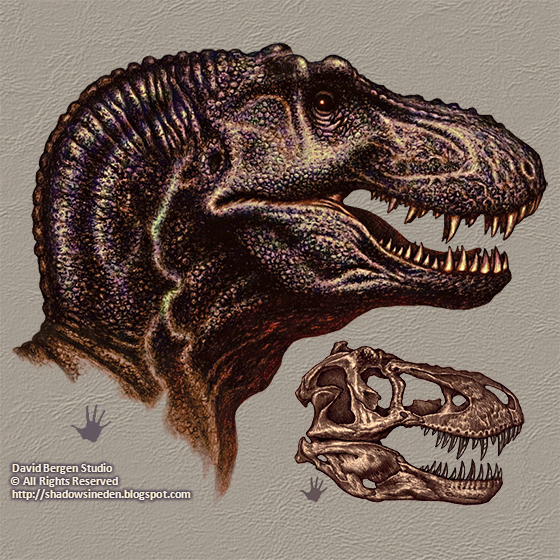
The head of Tyrannosaurus rex. My life reconstruction has to conform to the underlying bone - including the protuberances above the eyes known as rugosities. Experiments with a reconstructed jaw have determined that a T. rex bite generated a staggering 2,900 pounds of force per side: the most powerful bite known of any animal ever. An on-the-record statement by Kenneth Ham, CEO of the Creation Museum, declares that T. rex was on board Noah's Ark and ate coconuts. No, I'm not making this up.
Time on a museum field trip is a precious commodity. It has to be exploited to the maximum, and working hours need to be methodical and calculated. I recall on one field trip getting up at five in the morning, every morning. And weekends simply passed unnoticed. A field trip can by turns be fun, exciting, and tedious – but it is still hard work. How many excursions into the field did it take, over succeeding decades of time, and spanning many, many individual careers, for paleontologists to reconstruct the dinosaurs’ world?

A territorial dispute: pathologies on fossil bones in the form of bite marks suggest that T. rex probably fought its own kind, perhaps over prey or - as I have portrayed here - over territory. Sculpting and photographing a tabletop model was for me the most effective way to bring this scene to life. A dry riverbed served as an arena for the conflict, with typically Cretaceous redwoods and sabal palms in the background, and with the giant pterosaur Quetzalcoatlus cruising through the skies overhead.
And where did those scientists go to? From the Montana Badlands to arid Outer Mongolia, from Patagonia to Alaska’s North Slope, the destinations of such field trips usually demand lobbying for the necessary funding, and in the cases involving some far-flung destination, as often as not some deft and time-consuming bureaucratic navigation through a wild water stretch of red tape in the acquiring of visas, permits, and other assorted documents.

Using a line grid to map a fossil site at the Bay of Fundy.
Safely back on base, the conservation work begins: the painstaking release from its matrix, with small hand-held power drill and sable brush, of some fragile fossil, perhaps over a series of weeks or even months, and the publishing of any findings, as well as the report to the board of the museum in question to justify the funds which have been sunk into both the field work and the subsequent in-museum research and restoration time. More often than not, a fossil will not be found in any great degree of articulation: it usually will be both disjointed and incomplete, or even scattered over a wide area. Maybe the skull is missing – or conversely, maybe the skull is the only part found.

Freeing a fossil from its rock matrix.
So what would the missing parts have looked like? And what does the surrounding fossil environment tell us about the fossil itself? Was it buried in a flash flood, or by a collapsed sand dune? Was it a victim of predation, or was it a predator fallen victim to another of its species? What might the fossil bones tell us about that individual dinosaur’s pathologies – its injuries and diseases – which it suffered in life?

Give this fossil site map to a creationist, and tell them to restore the dinosaurs visible here, using only this map for reference. Click on the map to appreciate the scale of the task.
These are just several of the many questions facing a paleontologist when confronting a jumbled scattering of disarticulated fossil bones in a field location. And that scattering of bones might be from one individual or from several – and even then they might not be of the same species. Only later will someone like myself be brought in to flesh out the painstakingly restored bones as a life reconstruction, always recognizing that there are lines between applied knowledge, reasonable assumption, and artistic licence.

The Early Jurassic predator Dilophosaurus. My reconstruction combines the 'applied knowledge' of muscle attachment points on the bones, the 'reasonable assumption' of the animal's stance derived from the articulated restored skeleton, and my own 'artistic licence' in devising the skin patterns - which are themselves calculated reasonable assumptions based upon the creatures of our extant natural world. 
Applied knowledge would include such factors as the attachment points of muscles, which usually can be seen on bone as areas of rough pitted striations. Reasonable assumption could be the stance in which the animal is shown, which can be enhanced by the applied knowledge of the way in which the skeleton would have been articulated in life. And artistic licence would typically involve skin colour and patterns, which generally are speculative. But always when creating such a life reconstruction, I am aware of the untold research time of career scientists, both in the field and in the museum, behind what I am doing.

Dilophosaurus had a rather weak joint on its upper jaw, and its double crest was surprisingly fragile - hardly suitable for a pitched struggle with a large prey animal. Its long narrow teeth, however, would have been ideal for grasping a struggling fish: all factors which allowed me to portray it as, silent and intent, it fished for its breakfast in the early morning mists in southwest North America some two hundred million years ago.
So how do creationists know what dinosaurs looked like? They do not commit their time and [1]resources to the rigors of museum field work. They do not spend their working lives painstakingly piecing together the herculean puzzles of fossil bones tackled by professional paleontologists. There is only one answer possible: they have come by this knowledge by cynically climbing over the backs of the very scientists whom they so openly despise. And the reason why creationists are able to include in their [2]institution those [3]crowd-pulling animatronic dinosaurs is because career scientists of all [4]persuasions, philosophies and beliefs, but all of whom endorse evolutionary theory and geological time, have committed their working lives both to finding and restoring those jumbled scatterings of fossil bones.
Hawkwood


Notes:
[1] Please don't mention the name 'Buddy Davis' to me. A scientist might play country music, but a country music singer does not a scientist make. Mr. Davis also considers himself to be a reconstructional artist of things dinosaurean. Looking at his work is a chilling reminder of what can happen when reconstructional art is unsupervised by qualified professionals. All of my own work in this direction has been produced on a professional basis with consultant scientists, which therefore includes my above paintings. So... the Creation Museum organizes a 'field trip' to dinosaur country in Montana led by... Mr. Davis? Oh, spare me...

[2] It is a rich irony that, in an apparent attempt to give their institution a veneer of respectability, creationists have opted for the term 'museum'. As this word derives from the original temple of the Muse in Ancient Greece, these overtly Christian fundamentalists have named their building after a pagan temple. Time, I think, for a facepalm.

[3] These days the Creation Museum is, apparently, not so crowd-pulling. Presumably now that the initial novelty value has faded, public attendance figures for the 'museum' have been in decline.

[4] A creationist website I recently visited ('Answers in Genesis') describes all scientists who are not creationists as 'secular scientists'. This is insular fundamentalist absurdism. The scientists with whom I have worked over the years, all of them hard-working men and women, have been all shades of belief, from good Christian souls to sincere and decent-minded atheists. I have even worked on reconstructional art with a paleontologist (now retired) who held committed, serious and respectable pagan beliefs. The self-serving phrase which creationists like to use for their own kind - 'creationist scientists' - is an oxymoron (perhaps with the emphasis on the last five letters). Unless someone follows the scientific method of getting down and dirty in the field, making a career of tedious but necessary lab work, and writing papers to submit to accredited peer review journals, then it is not science, and one cannot with any justification call oneself a scientist.


Sources:
Top and second images: Original artwork painted by Hawkwood for the © David Bergen Studio, All Rights Reserved. Third image: Earthquake Dinosaurs. Fourth image: Australian Geographic. Fifth image: Barnum-Brown Howe Quarry dinosaur bones map from Wikimedia Commons. Sixth and last images: Original artwork painted by Hawkwood for the © David Bergen Studio, All Rights Reserved.

Gregory M. Erickson: Breathing Life into Tyrannosaurus rex. Scientific American, vol. 281, #3 (The article detailing the calculations of the bite force of T. rex. These calculations are, as Dr. Erickson points out, a 'conservative' estimate.).

Footnote added July 6, 2014: While cruising the radio dial yesterday, my wife tells me that she happened to hear a broadcast from the Dutch EO (Evangelische Omroep: Evangelical Network) channel which confidently announced the 'fact' that dinosaurs only became carnivorous once they had left the Ark, the apparent 'proof' for this being that no fleshy remains had been found between their teeth. I mention this here because it provides a neat example of the way in which evangelical creationists are forced to paint themselves into ever more ludicrous corners of reasoning.

A fossil T. rex tooth. The massive root is two-thirds of the total length, and there are rows of serrations on the anterior (leading) and posterior edges that would have trapped and shredded fibrous filaments of flesh. With the bite force behind it, this tooth would have sliced straight through bone.
The teeth of a carnivore: For those in touch with reality, the issue of Scientific American referenced above also contains an article (above) by William L. Abler (The Teeth of the Tyrannosaurs) which throws some rather more sane light on this issue. Dr. Abler has reasoned by experiment that traces of shredded flesh could have become trapped between the tooth's serrations, where they would have rotted, making the bite from a T. rex septic for its victims (and presumably also giving this most awesome of carnivores an extreme case of bad breath). There also are various existing fossils of the herbivore Edmontosaurus which show clear pathologies of wounds in the form of scars and bite marks which match those of T. rex teeth. To forestall counter-claims: no, these pathologies are not from dinosaurs which had already left the Ark. You either claim that all dinosaurs were herbivores or you don't. But you cannot have it both ways.