
Return here to the Shadows in Eden home page.....
Showing posts with label Feral humans. Show all posts

Tuesday, November 24, 2015

Mary of Egypt: A Heart in the Wilderness

Whatever the monk Zosimas expected to encounter when he [1]ventured into the Jordanian wilderness, what he discovered instead was something he could not have anticipated. There among the rocks and sand in front of him squatted a woman, emaciated and completely naked with dark leathery skin, her matted, straggling hair making her barely recognizable as anything human. Apparently reassured by the fact that her unexpected visitor was a monk, the woman gestured to Zosimas that she wished to use his cloak to cover herself. Then having wrapped herself in this makeshift garment, the woman asked the astonished monk to sit down with her, and she began to tell her story.

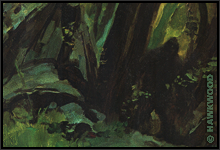
My painting of Mary portrays her as she might have appeared some ten years into her solitary retreat. Rather than portraying the Saint Mary of the Church, I wanted to be true to Mary’s humanity, to grant her the dignity of a very human soul living in harsh self-imposed exile from her own kind.
What we know of the woman’s story, and what she told to the monk Zosimas, we can learn in the account of her life written down by Sophronius, the Patriarch of Jerusalem during the 7th-century. Her name was Mary, and she had run away from her home in Egypt at the young age of twelve to journey to Alexandria. In the city she had lived a dissolute life, selling her sexual favours on the streets for the next seventeen years, or simply giving herself away for the sake of the experience. Apparently driven by a need to satisfy a carnal craving in new surroundings, she boarded a ship carrying pilgrims bound for Jerusalem. The pilgrims, both during the voyage and in Jerusalem itself, proved to be as willing as the residents of Alexandria, and she continued her wanton lifestyle within the city walls. Until the day that she found herself at the door of the Church of the Holy Sepulchre.

Sophronius’ account of Mary’s life does not provide us with the details of her journey, but using maps of the period it is possible to surmise that the ship on which she embarked from Alexandria would have sailed for the port of Joppa, which had a well-trodden connecting road to Jerusalem. The actual location of Zosimas’ monastery is unknown, but calculating its distance from Jerusalem and its location near the west bank of the River Jordan gives us its likely location. From the monastery Mary would have crossed the Jordan and travelled eastwards into the trans-Jordanian desert. 
Intending to enter in the hope of finding more clients among the congregation, she felt her way barred by some unseen force. Interpreting her impure lifestyle as the cause of her being unable to set foot in the church, she experienced a deep inner remorse. At this the withholding force seemed to vanish, and she entered the church and prayed by the relic of the [2]True Cross. Emerging once more into the sunlight, she felt that she heard a voice say to her: “If you cross the Jordan you will find glorious rest.” Renouncing the life which she had led, she journeyed to a monastery by the Jordan to receive Holy Communion before crossing the river to begin the life of a [3]recluse – a life that she would follow for the rest of her days.

Having related her story to Zosimas, Mary asked the monk to meet her in a year’s time to give her Holy Communion. At the appointed time Zosimas arrived at the banks of the Jordan to see Mary walking towards him across the waters. A further meeting was arranged for the following year, and this time Zosimas returned to the place where he had first encountered Mary, only to find her dead. It is said that a lion helped him to bury her, digging with its claws into the dry desert earth which had been Mary’s home for so many years, and which now would be her last resting place.

Two traditional icons of Mary. An anonymous Russian artist has surrounded Mary with scenes from her life (left), beginning with her kneeling in prayer before the relic of the True Cross, and ending with her burial by the lion. Gregory of Sinai monastery has chosen to depict the moment (right) when Mary walks across the River Jordan to meet Zosimas.
This, briefly, is the story of Mary – Mary of Egypt as she became known. It was preserved as an oral tradition by the monks of Zosimas’ monastery before being recorded by Sophronius a century later. In it we recognize elements similar to the life of [4]Thecla: a remarkable life of a turn to faith interwoven with the supernatural elements of legend. For the orthodox faithful, it provides a textbook example of repentance and redemption, and the mercies of the Spirit which such redemption ensures. But because these aspects of her story are the focus for the faithful, what is glossed over in such orthodox accounts is another central aspect of Mary’s story. It is a story of astonishing practical survival.

A popular 13th-century account of the lives of the saints apparently confused Mary’s story with that of Mary Magdalene. The story that Mary Magdalene spent her final years as a solitary naked penitent is wholly erroneous, but it nevertheless was seized upon by artists who were willing enough to portray the penitent naked Magdalene, as in this romanticised 19th-century version by Alfredo Valenzuela Puelma, which depicts an improbably healthy-looking Magdalene swooning before the cave in which she was supposed to have lived.
We do not know the exact years of Mary’s life, but if we assume that she must have been almost thirty when she crossed the Jordan, then her death in her late seventies means that she still must have lived for some forty-seven years in the wilderness. The legend relates that when she left for the desert she took only three loaves of bread with her. For the rest, she lived on whatever her unforgiving surroundings provided her with. This is a feat of endurance which leaves the achievements of even the most radical hard-core survivalists looking like a Sunday afternoon picnic. Given that the basic practical events of Mary’s story actually happened, we must marvel at the survival skills which she must have developed just to stay alive, and with them the mental and emotional commitment needed to sustain her existence of utter solitude. Zosimas mentions that she prayed in a near-unintelligible whisper, with all her words running together. And yet she apparently retained enough of her language skills to communicate her story to the monk.

The unforgiving harshness and haunting grandeur of the Jordanian desert. Mary somehow managed not only to survive, but to live in this hostile landscape, and not just for months or for years, but for several decades. Faith is a wondrous thing in itself. To add miracles to her story perhaps diminishes what she achieved on a human level.
We might or might not accept the supernatural elements of the story – the unseen force at the doors of the church, Mary walking on the waters of the Jordan, and the [5]helpful lion – for such elements remain a matter for individual faith. Such miraculous occurrences were needed to confirm Mary’s sainthood by the Church, and in any case remain a distant and unverifiable hearsay. My painting of Mary which heads this post does not need them: I find Mary’s commitment of faith and feat of survival sufficient marvels in themselves. The Church might have need of such miracles and mysteries, but there in the wilderness beyond the Jordan beat a heart in quiet solitude, and the human heart holds mysteries far greater than these.
Hawkwood    

Between Truth and Legend: Is Mary's story true? The circumstances of her life existed as an oral tradition before being set down in writing a century after the events. Faith is the criterion for us accepting the supernatural elements of her story, but what of the story itself? We know from documented examples that ten years is enough time for a human to revert to a feral state and lose the faculty of speech. And yet after some forty-seven years Mary was articulate enough to relate her story to Zosimus, even though the monk described her manner of praying as near-incoherent. I personally believe the substance of Mary's story, although that substance might have been embroidered upon over the years, as stories typically are.


Notes:
[1] It was expected of each monk at the monastery that he should make an annual sojourn into the desert to fast in prayerful contemplation.

[2] Please see my post Helena and the True Cross to read more about the veracity of this holy relic.

[3] A medieval tradition seems to have confused Mary Magdalene with Mary’s story. This tradition has a post-Resurrection Magdalene also living for many years as a repentant naked recluse, for which there is no evidence whatever. The source of this erroneous tradition was The Golden Legend, a 13th-century compilation of the lives of saints. The Legend freely mixed historical facts with fanciful fiction and hearsay miracles: a dubious literary cocktail which only increased its popularity. Later scholasticism treated the Legend more critically – although even up to the 19th-century artists were still portraying Mary Magdalene as a naked recluse (left, by Hans Olaf Heyerdahl) in the style of Mary of Egypt. Please see my post The Gospel of Mary.   

[4] Please see my post Thecla: A Woman between Rain and Fire to read Thecla’s remarkable story.

[5] Whether the intervention of the helpful lion could be considered as miraculous is perhaps questionable. I tend to think of it as a typical storybook element: unlikely and improbable, but not actually defying the laws of physics and nature, as miracles appear to do. 


Sources:
The original account by Sophronius on which my post is based can be read here. My post necessarily condenses or omits many of the details purportedly related by Mary to Zosimas, including the fact that she prostituted herself on board the vessel bound for the Holy Land specifically as a way of paying for her passage, and also includes an extended and detailed account of her first meeting with Zosimas, which is moving in itself.

Jordanian desert adapted from a photo by criscris1. Map and portrayal of Mary created for this post by Hawkwood for the David Bergen Studio © All Rights Reserved.

Wednesday, June 17, 2015

The Mermaid of Haarlem

The year 1430 was one of turmoil and strangeness. In France Joan of Arc was captured by Burgundian forces and burnt at the stake. Further to the north in the Lowlands, within the borders of what was then the Holy Roman Empire, terrible storms were raging. The gales were so strong that the dykes which protected West Friesland were breached, and the North Sea broke through and flooded the farmlands. But these storms were not all that visited the country. Among the many fish left stranded on the farmlands (if we believe the wondering [1]accounts written at the time) was a mermaid.

The mermaid painted by 19th-century English artist Annie Louisa Swynnerton. The artist was active in the Women’s Rights movement of the time, and her mermaid seems to embody those positive qualities of female empowerment, so different in approach to the winsome and youthfully-sweet mermaids painted by her Victorian male contemporaries John William Waterhouse and Herbert Draper. This mermaid knows who she is, where she is going, and how to get there.
A group of women gathering the stranded fish for an easy meal apparently discovered the unfortunate creature floundering in the shallow waters. Astonished (as well they might be), they somehow managed to carry the marvel to dry land, where she was eventually transported to the city of Edam (presumably by boat to the western coast of the Zuider Zee - see my map below), and from Edam to the city of Haarlem.

The mermaid’s journey. Following her capture in the flooded farmlands of Friesland, the mermaid was taken first to Edam and then to Haarlem. The coastlines are those of the 15th-century, before the extensive land reclamation from the sea of later centuries, with the names of the then-Lowlands provinces shown in green. The Zuider Zee is now a large lake known as the Ijsselmeer, and reclaimed polderlands have diminished its size still further.
The Mermaid of Haarlem, as she became known, was provided with good Christian clothes with which to suitably cover her heathen nakedness, and seems to have settled down to this new life away from her watery home. She also seems to have adapted her diet to one of cooked meat, and was taught to spin yarn, and to pray and to make the sign of the crucifix. In short: the mermaid was provided with the essentials for a life in the Christian community in which she now found herself.

This portrayal of Mary Magdalene reading by Rogier van der Weyden is contemporary with the mermaid’s story. In Mary’s resigned features and in her dress of the artist’s period and place we might glimpse a vision of how the mermaid could have appeared during her new life on land. Unable to read, the mermaid could only have looked wonderingly at the unfamiliar pictures in such scriptural texts. The inset shows a small personal crucifix of the type that would have been presented to the mermaid.
But these outward trappings of her surroundings do not seem to have erased her essential nature. Apparently she always retained a longing for her watery home, and every attempt to teach her even the essentials of human language resulted only in stubborn silence. How many years she spent as a half-reluctant member of her adopted community is not recorded, although we are told that on her death she was given a full Christian burial. Ah: if only we knew of her burial place! Would an exhumation reveal a marvel, or merely a prosaic disappointment?

Let us suppose (because it is what we would like to believe) that the story is true. Did the mermaid truly have some sense of Christian reverence when she crossed herself, or was she merely mimicking the actions of those around her? And how strangely alien and awkward the wearing of clothes must at first have seemed to her. And what apparently was her resistance to human speech might have been more to do with her inability to speak at all, for who knows the ways in which mermaids communicate with each other when swimming in their watery home?

Religions in Europe during the mid-15th-century. Martin Luther’s Protestant Reformation was still a century in the future, as was the reign of Henry VIII in England, whose rejection of Papal authority would shrink the borders of Catholicism still further. The Lowlands, yet to become the nation of the Netherlands, was part of the Holy Roman Empire, whose defined borders are shown here. The Iberian Peninsula was divided up into its own kingdoms, but Islam in the shape of Moorish culture and belief still had a foothold in the south of Spain. At this time the areas of the Ottoman Empire shown on the map had a majority Christian population ruled by an Islamic minority. 
Now let us suppose (because we also need to embrace prosaic probability) that the mermaid’s story, although perhaps having some basis in fact, was not what it seemed. In a [2]previous post I mention the likelihood of stories originating from something, which confronts us with the possibility that the ‘mermaid’ existed – but that she was not actually a mermaid. Such stories do not grow out of a vacuum, and perhaps the ‘mermaid’ was in reality a feral human. Significantly, no mention is made of the woman actually having that distinguishing feature of her kind: a fish’s tail in the place of human legs. She was not found swimming at sea, but rather was rescued from the flooded farmland. Her wild and naked appearance would have been enough for the mindset of the time to see her floundering in the watery shallows and think: ‘mermaid!’ Stories of such feral humans in Europe and elsewhere have been [3]documented, so to my mind this scenario is certainly a likely possibility.

A feral girl as imagined by contemporary Belgian artist René Hausman. The painting echoes such cases as the life of 18th-century Marie-Angélique Memmie le Blanc, known as the Wild Child of Sogny. Born Native American, Memmie came to France as a young girl and became lost in the French forests when she was nine, only to be discovered by villagers ten years later in a state of feral wildness.
How we interact with these feral humans confronts us, not so much with their wildness, as with our own civilized selves. Our first impulse is to clothe them, to teach them the rules of modesty and [4]shame which have filtered down to us from Eden. We next seek to make them, in whatever ways are necessary, adopt our own standards, beliefs and moral codes. In short: what we recognize in the mermaid’s story is the desire, however [5]well-intentioned, to want to change someone to be like us.

We resist that otherness which makes someone special, which makes them the unique individual that they truly are. We want someone to share our own beliefs, because that is a way of confirming to ourselves that the things in which we believe must be ‘right’. We misguidedly imagine that we can improve someone by persuading them to believe what we believe, and to think as we think. But is such persuasion a form of conversion, or a form of coercion? We might excuse the actions of her captors towards the mermaid as belonging to the attitudes of 15th-century Catholic Europe, but such attitudes persist. [6]Mormons or Jehovah’s Witnesses who come [7]knocking on your door are in their intention no different from the goodwives of Haarlem who taught the mermaid how to make the sign of the cross.

A mermaid, as imagined in the 19th-century by Danish-Polish artist Elisabeth Jerichau-Baumann. This mermaid seems sculpted from the very ocean. Serene and impassive, self-assured and yet detached from and seemingly-indifferent to us, her observers, she defies us to deny her existence.
Almost six centuries is a long time: long enough for us to wish that the story of the mermaid might just be true: long enough for us to hope that the story perhaps has a grain of substance. We seem to need mermaids and other fantastic creatures, but what also touches us about her story is the notion of exile. The mermaid of Haarlem was a stranger in a strange land. We need not ignore such differences in others. Strangers are not different from us, but are merely a different us. And it is a sad truth that, if ever we did discover a real stranded mermaid, it seems that the very last thing that we would do, the least likely thing that might occur to us, would simply be to promptly help her to return to her own ocean home.
Hawkwood

    
My grateful thanks to Emma for allowing me to borrow substantially from her own post on this subject. Emma’s blog Sophia's Mirror can be visited here.


Notes:
[1] This is the original story of the mermaid as described in a 19th-century journal, which itself is a copy of other earlier accounts. There is something unnerving about the account’s referring to the mermaid as ‘it’ instead of ‘she’: “So, also, the Mermaid reported by Johannes Hondius, as taken by some women in the meadows at Edam, in West Friesland, where it had been brought by the sea which entered through the broken dykes, during the great tempests in 1430. That Mermaid was taught to spin. Moreover, it was dressed in female attire, fed on cooked meat, had some notion of a deity, made its reverences when it passed a crucifix, lived some years at Haarlem (though it ever retained an inclination for the water), and was allowed at its death a christian burial; and yet all efforts to teach even that Mermaid to speak proved ineffectual. It is this Haarlem Mermaid only (though without her clothes) that is represented upon our signs and in our coat-armour.” ~ Abridged extract from: The Asiatic Journal and Monthly Register for British India and its Dependencies, vol. XV, January to June, 1823. London.

[2] Please see my post Renaissance Snuff.

[3] Please see Michael Newton’s title below.

[4] Please see my post Shame.

[5] And "the road to Hell is paved with good intentions" - a pearl of wisdom that apparently originated in the 12th-century, and was therefore even current in the mermaid's day.

[6] Formally known as the Church of Jesus Christ of Latter-day Saints, which is their  own preferred title, but which, it must surely be admitted, is not one which trips readily off the tongue. Hence: Mormons, after the father of the angel alleged to have appeared to their founder, Joseph Smith.

[7] Please see my Pocket Guide to Proselytizing.


Sources:
Michael Newton: Savage Girls and Wild Boys: A History of Feral Children. Faber & Faber, 2002. Michael Newton’s commendable and sympathetic book documents various cases, and critically examines both the discoveries of such cases and the attitudes of those into whose care they are received. Spanning several centuries, the author demonstrates that social and scientific methods might change, but basic attitudes do not, with inter-departmental social welfare rivalries, the quest for scientific accolades, and academic concerns often-enough taking precedent over simple human compassion.

The painting by René Hausman appears on the flyleaf of the hardcover edition of the graphic novel Laïyna, written by Pierre Dubois and illustrated by René Hausman. Published by Dupois in France, 1987, and published in Belgian and Dutch editions the same year. The book was subsequently re-issued in the Netherlands under a different title, although only the first edition features this painting. Hausman’s loose watercolour style is unique in the genre, and positively crackles with life and energy.

The painting of Mary Magdalene by Rogier van der Weyden is in the National Gallery, London. The small 15th-century crucifix is in the collection of the Museum of London. All referenced graphic novels are in my collection.

I soon discovered that different maps of the period tended to conflict with each other, and a variety of different sources were used to create the two maps featured in this post. The map of Religions in Europe in particular needed a lot of deft rechecking, which is understandable when one considers the labile shifting political alliances of the time (and I swiftly jettisoned one map as reference which claimed a swathe of Europe for Protestantism a century before it happened!). Nevertheless I feel that my maps accurately depict what their titles claim. 

A Footnote: The title page of this 18th-century songbook (left) printed in Haarlem continues to get mileage out of portraying one of Haarlem’s most famous citizens, however fictitious she might prove to be. The translation is: “The entertaining OUTDOOR LIFE, or the Singing and Playing FARMER’S JOY, Enriched with the art of Singing, and for the ease of the Players tuned to the key of G.”