
Return here to the Shadows in Eden home page.....
Showing posts with label Genesis. Show all posts

Monday, September 19, 2016

Ark Encounter: The Boat Don’t Float

To say that it would have been a rough voyage is an understatement. The weather on our planet owes all of its fluctuating patterns, its calms and its storms, to the variations in barometric pressure which its land masses produce. So what would happen to the Earth’s weather if we were to submerge these great continents, these many islands large and small, and cover the planet with water?

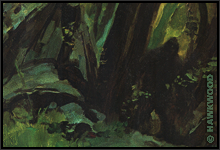
The reality of weather conditions during the Flood. My painting of the Ark Encounter’s ark bravely riding the monster waves is a fantasy. In reality, engineering principles for such an enormous wooden hull dictate that the vessel would inevitably have broken its back before even the first wave struck.
We do not need to speculate, because we can see the results by studying the other planets in our own solar system. Dry Venus and Mars have no surface water, and while both are certainly subject to [1]storms, to find a closer model to weather on our hypothetical water-covered Earth we need to look at such planets as Jupiter and Neptune. With lower cloud levels compressed by atmospheric pressure to a fluid-like [2]turbulence, massive storm systems rage unrelentingly around these planets. Why? Simply because there are no continental land masses to stop them. Once a wind picks up it is free to tear its way around every line of longitude a planet possesses – and with a planet’s rotation as its power source, it does.

Belts of storms rage around Jupiter. Removing Earth’s land masses from the equation to create a flooded world would generate such proportionally powerful and long-lived storms as these, and would have been the dismaying weather forecast for the ark’s seven-month voyage. 
This frightening weather scenario is the factor which seems to be most often overlooked – perhaps at times conveniently – when considering the feasibility of the story of Noah’s Ark. I was drawn back to this topic after learning that the Creation Museum in Kentucky has now opened its Ark Encounter theme park with its full-sized ark to the public. When I first discussed the feasibility of Noah’s Ark in my [3]previous post, plans by the [4]‘Museum’ to build a full-sized ark as a theme park attraction had just been made public. Now the ark is there, as large as life – or at least, as large as the dimensions provided by scripture.

The organizers of the Ark Encounter attraction claim their ark to be the most accurate ‘reconstruction’ ever. So let’s see what sort of description the Book of Genesis provides as a working blueprint. It is, in fact, so brief that I can quote it here in full. In Genesis 6 God instructs Noah as follows: “14: Make thee an ark of gopher wood; rooms shalt thou make in the ark, and shalt pitch it within and without with pitch. 15: And this is the fashion which thou shalt make it of: The length of the ark shall be three hundred cubits, the breadth of it fifty cubits, and the height of it thirty cubits. 16: A window shalt thou make to the ark, and in a cubit shalt thou finish it above; and the door of the ark shalt thou set in the side thereof; with lower, second, and third stories shalt thou make it."

This version of the Ark Encounter’s ark at sea from the creationist website Answers in Genesis promises calm seas and a prosperous voyage. Apart from the fact that the vessel is sitting far too high in the water for the combined weight of its live cargo and the vessel itself, the difference between their version and mine is clearly in the weather conditions. But let’s face it: creationists never were that big on the science.
That’s all there is. Unless I have missed something, there is nothing whatever in this description about the [5]ark being like a boat, or even like a sea-going vessel of any kind. And although precise dimensions are given, the fact is that we simply do not know exactly how long a ‘cubit’ was. It is usually thought of as being the length of the human forearm, but it turns out that different [6]cultures all had their own ‘cubits’, with each one differing from another.

The interior of the Ark Encounter’s ark. Imagine this scene, not well-lit and filled with curious visitors, but rolling and pitching in semi-darkness at sea in storm conditions. The lateral stress on all those massive beams, the combined  cacophony of noise produced by the groaning timbers and the cries of hundreds of frightened animals fouling their cages with fear, and Shem, Ham and Japheth frantically trying to stuff rags into ever-more-serious leaks presents a rather less cosy picture than is suggested here.
And what is ‘gopher wood’? The term is virtually unique to this single verse of scripture – and unknown anywhere else. We are left to speculate. It might have been cedar wood, or cypress, or even reeds. Or it might simply refer to wood which has been treated in some way: either planed smooth or treated with pitch. We simply do not know. So if we cannot exactly calculate its dimensions, and if we do not know the type of wood from which it was constructed, and if we are not even told what form or shape it took… on what basis can we assert that any given reconstruction of the ark is ‘the most accurate’?

This drone view of the ark under construction shows a row of thirty skylight windows per side. That’s fifty-nine more than are specified in scripture. Even for creationists the answers, apparently, are not all in Genesis.
The Genesis description specifies that the ark had one door and one window. But look at the Ark Encounter ark in the scale diagram below. It certainly has one door – but that door has been placed below the waterline. Draw your conclusions. And it certainly does not have ‘one window’. In fact, it has a whole row of skylight windows running almost full length on either side of the roof (or deck, if you’re of a seafaring nature). I have counted thirty windows on each side, making sixty in all. They’re certainly not mentioned in scripture, so where did they all come from?

The two largest historically documented wooden vessels ever built were the U.S.S. Dunderberg, renamed the Rochambeau, and the schooner Wyoming. The Rochambeau saw only brief service before being decommissioned due to constant serious leakage. The Wyoming sank in sheltered waters with the loss of all hands, also due to serious leakage. The Ark Encounter ark shown here is half again as large as these two ill-fated vessels – and the door is below the waterline!
Now consider the Ark Encounter hull shape. The forward-raking bow is clearly modelled, not upon any [7]vessel of the time, but upon the hull of a contemporary cargo ship. Why? And those wooden planks are clearly laid upon some sort of synthetic (insulation?) cladding. Rather than being structural to the vessel, they literally are a mere veneer. You might argue that the ark, which additionally rests upon concrete piles, was never actually intended as a serious Bronze Age reconstruction of a possible vessel. You might indeed, but then you should not make any claims for its ‘accuracy’. Still, creationist claims have time and again proven, both in their [8]‘Museum’ and with the Ark Encounter exhibit, that showmanship is prized above intellectual honesty. For all its size, this particular ark is a mere theme park attraction, and any pretence at Biblical ‘accuracy’ is exactly that: a pretence, and a dishonest one at that.

The Ark Encounter ark under construction. The hull planking is laid over a synthetic cladding. Bronze Age construction methods these are not. And where is the coating of pitch so specifically mentioned in scripture? A black ark, apparently, was deemed to be not such an aesthetic crowd-puller, and even this brief passage in Genesis was cherry-picked in the name of showmanship. 
My previous post on this subject covers in detail exactly why a wooden hull with the proportions of a contemporary steel cargo vessel (that is: the ark’s dimensions as specified in Genesis) would lead to inevitable disaster. To sum things up in a single sentence: the inescapable engineering rule states that the larger a wooden vessel is, the weaker its structural integrity becomes. With its keel of necessity being made from several individual trunks of timber the vessel would break its back under its own weight and the combined weight of its biomass cargo (all those dinosaurs sure won’t help) as soon as it became waterborne. Why are these points important? Because of the other claim about the Ark Encounter ark: as stated on its [9]website, it is claimed to be ‘amazingly seaworthy’.

Dinosaurs in their enclosures on board the Ark Encounter ark. There is much that I could say about this, but I think I’ll just sit on my hands and refer you to my extended ‘caption’ about it here.
There is one relevant factor which I did not mention in my previous post, and that is the dangerous phenomenon known as ‘freewater’. It was [10]freewater which caused the Herald of Free Enterprise tragedy in 1987. It was freewater which caused the sudden sinking of Henry VIII’s flagship Mary Rose in 1545, and which sealed the fate of the newly-launched magnificent Swedish warship Vasa in 1628. Freewater is a shallow layer of water (it need not be deeper than a few inches at most) which can enter through any opening and fatally compromise a vessel’s equilibrium. Wave action will cause an ever more severe side-to-side rocking motion until the vessel inevitably rolls over. The frightening thing about the phenomenon is just how little water in a vessel it takes to cause disaster.

Creationists seem to labour under the delusion that saying something loud enough somehow makes it more true. The irony which seems to escape them is that this billboard’s statement actually is true: you cannot sink a ship which has never been launched in the first place. And apparently they encourage their own siege mentality by branding all who disagree with them as ‘intolerant liberals’. Basically, that means anyone who uses their common-sense, whether they believe that faculty is God-given or not.
I trust the point has been made: it is the very size of the Ark Encounter’s ark (and we’ll assume that it is at least within a reasonable margin of Biblical accuracy) which so counts against it as a credible seaworthy vessel. We tend to equate large size with security and a greater degree of safety, but with a [11]wooden hull the opposite is true. Maybe half the size and the ark just might have been a going concern. But half the size is not Biblical size, and in Biblical literalism scripture has to be adhered to, even if that means that all credibility is jettisoned. Great size, then, does not equal greater safety and stability. In fact, it fatally compromises both if the vessel is made, not of steel, but of wood.

And what of those huge storm systems that would have swept around the planet during the Biblical Flood? They would have created an unrelenting series of perfect storms through which the Ark would have had to struggle, and my painting of the Ark Encounter ark battling monster waves which heads this post is anything but overdramatised. And with the weight of immutable engineering principles to back me up, and with professional experience in the field of marine archaeology, I figure I’d be just as likely to survive in a rusty bathtub.
Hawkwood


Notes:
[1] In the case of these waterless planets, it is principally the variations in land contours which provide the weather. Any planet with an atmosphere will generate weather of some description.

[2] That is: the compressed lower atmospheric levels of these gas planets become analogous to a water-covered planet.

[3] Please see my post: The Lost Ark of Noah.

[4] As I always relish pointing out: in an apparent attempt to imbue their institution with an aura of respectability, the very Christian creationists have named their building after a pagan temple. The original Museum was actually the temple of the Muse in Ancient Greece.

[5] The translated word ‘ark’ in the original Hebrew text is ‘tebah’, which implies any sort of protective container whose contents are precious. Thus: the Ark of the Covenant. The basket in which the baby Moses was found is also referred to as a ‘tebah’.

[6] The Biblical cubit is generally thought to have been almost 46 centimetres or around 18 inches, but clearly the greater the distance measured, the wider the margin of error becomes – and over the length of the Ark that is clearly considerable.

[7] The only vessels of the time which had such a water-cleaving prow were modestly-sized Bronze Age Greek ships. Such a hull design did not reappear on ships until comparatively late in the modern era.

A side-by-side comparison between these three hulls clearly shows the influence upon the Ark Encounter’s ark of modern supertanker design. There is no mention whatever in scripture of such a forward-raking prow for the ark, or even that the vessel was boat-shaped as such, so where did these ideas come from?
[8] Please see my post: How do Creationists know what Dinosaurs looked like? for a particularly dubious  example of creationist hypocrisy.

[9] Ark Encounter. Bring a life vest.

[10] In the tragic case of the Herald, the loading ramp of the car ferry apparently had not been fully closed before the ferry cast off, and the vessel sank in calm weather within sight of the harbour which it had just left. With the Mary Rose and the Vasa, water appears to have entered through the open lower gun ports, although the Vasa already was a flawed top-heavy design. In all cases, witnesses report the shocking speed at which such a freewater-endangered vessel will roll over and sink – literally within minutes.

[11] What makes the ark so vulnerable? To clarify this point for any reader who is still wondering (or who might doubt what I say here!): steel can be welded to itself. Once a weld is made, two sheets of steel effectively become one large sheet, and so on over a whole hull. Wood is wood, and the size of the continuity of construction is limited by the plank or beam from the original tree. You cannot weld wood to itself. You can only join it using carpenter's joinery methods.

Rolling and pitching: So the larger the wooden hull, the more such joints it will contain. Every single joint represents a potential stress point which at sea is subject to wave action, and this action comes from multiple directions: both from the roll (side-to-side rocking) movement of lateral wave action, and from the pitch (up-and-down) bow to stern movement when the vessel is directly facing a wave. In rough weather these forces come from various directions at once, placing each and every joint under greater stress.

Why more joints equals greater risk: In heavy or even moderate seas most of the joints in the whole vessel will be subject to the added stress of water pressure from the sea itself, and every joint, no matter how perfectly-fitted it might be to its adjoining beam or plank, will move, and leakage is inevitable. The larger the hull size the more this factor is multiplied. For the ark, the factor is not so much how large it is overall, but how many joints its many timbers contain. So the engineering formula is:

The larger the wooden hull, the more joints there are, and the more joints there are the weaker and more vulnerable the overall structure becomes in waterborne conditions.

What is broaching? The ark has no steering means whatever. It would be completely at the mercy of the prevailing wind direction, and an unsteerable vessel is subject to a phenomenon known as 'broaching'. That is: it will tend to turn beam-on (side-on) to the weather. This means that the waves will be hitting it from the side - and with the hull proportions of the ark, that really matters. The longer a hull is, and the more narrow in the beam (width), the more vulnerable it becomes to a rollover in a broaching situation. Far from being the ideal proportions for seaworthiness claimed for it by the Ark Encounter exhibit, the ark's supertanker proportions combined with its wooden construction would have sealed its fate in even moderate seas.

Tuesday, February 9, 2016

Rise of the Nephilim

“The Nephilim were on the earth in those days, and also afterward, when the sons of God came into the daughters of men, and they bore children to them. These were the mighty men that were of old, the men of renown.” These two brief sentences from the Book of [1]Genesis tantalize us. They suggest so much more than they tell, and we want to know more. Who were these mysterious Nephilim? And who were the ‘sons of God’ who sired them? The words hint at a powerful story, but the story does not continue further. It is as if we are in the middle of reading an exciting book – only to discover that the next several pages have been torn out. And in a sense, they have been.

One of the most intriguing names in scripture, the Nephilim have given rise to a whole body of speculative literature. They were giants. They were fallen angels. They were extra-terrestrials who visited our ancient Earth. Whatever their true nature, the devastation which these beings wrought seems to have been real enough.
Before the Bible became the book as we now know it, there were many such texts in circulation, each one with its own story to tell. One of these texts was the [2]Book of Enoch, the prophet who, we are told, was the seventh generation from Adam and the great-grandfather of Noah. As with other books bearing the names of the prophets of old, this does not mean that Enoch actually wrote the text, any more than Isaiah, Jeremiah, Ezekiel and Daniel wrote the books which bear their names. In writing these texts at times in the first person (‘I was lifted up to heaven’, ‘then the angel answered me,’ etc.) the unknown authors of these texts were using a literary device which gave their texts both conviction and authority.

The prophet Enoch, said to have been the seventh generation from Adam. The parts of the Book of Genesis which mysteriously omit major narrative developments can be resolved by reading Enoch, even though the Book of Enoch appears nowhere in scripture.
This does not mean that these texts are less ‘authentic’ because we do not know who wrote them: we still can read them as accomplished pieces of ancient literature. And this is how we may regard the Book of Enoch. The mere fact that Enoch was presumed to have lived before the Flood, and therefore was describing events which happened prior to creation’s destruction, is enough to tell us that such events are fiction. But even fiction can contain elements of folktales and memories of events passed down through the generations as oral tradition before being committed to writing. So why does the Book of Enoch appear [3]nowhere in the Bible? It contains a truly visionary account of Enoch’s celestial journey to the heavenly realms at least as stirring as anything in Ezekiel, that other book of visions. And it significantly contains many details and even whole narratives that otherwise are [4]missing from Genesis. One of these is the complete story of those mysterious Nephilim.

The remarkable and vivid description of Enoch’s journey to the celestial realms is at least as stirring as anything comparable which we can read in the text of Ezekiel. And yet one is omitted from scripture while the other is not, and we are left to ponder the seemingly arbitrary nature of the reasons either for accepting or rejecting a particular text for inclusion in the canon.
His name, the writer of Enoch tells us, was Samyaza: one of the hosts of heaven. From on high Samyaza gazed down upon the earth, and his eye fell upon the comely ‘daughters of men’. Driven by a distinctly un-angelic lust, this rebel angel laid his plans. Samyaza got together a coalition of the willing: two hundred angels known as the Watchers, the ‘sons of God’ in Genesis, who swore a terrible oath of allegiance before descending through the heavenly realms to determine just how easy Earth girls were. By the time the company arrived on our planet they had acquired bodies of flesh and blood. And flesh and blood were what they were after.

Samyaza, the leader of the two hundred fallen angels described in Enoch as the Watchers, and in Genesis as the sons of God. The fact that Samyaza shares certain characteristics and story elements with Satan suggests that this particular fallen angel might have been an early version of the Prince of Darkness himself. 
But the Watchers were prepared to give as well as to take. One of their number, Azazyel, taught men the dubious arts of weaponry and warfare, and he showed women how they could enhance their beauty with trinkets, jewellery and makeup. The world became a place of lost innocence, of desecration, of suffering. And the half-angel offspring of the Watchers born to Earthly women, the Nephilim, proved to have insatiable appetites, gorging their way through every living thing: the beasts of the field, the birds of the air, crawling reptiles, and the fish that swam in the waters. But then the humans around them also went onto the menu. Enough was enough.

The nightmare visions of Hieronymus Bosch, with their desolate landscapes peopled by grotesque hybrid creatures and other monstrosities, powerfully suggest the world desecrated by the Watchers and their terrible offspring the Nephilim as described in the text of the Book of Enoch – which itself could have influenced such scenes in the Book of Revelation.
The cries of despair coming from the human world were heard in heaven. The five [5]archangels - Gabriel, Michael, Raphael, Suryal and Uriel – descended to join battle with the wayward fallen angels. Raphael bound the troublemaking Azazyel fast, Gabriel incited the Nephilim to an act of terrible mutual slaughter, and [6]Michael bound Samyaza deep beneath the earth, where he shall remain until the End of Days before being thrown into the bottomless Pit of Fire.

It certainly makes for a tremendous story: an epic clash of forces classically portrayed as good pitted against evil, with our own Earth as the battleground. But is this primal battle the stuff of folk culture which simply belongs with other such texts and mythologies? Or is it something more? Supposing that these fallen angels were indeed more than just a story? Supposing that these beings really walked among us in those ancient times? If this was so, and if the Watchers and the Nephilim really existed, then who were they?

These two female figurines are from the pre-Sumerian Ubaid culture, and date from between 4,000 to 5,000 BCE. Archaeology cannot explain the strange reptilian faces, which are characteristic of all such Ubaid figurines, other than to comment that they cannot be masks: even the nursing infant has the same distinctly non-human face. Do these figurines suggest genetic deformities of some kind, or perhaps mysteriously hint at some distant truth to the story of the Nephilim?
Were the Watchers in reality perhaps all-too-Earthly visitors from a then-less familiar [7]geographical region, strangers come from a strange land? Or were they even extra-terrestrials visiting our planet to throw a few alien genes into the human mix, as has been speculated on the wilder shores of probability by some [8]credulity-stretching theorists? As with other such stories, it gets down to what we personally choose to believe. But the brief reason given in Genesis for the cause of the Flood – the ‘wickedness of men’ – seems way too vague and generic to be a justifiable reason for wiping out the whole of creation – with the exception, of course, of Noah and the contents of the Ark. As if things are any different now.

This 19th-century depiction of the Deluge by Gustave Doré manages to include every element of the drama. Even the very waves reach up like wrathful fingers to snatch the despairing figures from the last rock where they have taken refuge. We can read the story of the Flood in Genesis (which itself is borrowed from Mesopotamian sources), but it is in Enoch that we learn of the true reasons for the destruction of God’s creation. 
Again, it is not Genesis but the text of Enoch which suggests the true reason for the cause of the Deluge. The frightful Nephilim were half-fallen angel, half-human. They were malicious hybrids whose ruthless appetites consumed and despoiled everything around them. Nephilim greed had laid waste to the earth, and the lust of the Watchers had defiled the purity of human genetics. Creation had become tainted. Creation must begin anew.

We do not need to resort to conspiracy theories featuring interbreeding aliens to see the uncomfortable parallel with our own times. It is we, with our insatiable corporate-greed appetite for consuming all the natural products of our world and despoiling the very environment on which we depend, who are behaving like the Nephilim. Twenty-three centuries after it was first written, the Book of Enoch, and the vivid story of the Nephilim which it contains, carries an urgent and startlingly topical warning for us all. We have encountered the new Nephilim, and they are us.
Hawkwood       


Notes:
[1] This quote from Genesis 6:4 is from the Revised Standard Version. The King James Version offers a different nomenclature: “There were giants in the earth in those days; and also after that, when the sons of God came in unto the daughters of men, and they bare children to them, the same became mighty men which were of old, men of renown.” This comparison raises the gnarly question of translation, and what the term ‘Nephilim’ might actually mean. ‘Nephilim’ and ‘giants’ are not necessarily interchangeable terms, with the original Hebrew suggesting the term might mean ‘fallen ones’, although there is no scholastic consensus on this.


In 2004 Worth1000, a website which hosts contests for digital artists, created a competition on the theme of 'Archaeological Anomalies'. An artist with the web identity IronKite Photoshopped a clever image which went on to lead a life of its own. The image (above) subsequently appeared (with its source uncredited) on various pro-scriptural conspiracy theory websites and in videos, claiming to be ‘proof’ that the ‘giants’ of Genesis 6:4 had been discovered: not the first time that hoaxed claims have attempted to ‘prove’ the truth of scripture with misrepresentation. Please see note [2] of my post A Simple Misunderstanding for another such example.

[2] The Book of Enoch is actually five different texts taken together. There are enough stylistic differences between these five texts to regard them as being by different authors at different times.

[3] The question of the Book of Enoch’s non-canonical status is complex, and provides a good example of just how arbitrary is the choice of texts which make up the scriptural canon. Various denominations or branches either of the Christian church, the Coptic church, or the Jewish community either partially include it or omit it, and for equally various reasons. One reason for its omission – the objection to angels having corporeal bodies – hardly holds up when we remember that the two angels (left, with Lot, by James Tissot) who entered the city of Sodom also had material bodies. Please see my post Lot and his Daughters: The Inside Story.


[4] It is in Enoch that we find a more detailed description of the fruit of the tree in Eden than is provided in Genesis. Please see my post Forbidden Fruit.

[5] The substance of my post is taken from the Richard Laurence translation of the Book of Enoch. The names of the five Archangels and the Watchers are taken from this translation.

[6] That the story tells us that it was Michael who bound Samyaza, and Samyaza’s own rebellious and troublemaking nature, suggests that Samyaza was an early archetype who later would evolve into Satan. The Book of Revelation was very nearly dropped from the canon because of its obvious resemblance to this passage in the text of Enoch, from which it presumably was derived.

[7] The case for the Watchers actually being humans from a different geographical region is cogently argued by Andrew Collins in his book From the Ashes of Angels. Collins mentions that early Judaic literature assigns specific physical characteristics to the Watchers as being extremely tall with white skin, hair ‘white as wool’, ruddy complexions, piercing eyes and serpent-like faces.

[8] The books of Zechariah Sitchin, particularly his first book The 12th Planet, claim an extra-terrestrial involvement in human affairs. Sitchin equated his extra-terrestrials, whom he called the Anunnaki, with the Nephilim, and postulated that they come from a planet as yet unknown in our own solar system which he called Nibiru (right), orbiting in a distant pronounced elliptical orbit around the sun. Weirdly enough, as recently as January 2016 a team of scientists suggested that an unknown giant planet might indeed exist in such an orbit, and which planet’s existence could account for gravitational anomalies observed in outer solar system bodies. That article may be read here.


Sources:
Elizabeth Clare Prophet: Fallen Angels and the Origins of Evil: Why Church Fathers suppressed the Book of Enoch and its startling revelations. Summit University Press, 2000. This title contains the complete Richard Laurence translation of the Book of Enoch, as well as a concordance citing references to Enoch in other texts, both canonical and ex-canonical.

Andrew Collins: From the Ashes of Angels: the Forbidden Legacy of a Fallen Race. Michael Joseph Ltd, 1996.

Zechariah Sitchin: The 12th Planet. Stein and Day, 1976. I am aware that Sitchin has a huge fan base out there, but it must be said that his theories contain fundamental inaccuracies both astronomical (to do with his calculations for the orbit of his hypothetical planet Nibiru) and cultural (to do with his misrepresentation of Mesopotamian mythology and texts). 

Monday, February 23, 2015

Pandora's Box

We might think that we know the myth. Pandora, the first created woman, arrives from Olympus in the world of mortals together with a box. The box contains all the evils and pestilences which otherwise would plague humankind, but as long as they remain safely shut away then the world is a peaceable place. In her innocence, Pandora peeks inside the box to see what it might contain. Bad idea. The terrible contents are released into the world, and humankind has been afflicted with them ever since. Pandora just has the time – and the presence of mind – to shut the lid before the last thing escapes. That thing is Hope: only Hope is preserved safely, to be nurtured for the times when it is needed.

Pandora opens the box, as imagined by John William Waterhouse in the 19th-century.
The story has a familiar echo. We need only think of that other first woman to be awake to the parallels of both stories. Eve in the Book of Genesis also had her problems with human curiosity, of crossing the line of deific instructions to release blight and death upon all of humankind. In a [1]previous post I have mentioned that this literal reading of Genesis points us towards only a superficial truth. And yet it is this ‘storybook’ truth which has dominated Western thinking – and our attitudes towards womankind – ever since. Eve the Woman is the cause of all our misery, and the active agent in releasing evil into what up till then had been blissful paradise. 

Such shapers of early church doctrine as [2]Augustine and [3]Tertullian were in their writings only too eager to hammer this particular nail home. Woman is evil. Woman is a temptress. Woman is only good for bearing children. That canonical texts appeared to support such rampant chauvinist views gave enough legitimacy to such conclusions, even to the extent that right here in the twenty-first century the ideas of guilt, shame and sin still leave their traces on the minds, not only of the ‘faithful’, but also on the minds of those who seldom if ever set foot in a church.

The sign above this languidly reclining Pandora, painted by Jean Cousin in the 16th-century, makes the parallel with Eve crystal clear. The artist is actually correct in showing this Pandora with a vase or jar. The original myth specifies that it was a jar. It was a mistranslation from the Greek that turned it into a box, and the mistranslation has endured ever since.
That the story of the Fall in Eden can be interpreted in profoundly different [4]ways, and in ways which do not weigh down all womankind with the crushing burden of guilt, has gone largely unnoticed for centuries – mainly because the texts of these other versions were destroyed by the Augustines and the Tertullians of their world. What remains of these other texts has been down to the [5]chances of history, of surviving against all the odds. But we do have them, and they are in our world. But if it is possible to redeem Eve, to come at the story from a radically different angle, might the same be possible for the story of Pandora’s box? Does the apparently over-curious Pandora, that other first woman of Ancient Greek myth, actually display a profound wisdom?

A repentant Eve portrayed by Anna Lee Merritt in the 19th-century. But is such deep and bitter contrition by Eve - and also by Pandora - misplaced? 
All we humans who have come after Pandora might have continued to live in a state of carefree bliss. But is this truly what is intended for us? How can we progress if for us sorrow remains an unknown? How can we taste sweetness if bitter regret also is not part of the human condition? So carefully, carefully, Pandora opens the box, and the world becomes as we experience it, with all its joys and its sorrows, its pains and its heartaches. It is not that we experience pain and loss. It is what we do with these emotions which potentially opens the door to growth of the spirit. But what of Hope?

Hope is left behind, sealed shut. Wise Pandora knows the folly of hope. Hope can be a false god, for so often hope can foster false expectations. Only by relinquishing hope are we truly free to act from a position of strength. With hope we might be fighting with one hand tied behind our backs. Without hope our actions are unlimited by any thoughts of ‘wishing for’, that otherwise might constrain us. As with Eve and her forbidden fruit, perhaps we instead should be grateful to Pandora for opening her box – and also for shutting it just in time.
Hawkwood


Notes:
[1] Please see my post Eve's Story.

[2] Writing in the 5th-century, Augustine said: “What is the difference whether it is in a wife or a mother, it is still Eve the temptress that we must beware of in any woman... I fail to see what use woman can be to man, if one excludes the function of bearing children.” Augustine was instrumental in propounding the doctrine of original sin specifically as being sexual sin, and the fault of the Woman for seducing the Man. Before Augustine, the sin of Eden was principally viewed as being disobedience to God.

[3] Writing in the 3rd-century, Tertullian tersely commented that “Woman is the gateway of the Devil.” Tertullian is now viewed as the originator of the doctrine of the Holy Trinity – a concept nowhere mentioned in scripture – although the idea of the Trinity is found in the pre-Christian (and therefore pagan) mystery schools.

[4] Please see my posts Adam, the God who Failed, and The Enlightened Insight of the Woman, for two of these ‘profoundly different ways’.

[5] Those chances happened as recently as last century, when many Gnostic texts, both Christian and pre-Christian, were discovered by chance, having been buried in a sealed jar in the Egyptian sands for sixteen long centuries.

Monday, September 29, 2014

The Enlightened Insight of the Woman

Adam is a pushover for the dark powers to corrupt. He is already compliant to the suggestions of the serpent. But within Adam’s innermost secret being lies a mysterious purity, a wise and essential other Self, which will prevent his further corruption. To weaken Adam further, so that he will become a willing participant in the [1]creator’s schemes, the creator knows that he must extract this pure and powerful essence from Adam, and so causes Adam to become unaware. Now with Adam in a state of unawareness his creator can, as it were, make a forced entry into Adam’s being.


And so within the deepest recesses of the Man’s inner being the creator is able to locate and remove this secret Self, this enlightened Insight from Adam. The creator places this Insight inside a female form, because this is the form which most closely mirrors the perfect Self that the creator had seen in a vision. In this way this essential part of Adam is removed from him and given its own independent existence: a form which reflects the purity that once had been an integral part of Adam’s own being, a form which embodies this precious quality of enlightened Insight.


Adam now sees this shining new form standing beside him. At this same moment his state of unawareness vanishes as enlightened Insight lifts the veil that has covered his mind. In this new being Adam recognizes his partner, his equal, his true other Self. And although they are now two separate beings, together they are a reflection of the unity that once had existed, and will do so again.

*****

When compared with the widely known version in the Bible, the above story is an unfamiliar recounting of the creation of Eve. In the [2]second chapter of the Bible’s Book of Genesis Adam literally is sent into a ‘deep sleep’, during which God physically removes one of his ribs from which he then creates the Woman. The Genesis recounting of these events is literal indeed, and has the Woman being formed from the actual flesh of the Man. In Genesis, Eve is a creation from [3]second-hand material.

But the above first version of the creation of Eve concludes by assuring us that, although the Woman was extracted from the Man, it was a process of mysterious essence, and not, as the text emphasises, involving any physical modification of Adam’s anatomy, as [4]Moses describes in Genesis. This first version actually names Moses and ‘Adam’s rib’ in its striving to correct what it clearly considers to be an erroneously literal version of the creation of Eve.

In this 16th-century woodcut by Heinrich Aldegraver of the creation of Eve, a pontifical deity physically extracts Eve from the side of a sleeping Adam. However fervently we as believers might read the scriptural text, a literal depiction of the event confronts us with an anatomical absurdity.
What we notice in the above first version is that, far from being the rather condescending literalist description of Eve’s creation which Genesis offers us, it instead honours the Woman. In this version, the form of the Woman – her very body – is itself the embodiment of this precious quality of enlightened Insight. The Woman does not just ‘have’ insight: she actually is Insight. What at first seems to be an adjustment to the literalist Genesis account is actually a radical revision – a ‘re-visioning’, and we must weigh the two alternatives: the Genesis version which treats the Woman as a sort of creative [5]afterthought, and the other which, in the manner of her creation, grants her both status and dignity.

The Biblical version of the creation of Eve from Adam’s flesh is, as we know, recounted in the second chapter of the Book of Genesis. The other less familiar version related here is told in The Secret Book of John, one of the texts now known as the Nag Hammadi scriptures, after the nearby Egyptian village where they were discovered by chance in 1945. For over sixteen centuries the literalist version of scripture is the one which has had the official Church stamp of approval. Of the other, all known copies were burned or otherwise destroyed in the 3rd-4th-century purges organized by the Church. The text of The Secret Book of John discovered at Nag Hammadi is one of only [6]two known copies which we have.

  
Both of these versions of the creation of Eve are stories, not history. But stories also can be ways of transmitting greater truths, and we must decide for ourselves which [7]stories carry the most truth and meaning for us personally. But supposing that our choice of which story to take on board carries with it a moral responsibility, and with this in mind the weighing up of such a choice can have huge, even momentous significance, with consequences for our perception of womankind that will echo down the centuries. So: of these two stories of the creation of Eve, which version, the Gnostic or the Biblically orthodox, shows womankind more respect, and gives her creation – her very existence – a greater meaning and dignity?
Hawkwood  

   
Notes:
[1] The identity of this creator will be the subject of a future post. 

[2] Although it is the familiar version in the second chapter of Genesis which is featured in this post, please see my post Lilith: Spirit of the Night for a separate and conflicting version of the Woman’s creation in the first chapter of Genesis. Please also see my posts Adam: The God who Failed and Eve's Story for other alternative versions of the Eden story.

[3] ‘Second-hand’, because in Genesis 2 God already has created the Man, and then creates the Woman from the material which already has been created. 

[4] Tradition names Moses as the author of the first five books of the Old Testament (the Jewish Torah), although this attribution is unsupported by scholarship.

[5] My use of the term ‘creative afterthought’ is justified by scripture itself, which relates that God, having created the Man, then decides that he needs a ‘help meet’ (K.J.V. Genesis 2:18). In the Revised Standard Version the term is ‘helper’. Apparently it only occurs to God to create the Woman once the Man has been created - and then not as his equal partner, but merely as his 'helper'.

[6] The other copy was discovered in a monk's tomb in the 19th-century. And while I am always cautious about floating the idea of conspiracy theories, it is possible, even plausible, that other copies of these Gnostic texts (and other such texts which the Church deemed to be heretical), which have yet to be evaluated or even viewed by impartial scholarship, were kept at the time for record and archival purposes, and to this day remain under seal either in the Vatican Library or in the Vatican Secret Archives.

[7] The current resurgence of alternative spiritual views and values did not grow out of a historical vacuum, but reflects the Church’s loss of control as the arbiter of truth in such matters. Only a little less than two centuries ago the Church still could – and did – impose the death penalty for any view which it considered heretical, with the last execution for heresy being carried out by the Inquisition as recently as 1826. The breaking of the Church as a political power altered the whole game plan – but it should never be forgotten that such countries as Iran and Saudi Arabia still provide a chilling example in our own time of what happens when religion has a political power base. Under Islamic law the death penalty for apostasy is still current. Keeping the adherents to one’s faith in line through threat and fear of the consequences has long been an option for those who wield religious power.  


Sources:
The Secret Book of John, translated from the Coptic by John D. Turner and Marvin Meyer, can be read in its entirety with all textual notations in: The Nag Hammadi Scriptures, edited by Marvin Meyer. Published by Harper One for Harper Collins, 2008. The story retold in my post is only one episode in this text, which contains both further narrative events regarding the expulsion from Eden and the Flood, and advice about the soul's journey. The entire book is in the form of a first person narration by Jesus.

No illustrated version of The Secret Book of John exists. The first, second and the last images suggesting the events from this text have been painted for this post by Hawkwood for the David Bergen Studio © All Rights Reserved.

Please see my post The Ecstasy of Eve for several other versions of the creation of Eve by different artists.

Friday, August 15, 2014

The Mystic Marriage

Is all which I now see around me truly the result of my brief presence on Earth? Has all this truly been done in my name? I came among you with a single intent. Not, as you seem to think, to win redemption for all of you for the sin in Eden (how could you imagine such a thing?). There was no Fall in Eden. The Man and the Woman remained unblemished. So how could there be such a thing as universal redemption when there is no such thing as universal sin? No, the only sin is the personal sin of not being true to one’s own self. That is the greatest betrayal, for if we betray ourselves, then we also betray our true Selves.


But you do not need me to redeem you, for I tell you truly that each and every one of you has the spirit to redeem yourself, because each and every one of you is me, and I am each and every one of you. Why have you forgotten this? I will tell you why: you have forgotten this because you have placed me outside of yourselves. In your frenzy to banish bronze idols you have merely replaced them with another idol. And the idol which you have created is a monster, not of bronze, but of ideas, of doctrines and of dogmas which have served only to divide you against yourselves, and therefore from me also. That idol is myself as you have created me. You have so occupied yourselves with building a towering plinth for me to stand on that you have forgotten that if I am standing high above you then we no longer can look each other in the eye.

And this is not the only idol which you have created in my name. You have built another idol to worship: an idol of words. You have transformed something that shone with the light of my being, something bright with radiant change, into something harder than stone. For even stone, which seems unyielding, changes its form over time. You have taken it upon yourselves to decide what is or is not ‘holy’, and yet I say to you now that all which is thought or said or written with a pure heart is holy in my eyes, and whether something is or is not holy to me is not something for you to decide. And yet this is what you have done. I speak with many voices, and yet how many of my voices have lain in the dust of centuries, or which you even have consigned to the flames, because of the choices which you have claimed to make on my behalf, because of your folly in believing that such choices were yours to make?


Look at the footprints I leave behind in the soil. They are the footprints left by a mortal form who wore only simple woven sandals. And yet many of the footprints left by those who deign to place themselves nearer to me have sunk deep into my earth, weighed down by the finery of their wearers. Their footprints are heavier than my own, and I tell you that their weighty apparel, their jewelled rings and resplendent robes, distances them from me more than the pure of heart who must walk barefoot, for such earthly show is a greater barrier to drawing close to me than the simplest garments worn by those who leave footprints as light as my own. The footprints of the meek have trodden where I also have trodden, and their footprints and mine are therefore the same. Lightness is a virtue, and a crown of thorns weighs less than a crown of jewels and gold, both in this world and in the one to come.


But these robes of earthly glory are not all that in my eyes truly weighs down mortal flesh. If the blood of even one individual is shed in my name, I say to you that the death of that single individual is a matter of greater weight to me than my own mortal death, which was no death but a mere revealing of my true nature, as it is for you all. And yet the lives of millions have been offered up in my name. Where is the kingdom of heaven for those who have swung the sword, or caused conversion in my name by fear or by force, or torched the pyre beneath the stake? How can it ever be attained when all which I truly am has become so misshapen?

How could it have come to pass that so many innocent young souls so precious to me have been damaged by those who actually make claim to represent me, but who in truth only represent their own darkness? I, who have entrusted to the Woman the most difficult and the most sacred task of all, and who should only be honoured, now find Her damned by you. Do you seriously imagine that I will return in triumph when so much that has been done in my name has served only to create damage and division, and even a loss of life itself? Only a fool would think that I one day shall return. The pure of heart know that I have never left.


But why did I come to you at all, if not to redeem a sin of your own imaginings? If redemption exists in each and every moment (and it does), then my descent to earth, my entry into this world of coarse matter, must have been for another reason. And it was. Such events move on a stage greater than your imaginings. They arc across all of time and space, and from time to time these events emerge into your world, become momently visible to your histories, and you create messiahs and mythologies: stories and writings which are mere faint echoes of far larger truths.


So why did I come? Why, if not to redeem, did I descend into this flesh? I had been waiting. I had been waiting for my beloved Other Self, waiting for her arrival in the world so that I might join her and so on earth complete the sacred union of soul and spirit. I came, not for all, but only for one. You, my beloved one, who in these greater realities take the form of the clear voice of wisdom, my bride Sophia, were that One. You, who are the Ocean holding all life within your sacred womb. You, who trod the soil in the same place and at the same time as my own brief sojourn. You, who witnessed my mystic death and resurrection. You, who took me as husband at Cana in a marriage that was the earthly echo of our union which already had found place in the luminous Beyond. Mary, I came for you.
Hawkwood


Sources:
The drawings and paintings in this post have been adapted from the late 19th-early 20th-century works of Odilon Redon. From the top: Closed Eyes, Reflection, Christ, The Golden Cell, and Melancholy.