


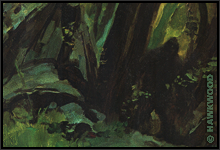


What is possession? The several months of work which I have just spent creating a video of my own version of Bram Stoker’s Dracula gave me time enough to ponder this question while I was occupied with this project. To be clear: I do not mean ‘possession’ in the exorcist casting-out-devils sense, which I regard as a separate issue. I mean: the will to possess another, to gain mastery over someone else’s independence, even over that person’s life.
 |
| Lucy Westenra: the ghostly pallor of a life unnaturally sustained beyond death itself. |
In Stoker’s classic tale of the struggle against evil, despite the heroic efforts of the Dutch vampire hunter Abraham Van Helsing to prevent the encounter, the notorious Count stalks and finally overcomes the hapless Lucy Westenra, and she wastes away and dies. Van Helsing and his associates visit the place of her interment only to discover that her coffin lies empty. Having been bitten by Dracula, Lucy has herself become one of the ‘Un-Dead’: has herself become a vampire, neither alive nor truly dead.
 |
| Dracula's letter of welcome to Jonathan Harker containing instructions for his journey to the Count's castle - instructions that Harker would come to regret acting upon. |
Dracula, the supreme vampire, is also the supreme possessor. In contemporary profiler terms, he is a pathological control freak. He is ‘evil’ in the context of the story’s classic Gothic theme, but (again in contemporary terms) his pathological nature leaves him merely indifferent to the sufferings which he causes to others, including the loved ones of his victims, who are left to cope with the loss of their dear departed who become stranded in a terrible no-man’s-land between life and death.
In my video, Transylvania, while initially being an actual place on the map to which the characters journey, becomes ultimately, not so much a geographical location as a state of mind. ‘Transylvania’ is where you find yourself as a victim of a predator, and it is a frightening place to be. And if you are in that place, two choices lie open to you: the first is to remain aware of your situation, and attempt an escape (as the story’s young realty agent Jonathan Harker actually does). The second choice is to succumb, to (again in contemporary terms) go over to the dark side: to surrender your own will to that of your possessor.
 |
| The grim edifice of Dracula's "...vast ruined castle, from whose tall black windows came no ray of light." |
Does all this talk about vampires and Transylvania seem rather remote from the usual themes which my posts here address? Think about the many religious and quasi-religious cults and the ways in which they manipulate and control their followers. Cult leaders often-enough have a ‘Dracula’ profile: they can be intensely [1]charismatic, and that charisma at times can have a sexual tint. Cult leaders (almost invariably male) may demand – and receive – sexual favours from their female followers, whether or not those followers have partners. And the news will at times carry stories of the openly pedophile activities of such leaders. It’s not really about sex. It’s about feeding off the energy of one’s victims during such encounters, and perhaps also about cementing their loyalty and drug-like dependence upon the leader. And when true and sincere love finds no place in the act, the transfer of bodily fluids becomes vampiric, an expression of mere brute mastery and power. Ask any victim of rape or sexual abuse.
 |
| Transylvania as a place on the map. Using maps of the story's 19th-century period in tandem with Stoker's text, it was possible for me to plot Dracula's overland route to the Black Sea port of Varna, and thence by schooner to the English harbour town of Whitby. For the Count, as for voyagers of today, the Bay of Biscay was a place of storms. |
It is typical of cults that the leaders will encourage or even insist upon their followers severing contacts with their past lives, including with their families. This is usually demanded under the pretext that the cult is their new ‘family’, and the leader is their new father and mother rolled into one. The true reason, as the cult leader well knows, is that any such contacts, were they to be sustained, would undermine the new ‘reality’ which the leader has constructed. But all this manipulation need not be confined to religious cults.
‘Transylvania’ also can exist within an individual relationship. A person with a particularly possessive nature might move to ensure that a partner’s family contacts are damaged or even destroyed. The means to accomplish this might vary, but the result is the same: that partner (perhaps out of a misguided love) will become isolated from his/her own family or parents, and become encased within the new ‘reality’ – and dependent upon the possessive partner – in the way that such a possessive relationship demands. To more-aware others, such a relationship might have the outward appearance of a cult, and itself might actually function using the manipulative emotional mechanisms similar to a cult – but with one [2]leader and one member. It is possible that you might even know of someone in such a situation.
 |
| Once on English soil the Count uses his shapeshifting abilities to transform into both a wolf and a bat: metaphors for the subtle and not-so-subtle masks of human predators in our own reality. |
It is likely that at some time you have had on your doorstep the members of one or other church denomination who proselytize from door-to-door in the hopes of making a new conversion. Such proselytizing activity might actually be a requirement of one’s faith, as it is for the Church of Jesus Christ of Latter-day Saints (known as the Mormons), or for Jehovah’s Witnesses. But is trying to persuade someone (in such cases, a complete stranger) to believe the same things in which you believe an act of conversion, or an act of possession? We find it reassuring when someone else believes the same things that we do, simply because it provides us with a confirmation that what we believe must be ‘right’, and gives us a sense of communal belonging. But however well-intentioned it might be, such persuasive attempted conversion by its very nature and intent is also spiritually predatory – and doubly so when forced conversion is involved, as it has been both in [3]history and in our [4]present-day world.
 |
| The eyes of a predator mirror the same intentions, whether that predator is animal or human. |
Transylvania, it seems, is far from being just a place on the map. As a state of mind it can be anywhere and everywhere, and is real enough. If ever we find ourselves in that terrible place, like Stoker’s young hero Jonathan Harker we need to resist the easy option to succumb and instead struggle to stay awake and alert, and escape if we can to seize our own life back – although we might need the help of loyal friends and loved ones on the 'outside' to accomplish this. And they might not always have fangs and wear swirling black cloaks, but vampires as well are real enough.
Hawkwood
Notes:
[1] Eastern faiths will caution novices about the dangers of becoming beguiled by and ‘stuck’ in the charismatic stage of spiritual development, which is recognized for what it truly is: a mere doorway to further spiritual progress. In the West there are no such cautionary restraints, and you can see the results on any evangelical television network: many such preachers become enamoured of their own charismatic powers, and so stay at that stage rather than moving on into calmer and more humble spiritual waters.
[2] Such a pathologically possessive partner can be a consummate actor. A casual contact with such a type might well leave you concluding that the person is friendly and sincere. I have even seen an interview with an experienced psychiatrist who admitted that, had he not previously read his patient's unnerving case file, he would have been totally fooled into concluding that the man was entirely compliant and normal. If you have seen the film, think of Clarice Starling's first meeting with the courteous and considerate Hannibal Lecter in The Silence of the Lambs. Anthony Hopkins' performance was accurate to type - and the more chilling for being so.
[2] Such a pathologically possessive partner can be a consummate actor. A casual contact with such a type might well leave you concluding that the person is friendly and sincere. I have even seen an interview with an experienced psychiatrist who admitted that, had he not previously read his patient's unnerving case file, he would have been totally fooled into concluding that the man was entirely compliant and normal. If you have seen the film, think of Clarice Starling's first meeting with the courteous and considerate Hannibal Lecter in The Silence of the Lambs. Anthony Hopkins' performance was accurate to type - and the more chilling for being so.
[3] The occupying Roman forces in the Near East and Europe famously executed those locals (either Christians or pagans) who refused to make an offering to their gods. In later centuries, during the Christianization of Europe, the dubious favour was returned by such Christian rulers as Charlemagne, who had 4,500 pagans who refused to convert to the faith beheaded in a single afternoon, after which he retired to attend mass. During the Papal-instigated Albigensian crusade, Christian Cathars were given the choice either to convert to Catholicism or be burned alive. Many chose for the flames.
[4] The recent terrible case of the kidnapping of 200 Nigerian Christian schoolgirls by Muslim radicals carries the news by those radicals that, not only had the schoolgirls ‘embraced’ Islam, but they had ‘decided’ to take Muslim husbands. The girls' whereabouts are still unknown.
Sources:
All images are the copyright of the © David Bergen Studio, and are taken from my video which can now be seen on YouTube here: Dracula: Darkness Rising.


