




In heaven, we are told, hosts of angels sing the praises of the Deity in never-ending glory and affirmation. If we could transcribe their mysterious words, how might they appear? I drew these characters to suggest something of this secret tongue of the angels to incorporate into a piece of [1]art which I was then creating. It was important for me that the characters credibly looked as if they might, just might, belong to a coherent written language.

Now look at this other example of unknown script below. It is a particular treasure of mine, and was found among the effects of my late great-uncle, who (so the story in our family goes) is said to have copied it from characters inscribed upon a small metallic disk which as a young man he found while hiking in the remote Yakima Reservation in Washington State. Convincing? Not really. It’s by me again, I’m afraid. As far as I am aware, my great-uncle never set foot on the Yakima reservation. I myself wrote out the characters in pencil on a sheet of paper, aged to suggest an earlier time frame.
 |
| An alien language? Or perhaps not.. |
My point is that, with a little flair and imagination, it is possible to devise such scripts. On a considerably grander scale than my own modest efforts, J.R.R. Tolkien did the same in his epic works of fantasy with the scripts which he called ‘Elvish’. The example below, stylishly calligraphed by Maciej Garbowski, is in an Elvish script known as [2]Tengwar, used initially by the author to write the language of angelic supernatural immortals. Tolkien’s sophisticated approach to these fictional tongues was based upon his scholarly knowledge of Runic and other proto-European languages, and with this academic grounding to back up his fantasy, he took the development of such fictional scripts far. There is even an [3]organization that studies and perpetuates what he began.
 |
| Tengwar script: the script of Tolkien's angels and elves. |
But even such an adept as Tolkien must bow to what I personally consider to be the benchmark of such scripts: the modestly-sized volume which has been called ‘the most mysterious book in the world’: the [4]Voynich manuscript. Dated to the 15th-century, this book is filled with strange and whimsical illustrations of what appear to be botanical studies, astrological diagrams of stars and cavorting damsels. But it is the astonishingly confident script which is interspersed between these that arrests the attention. Calligraphic and elegant in appearance, the script flows effortlessly on for well over a hundred pages – and yet not so much as a single word has ever been deciphered.
 |
| The elaborate script in the Voynich manuscript remains undeciphered to this day. |
Not that this lack of our ability to read the book has been for want of trying. Cryptographers and linguists, experts in their field, have all attempted to wrestle its secrets free, but without success. The Voynich manuscript remains almost as much of a mystery today as it was when it came to light in our contemporary era in 1912. It is a secret code. It is an elaborate hoax. Both options are possible. But the accomplishments of Tolkien and the unknown author of the Voynich manuscript in creating these seemingly-convincing though apparently fictitious languages are self-evident.
 |
| A diagram from the Voynich manuscript which suggests either a map of a celestial city, or even a plan of Eden with its flowing four rivers - or neither of these things. |
With his Tengwar script Tolkien attempted to suggest the language of angels. But he made no claim to any authenticity in this direction. Not so with my next example. The characters on the document below are claimed to be the actual authentic tongue of angels. This photograph, which came to light as recently as [5]2012, is apparently the only evidence we have for the appearance of the characters on the gold plates alleged to have been unearthed from a Native American burial mound by Joseph Smith, the self-styled prophet and founder of the [6]Church of Jesus Christ of Latter-day Saints, known informally as the Mormons. No hard evidence for these plates has ever been produced, so this transcription purported to be from one of them, apparently written by Smith himself, is our only record of the appearance of the script which Smith translated as the Book of Mormon.
 |
| The only evidence for the appearance of Joseph Smith's angelic language is this photograph of a passage purportedly from one of the gold plates of the original Book of Mormon. |
Smith named the script ‘Reformed Egyptian’: a language unknown either to linguists or cryptographers. He might have been incautious in specifying the name of the purported language. To give it an Egyptian connection invites comparison with an existing script such as Coptic. But it bears no resemblance either to Coptic, Demotic, Syriac, or any other [7]regional written language. The devil is in the term 'reformed', which can mean anything and everything that one chooses it to mean.
And so we must judge this script on this one surviving example – a photograph of an alleged transcription whose whereabouts are unknown of an original for which we have no evidence. Why, when the copyist presumably had the original before him, and knew therefore how much space he had at his disposal to write the passage, do the characters become squeezed for space towards the paper’s fold? These scrawled characters are, remember, purported to be the actual authentic language of angels: they literally are the [8]basis upon which a new religion has been founded.
The alleged transcript seems intriguing, but when compared with the sophisticated mystery of the text in the undeciphered Voynich manuscript, or Tolkien’s elegant Tengwar, it appears clumsy and amateurish – bearing in mind that, if the script is genuine, the writer did not have to invent, but merely copy. Certainly when viewed alongside the superior accomplishments of Tolkien and the unknown author of the Voynich manuscript, and when considered objectively, outside of any context of religious belief, the characters in the transcript would appear to be a fabrication, and a mediocre one at that.
 |
| Demotic text as a vernacular form of Egyptian hieroglyphs written beneath such hieroglyphs on the Rosetta stone. Neither Demotic (which itself could be described as 'reformed Egyptian') nor any other regional language of the time bear any more than a superficial resemblance to the Mormon characters. |
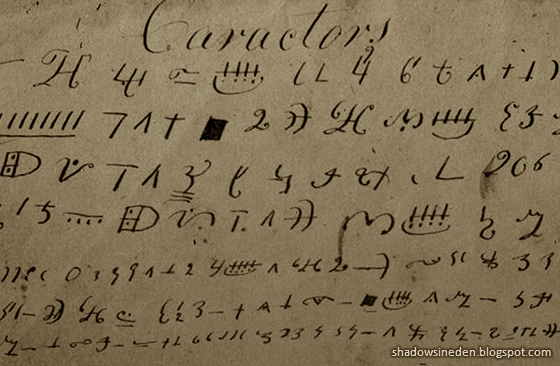 |
| A [9]detail of the transcript alleged by Joseph Smith to be the language of angels. |
Perhaps it is to regret that our faith apparently needs foundations of some material evidence on which it can be built. For if that claimed material evidence cannot be produced, or seems for one reason or another not to hold up to scrutiny, where does that leave us? What we might consider to be the truth of faith is something which is experienced in our hearts, in our innermost being, and that is where the voices of angels are most clearly heard.
Hawkwood
Notes:
[2] Tengwar is the name of the script itself. The language is called Valarin, after the Valar immortals: Tolkien’s angels.
[3] The Elvish Linguistic Fellowship, with the appropriate acronym of E.L.F.
[4] Catalogued as MS 408 in the Yale University Library.
[5] The top half of this image – the half which includes the transcript – was known earlier, but the whole uncropped photographic plate was discovered among the effects of the Hicks photographic collection in December, 2012. The title The Book of the Generations of Adam can just be read on the lower fold.
[6] Please see my previous post A Harvesting of Souls about the Church of Mormon archives.
[7] According to paragraph 64 of chapter 1 of Joseph Smith's 1838 History, the characters were identified as "Egyptian, Chaldaic (sic), Assyriac (sic), and Arabic" by a Professor Charles Anthon in New York. Two of these four terms - Chaldean and Syriac (or Assyrian?) - are incorrect, and Anthon later distanced himself from any involvement, denying that he had validated the script. In any event, the characters are unrelated to these four bona fide languages of the Levant recognized by scholars. The four specified languages all stem from Aramaic, which would fit Smith's time frame, and which therefore would be the most appropriate language for the script, but which strangely is the one language which Smith (or Anthon) did not name.
 The right-to-left reading Aramaic-derived Syriac (left) bears no resemblance to Smith's script. One is left to wonder why Smith took the risk of specifying the four languages which he claimed comprised his characters. Perhaps he considered that such names might lend his document an aura of authenticity - but did he seriously imagine that no one would actually check what he claimed for his mysterious script? In this linguistic sense, the claimed authenticity of Smith's document is comparatively easy to disprove.
[8] This post focuses on the purported characters of the Mormon angel script. The textual content and linguistic style of the Book of Mormon I regard as a separate issue, but clearly if the characters themselves are open to doubt, then the entire book and the story of its alleged coming to light must also be reasonably called into question, as in turn must the whole foundation of Mormon belief.
 [9] From my own experience of devising such imaginary scripts I know that one has to consciously resist lapsing into forms which are already familiar from one's own language. The letter forms of H,L,M,D,V,T and Z can all be seen in this detail, as can various numerals: 4,6,2,3, and even ½. Were these characters copied from a totally unknown language (that is: one that was unknown at the time to Smith), the chances of this happening would be reduced to a negligible coincidence.
 The 'H' in particular (above), which is repeated no less than five times in just this detail, typically follows the form of the capital 'H' in 19th-century penmanship. Curiously, another character, seen at 9 o'clock in the detail, is identical to the astrological sign for the planet Saturn (right). Clearly this could be coincidental - but it is not the sort of coincidence that copying the characters of an unknown language should produce.
Note added 9 January 2015: I have only recently discovered the remarkable work of Ian James, who has created, not just one or two, but many different language scripts, all with authentic historical and ethnic origins, and all of which can be written coherently. These scripts are of such a creative order that (it has to be said) their level of sophistication, and the fact that they actually can be written with a lingual coherence, surely leaves the example of Joseph Smith floundering in the world of crude fabrication.
Ian James' website: Sky Knowledge.
[9] From my own experience of devising such imaginary scripts I know that one has to consciously resist lapsing into forms which are already familiar from one's own language. The letter forms of H,L,M,D,V,T and Z can all be seen in this detail, as can various numerals: 4,6,2,3, and even ½. Were these characters copied from a totally unknown language (that is: one that was unknown at the time to Smith), the chances of this happening would be reduced to a negligible coincidence.The 'H' in particular (above), which is repeated no less than five times in just this detail, typically follows the form of the capital 'H' in 19th-century penmanship. Curiously, another character, seen at 9 o'clock in the detail, is identical to the astrological sign for the planet Saturn (right). Clearly this could be coincidental - but it is not the sort of coincidence that copying the characters of an unknown language should produce. Note added 9 January 2015: I have only recently discovered the remarkable work of Ian James, who has created, not just one or two, but many different language scripts, all with authentic historical and ethnic origins, and all of which can be written coherently. These scripts are of such a creative order that (it has to be said) their level of sophistication, and the fact that they actually can be written with a lingual coherence, surely leaves the example of Joseph Smith floundering in the world of crude fabrication.
 |
| A quatrain from Omar Khayyâm, written in Ian James' Bostani script which is derived from Ancient Persian and Arabic sources. |


