
Return here to the Shadows in Eden home page.....
Showing posts with label Evolution. Show all posts

Monday, June 30, 2014

How do Creationists know what Dinosaurs looked like?

While watching a video of the Creation Museum in Kentucky, with its impressively-detailed animatronic full-scale dinosaur models, I was struck by the thought: how do creationists know what dinosaurs looked like? I mean: there are these moving, snarling model dinosaurs in an institution which has elevated pseudoscience to the dubious level of a theme park attraction, and whose staff (at least, in the various interviews in which I have seen them appear) give every indication of holding a testy disdain for career scientists and the scientific method. So how do creationists know what dinosaurs looked like?

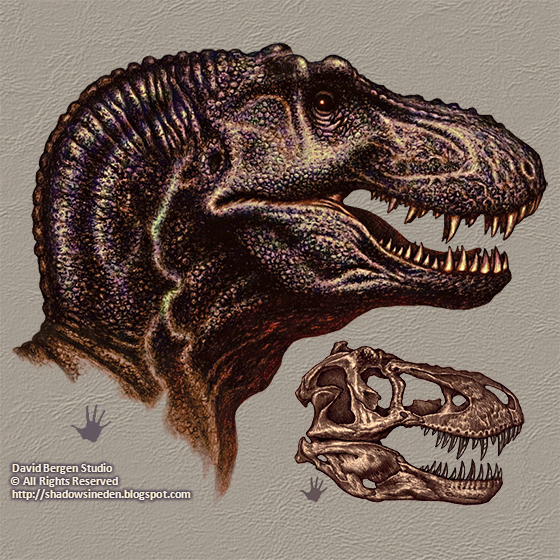
The head of Tyrannosaurus rex. My life reconstruction has to conform to the underlying bone - including the protuberances above the eyes known as rugosities. Experiments with a reconstructed jaw have determined that a T. rex bite generated a staggering 2,900 pounds of force per side: the most powerful bite known of any animal ever. An on-the-record statement by Kenneth Ham, CEO of the Creation Museum, declares that T. rex was on board Noah's Ark and ate coconuts. No, I'm not making this up.
Time on a museum field trip is a precious commodity. It has to be exploited to the maximum, and working hours need to be methodical and calculated. I recall on one field trip getting up at five in the morning, every morning. And weekends simply passed unnoticed. A field trip can by turns be fun, exciting, and tedious – but it is still hard work. How many excursions into the field did it take, over succeeding decades of time, and spanning many, many individual careers, for paleontologists to reconstruct the dinosaurs’ world?
A territorial dispute: pathologies on fossil bones in the form of bite marks suggest that T. rex probably fought its own kind, perhaps over prey or - as I have portrayed here - over territory. Sculpting and photographing a tabletop model was for me the most effective way to bring this scene to life. A dry riverbed served as an arena for the conflict, with typically Cretaceous redwoods and sabal palms in the background, and with the giant pterosaur Quetzalcoatlus cruising through the skies overhead.
And where did those scientists go to? From the Montana Badlands to arid Outer Mongolia, from Patagonia to Alaska’s North Slope, the destinations of such field trips usually demand lobbying for the necessary funding, and in the cases involving some far-flung destination, as often as not some deft and time-consuming bureaucratic navigation through a wild water stretch of red tape in the acquiring of visas, permits, and other assorted documents.

Using a line grid to map a fossil site at the Bay of Fundy.
Safely back on base, the conservation work begins: the painstaking release from its matrix, with small hand-held power drill and sable brush, of some fragile fossil, perhaps over a series of weeks or even months, and the publishing of any findings, as well as the report to the board of the museum in question to justify the funds which have been sunk into both the field work and the subsequent in-museum research and restoration time. More often than not, a fossil will not be found in any great degree of articulation: it usually will be both disjointed and incomplete, or even scattered over a wide area. Maybe the skull is missing – or conversely, maybe the skull is the only part found.

Freeing a fossil from its rock matrix.
So what would the missing parts have looked like? And what does the surrounding fossil environment tell us about the fossil itself? Was it buried in a flash flood, or by a collapsed sand dune? Was it a victim of predation, or was it a predator fallen victim to another of its species? What might the fossil bones tell us about that individual dinosaur’s pathologies – its injuries and diseases – which it suffered in life?

Give this fossil site map to a creationist, and tell them to restore the dinosaurs visible here, using only this map for reference. Click on the map to appreciate the scale of the task.
These are just several of the many questions facing a paleontologist when confronting a jumbled scattering of disarticulated fossil bones in a field location. And that scattering of bones might be from one individual or from several – and even then they might not be of the same species. Only later will someone like myself be brought in to flesh out the painstakingly restored bones as a life reconstruction, always recognizing that there are lines between applied knowledge, reasonable assumption, and artistic licence.

The Early Jurassic predator Dilophosaurus. My reconstruction combines the 'applied knowledge' of muscle attachment points on the bones, the 'reasonable assumption' of the animal's stance derived from the articulated restored skeleton, and my own 'artistic licence' in devising the skin patterns - which are themselves calculated reasonable assumptions based upon the creatures of our extant natural world. 
Applied knowledge would include such factors as the attachment points of muscles, which usually can be seen on bone as areas of rough pitted striations. Reasonable assumption could be the stance in which the animal is shown, which can be enhanced by the applied knowledge of the way in which the skeleton would have been articulated in life. And artistic licence would typically involve skin colour and patterns, which generally are speculative. But always when creating such a life reconstruction, I am aware of the untold research time of career scientists, both in the field and in the museum, behind what I am doing.

Dilophosaurus had a rather weak joint on its upper jaw, and its double crest was surprisingly fragile - hardly suitable for a pitched struggle with a large prey animal. Its long narrow teeth, however, would have been ideal for grasping a struggling fish: all factors which allowed me to portray it as, silent and intent, it fished for its breakfast in the early morning mists in southwest North America some two hundred million years ago.
So how do creationists know what dinosaurs looked like? They do not commit their time and [1]resources to the rigors of museum field work. They do not spend their working lives painstakingly piecing together the herculean puzzles of fossil bones tackled by professional paleontologists. There is only one answer possible: they have come by this knowledge by cynically climbing over the backs of the very scientists whom they so openly despise. And the reason why creationists are able to include in their [2]institution those [3]crowd-pulling animatronic dinosaurs is because career scientists of all [4]persuasions, philosophies and beliefs, but all of whom endorse evolutionary theory and geological time, have committed their working lives both to finding and restoring those jumbled scatterings of fossil bones.
Hawkwood


Notes:
[1] Please don't mention the name 'Buddy Davis' to me. A scientist might play country music, but a country music singer does not a scientist make. Mr. Davis also considers himself to be a reconstructional artist of things dinosaurean. Looking at his work is a chilling reminder of what can happen when reconstructional art is unsupervised by qualified professionals. All of my own work in this direction has been produced on a professional basis with consultant scientists, which therefore includes my above paintings. So... the Creation Museum organizes a 'field trip' to dinosaur country in Montana led by... Mr. Davis? Oh, spare me...

[2] It is a rich irony that, in an apparent attempt to give their institution a veneer of respectability, creationists have opted for the term 'museum'. As this word derives from the original temple of the Muse in Ancient Greece, these overtly Christian fundamentalists have named their building after a pagan temple. Time, I think, for a facepalm.

[3] These days the Creation Museum is, apparently, not so crowd-pulling. Presumably now that the initial novelty value has faded, public attendance figures for the 'museum' have been in decline.

[4] A creationist website I recently visited ('Answers in Genesis') describes all scientists who are not creationists as 'secular scientists'. This is insular fundamentalist absurdism. The scientists with whom I have worked over the years, all of them hard-working men and women, have been all shades of belief, from good Christian souls to sincere and decent-minded atheists. I have even worked on reconstructional art with a paleontologist (now retired) who held committed, serious and respectable pagan beliefs. The self-serving phrase which creationists like to use for their own kind - 'creationist scientists' - is an oxymoron (perhaps with the emphasis on the last five letters). Unless someone follows the scientific method of getting down and dirty in the field, making a career of tedious but necessary lab work, and writing papers to submit to accredited peer review journals, then it is not science, and one cannot with any justification call oneself a scientist.


Sources:
Top and second images: Original artwork painted by Hawkwood for the © David Bergen Studio, All Rights Reserved. Third image: Earthquake Dinosaurs. Fourth image: Australian Geographic. Fifth image: Barnum-Brown Howe Quarry dinosaur bones map from Wikimedia Commons. Sixth and last images: Original artwork painted by Hawkwood for the © David Bergen Studio, All Rights Reserved.

Gregory M. Erickson: Breathing Life into Tyrannosaurus rex. Scientific American, vol. 281, #3 (The article detailing the calculations of the bite force of T. rex. These calculations are, as Dr. Erickson points out, a 'conservative' estimate.).

Footnote added July 6, 2014: While cruising the radio dial yesterday, my wife tells me that she happened to hear a broadcast from the Dutch EO (Evangelische Omroep: Evangelical Network) channel which confidently announced the 'fact' that dinosaurs only became carnivorous once they had left the Ark, the apparent 'proof' for this being that no fleshy remains had been found between their teeth. I mention this here because it provides a neat example of the way in which evangelical creationists are forced to paint themselves into ever more ludicrous corners of reasoning.

A fossil T. rex tooth. The massive root is two-thirds of the total length, and there are rows of serrations on the anterior (leading) and posterior edges that would have trapped and shredded fibrous filaments of flesh. With the bite force behind it, this tooth would have sliced straight through bone.
The teeth of a carnivore: For those in touch with reality, the issue of Scientific American referenced above also contains an article (above) by William L. Abler (The Teeth of the Tyrannosaurs) which throws some rather more sane light on this issue. Dr. Abler has reasoned by experiment that traces of shredded flesh could have become trapped between the tooth's serrations, where they would have rotted, making the bite from a T. rex septic for its victims (and presumably also giving this most awesome of carnivores an extreme case of bad breath). There also are various existing fossils of the herbivore Edmontosaurus which show clear pathologies of wounds in the form of scars and bite marks which match those of T. rex teeth. To forestall counter-claims: no, these pathologies are not from dinosaurs which had already left the Ark. You either claim that all dinosaurs were herbivores or you don't. But you cannot have it both ways.

Sunday, September 1, 2013

All Things Bright and Beautiful

Seeing the hand of God in creation is not difficult. One has only to look at the magnificence of a sunset, or the splendour of a rainbow after a shower of life-giving rain, or the intricate beauty of a butterfly’s wings. At least, that was what someone once reassured me. My answer was that if he accepted these things as part of that creation, then he must also accept that the spirochetes which form syphilis, the rogue cells of cancer, and the bot fly are also part of that same scheme of things.

The eyes of a leopard. We tend to think of such predators as being at the top of the food chain, but titanic struggles between predators and prey are constantly taking place at the microscopic level as well.
The bot fly (I explained to him) injects its larvae into the nestlings of [1]birds. The huge growing larvae, crawling their way through living flesh, eat the baby birds from the inside out, causing slow and excruciating death before they [2]burst through the flesh to continue their own life cycle. He thought for some time about this, then carefully responded that those sorts of creations cannot be God’s, but must instead be the work of the Devil. He seemed not to be aware that, in ascribing equal creative powers to the Devil as he gave to God, he was committing what from an orthodox standpoint was an extreme heresy.

An electron microscope image of the bacteria Vibrio vulnificus. This exclusively carnivorous and highly-predatory water-dwelling bacteria eats flesh – any flesh, including that of humans. Wounds on the victims resemble the massive and ragged-edged bites of a shark attack.
Perceiving the mechanisms of the natural world as a blind force with no supernatural agency involved removes this gnarly moral problem at a stroke. It is only with the introduction of supernatural creation that seemingly-insurmountable moral ambivalence is introduced into the mix. If God created everything, then he also consciously created some very nasty stuff as well as those butterfly wings: things which were deliberately created to make other things suffer, which makes God’s own moral stance anything but ‘loving’. But if you accept that God created rainbows, but don’t accept that he created everything, well… then you’re a dangerous heretic by default. Ah, the dilemma!

The magnified scales on a butterfly’s wing. The colours are not formed from pigment, but from minute prisms which refract the light. Much that we perceive as beautiful is not even visible to the naked eye.
And what a strange creation it is. It exists by consuming itself, with a large percentage of all the organisms sustaining themselves by eating other organisms, from big cats on the Savannah right down to predatory microbial life – and often-enough with processes involving considerable pain, stress and suffering to the consumed. It has been the unenviable task of religious belief to iron out this paradox, which becomes a moral paradox as soon as it is linked to a consciously intelligent creator. The person with whom I was in conversation had opted, quite unknowingly, for a scheme of things which was proposed in distant centuries by the Gnostics.

A common dandelion head festooned with dew and spider silk on an overcast morning. The human mind perceives the beauty while the natural world remains indifferent. The delicate lace of a spider’s web is an efficient trap spun by a predator for ensnaring prey, which it then paralyzes and keeps alive to consume.
What the Gnostics believed was that the ultimate godhead is unknowable, unfathomable, and defying any attempt at description by mere humans. The first emanation from this Mystery is [3]Sophia – Wisdom – the feminine creative force. Sophia, rashly experimenting with her own creative powers, begets a monster known as the Demiurge – the ‘Craftsman’ – who is sometimes depicted as a serpent with a lion’s head. The Demiurge in his turn also rashly forgets that his powers are not his own, but are loaned from Sophia. In his hubris the Demiurge then creates the world, and all the creatures in it.

The veined traceries of fallen leaves in Autumn. The human mind’s ability to create patterns of its own seems to make it hard-wired to assume intelligence behind naturally-occurring patterns in the wild. Since such an assumed intelligence would by definition have to be a supernatural one, it lies forever beyond proof in the realm of personal belief.
It is this [4]Demiurge who resembles the creator god of scripture – a god who creates the world and its creatures. We consider the scriptural God as supreme, just as the Demiurge, in forgetting the higher powers above him, also thought that he was the supreme creative force. Knowing this ‘back story’ readily explains why the world is flawed, violent and ambivalent, why it survives by consuming itself in ways that are often savage and the cause of suffering to its denizens. This makes sense if the creator god is a lesser god who acted out of arrogance. But attributing the world and its creation to a god who is loving and all-powerful immediately gives rise to disturbing moral issues. If God is all-powerful, why does he allow such suffering to exist? And if he is loving, why did he consciously and willfully create the natural mechanisms which cause such suffering in the first place? You cannot cite sin as a reason, because the [5]natural world is not subject to sin.

A Dutch winter landscape, photographed not far from where I live. Our senses respond to the snowy white silence and purity of nature in winter, but for the animals which live in it, it can mean a time of hardship, starvation, and even death. 
In a recent earthquake that occurred in Peru a church collapsed, tragically killing many of the congregation who were at worship inside. What are we to think of this incident, if we consider the presence of an omnipotent god? Weren’t they praying hard enough? Such speculation hardly comforts the bereaved, and leaves us floundering in a moral morass.

All things bright and beautiful,
All creatures great and small,
All things wise and wonderful:
The Lord God made them all.

So go the words of the well-known Sunday school hymn. But this squeaky-clean version of the creation only tells half the story. And Gnostic beliefs might have been vilified by the Church for centuries, but at least Gnostics managed to come up with a more feasible explanation for why things are the way they are.
Hawkwood   


Notes:
[1] Potentially any warm-blooded animal, including humans, can become a host. But with nestlings I’m using the example which I have seen.

[2] Yes, I know what you’re thinking, and yes, such earthly parasitic life-forms were indeed the inspiration for the alien’s life cycle in Ridley Scott’s film.

[3] Hence the term ‘philosophy’: ‘love of Sophia (Wisdom)’.

[4] Although a unique entity, the Demiurge tends to be confused in Christian thought with the Devil, which is why the Christian claim that the Gnostics believed that Satan created the world is a misunderstanding.

Tyrannosaurus rex, the superlative-defying predator at the top of the Cretaceous food chain - and of the dinosaur popularity stakes in the human imagination - flourished at the very end of the age of the dinosaurs for a comparatively brief two million years.
[5] Even your familiar four-legged household friend lacks the enzymes necessary for the digestion of a vegetable diet, so please spare me the Christian fundamentalist claim that animals only became carnivorous after the Fall. Such a line of thinking leads inexorably to the idiocies of creationism, and creationist claims that Tyrannosaurus rex (above), whose bite force has been calculated at a staggering 2,900 pounds per side of the jaw (the most powerful of any animal known), was on board Noah’s Ark and ate coconuts. You think I’m making this stuff up? I wish that I was, but Kenneth Ham, the founder and CEO of the Creationist Museum in Kentucky, is on record as saying this. But then again, how do creationists know what dinosaurs looked like?


Sources:
Sources are untraced for the leopard, the Vibro vulnificus bacteria, and the butterfly wing scales. All other photography and T. rex skull drawing by Hawkwood for the David Bergen Studio © All Rights Reserved. 

Thursday, October 4, 2012

Respect

In this week’s [1]newspaper the Dutch philosopher and columnist Martin Slagter questions the assumed right of religious beliefs to command automatic respect. Our very laws are slanted in favour of this, both socially and politically. But, Slagter wonders, just how justified is such a stance really? I weighed Slagter’s words against my own experiences. Right here in Holland, in my own neighbourhood, Christian Calvinists have averted their eyes and turned their backs on me when I have walked past them, apparently for no other reason than that my appearance is fairly goth (how ironic, then, that both they and myself favour wearing black!). When considered simply as preferred lifestyles, there is no reason whatever that my Calvinist neighbours should not give me as much social acceptance as I would give to them. And yet in some mysterious way, because their own lifestyle is belief-driven, they apparently assume the moral high ground, and their actions leave me feeling judged by them accordingly.


On various Internet forums I have had much experience debating the case for science (drawn from my own professional experience) with numerous Fundamentalist Christian creationists who clearly considered that Charles Darwin is almost interchangeable with the Prince of Darkness himself, and who regarded the theory of evolution as the ultimate heresy. The sheer toxic invective directed at the theory of evolution in general, and Darwin in particular, actually took me aback the first time I encountered it. And it was not so long ago that a furore broke out here in Holland when it was discovered that the Christian Evangelical channel was broadcasting David Attenborough’s commendable Life of Mammals nature series with the scenes which referred directly to evolution discreetly edited out.


To encounter minds right here in the 21st century which sincerely believe that dinosaurs were on board Noah’s Ark (which they had to be, if one also believes that all animals were created within one extremely busy week), and that the Earth is no more than [2]6,000 years old, was an experience for me almost akin to culture shock. I don’t go toe-to-toe with creationists any more (these days I’d sooner more fruitfully spend my time writing my blogs!), but in the two years which I did so, I encountered some very strange minds indeed in the anti-evolution camp. ‘Strange’ in the sense of apparently being willfully misshapen by the very religious beliefs which they sought to uphold.

Borders inside ourselves can be slipped over without our even noticing, and these include borders of human decency: of a sense of moral worth in what we believe as religious faith, and the acts which we perform in the name of such faith. Inevitably, this now includes those acts of social violence and terror which are committed in the name of Islam. To physically attack another – even to take a life - in the name of ‘upholding’ one’s faith is to diminish both oneself and, inevitably, one’s faith as well. And how bitterly ironic is it that you exultantly proclaim that ‘God is great!’ at the very moment that you take the lives of those (as someone doing so surely must believe) who are the creations of that same God?


I personally see no reason why religious belief as such should be granted respect as part of any privileged package deal simply because it is religious belief, and not some other form of moral code or ethical principle. Sure, we should respect the worldviews of others, but that respect should have more to do with a deeply-driven sense of human decency, of ‘doing the right thing’. And in religion, alas, that is not always present. Should I respect a religion whose ultimate authority on this Earth throws a mantle of tacit inaction - even protection - over the systematic and long-term pedophiliac activities of those answerable to it, instead of firmly establishing its own moral authority by conducting a rigorous and sweeping root-and-branch excision from their holy offices of the offending priests who have been responsible for ruining so many young lives?

Steven Weinberg said: “With or without religion, you would have good people doing good things and evil people doing evil things. But for good people to do evil things… that takes religion.” Everything in me wishes that it were not so. Desperate experience shows that it is.
Hawkwood


Notes:
[1] Martin Slagter: Geloofsovertuiging is ook maar een mening (‘Religious conviction is also just an opinion’), in De Volkskrant, 3 October, 2012.


[2] For those unfamiliar with the arcane logic of creationists, they rely for this particular bit of reasoning on the calculations of Archbishop James Ussher, who in the 17th century totted up all those Biblical ‘begattings’ to conclude that the creation of the Earth took place on the evening before 24 October, 4004 BC. I try to be tolerant of others, I really do. But truth to tell, inside a creationist’s head is not a place that a sane, well-balanced person would wish to be.

Sources:
Top image: Alberta Human Services. 2nd image: AnimalPhotos! 3rd image: Associated Press.