Return here to the Shadows in Eden home page.....

Sunday, July 21, 2013

Dreamland: Inside Area 51

It covers several sprawling square miles of ground in arid southern Nevada. Ringed by notices which carry dire warnings to trespassers, it is known officially as the Nevada Test and Training Range. To the several thousand Federal Government employees who work there it is, with a touch of whimsical irony, known as Dreamland. To the public, and to conspiracy theorists the world over, it is better-known by the number of the land grid that it occupies, which carries the simple designation of Area 51.


Beyond the stern warning signs is a facility that ostensibly is (or was) used to test new technology in military aircraft: reason enough for every employee on the site to be subject to the Internal Security Act – and also reason enough for the Central Intelligence Agency to have a finger deep in this particular pie. The adjacent white expanse of Groom Lake – which is not a lake but a dry salt flat – makes a natural surface to exploit as a runway, and the various large covered hangars and other peripheral buildings keep their secrets safe, both from the prying eyes of powerful binoculars viewing from the surrounding hills and from digital visitors on [1]Google Earth.


Since its inception in the 1950’s, rumours have persisted that the base is really an elaborate cover for more clandestine activities, as bizarre as they are secretive. These rumours claim that the base is really a holding ground for captured Unidentified Flying Objects – UFO’s – and more specifically (and perhaps more sensationally), for their alien crews. There are two alternative ways of viewing these stories. A lack of available firm knowledge about something creates a vacuum into which speculation naturally rushes. Prompted by the veil of secrecy surrounding the site, and boosted by claims of sightings of unknown aerial craft in the vicinity, the rumour mills began to grind. But the opposite cause could equally be true: that these stories were actually generated by the CIA itself as a smokescreen for the secret military activities which take place there.


You can read about these [2]claims in depth on any number of conspiracy theory websites, so merely repeating them here would serve little purpose. My own focus is different, and has more to do with the way in which smoke can be generated without fire. In spite of all the speculation, and the whistle blowing by [3]former employees, not a scrap of hard evidence has emerged that would give solid support to these theories. And yet they not only persist, but are believed in passionately by their adherents: aliens are on our planet, and they are being held under conditions of top security at Area 51. Why, even the President himself has met them!

Where is the truth in all this? It is impossible to say. An alleged smuggled-out grainy black-and-white film purporting to show an autopsy of an extra-terrestrial is only ever going to be circumstantial. Is it a clever (or a clumsy) fake? Who knows? Common sense might say ‘yes’, but what fascinates me is the way in which the human mind naturally clings to something, is willing to go on believing in that thing, even when there is no supporting evidence to back it up. The obvious parallel is with religion. Religion has to be about faith – the faith to believe in something for which there is no clear evidence.

Area 51 on Google Earth. Click on the image to view it screen size.

In the Book of [4]Exodus we read how Moses encountered a voice that spoke to him from a bush which, though burning, was not consumed. But how do we know about this? Moses was the only one present, so any credence we give to the story is based on hearsay. Hearsay …and the faith which is generated by the simple fact that the story appears in scripture. Place the story in a secular context, and the very people who believe passionately in the actuality of the story would dismiss it as the deluded ramblings of an old Bronze Age shepherd, whose actual existence is itself a matter of belief. They might still give it value as a story, but its actuality would carry no more weight than we would give to such a story as Odysseus’ defeat of the giant cyclops Polyphemus. [5]Homer might thrill us with his storytelling, but not for a moment do we imagine that this incident actually happened.

Belief without evidence is smoke without fire, whether that belief is in the existence of detained aliens at Area 51, or in a Bronze Age shepherd listening to a bush that talked to him. But such belief still ironically depends on the fires of faith to keep it burning – and on the existence of Dreamland.
Hawkwood   

  
Notes:
[1] For those with the free Google Earth program, the coordinates are: 37°14′06″N 115°48′40″W. Just paste these coordinates into the search box and you'll be flown there!

[2] These include ‘reverse technology’ study of captured UFO’s (that is: studying such craft in an attempt to duplicate their alien technology for military purposes), attempts to communicate with surviving aliens, etc.

[3] The controversial testimony provided by Bob Lazar is probably the best-known example of this.

[4] Exodus 3:1-5. Please also see my post The Burning Bush. Yes, I am aware that Moses is traditionally considered to be the author of the first five books of the Old Testament, but this is attributed tradition, and has no basis in scholarship. Neither is there any historically independent verification that Moses actually existed. He might have been an amalgamation of various such characters from that time. There are enough textual and stylistic inconsistencies apparent in these texts (even within the first few verses of Genesis) to postulate various unknown authors for these writings.

[5] It occurs to me that a curious parallel exists between Homer and Moses: they both were presumed to have lived some 3,000 years ago, and they both were the presumed authors of texts which tradition associates with their name. Scholastically, however, neither author can be proven to have existed, and the texts ascribed to them could well be an amalgamation of the works of various unknown writers from that time. 


The second image is adapted from a photo by X51. The smaller sign reads:
WARNING
Restricted Area
It is unlawful to enter this area without permission of the Installation Commander.
Sec. 21, Internal Security Act of 1950; 50 U.S.C.797
While on this Installation all personnel and the property under their control are subject to search.
Use of deadly force authorized.

The third image is from UFOPictures.info. The fourth image shows the view north towards Groom Lake, with various hangars and buildings as seen on Google Earth, photo by Digital Globe, image by Landsat.

Tuesday, July 9, 2013

Hawkeye, Moses and the Right Stuff

Glancing at my bookshelf a couple of evenings ago, my eye fell upon a great American literary classic: James Fenimore Cooper’s The Last of the Mohicans. It set me to thinking about the moral compass of such narratives. For all his ups and downs, Hawkeye, Fenimore Cooper’s existential frontiersman, strives to ‘do the right thing’ in the situations in which he finds himself. At certain moments in the narrative such striving lifts him to heroic stature, and his example lifts us up with him.


The moral compass of this work and other such titles as John Steinbeck’s Cannery Row, or Ernest Hemmingway’s The Old man and the Sea, or even Mark Twain’s [1]The Adventures of Huckleberry Finn, is never in doubt. Their central characters, however embattled through circumstances, remain basically good and decent. Indeed, guided by his own moral compass, Hawkeye moves mountains in his attempts to affect a rescue of the story’s victims of kidnap. 

Now let’s take Fenimore Cooper’s protagonist and place him on a very different frontier. Could we imagine Hawkeye willing to kill a child, or handing over a young girl in his care to be raped, or overseeing a massacre of women and children? If the answer is ‘no’ – and it has to be – then what makes such possibilities, not merely unlikely, but in the minds of we the readers, completely out of the question? We take our lead from the narrative itself, which gives us every indication of Hawkeye, not just having decent moral standards, but of adhering to those standards. In short: he lives by his own innate code of moral values.


My eye travels to another title on my shelf. Four of its characters we already have encountered in [2]posts on this blog. Could we imagine these characters being prepared to kill their own children, or offering their own daughters up to be gang-raped by a mob, or directing a massacre of defenceless women and children? The answer has to be ‘yes’- because all these events actually take place within the narrative. The characters are respectively Abraham, Jephthar, Lot and Moses, and the book is of course my own copy of the King James Bible.

Now we are confronted with a paradox. On the one hand we have Hawkeye, the frontiersman with the moral right stuff. On the other, we have four names whose moral compass is clearly awry – at least when compared to those of our frontiersman. How is it then possible that these names are held up as examples of ‘doing the right thing’: in this case, of being obedient to God’s will? Abraham is prepared to kill his own son. Jephthar actually does kill his own daughter. Lot actually does offer his two virgin daughters to a street mob to be raped. Moses actually does command his men to kill many defenceless women and children whose lives had previously been spared.


The question has to be: why do we not condemn these four, whose actions are so clearly reprehensible, even inhuman? Why, against all reason, does an aura of virtue apparently cling to them? There is only one answer which presents itself: because they are in scripture. Hawkeye, on the other hand, has to make do with a secular context. And yet all our instincts tell us that, were there ever to come a hypothetical face-off between, say, Hawkeye and Lot, then the frontiersman would view the Sodomite as being worthy of nothing but his contempt, as flawed in his values as the treacherous Huron Magua from his own world, who, like Lot, was fully prepared to betray the trust which others had placed in him.


There might be someone, somewhere, who can clearly explain to me the reasons why the moral compass of such characters from scripture is worthy and exemplary – and indeed, why God’s also is, if these actions were in his name. There might be, but I’m not holding my breath. In the meantime, I’m happy enough to take Hawkeye, the embattled frontiersman with the moral right stuff, as being more worthy of my emulation and more deserving of my respect than such flawed scriptural luminaries as Abraham, Jephthar, Lot and Moses.
Hawkwood


Notes:
[1] I seem to have chosen four American authors as my examples. You can probably think of as many British, European and other authors whose characters exemplify moral decency. Heck, I can even think of the characters in Bram Stoker’s classic gothic tale Dracula – Jonathan and Mina Harker, John Seward and Abraham Van Helsing – whose moral decency drives them to strive their utmost in their struggle against the notorious Count. Would Van Helsing have offered his own daughter up to be raped? Just saying.

[2] If you wish to independently check for yourself that the Bible really does say what I claim for it here, these posts together with their chapter-and-verse citations are:
For Abraham: Abraham, Isaac and a Stressed Out Ram, (Genesis 22:1-18).
For Lot: Lot and His Daughters: The Inside Story (Genesis 19:1-38).
For Moses and Jephthar: Frontier Justice in the Promised Land (Numbers 31:7-18, and Judges 11:29-40).


The two top images are adapted from paintings by Zdeněk Burian, the second two images are adapted from paintings by N.C. Wyeth.

Thursday, July 4, 2013

Abraham, Isaac and a Stressed-out Ram

If ever a ram was in the wrong place at the wrong time, it was this one. It already was having a rather rough day, having somehow managed to entangle its horns in a thicket. With the desperation which any animal feels when it knows that it is stuck fast, it must have been feeling pretty stressed out as it struggled to free itself. But for this particular ram, a day which already had begun badly was about to get a whole lot worse.


This is, naturally enough, how things must have seemed from the ram’s side of things. From the point of view of the two humans who appeared on the scene, this particular ram was - quite literally – heaven sent. The two humans were Abraham and his beloved [1]only son Isaac, and they were there on that mountainside because God had commanded Abraham to sacrifice Isaac to him as a [2]burnt offering. This story in [3]Genesis is traditionally put forward as a shining example of ultimate obedience to God’s will – although any parent will fully appreciate the mental anguish that Abraham must have endured upon hearing God’s command.

And Isaac? Well, young Isaac does not actually know of God’s – or his father’s – intentions. And neither does his father tell him. On the way up the mountain he actually innocently carries the load of wood for his own funeral pyre on his back. One wonders how willingly he would have shouldered the load (if at all) had he known that he would play the central role in the coming sacrifice. But clearly he has his suspicions, because he asks his father where the sacrificial animal is. To which Abraham guardedly replies that the Lord will provide. Which, considering that Abraham already knows that (as far as he was aware) the Lord already had provided, is a cruelly cryptic response, to say the least.


But at what exact point in the story does Isaac sus the awful truth? We are only told that, when the place of sacrifice is reached, Abraham ‘bound Isaac his son, and laid him on the altar upon the wood’. Well, if poor Isaac didn’t know before, he sure must have tumbled to the way things are by now. But what happened? Did he struggle when he felt the rope tighten around his arms? Did he feel a terrible sense of betrayal at the way in which his father had tricked him into accompanying him? We are not told. What we know is that, just as Abraham raises his knife to do the deed, the angel of the Lord stays his hand and draws his attention instead to the ram.

Ah, yes… the ram. It was, apparently, ‘behind’ Abraham the whole time – and presumably struggling to break free from the thicket. Did Abraham neither see it nor hear its struggles during the whole episode? Apparently not. Of course, the reason might well have been because Isaac was at the time screaming his lungs out in anguished protest, both at his father's betrayal of trust and at the realization of his own unexpected mortality, which, though unbiblical in sentiment, would certainly be plausible as a normal human response to the situation.


So the ram is predictably sacrificed in Isaac’s stead, and we are left with a hatful of questions. What does this story say about Abraham, who was quite prepared, not merely to sacrifice his son, but to trick him into attending his own funeral service? And what does it say about a God who was fully prepared to let a father think that he must kill his own son, and then at the supreme moment turns around and says that it was all just a test?

This story has become an irresistible soft target for scripture’s detractors, with its apparently bizarre standards of morality and its flirting with human sacrifice in God’s name. But what I find disturbing on a more profound level is the way in which those who accept scriptural authority seek to justify the events. I have just read on one such [4]website the statement which urges us while reading this story to remember that “sacrificing children was neither against the law nor uncommon especially in the land of Canaan.” As if that in some obscure way makes things okay. It does not, and if you think that it does, then somewhere along the line you have made a sacrifice of your own – to what is morally and humanly decent – for the sake of your beliefs.
Hawkwood


Please Note:
If you who are reading this imagine that such a misguided and reprehensible action as sacrificing one's own child to one's deity belongs to a safely remote past, then consider this: My wife has drawn my attention to a column in today's newspaper (Trouw, 7 July 2013) in which the communications advisor Ton Planken (right) underscores the situation here in the Netherlands' Bible Belt. Their religious beliefs dissuade strict Calvinists from having their children vaccinated. In the last outbreak of measles here in 2,000, three children from such families died - each one an easily preventable death had those children received the available vaccination. With the first outbreak since that time now current, one hundred and sixty one children in the region have already fallen ill. One holds one's breath to see how many children will this time be offered up in the name of the religious beliefs of their parents. The full article in Dutch can be read here: Measles and Human Sacrifices.
Note added 20 January 2014: I overlooked adding this note at the time, but one girl died of measles in the area in this new outbreak - another easily-preventable death as a direct result of the parents' religious convictions. Were it in my power I would hold them culpable for death by neglect. 


Notes:
[1] It is puzzling that Genesis describes Isaac in these terms when we also are told by scripture that he in fact had an older brother named Ishmael.  

[2] A burnt offering was any corpse of a human or carcass of an animal which, having been slaughtered, was then ritually burned so that the smoke would waft heavenwards to please the deity in whose name he, she or it had been killed. Please see my post Frontier Justice in the Promised Land for an example of actual human sacrifice in God’s name. Yes, as related in Judges 11:29-40, it was another infanticide: in this case of a father sacrificing his daughter.  

[3] Genesis 22: 1-18.

[4] http://nowthinkaboutit.com/2010/09/abraham-sacrifices-isaac-not/


Top image: Abraham and Isaac, by Anthony van Dyck.
Other images: Abraham and Isaac, by Gerhardt Willem von Reutern.

Tuesday, June 18, 2013

Leaving the Cult

“Gnosticism is a form of spiritual perversion. Its main teaching is focus on self salvation through knowledge only. Gnosticism comes from the mixing of the ancient teachings of the kabbalah with the teachings of Christianity. The end result of this mixture is a systematic distortion of the teachings of Jesus.” ~ quoted on [1]Leave the Cult Website.

The above passage from a Christian website which purports to reveal the 'truth' about Gnosticism is typical of the disinformation which I have come across on such sites. Its text scrolled on down in the same grand style for a length of time way beyond my own reasonable attention span, and left me wondering why almost two thousand years of vilification is apparently still not enough for orthodoxy to have done with Gnosticism.


So in the interests of delivering a better class of information, let's take each statement in the above short paragraph individually:

"Gnosticism is a form of spiritual perversion."
I would suggest that it is a form of spiritual perversion actually to kill someone for no other reason than that you happen to disagree with their beliefs. I’m still searching my history books for an occasion when Gnostics have done this, but can find [2]examples aplenty when the Church has done so – often enough against Gnostics, whose scriptural texts were destroyed and whose right to practice their beliefs was denied by the Church in a succession of 2nd-3rd-century persecutions. This to me is true spiritual perversion.

And to me (and I trust also to you who are reading this), sexual discrimination against women on religious grounds is a particularly insidious form of spiritual perversion. And yet even right here in the 21st-century, the Church still [3]practices wholesale discrimination against women on the question of holding positions of authority within the Church hierarchy. Contrastingly, Gnosticism, both Christian and pre-Christian, recognised gender equality in which women also could - and did - become spiritual leaders and teachers within their communities.


"Its main teaching is focus on self salvation through knowledge only."
Gnosticism certainly focused on self salvation. That was the whole point. Salvation – recognition – of one’s true Self, which was and is the Self which is the divine essence which lies beyond the selfish and illusory ‘self’ of the ego. In this personal quest, Gnosticism sidestepped the top-down religious chain of command set up by the Church, which insisted – and still insists – that the [4]Pope, quite literally, is closer to God than humble you and I, and bishops were to be obeyed without question.

'Gnosis’ is a Greek word usually translated simplistically as ‘knowledge’. But gnosis is more than finding out about things. It involves a profound sense of seeing into the heart of the world, which allows us to glimpse the oneness behind the many forms of our everyday experience. In this quest Gnosticism was profoundly spiritual in its intent, as such a quest was expected to lead to an experience of the divine, and the experience of true gnosis was therefore an epiphany which had perhaps more in common with the eastern spiritual experience of enlightenment.


"Gnosticism comes from the mixing of the ancient teachings of the kabbalah with the teachings of Christianity."
Pre-Christian Gnosticism included both the teachings of the wisdom of the Greek Pythagorean and Egyptian Hermetic mystery schools, which in turn influenced the Hebrew Mosaic elements which still can be found in the Old Testament – remembering that Moses was himself an initiate of the Egyptian temple mysteries. As to the ‘teachings of Christianity’: there was no ‘Christianity’ – and also no Bible – for at least the first hundred years following the events of the crucifixion. The popular misconception is that there were such people as ‘Christians’, but the historical reality is that there were many different versions of these beliefs, with no one version being more ‘right’ than another. But which version is today the ‘right’ one? Currently there are some 23,000 to 38,000 [5]different Christian denominations worldwide, many and perhaps most of whom would not worship in the church of a different denomination.

Despite the zeal of the early Church Fathers in their willful attempts to eradicate Gnostic beliefs from scripture, much Gnosticism remains [6]‘hidden in plain sight’ in canonical texts. So if you have no wish to be influenced by Gnostic beliefs, then I would strongly suggest that you stop reading your Bible. Seriously.


"The end result of this mixture is a systematic distortion of the teachings of Jesus."
Current [7]scholastic opinion now considers it likely that the original form of Christianity was Gnostic, or stemmed from Gnostic principles. Oh, the irony.

I have just read on another [8]website similar to Leave the Cult the startling statement:
"To conflate the bogus [9]pseudographia (sic) of the Nag Hammadi library with genuine scriptures is immensely dishonest." …which is itself an ‘immensely dishonest’ statement. Why? Because it slips in a [10]non sequitur by presuming that the Gnostic scriptures contained in the Nag Hammadi library are ‘bogus’. Of course they are not. And that 'genuine scriptures' phrase warrants critical scrutiny. Genuine to whom? To impartial scholarship? To those who are prejudiced in one direction or another by their faith?

As I have said before on this blog: at this time frame, no scriptural writings (and there were many of them) were more or less authentic than others. There was no Bible. There were no ‘authenticated’ scriptures. And what ultimately became canonical doctrine was hammered out under the fist of Emperor Constantine, measured and found wanting (or not) in the personal opinion of Augustine, and in the enforced wills of such individuals as Irenaeus, Athanasius, Tertullian, Eusebius and others. And it is always worth remembering that not one single original Biblical text is known to exist. In any case, the description ‘bogus pseudographia’ is not merely tautological; it is disrespectful to the sincerely-held beliefs of others.


My use of the word ‘enforced’ is intentional. Anyone who seriously (and fearlessly) looks into the history will encounter a chronicle of systematic persecution of Gnostics, destruction of Gnostic texts, and annexation of places of Gnostic worship orchestrated by the handful of individuals who decided that their version of Christian doctrine was the only ‘correct’ one. This is the stone cold reason why orthodox doctrine now prevails. Since such doctrinal issues are to be read nowhere in canonical scripture (no, not even what the concept of the Trinity specifically is) the scope for personal interpretation was and is as wide as a Texas horizon.
Hawkwood


Notes:
[1] http://leavethecult.com/gnosticism-perversion-of-the-gospel/
(Note added February 21, 2015:
The 'Leave the Cult' website has now been deleted.)

[2] Apart from the persecution of the Gnostics themselves, other obvious examples from history include the Thirty Years' War, which saw Catholics and Protestants increasing each other's death toll with grim abandon, the infamous practices and sentences of the Inquisition, which, as a Church-founded and run organization, had the power of life and death over those who came before it as 'heretics', and the notorious Papal-instigated Christian-against-Christian Albigensian Crusade (please see my post A Dark Crusade for an overview of this desperately tragic and very dark episode in history).

[3] Please see my post "Behold This Woman".

[4] Please see my post Martin Luther's Final Solution if Protestantism is for you an acceptable alternative, and read about how the decidedly anti-Semitic Martin Luther urged an act of genocide, which then actually took place. Yes, it is historically documented.

[5] This total is given in the World Christian Encyclopedia. This is inevitably dependent upon how a denomination is defined, and the total could well be much higher.

[6] Please see note [12] in my post Vesica Piscis: The Tale of a Fish.

[7] Pagels, Meyer, Scopello, Robinson, et al.

[8] http://edgeinducedcohesion.wordpress.com/2011/08/28/on-the-appeal-of-gnosticism/

[9] Alas, there is no such word as 'pseudographia', I'm assuming that this writer meant pseudepigrapha ('spuriously attributed writings'), a term which also covers those texts ascribed to a specific person, but unauthenticated to be by that person. Since this includes most texts in canonical scripture, the Bible as well comes under the classification of pseudepigraphic writings. If you think that you're on safe ground by ascribing the authorship of the four Gospels to Matthew, Mark, Luke and John, I invite you to read my post The Gospel According to Somebody.

[10] Non sequitur: a conclusion doomed to be false because the starting point is itself a false or erroneous assumption. In this case, the non sequitur is to describe the Nag Hammadi scriptures as 'bogus', without providing any rationalization of this assumption. Actually reading the Nag Hammadi texts offers a profound experience, containing as they do both great wisdom, deep spiritual reflection and intense poetic phrasing. And they are notably free of the genocidal body count, the rough and ready justice, and the guilt-inducing reward-and-punishment views of sin found in canonical writings. For those interested (and open-minded enough), the complete English translations of these texts are available in a single volume as The Nag Hammadi Scriptures, edited by Marvin Meyer, and published by Harper One for Harper Collins.


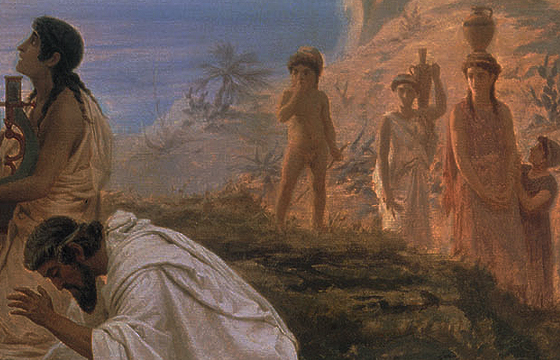
The images are taken from the painting Pythagoreans’ Hymn to the Rising Sun, by Fyodor Andreyevich Bronnikov.

For a further moving description of an aspect of Gnostic beliefs, you are invited to read the post on Emma's blog: Dazzling Darkness.

Sunday, June 9, 2013

Lot and his Daughters: The Inside Story

You perhaps know of the story. It can be found in the Old Testament’s [1]Book of Genesis, and the names of the protagonist and the places are familiar enough, even to those souls who never pick up a Bible. There is old Lot sitting at the gate of the city of Sodom, when up come two angels. Except these angels apparently are human-enough in appearance for Lot to assume them to be ordinary mortals – albeit strikingly good-looking ones. They tell Lot that they are newly-arrived to the city, and having nowhere to stay, plan to spend the night on the street.


Being familiar-enough with the fancies of his home city’s menfolk, our hero sees the dangers, and rather than have them become easy pickings on the moonlit streets of Sodom invites the two strangers to spend the night under the safety of his roof, to which the two assent. Ah, but no sooner do the trio make it to the safety of Lot’s front door when the house is surrounded by a generous number of the city’s male population who, having already caught a glimpse of the two handsome strangers, are only too eager to press their penchant for something more.

So far it’s not a bad story. It’s what happens next that sends things down a mind-spinning chute of deeply-dubious morality – and that morality has nothing to do with the sexual preferences of Sodom’s menfolk, whose city’s name has become a verb still current today. No, that morality has to do with Lot’s own decision making. Because what happens next is that Lot steps outside to calm the crowd, and his attempted means of doing so is to offer his own two virgin daughters to the rabble to have their way with as long as they agree to leave the two strangers alone.


And it’s not just a bluff. He actually means it. Lot actually seriously offers his own daughters to be gang-raped on the street, rather than (as he sees it) compromise the sanctity of his hospitality. Each time I read this story, this is the point at which I shake my head in numbed disbelief. Not just because of Lot’s offer to the mob, but because it is supposed to be Lot’s virtue that sways the angels to warn him, and him alone, of God’s coming destruction of the city, which is why he’d better leave town in a hurry. Virtue? What virtue? For pity’s sake, this is a man who is more than prepared to hand his own young daughters over to be gang-banged by a sex-hungry street mob. I’m not making this stuff up: it’s right there in Genesis 19:8 if you want to check.

Recovering our mental equilibrium enough to read further, we learn that the mob now rounds on Lot, which to me smacks of rough justice, but justice deserved nevertheless. He is, however, dragged inside to safety by his two guests, who for good measure use their supernatural powers to strike the seething throng collectively blind. This is the point in the story where we realise that sleeping on the street for these two would actually have been a viable and completely safe option anyway.


Dawn’s light sees Lot and family fleeing from the city and its coming destruction. God does his fire-and-brimstone thing, Lot’s [2]wife looks back at the ghastly destruction and, as we all know, is promptly turned into a pillar of salt. Not that old Lot shows any particular signs of remorse at being summarily widowed by the Almighty: he’s too busy negotiating with God about where he’s going to flee to. He drives a [3]bargain with God that he can flee to the nearby city of [4]Zoar, because, well… it’s only a small city after all, and hardly worthy of God’s destructive attention. So God wouldn’t mind sparing such a small city, would He? God agrees.


But even in Zoar Lot feels ill-at-ease (which to me smacks of mistrust in God’s word), and flees farther. He takes his two daughters to a cave in the wilderness beyond the city walls, and there occurs probably the most astonishing twist in the story. With their mother no longer a going concern, the daughters realise that their father has no possibility of siring male heirs to carry on his line. So they ply old Lot with wine, and that night the eldest daughter, in that grandly coy Biblical euphemism, ‘lay with him’. We are reassured that Lot sleeps through the whole process, apparently as a way of excusing the whole thing. The next night the younger daughter: ditto. So the two daughters lose their virginity to their own father, and the incestuous results are two sons who go on to found the Moabites and the Ammonites.


It’s a story with threatened rape, threatened sodomy, actual incest, and plenty of disaster movie-scale destruction. And the moral standards of its central character whom God chose to spare are plainly as dubious as those of the inhabitants of the city which God in his wrath destroyed. But it’s in scripture, so all this must be okay, right? And hands up anyone who believes that old Lot was only pretending to be asleep? I thought so… J
Hawkwood


Notes:
[1] Genesis 19:1-38 contains the complete story related here. Aside from a necessary condensing of some details, all the events related in this post can be found in this passage of scripture.

[2] As with his two daughters, we are never told the name of Lot’s wife. This is certainly not the only instance in scripture when protagonists who play a key role in a story remain unnamed, apparently for no other reason than that, being female, their names were considered not worth recording. As if in support of this chauvinism, we straight away learn the names of the daughters’ sons: Moab and Ben-ammi. Please see also my previous post Frontier Justice in the Promised Land for another instance of a female lead character remaining anonymous, and a father’s callous behaviour towards his own daughter at least as heartless and despicable as Lot’s in this story. Jephthar, in case you’re not aware of the story, actually offered his own daughter up to God as a human sacrifice (Judges 11:29-40) to keep a bargain with God for his resounding victory over the Ammonites: the people of the line of Lot’s youngest daughter’s son. Oh, the irony.

[3] Lot was not the only one to drive a bargain with the Almighty. In a preamble to this story (Genesis 18:26-32) we learn that Abraham, disapproving of God’s ruling that fifty righteous men must be found in Sodom for him to spare the city from destruction, actually haggles God down until God agrees to spare the city if only ten righteous men of Sodom can be found, thus considerably reducing the odds for the coming omnipotent devastation. As we know, even these reduced odds prove to be of no avail, and Sodom was wiped from the map. And no other commentator on these events whom I have so far read has picked up on the supreme irony that Abraham, in pleading with God for his nephew Lot’s life to be spared, could have saved his descendants much misery had he not done so. For it was these very descendants of Abraham who were so harassed by the Moabites and the Ammonites – the two tribes who themselves were the descendants of Lot’s two daughters by their own father!

[4] This city is now the only one of the five original ‘cities of the plain’ whose location can be traced with reasonable certainty.


The Paintings:
Lot and his Daughters, by Francesco Furini, 17th-century. Furini’s intense interpretation is a scene which the artist depicts as a grand seduction, as one of Lot’s daughters offers their befuddled father a goblet of wine while the other tugs teasingly on the hem of his cloak. Here there are no tableaux of destruction as a backdrop, no suggestions of cave or wilderness. Instead Furini treats his background as a blank screen onto which we project our own imaginations, and in so doing thrusts all the focus onto the human drama of the moment. I discuss another work by Furini on my art blog here.

The Sodomites, by James Tissot, 19th-century. Tissot enjoyed a reputation as a painter of elegant society scenes until he turned his attention to Biblical subjects such as this one. We see Lot confront the agitated crowd as the two credibly-human angels shelter behind the shutters. Intriguingly, the artist has chosen to portray Lot as a younger man than is usually the case with this theme. And the two angels are also exceptional in that they suggest an altogether darker mood: fitting enough for these two who serve, after all, as the hit men of the angelic host. 

The Destruction of Sodom, by John Martin, 19th-century. Martin was the ‘master of disaster’ of his era, and painted many such Biblical scenes of destruction so dramatic, and on such a grand scale, that his canvases would collect audiences in the same way that disaster movies do today. Indeed, Cecil B. DeMille was inspired by his work to make the films which he did, and the artist’s visionary genius continues to influence film makers of our own time. Martin portrays the Almighty as an accusing finger of lightning stabbing down to transform Lot's wife into the famed portion of sodium nitrate. 

Lot and his Daughters, by Hendrick Goltzius, 17th-century. The artist’s treatment of the subject is typical of many: Sodom burns in the background as the two seductively nude daughters ply their father with the necessary alcoholic beverage. Goltzius was by no means the only artist to seize upon the subject as a veiled excuse to portray voluptuous female flesh, but what charms is his inclusion of whimsical details: the scene includes half a wheel of good Dutch cheese, the family’s pet dog (definitely not a part of the original story!), and even an inquisitive fox in the background. 

Thursday, April 18, 2013

All Things Must Pass

The lioness-headed goddess Sekhmet of Ancient Egypt, mighty Odin of the Vikings, the amorous Zeus of Ancient Greece seeking mortal women to seduce: we now think of these gods and goddesses as the deities of mythology, and the surviving stories in which they feature as mythological tales. But all of these deities, and all of their stories, were once a part of living, breathing religions. All of these deities once were worshipped and believed in as surely, and with as much passion and conviction, as those deities of the religions which are with us today.

Zeus and Danae: Incarcerated in a tower of bronze, Danae is visited by Zeus in the form of a shower of gold. The result of this encounter is the hero Perseus, whose story lives on, even though the once-great Zeus has become a figure of mythology.
It is only through the lens of time that we view these beliefs as ‘mythology’, because as vibrant religions they have with passing time, and for various reasons of history, become a spent force. This being so, then by logical extension it must follow that if the religions of the past have for us turned into mythology, then the religions of today must be the mythologies of the future. Does this thought make you howl in protest? Do you believe that your religion will be eternal? In history, there is no such thing. Ra, the creator sun god of dynastic Egypt, was worshipped as a principal deity for almost three thousand years before he too had his day.

A god also rises and sets.
Christianity has now been with us as a practicing religion for two thousand years. Will it still be here in that same form a thousand years from now, in the year 3013? How about 4013 – or even 8013? The year 8013 (for convenience and clarity I’m assuming the Common Era calendar) is more remote from our own time than our own time is from the building of ancient Babylon. I’m not making bets on anything six thousand years into the future – but I am prepared to make reasonable assumptions. And reasonable assumptions tell us that all things must pass.

The Roman Forum: The present contains the ruins of the past, and the future will contain the ruins of the present.
The historian Edward Gibbon sat down among the ruins of the once-great Forum in the city of Rome and, overwhelmed by the finality of this great truth, and surrounded by the echoing remains of temples and roofless columns, conceived his plan to write his multi-volume classic on the decline and fall of the Roman Empire. Empires are in a sense the secular versions of religions – although it is true enough that empires and religions are at times inextricably intertwined.  The Holy Roman Empire (which the ever-philosophical Voltaire dryly described as being neither holy, nor Roman, nor an empire) carried its religious convictions to the New World, there to lay waste the then-existing indigenous pre-Columbian cultures in a frenzy of conversion by conquest.

Burnt by the fires of a new faith: Of the thousands of Pre-Columbian sacred books that were destroyed during the 16th-century Spanish conquest of the New World, the damaged Codex Borgia is one of less than ten to survive.
The three great religions of today known as the Religions of the Book – Christianity, Judaism and Islam – are all monotheistic. From within those religions there is probably a tendency to view the belief in a single omnipotent deity as a progression beyond the primitive polytheistic religions of the past, with their head-spinning diversity of gods, goddesses and semi-divine heroes and heroines. Monotheism is therefore perhaps viewed as an evolution beyond such ancient mindsets, as being  ‘the way to go’. But Hinduism makes a nonsense of such an idea – and Hinduism, with its rich pantheon of gods and goddesses, is still well-and-truly with us after some four thousand years. And Taoism, dating from the same era as the beginnings of Judaism in the Near East, and with no gods to its name, has successfully put down new roots in the West – as has Buddhism. The message from history is clear: one supreme god, or many, or even none, have no bearing on the staying power of a belief.

Wise Ganesha: With his distinctive broken tusk, the Hindu elephant god is widely worshipped as the remover of obstacles from the paths of the faithful, and as the patron of the arts and sciences.
Voltaire (yes, Voltaire again!) said that if God did not exist, it would be necessary to invent him. Atheist cultures, which by default seem to be politically atheist, merely replace the gods of religion with gods of political and revolutionary heroism. Towering bronze and stone statues of ‘the great helmsman’ Mao and other communist luminaries, some as massive as the statue of Christ which watches over the city of Rio, and as sterile as the vast and soulless city squares in which they stand, serve as substitutes for the missing supernatural deities of other countries. Inspiring and consoling their subjects from the lofty heights of apotheosis, these mortals are revered in a way that is only nominally secular. 

Chairman Mao: New gods rush in to fill the vacuum left by those banished by politically atheist regimes.
But if, as it seems history wishes to demonstrate to us, all religions sooner or later pass into mythology, is there any belief anywhere which has gone the distance? Yes, there is. Cave art and other Paleolithic artifacts depict forms of fertility, hunting and other visionary rituals. Shamanism, and its practices and beliefs, stretches back some thirty five thousand years into our distant past. It has consistently been a part of the heritage of human spirituality, and is still with us today, both in indigenous communities and in a new urban renewal.

Ancient ceremonies: Hunting, fertility and other rituals strove to tip the balance of fortune in the favour of those who practiced them.
The names of the protagonists in these shamanic stories may shift with the telling, but their roles remain consistent. The hero (often-enough setting out on a quest of some kind), the heroine, the mischievous trickster, the spirits who need to be kept on the right side of:  such stories have been told for as many millennia as human culture has had language. And such stories can be instructive, or explanatory of the natural order of things, or just plain entertaining. Shamanism never actually passed into myth. It just kept right on going.

The year 8013: New rituals for a new world in which as-yet unborn heroes will create mythologies for a future even more remote from their own times, and our gods will have become their mythologies.
Given its staying-power, perhaps in our distant future a form of neo-shamanism will endure, and humans may themselves appear as creatures of myth: future Valkyries, harpies and sphinxes against which unknown heroes will pit themselves: new rituals for a new world which will have become unrecognisable to us. Or maybe – just maybe – the human species will have outgrown its need for religion as such, and spirituality and secularism will have blended seamlessly into one indistinguishable whole, and all that is around us will be infused with a startling new magic.
Hawkwood  


Images:
ZEUS & DANAE: Incarcerated in a bronze tower, the mortal woman Danae was visited by Zeus in the form of a shower of gold. The result of this amorous encounter was the hero Perseus, who went on to slay the gorgon and rescue the fair princess Andromeda from a terrifying sea monster. If you would like to read and see more about the story of Perseus and Andromeda, you are welcome to visit the post on my other blog Beautiful, Naked and Chained to a Rock. Original artwork © David Bergen Studio, all rights reserved.

A GOD ALSO RISES AND SETS:  A pendant in gold, carnelian and lapis lazuli from the tomb of Tutankhamen. Enfolded by the wings of the rising sun, the scarab beetle pushes the sun’s disc into the heavens at dawn. Adapted from a photo at the online Global Egyptian Museum.

THE ROMAN FORUM: The overgrown ruins of the Forum as they appeared in the 1920’s, with the columns of the temples of Vesta and Castor. The forces of the Christian Visigoth King Alaric overran Rome to enter the Forum in 410 CE, putting a definitive end to over four centuries of Roman domination. The quote paraphrases that of the Japanese architect Arata Isozaki: “Only one thing is certain: the future will contain the ruins of the present.”

BURNT BY THE FIRES OF A NEW FAITH: Image adapted from the facsimile edition of the Codex Borgia restored by Gizele Díaz and Alan Rodgers, issued by Dover Publications. This particular page has been fire damaged as shown, and depicts the sun god Tonatiuh (lower left) and Tláloc, the god of rain and storms (lower right), with the central frieze showing signs for the various days. Although almost all such codices were burnt in huge bonfires by the Spanish priests who accompanied the conquistadores, a handful were kept for curiosity value. Please see my post The Stone from Satan's Crown for another story of the Conquest.

WISE GANESHA: The symbol on his forehead is known as a tilaka. Ganesha has a human body, and is sometimes depicted holding his broken-off tusk in one hand. Yes, I realise that this is actually an African, not an Indian elephant, but its broken tusk made an irresistible reference for my painting. Original photographer unknown.

CHAIRMAN MAO: The apparent need which the human mind has for a deity of some description is dramatically expressed in the statuary of Communist public places. If this need is abolished, it merely pops up in a disguised form. Statue of Mao Zedong adapted from a photo by Andreas Schreiber. In the background is the national emblem of the People’s Republic of China, with the title of Mao’s famed 'little red book’ of quotations superimposed.

ANCIENT CEREMONIES: A hunting ritual presided over by a shaman taking place in the famed cave of Lascaux, as imagined by that master of such scenes, Zdeněk Burian. The Lascaux cave paintings in the Dordogne region of France have been dated to some 17,300 years ago. Now closed to the public for conservation reasons, the climate of the cave – and the limited number of scientists who are allowed access – is strictly controlled.

8013: NEW RITUALS FOR A NEW WORLD: DNA and electron sequencing from the world of science combine with occult and other symbols in an imagined future in which these two worlds merge to become indistinguishable from each other. Original artwork © David Bergen Studio, all rights reserved. 

Saturday, April 6, 2013

The Pope and the Astrologer

What would the astrologer Tommaso Campanella have made of his own star chart, I wonder? The capricious stars must have looked down at his life and decided for their own inscrutable reasons that this was one mortal that they would take for a wild ride.


With his life straddling the 16th-17th-centuries, the Dominican friar from southern Italy began an enthusiastic career of heresy by writing a book which advocated the idea that all things were infused with a sensory awareness. This idea we now call animism – the belief that all things in nature are animated with a spirit. For its time and place, this progressive and un-scriptural idea inevitably put the Dominican on a collision course with the Inquisition, and he was confined to a monastery for several years.

Unbowed, the newly-released Campanella again busied himself with his astrological charts, and predicted the coming of the Age of the Spirit at the turn of the new century – a sort of 17th-century dawning of the Age of Aquarius. This, as he saw it, would usher in an era of equality, communal property, and – perhaps for good egalitarian measures – shared-around partners: more than enough reasons to send the Inquisitors’ officials once again scurrying to his door.  This time his incarceration involved torture. Stretched upon the rack, he made a full and formal confession of his heretical ways, and was duly sentenced to death.


But Fate was not yet done with the friar, and neither was the wayward friar done with life. Fuelled by fires of madness that perhaps were only half-feigned, he set his cell ablaze. Evidently the ruse worked, for his sentence was then commuted to life imprisonment. After twenty seven years of incarceration by the Inquisition, which included several further sessions of gruelling torture, Campanella was unexpectedly released. His astonishing benefactor was none other than the pope himself – Pope Urban VIII.


History often-enough contrives narratives and twists of plot that novelists would reject as too outrageously improbable to use – so what remarkable crossroads in the stars brought these two contrary characters together? Having already dragged the papal treasury into a sea of debt by redistributing the papal funds through nepotism on a near-industrial scale, apparently the pope would privately amuse himself by casting the horoscopes of his cardinals – and predicting their deaths in the stars.

Apparently hearing of these decidedly [1]un-Christian activities (which would have been enough to frog-march a lesser personage in front of the [2]Inquisition), other astrologers then cast their own horoscopes to predict the pope’s own death. Understandably rattled, the pope decided that he needed the aid of a big-gun astrologer – and Tommaso Campanella was the man for the job. From prison to the pope’s chambers – a reversal of fortune no novelist would dare invent. But there was the heretic friar, crippled with the injuries sustained by past torture, it’s true, but nevertheless now in favour with – and at the service of – the most powerful man in Christendom.

These two most unlikely of allies set to work with a will. Adverse stellar influences were held at bay by sealing off the pope’s chamber ‘from outside air’, and then sprinkling the room with ‘aromatic substances’. Laurel, myrtle, rosemary and cypress were burned. Purifying white silk cloths were draped over the walls, and seven candles and torches were lit to represent the seven astrological planets. The benign influences of the planets Jupiter and Venus were invoked with the aid of various stones, plants and colours, and the sessions would culminate in playing sweet music and imbibing ‘astrologically distilled liquors’. It sounds more to me like a good time was had by both parties concerned. And – at least to the pope’s satisfaction – these distinctly un-Christian rituals seemed to do the trick. He lived on for another sixteen years, until 1644, passing on the massive incurred debts to his successor, Innocent X.


And Tommaso Campanella? Out of favour once more, our friar fled to France, where he was taken under the wing of Cardinal Richelieu – who two centuries later would himself become a fictionalized (and villainized) character in Alexandre Dumas’ classic tale of adventure and intrigue The Three Musketeers. For the friar, real life had been all-too real enough, and he would quietly live out his remaining days in a French monastery, perhaps at night to gaze up and wink at the stars, as they would wink back at him.
Hawkwood


Notes:
[1] Deuteronomy 18:10 lists divination under ‘forbidden pagan practices’. Mosaic law prescribed the penalty of death by stoning for any fortune-telling activities, which therefore technically included Pope Urban VIII as a transgressor. Presumably His Holiness was familiar with this passage of scripture, but considered himself exempt from God’s Law.

[2] There was a whole subplot going on parallel to this story, which involved Galileo’s revolutionary idea at the time about the earth actually revolving around the sun, and with Campanella courageously writing a tract in defense of Galileo’s heretical theory. But I figured that the events related in this post would be enough excitement for you for one day.


Sources:
Michael Baigent and Richard Leigh: The Elixir and the Stone.
D.P. Walker: Spiritual and Demonic Magic from Ficino to Campanella.
Frances A. Yates: Giordano Bruno and the Hermetic Tradition.

Top image: Adapted from a 1643 medallion of Urban VIII (a year before the pope’s death) with an additional frame of zodiac horoscope signs (Creative Commons photo of medallion by Sailko) . Second image: Portrait of Tommaso Campanella by Francesco Cozza, featuring a 17th-century square horoscope. Third image: Portrait of Urban VIII by Gian Lorenzo Bernini, featuring astrological signs for the seals of the planets Jupiter (left) and Venus, from Heinrich Cornelius Agrippa’s Occult Philosophy.