
Return here to the Shadows in Eden home page.....
Showing posts with label Thecla. Show all posts

Tuesday, November 24, 2015

Mary of Egypt: A Heart in the Wilderness

Whatever the monk Zosimas expected to encounter when he [1]ventured into the Jordanian wilderness, what he discovered instead was something he could not have anticipated. There among the rocks and sand in front of him squatted a woman, emaciated and completely naked with dark leathery skin, her matted, straggling hair making her barely recognizable as anything human. Apparently reassured by the fact that her unexpected visitor was a monk, the woman gestured to Zosimas that she wished to use his cloak to cover herself. Then having wrapped herself in this makeshift garment, the woman asked the astonished monk to sit down with her, and she began to tell her story.

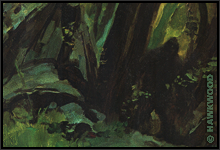
My painting of Mary portrays her as she might have appeared some ten years into her solitary retreat. Rather than portraying the Saint Mary of the Church, I wanted to be true to Mary’s humanity, to grant her the dignity of a very human soul living in harsh self-imposed exile from her own kind.
What we know of the woman’s story, and what she told to the monk Zosimas, we can learn in the account of her life written down by Sophronius, the Patriarch of Jerusalem during the 7th-century. Her name was Mary, and she had run away from her home in Egypt at the young age of twelve to journey to Alexandria. In the city she had lived a dissolute life, selling her sexual favours on the streets for the next seventeen years, or simply giving herself away for the sake of the experience. Apparently driven by a need to satisfy a carnal craving in new surroundings, she boarded a ship carrying pilgrims bound for Jerusalem. The pilgrims, both during the voyage and in Jerusalem itself, proved to be as willing as the residents of Alexandria, and she continued her wanton lifestyle within the city walls. Until the day that she found herself at the door of the Church of the Holy Sepulchre.

Sophronius’ account of Mary’s life does not provide us with the details of her journey, but using maps of the period it is possible to surmise that the ship on which she embarked from Alexandria would have sailed for the port of Joppa, which had a well-trodden connecting road to Jerusalem. The actual location of Zosimas’ monastery is unknown, but calculating its distance from Jerusalem and its location near the west bank of the River Jordan gives us its likely location. From the monastery Mary would have crossed the Jordan and travelled eastwards into the trans-Jordanian desert. 
Intending to enter in the hope of finding more clients among the congregation, she felt her way barred by some unseen force. Interpreting her impure lifestyle as the cause of her being unable to set foot in the church, she experienced a deep inner remorse. At this the withholding force seemed to vanish, and she entered the church and prayed by the relic of the [2]True Cross. Emerging once more into the sunlight, she felt that she heard a voice say to her: “If you cross the Jordan you will find glorious rest.” Renouncing the life which she had led, she journeyed to a monastery by the Jordan to receive Holy Communion before crossing the river to begin the life of a [3]recluse – a life that she would follow for the rest of her days.

Having related her story to Zosimas, Mary asked the monk to meet her in a year’s time to give her Holy Communion. At the appointed time Zosimas arrived at the banks of the Jordan to see Mary walking towards him across the waters. A further meeting was arranged for the following year, and this time Zosimas returned to the place where he had first encountered Mary, only to find her dead. It is said that a lion helped him to bury her, digging with its claws into the dry desert earth which had been Mary’s home for so many years, and which now would be her last resting place.

Two traditional icons of Mary. An anonymous Russian artist has surrounded Mary with scenes from her life (left), beginning with her kneeling in prayer before the relic of the True Cross, and ending with her burial by the lion. Gregory of Sinai monastery has chosen to depict the moment (right) when Mary walks across the River Jordan to meet Zosimas.
This, briefly, is the story of Mary – Mary of Egypt as she became known. It was preserved as an oral tradition by the monks of Zosimas’ monastery before being recorded by Sophronius a century later. In it we recognize elements similar to the life of [4]Thecla: a remarkable life of a turn to faith interwoven with the supernatural elements of legend. For the orthodox faithful, it provides a textbook example of repentance and redemption, and the mercies of the Spirit which such redemption ensures. But because these aspects of her story are the focus for the faithful, what is glossed over in such orthodox accounts is another central aspect of Mary’s story. It is a story of astonishing practical survival.

A popular 13th-century account of the lives of the saints apparently confused Mary’s story with that of Mary Magdalene. The story that Mary Magdalene spent her final years as a solitary naked penitent is wholly erroneous, but it nevertheless was seized upon by artists who were willing enough to portray the penitent naked Magdalene, as in this romanticised 19th-century version by Alfredo Valenzuela Puelma, which depicts an improbably healthy-looking Magdalene swooning before the cave in which she was supposed to have lived.
We do not know the exact years of Mary’s life, but if we assume that she must have been almost thirty when she crossed the Jordan, then her death in her late seventies means that she still must have lived for some forty-seven years in the wilderness. The legend relates that when she left for the desert she took only three loaves of bread with her. For the rest, she lived on whatever her unforgiving surroundings provided her with. This is a feat of endurance which leaves the achievements of even the most radical hard-core survivalists looking like a Sunday afternoon picnic. Given that the basic practical events of Mary’s story actually happened, we must marvel at the survival skills which she must have developed just to stay alive, and with them the mental and emotional commitment needed to sustain her existence of utter solitude. Zosimas mentions that she prayed in a near-unintelligible whisper, with all her words running together. And yet she apparently retained enough of her language skills to communicate her story to the monk.

The unforgiving harshness and haunting grandeur of the Jordanian desert. Mary somehow managed not only to survive, but to live in this hostile landscape, and not just for months or for years, but for several decades. Faith is a wondrous thing in itself. To add miracles to her story perhaps diminishes what she achieved on a human level.
We might or might not accept the supernatural elements of the story – the unseen force at the doors of the church, Mary walking on the waters of the Jordan, and the [5]helpful lion – for such elements remain a matter for individual faith. Such miraculous occurrences were needed to confirm Mary’s sainthood by the Church, and in any case remain a distant and unverifiable hearsay. My painting of Mary which heads this post does not need them: I find Mary’s commitment of faith and feat of survival sufficient marvels in themselves. The Church might have need of such miracles and mysteries, but there in the wilderness beyond the Jordan beat a heart in quiet solitude, and the human heart holds mysteries far greater than these.
Hawkwood    

Between Truth and Legend: Is Mary's story true? The circumstances of her life existed as an oral tradition before being set down in writing a century after the events. Faith is the criterion for us accepting the supernatural elements of her story, but what of the story itself? We know from documented examples that ten years is enough time for a human to revert to a feral state and lose the faculty of speech. And yet after some forty-seven years Mary was articulate enough to relate her story to Zosimus, even though the monk described her manner of praying as near-incoherent. I personally believe the substance of Mary's story, although that substance might have been embroidered upon over the years, as stories typically are.


Notes:
[1] It was expected of each monk at the monastery that he should make an annual sojourn into the desert to fast in prayerful contemplation.

[2] Please see my post Helena and the True Cross to read more about the veracity of this holy relic.

[3] A medieval tradition seems to have confused Mary Magdalene with Mary’s story. This tradition has a post-Resurrection Magdalene also living for many years as a repentant naked recluse, for which there is no evidence whatever. The source of this erroneous tradition was The Golden Legend, a 13th-century compilation of the lives of saints. The Legend freely mixed historical facts with fanciful fiction and hearsay miracles: a dubious literary cocktail which only increased its popularity. Later scholasticism treated the Legend more critically – although even up to the 19th-century artists were still portraying Mary Magdalene as a naked recluse (left, by Hans Olaf Heyerdahl) in the style of Mary of Egypt. Please see my post The Gospel of Mary.   

[4] Please see my post Thecla: A Woman between Rain and Fire to read Thecla’s remarkable story.

[5] Whether the intervention of the helpful lion could be considered as miraculous is perhaps questionable. I tend to think of it as a typical storybook element: unlikely and improbable, but not actually defying the laws of physics and nature, as miracles appear to do. 


Sources:
The original account by Sophronius on which my post is based can be read here. My post necessarily condenses or omits many of the details purportedly related by Mary to Zosimas, including the fact that she prostituted herself on board the vessel bound for the Holy Land specifically as a way of paying for her passage, and also includes an extended and detailed account of her first meeting with Zosimas, which is moving in itself.

Jordanian desert adapted from a photo by criscris1. Map and portrayal of Mary created for this post by Hawkwood for the David Bergen Studio © All Rights Reserved.

Thursday, January 29, 2015

Thecla: A Woman between Rain and Fire

The Roman governor of Iconium must have wondered at the forces which seemed to be sweeping through his city. Only recently he had detained a man called Paul whose teaching activities had become so popular that they had caused civic unrest. Now before him stood this striking and charismatic woman, reported by her own mother and indignant fiancé for breaking her vows of betrothal in favour of becoming a follower of that same Paul. The woman’s silent and dignified refusal to recant must have been troubling to the governor. But the mother’s insistence of the deep shame which her daughter had brought upon the family honour seems to have swayed the case. The woman called Thecla was condemned to be burned.

Thecla, as with so many names which have come down to us, occupies an uncertain place between fictional stories, folklore, legend and actual history.
In the city’s amphitheatre Thecla was stripped and tied to the stake. Flaming torches were set to the pyre, and the flames rose. How to account, then, for the sudden darkening of the skies on such a clear day? How to account for the heavens opening and pouring such a deluge of rain upon the scene that the burning pyre beneath Thecla was quenched? Shaken, and perhaps even afraid at witnessing this seemingly supernatural turn of events, the governor ordered that Thecla be freed.

Now his travelling companion, Thecla journeyed with Paul to the city of Antioch. On the streets of the city Thecla was accosted by a nobleman named Alexander who, besotted with her [1]beauty, attempted to rape her. In her struggles to resist, Thecla tore the nobleman’s cloak. This apparently inexcusable insult to a member of the nobility brought Thecla before the governor.

The remains of the Roman amphitheatre in Antioch as they are today. The footprints of Thecla remain in the sand, in story if not actually in history.
Another city, another governor – and another amphitheatre. This time it was not fire which threatened to end the newly-condemned Thecla’s life, but the wild beasts of the arena. Standing once more alone and naked in the sand, again Thecla found herself at the mercy of forces seemingly greater than herself. But other forces greater even than these would again conspire to save her. The howls of protest from the women in the crowd at the injustice of Thecla’s fate turned first to cries of disbelief, and then to shouts of astonished joy as the lionesses among the animals moved to circle protectively around Thecla, fighting off the big maned males when they came too close.

And then it seemed to the astonished crowd that Thecla became enveloped in a garment of bright and shining fire: yet more seemingly supernatural occurrences which ensured her pardon and release. When the wondering governor presented her with garments to cover herself, Thecla is said to have replied: “He that clad me when I was naked among the beasts, the same in the day of judgement will clothe me with salvation.”

************

The above incidents are the substance of the Thecla legend. They can be found in the apocryphal Acts of Paul, a manuscript written some 130-140 years after the events which they describe by the presbyter of an [2]Asian orthodox church. [3]Tertullian, the author and shaper of Christian doctrine, informs us that this presbyter was charged with imposture and stripped of his office. This would seem to make the writer of the Acts a distinctly dubious source, but the vivid recounting of such apparent wonders emanating from on high evidently has been enough evidence for orthodoxy to grant Thecla sainthood, the criteria for which include such miracles of faith as these.

Following her redemption in Antioch's Roman amphitheatre, Thecla journeyed to Myra in the southern province of Lycia to continue her ministry. Seleucia in what was then the eastern province of Syria is the site of her supposed tomb. Greek copies of the Acts relate that she lived into her 90's, spending her last years in reclusive meditation.
But if the Thecla of legend is not the real Thecla, might we discover the woman behind the stories? However much legends embroider upon more prosaic realities, they draw us towards them because of the human truths which they contain. What we recognize and respond to in Thecla’s legend are the fundamental truths of injustice: injustice by those in positions of authority, and the shockingly obvious injustice perpetrated against women by men. The story even emphasizes this injustice by describing the reaction of the women in the amphitheatre crowd. Thecla is not just a woman thrown upon the mercy of beasts: she is a woman who must navigate her way in a man’s world, where men have not only the authority but the greater physical strength. Thecla is, in short, as much a woman of our time as she is of her own distant world.

The remains of the library at Ephesus. As with these ruins, so with the scrolls and manuscripts which they once contained: what has survived is at one and the same time a reminder of what has been lost to us forever. We sometimes know of these lost literary masterpieces of antiquity only through their being mentioned and praised by other writers in the works which have survived.
Thecla’s world was not as we now tend to envisage it. Paul and Thecla lived a scant few years after the events of the crucifixion. It was not an emerging [4]‘Christian’ world in the sense in which we would now use the term. There was no ‘Bible’. Many different texts were in circulation among different groups, and no one text had more authority than another. Iconium, Antioch, and even northern Galilee were subject to Hellenist and therefore pre-Christian Gnostic influence. A 5th-6th-century [5]mural in Ephesus in present-day Turkey portrays Thecla and Paul side by side, both of them with upraised right hands to indicate both their teaching status, leadership status and equal status with each other: a gender equality which would have been the norm in Gnostic or pro-Gnostic communities.

This regional inscription bears the name of the city of Iconium. The city was real enough, but those who might or might not have walked her streets could have been phantasms. Perhaps this also includes Thecla: a ghost in an actual place, like a fictional Hamlet wandering the real-enough corridors of Denmark's Elsinor Castle.
So how is it possible that Thecla has become a saint of the orthodox Church? It would seem that she joined that dubious list of those who, however remote their principles from those of orthodoxy, have been reinvented at a later date by those orthodox individuals who sought to fictionalize what they could not change in life, and then pass off that fiction as historical reality: a list which includes ‘Saint’ Mary Magdalene, ‘Saint’ Anthony – and ‘Saint’ Paul himself.

But in the end perhaps it does not matter greatly who ‘claims’ Thecla for their own. What we are left with is the essence of a strong, beautiful and principled woman who burned with the bright fire of her faith, but who also touches us with the gentle rain of her grace, and so lifts us up with her.
Hawkwood 


Notes:
[1] Independently of the description of Thecla in The Acts of Paul, Paul himself mentions that he was concerned that Thecla’s striking beauty might distract her audience from her ministry. Paul himself was described as being bow-legged, balding and very short. 

[2] ‘Asia’ in this context was a province in what is now Turkey (please see my map above).

[3] Tertullian of Carthage (left) is conventionally credited with the Christian concept of the Trinity, although the concept can be traced back to the pre-Christian Ancient Greek mystery schools.

[4] The author of The Acts of Paul has Thecla make ‘the sign of the cross’ as she resigns herself to be burned. But (apart from the obvious physical impossibility of doing so when her hands were tied to the stake!) no such sign would have been current at this early date. The sign seems to have originated well over a century after Thecla lived, in the unknown author’s own time - a clear indication of the gap which exists between legend and history, and of the clues offered to us for discerning between the two.

[5] Please see my post "Behold This Woman". The Catholic Encyclopedia is careful to stress that Thecla needed Paul's permission to begin her ministry, and describes her as 'the pupil of Paul' - a description which the existing mural (right) in Ephesus depicting her as Paul's apparent equal contradicts. As Catholicism only emerged in a recognizable form some two centuries after Thecla's time, the moral and ethical question has to be: can the Catholic church claim someone to be a 'saint' of that church if that person lived before Catholicism as such even existed?


Sources:
The Acts of Paul. From: The Apocryphal New Testament, Translated and with notes by M.R. James. Oxford: Clarendon Press, 1924.

Elaine Pagels: The Gnostic Paul: Gnostic Exegesis of the Pauline Letters. Trinity Press International, 1975.

Valerie Bockman: The Role of Women in the First Century Church: A Model for Today. PDF document based on a talk given at the Orthodox Conference hosted by St. Mark's Orthodox Cathedral Church in July 1991. Presbyteria Bockman states that: “In Christian Tradition veils denote sacredness, being set apart. When a woman veils her head, it is not a demeaning act. It denotes, rather that her femininity is sacred, special, to be revered, and simultaneously that she... is a handmaid of the Lord.” This statement has guided my own imagined portrait of Thecla seen at the head of this post.

Thursday, January 24, 2013

"Behold This Woman"

As a woman, you should dress plainly and modestly. You should not braid your hair. You should not wear jewellery, and certainly not costly gold and pearls. You should remain silent, and learn submissively. You are not allowed to teach, neither must you question nor rise above the authority of a man. And do not forget: you must keep silent. Why must you do these things? Because it was Adam who was created first, and because it was Eve who was deceived by the serpent and transgressed.


No, the little manifesto of all-brakes-off male chauvinist piggery with which I began this post is certainly not my own. You can read it for yourself in the New Testament’s 1 Timothy, 2:9-14. Its anti-female stance has served the Church well ever since it was written in the 2nd-century, and it has been seen as a licence to keep women in a second-class citizen role with a scriptural seal of approval. This passage on which so much Church policy rests appears in one of the letters of Paul, and among more free-thinking minds it has earned that particular saint the dubious reputation of being a grade-A [1]misogynist. 

There is just one problem. It seems that the letter in which this passage appears is not by Paul at all. The three letters 1 Timothy, 2 Timothy and Titus, bear Paul’s name. But for various reasons, partly to do with discrepancies of language, dating and theme, a majority of scholastic opinion now considers these [2]three letters to be written, as it were, under a falsified signature.

Now consider this: a global corporate business has as strict company policy a blanket ban on women holding any positions of authority within the company. Here in the European Union that company would have its ass hauled into court so fast that its feet wouldn’t even touch the ground. And it would lose the case, because the EU is very specific in its directives about ensuring gender equality in the workplace. Now for ‘global corporate business’ read ‘Catholic Church’, and my point is made. Apparently it is because our society invests religion with respect by default, whether that respect is [3]deserved or not, that the Church can with [4]impunity get away with practicing discrimination against women on a global scale, and in so doing, is placing itself – literally – beyond the law.

“We declare that the Church has no authority whatsoever to confer priestly ordination on women and that this judgment is to be definitively held by all the Church's faithful.” The concluding [5]statement of the Apostolic Letter by John Paul II, May 22, 1994, entitled: “To the bishops of the Catholic Church on reserving priestly ordination to men alone.” The specific justification given in the letter – that Jesus chose only men as disciples – is a scriptural fallacy which it has become expedient for the Church to perpetuate.
Clearly on this example alone the law is a two-tiered structure: one for the Church, and another for the rest of us. Within the Catholic hierarchy the [6]glass ceiling is already reached at the lowly level of the mother superior of a local convent. Higher than that… forget it. Women within the Anglican community fare somewhat better, with Australia having recently appointed its [7]first female bishop. But as recently as November of last year, the Synod of the Church of England voted against the appointment of women as bishops.

This flagrant sexual discrimination which is both sanctioned and practiced by orthodox Christianity is tragic and demeaning for more than the reason of the obvious deep injustice to women. It is a brand of sexual prejudice which goes directly counter to the original egalitarian example of Jesus. Orthodoxy, in winning the 3rd-4th-century battle as the ‘official’ form of Christianity, ciphered away the original status of women’s spiritual equality which they had known in Gnostic communities. Female disciples were consigned to the background of history, and the sympathetically Gnostic Paul was redesigned by orthodoxy as both anti-Gnostic and anti-feminine with the aid of letters written in his name.


On the walls of a grotto in Ephesus, Turkey, is a mural depicting Paul with his companion Thecla. The way in which the two figures are portrayed indicates that, rather than being a mere disciple of Paul, Thecla shared [8]equal status as a wise teacher. It appears that Paul and his female companion wished to be a conscious mirror of the original Jesus-Mary Magdalene model. This does not imply a relationship in the way in which we might now view it, but was intended to reflect the greater cosmic harmonies of Spirit and Soul. Other Gnostics formed couples for the same reason, as did alchemists of later centuries: men and women who worked together at a transformation of the Self. Such partnerships of gender equality were therefore seen, not as ‘earthly’ relationships, but as mystic unions both in their nature and their objective.

Although the lower half of the Ephesus mural has been lost, what remains of the figure of Paul is in reasonable condition. But the figure of [9]Thecla who stands next to him has been vandalized at some time in antiquity: her eyes and her upraised hand have been gouged away. Blinded and mute, this defaced portrayal of a woman still communicates with us from out of her wounded silence.  
Hawkwood     


Notes:  
[1] Misogynist: a man who despises women. 

[2] Although not the only letters of Paul to have a suspect authorship, these specific three seem to be from the same hand. But if not Paul’s, then whose hand is it? One possible candidate is Bishop Polycarp, who apparently provided the role model for Bishop Irenaeus, a name not unknown on this blog as the editor of the four gospels which made it into the canon (my post The Gospel According to Somebody). And how suspect is it that 1 Timothy ends with a specific warning against following Gnostics and their beliefs, when that also happened to be Irenaeus’ favourite hobby horse? Add to this the fact that Paul himself expressed pro-Gnostic beliefs – and might even have been a Gnostic – and that these three letters could well have turned up (perhaps a little too conveniently?) around the time that Irenaeus was busy writing his massive anti-Gnostic work Against Heresies, then this would date the three letters to a period decades after Paul wrote those letters now accepted as authentic.

[3] Please see my post Respect. Catholic priests can be, and are, excommunicated even for just supporting the ordaining of women priests. Father Roy Bourgeois (right) was excommunicated after over 40 years of service to his church for speaking out against the injustice of this issue. The official papal stance is that the issue is beyond discussion (Apostolic letter of Pope John Paul II, 22 May, 1994). The phrasing of the letter - that the judgement will be 'definitively held' - ensures that the ruling is intended to be enforced in perpetuity, and that the Catholic Church will not allow the ordination of women as priests, not now, not ever. Oh, if only the Catholic hierarchy would show itself willing to punish its morally corrupt pedophile priests with the same robust vigor.

[4] Although it uses the euro currency, Vatican City State is not a member of the European Union and preserves its independent status; a status that clearly works to its advantage in such issues.


[5] This concluding phrase of the Apostolic Letter deserves close scrutiny. The adamant statement that the Church has "no authority whatsoever" is actually a subtly assumed negative. Think about it: the Church is in this sense not bound by civic law, and can - and does - assume whatever authority it chooses to invest itself with. If it decides that it has the authority to excommunicate someone (see note 3 above) then it does so. If the Vatican wanted to have the authority to invest women then it would grant itself that authority. So for the Church to claim that it has "no authority" to invest women is a pretense. Thus did Pilate wash his hands.

[6] The phrase 'glass ceiling' is taken to mean the invisible barrier which women encounter in organizations that thwart their further promotion upwards through management hierarchy.

[7] Bishop Kay Goldsworthy, appointed bishop of Perth in May, 2008. Anglican communities in New Zealand, Africa, the United States and Canada also have appointed women bishops.

[8] The author John Dominic Crossan points out that figures in a mural of this date (c.5th-6th-century), when depicted of the same height, as here, indicate equal social status, and the raised right hand denotes both teaching and leadership status – as would have been the norm for women in Gnostic communities. One Christian apologist assertion which I have come across attempts to explain this away with the claim that the woman is actually Thecla's mother: a strange claim to make when the name 'THECLA' (left) has been written alongside the figure.

[9] The Church has made Thecla a saint, but how many who already are familiar with Paul are as familiar with Thecla? And even the now-familiar Paul is the official Church version, which is not who Paul actually was in life, as this post indicates. Please see my post Anthony of the Desert: Life as Fiction for another example of the Church reinventing someone’s life to drive its own agenda. The events of Thecla's life are interwoven with legend. Condemned to be burned, she was saved by the timely intervention of a furious storm. On a later occasion, having fought off a nobleman who was attempting to rape her, she was herself charged with assault and condemned to be torn apart by lions. Again miraculous forces appeared to save her when the female beasts protected her from the aggressive males. No such miracles saved Polycarp. He was burned at the stake for refusing to make an offering to the Roman Emperor. This portrayal of Thecla (right) was painted by Sarah Paxton Ball Dodson in 1891. To read Thecla's story, please see my post Thecla: A Woman between Rain and Fire.


Sources:
Elaine Pagels: The Gnostic Paul.
John Dominic Crossan and Jonathan L. Reed: The Search for Paul.

Top image: “Behold This Woman”, published here under the terms of my Creative Commons Licence, original artwork created for this post by the ©David Bergen Studio, all rights reserved. Adapted from Emilio Franceschi's 19th-century bronze sculpture Eulalia Christiana in Rome's National Gallery of Modern Art. For those who would like to know more about Eulalia, the story of her defiant and tragic martyrdom is recounted on my other blog in the post The Sheltering Snow.


Stop Press added July 17, 2014: A year and a half after I wrote this post, this week has brought the news that the General Synod of the Church of England has voted by a majority of 351 to 72 (with a further 10 abstentions) to accept women as bishops, and so finally bringing it into line with other Anglican communities in the U.S., Canada, Africa and Australasia. The news is both welcome and shocking: welcome, because the approval is so many years overdue. But it is shocking and shameful that the question of whether or not women have equal rights before God is even an issue in the 21st-century. In an age which contains female Anglican bishops, female rabbis and female imams, the Catholic church shows every sign of continuing to hold on to its unrivaled position at the top of the religious male chauvinist piggery chart. What would Jesus say?