Return here to the Shadows in Eden home page.....
Showing posts with label Mormon beliefs. Show all posts

Wednesday, June 17, 2015

The Mermaid of Haarlem

The year 1430 was one of turmoil and strangeness. In France Joan of Arc was captured by Burgundian forces and burnt at the stake. Further to the north in the Lowlands, within the borders of what was then the Holy Roman Empire, terrible storms were raging. The gales were so strong that the dykes which protected West Friesland were breached, and the North Sea broke through and flooded the farmlands. But these storms were not all that visited the country. Among the many fish left stranded on the farmlands (if we believe the wondering [1]accounts written at the time) was a mermaid.

The mermaid painted by 19th-century English artist Annie Louisa Swynnerton. The artist was active in the Women’s Rights movement of the time, and her mermaid seems to embody those positive qualities of female empowerment, so different in approach to the winsome and youthfully-sweet mermaids painted by her Victorian male contemporaries John William Waterhouse and Herbert Draper. This mermaid knows who she is, where she is going, and how to get there.
A group of women gathering the stranded fish for an easy meal apparently discovered the unfortunate creature floundering in the shallow waters. Astonished (as well they might be), they somehow managed to carry the marvel to dry land, where she was eventually transported to the city of Edam (presumably by boat to the western coast of the Zuider Zee - see my map below), and from Edam to the city of Haarlem.

The mermaid’s journey. Following her capture in the flooded farmlands of Friesland, the mermaid was taken first to Edam and then to Haarlem. The coastlines are those of the 15th-century, before the extensive land reclamation from the sea of later centuries, with the names of the then-Lowlands provinces shown in green. The Zuider Zee is now a large lake known as the Ijsselmeer, and reclaimed polderlands have diminished its size still further.
The Mermaid of Haarlem, as she became known, was provided with good Christian clothes with which to suitably cover her heathen nakedness, and seems to have settled down to this new life away from her watery home. She also seems to have adapted her diet to one of cooked meat, and was taught to spin yarn, and to pray and to make the sign of the crucifix. In short: the mermaid was provided with the essentials for a life in the Christian community in which she now found herself.

This portrayal of Mary Magdalene reading by Rogier van der Weyden is contemporary with the mermaid’s story. In Mary’s resigned features and in her dress of the artist’s period and place we might glimpse a vision of how the mermaid could have appeared during her new life on land. Unable to read, the mermaid could only have looked wonderingly at the unfamiliar pictures in such scriptural texts. The inset shows a small personal crucifix of the type that would have been presented to the mermaid.
But these outward trappings of her surroundings do not seem to have erased her essential nature. Apparently she always retained a longing for her watery home, and every attempt to teach her even the essentials of human language resulted only in stubborn silence. How many years she spent as a half-reluctant member of her adopted community is not recorded, although we are told that on her death she was given a full Christian burial. Ah: if only we knew of her burial place! Would an exhumation reveal a marvel, or merely a prosaic disappointment?

Let us suppose (because it is what we would like to believe) that the story is true. Did the mermaid truly have some sense of Christian reverence when she crossed herself, or was she merely mimicking the actions of those around her? And how strangely alien and awkward the wearing of clothes must at first have seemed to her. And what apparently was her resistance to human speech might have been more to do with her inability to speak at all, for who knows the ways in which mermaids communicate with each other when swimming in their watery home?

Religions in Europe during the mid-15th-century. Martin Luther’s Protestant Reformation was still a century in the future, as was the reign of Henry VIII in England, whose rejection of Papal authority would shrink the borders of Catholicism still further. The Lowlands, yet to become the nation of the Netherlands, was part of the Holy Roman Empire, whose defined borders are shown here. The Iberian Peninsula was divided up into its own kingdoms, but Islam in the shape of Moorish culture and belief still had a foothold in the south of Spain. At this time the areas of the Ottoman Empire shown on the map had a majority Christian population ruled by an Islamic minority. 
Now let us suppose (because we also need to embrace prosaic probability) that the mermaid’s story, although perhaps having some basis in fact, was not what it seemed. In a [2]previous post I mention the likelihood of stories originating from something, which confronts us with the possibility that the ‘mermaid’ existed – but that she was not actually a mermaid. Such stories do not grow out of a vacuum, and perhaps the ‘mermaid’ was in reality a feral human. Significantly, no mention is made of the woman actually having that distinguishing feature of her kind: a fish’s tail in the place of human legs. She was not found swimming at sea, but rather was rescued from the flooded farmland. Her wild and naked appearance would have been enough for the mindset of the time to see her floundering in the watery shallows and think: ‘mermaid!’ Stories of such feral humans in Europe and elsewhere have been [3]documented, so to my mind this scenario is certainly a likely possibility.

A feral girl as imagined by contemporary Belgian artist René Hausman. The painting echoes such cases as the life of 18th-century Marie-Angélique Memmie le Blanc, known as the Wild Child of Sogny. Born Native American, Memmie came to France as a young girl and became lost in the French forests when she was nine, only to be discovered by villagers ten years later in a state of feral wildness.
How we interact with these feral humans confronts us, not so much with their wildness, as with our own civilized selves. Our first impulse is to clothe them, to teach them the rules of modesty and [4]shame which have filtered down to us from Eden. We next seek to make them, in whatever ways are necessary, adopt our own standards, beliefs and moral codes. In short: what we recognize in the mermaid’s story is the desire, however [5]well-intentioned, to want to change someone to be like us.

We resist that otherness which makes someone special, which makes them the unique individual that they truly are. We want someone to share our own beliefs, because that is a way of confirming to ourselves that the things in which we believe must be ‘right’. We misguidedly imagine that we can improve someone by persuading them to believe what we believe, and to think as we think. But is such persuasion a form of conversion, or a form of coercion? We might excuse the actions of her captors towards the mermaid as belonging to the attitudes of 15th-century Catholic Europe, but such attitudes persist. [6]Mormons or Jehovah’s Witnesses who come [7]knocking on your door are in their intention no different from the goodwives of Haarlem who taught the mermaid how to make the sign of the cross.

A mermaid, as imagined in the 19th-century by Danish-Polish artist Elisabeth Jerichau-Baumann. This mermaid seems sculpted from the very ocean. Serene and impassive, self-assured and yet detached from and seemingly-indifferent to us, her observers, she defies us to deny her existence.
Almost six centuries is a long time: long enough for us to wish that the story of the mermaid might just be true: long enough for us to hope that the story perhaps has a grain of substance. We seem to need mermaids and other fantastic creatures, but what also touches us about her story is the notion of exile. The mermaid of Haarlem was a stranger in a strange land. We need not ignore such differences in others. Strangers are not different from us, but are merely a different us. And it is a sad truth that, if ever we did discover a real stranded mermaid, it seems that the very last thing that we would do, the least likely thing that might occur to us, would simply be to promptly help her to return to her own ocean home.
Hawkwood

    
My grateful thanks to Emma for allowing me to borrow substantially from her own post on this subject. Emma’s blog Sophia's Mirror can be visited here.


Notes:
[1] This is the original story of the mermaid as described in a 19th-century journal, which itself is a copy of other earlier accounts. There is something unnerving about the account’s referring to the mermaid as ‘it’ instead of ‘she’: “So, also, the Mermaid reported by Johannes Hondius, as taken by some women in the meadows at Edam, in West Friesland, where it had been brought by the sea which entered through the broken dykes, during the great tempests in 1430. That Mermaid was taught to spin. Moreover, it was dressed in female attire, fed on cooked meat, had some notion of a deity, made its reverences when it passed a crucifix, lived some years at Haarlem (though it ever retained an inclination for the water), and was allowed at its death a christian burial; and yet all efforts to teach even that Mermaid to speak proved ineffectual. It is this Haarlem Mermaid only (though without her clothes) that is represented upon our signs and in our coat-armour.” ~ Abridged extract from: The Asiatic Journal and Monthly Register for British India and its Dependencies, vol. XV, January to June, 1823. London.

[2] Please see my post Renaissance Snuff.

[3] Please see Michael Newton’s title below.

[4] Please see my post Shame.

[5] And "the road to Hell is paved with good intentions" - a pearl of wisdom that apparently originated in the 12th-century, and was therefore even current in the mermaid's day.

[6] Formally known as the Church of Jesus Christ of Latter-day Saints, which is their  own preferred title, but which, it must surely be admitted, is not one which trips readily off the tongue. Hence: Mormons, after the father of the angel alleged to have appeared to their founder, Joseph Smith.

[7] Please see my Pocket Guide to Proselytizing.


Sources:
Michael Newton: Savage Girls and Wild Boys: A History of Feral Children. Faber & Faber, 2002. Michael Newton’s commendable and sympathetic book documents various cases, and critically examines both the discoveries of such cases and the attitudes of those into whose care they are received. Spanning several centuries, the author demonstrates that social and scientific methods might change, but basic attitudes do not, with inter-departmental social welfare rivalries, the quest for scientific accolades, and academic concerns often-enough taking precedent over simple human compassion.

The painting by René Hausman appears on the flyleaf of the hardcover edition of the graphic novel Laïyna, written by Pierre Dubois and illustrated by René Hausman. Published by Dupois in France, 1987, and published in Belgian and Dutch editions the same year. The book was subsequently re-issued in the Netherlands under a different title, although only the first edition features this painting. Hausman’s loose watercolour style is unique in the genre, and positively crackles with life and energy.

The painting of Mary Magdalene by Rogier van der Weyden is in the National Gallery, London. The small 15th-century crucifix is in the collection of the Museum of London. All referenced graphic novels are in my collection.

I soon discovered that different maps of the period tended to conflict with each other, and a variety of different sources were used to create the two maps featured in this post. The map of Religions in Europe in particular needed a lot of deft rechecking, which is understandable when one considers the labile shifting political alliances of the time (and I swiftly jettisoned one map as reference which claimed a swathe of Europe for Protestantism a century before it happened!). Nevertheless I feel that my maps accurately depict what their titles claim. 

A Footnote: The title page of this 18th-century songbook (left) printed in Haarlem continues to get mileage out of portraying one of Haarlem’s most famous citizens, however fictitious she might prove to be. The translation is: “The entertaining OUTDOOR LIFE, or the Singing and Playing FARMER’S JOY, Enriched with the art of Singing, and for the ease of the Players tuned to the key of G.”

Wednesday, January 14, 2015

Possession

What is possession? The several months of work which I have just spent creating a video of my own version of Bram Stoker’s Dracula gave me time enough to ponder this question while I was occupied with this project. To be clear: I do not mean ‘possession’ in the exorcist casting-out-devils sense, which I regard as a separate issue. I mean: the will to possess another, to gain mastery over someone else’s independence, even over that person’s life.

Lucy Westenra: the ghostly pallor of a life unnaturally sustained beyond death itself.
In Stoker’s classic tale of the struggle against evil, despite the heroic efforts of the Dutch vampire hunter Abraham Van Helsing to prevent the encounter, the notorious Count stalks and finally overcomes the hapless Lucy Westenra, and she wastes away and dies. Van Helsing and his associates visit the place of her interment only to discover that her coffin lies empty. Having been bitten by Dracula, Lucy has herself become one of the ‘Un-Dead’: has herself become a vampire, neither alive nor truly dead.

Dracula's letter of welcome to Jonathan Harker containing instructions for his journey to the Count's castle - instructions that Harker would come to regret acting upon.
Dracula, the supreme vampire, is also the supreme possessor. In contemporary profiler terms, he is a pathological control freak. He is ‘evil’ in the context of the story’s classic Gothic theme, but (again in contemporary terms) his pathological nature leaves him merely indifferent to the sufferings which he causes to others, including the loved ones of his victims, who are left to cope with the loss of their dear departed who become stranded in a terrible no-man’s-land between life and death.

In my video, Transylvania, while initially being an actual place on the map to which the characters journey, becomes ultimately, not so much a geographical location as a state of mind. ‘Transylvania’ is where you find yourself as a victim of a predator, and it is a frightening place to be. And if you are in that place, two choices lie open to you: the first is to remain aware of your situation, and attempt an escape (as the story’s young realty agent Jonathan Harker actually does). The second choice is to succumb, to (again in contemporary terms) go over to the dark side: to surrender your own will to that of your possessor.

The grim edifice of Dracula's "...vast ruined castle, from whose tall black windows came no ray of light."
Does all this talk about vampires and Transylvania seem rather remote from the usual themes which my posts here address? Think about the many religious and quasi-religious cults and the ways in which they manipulate and control their followers. Cult leaders often-enough have a ‘Dracula’ profile: they can be intensely [1]charismatic, and that charisma at times can have a sexual tint. Cult leaders (almost invariably male) may demand – and receive – sexual favours from their female followers, whether or not those followers have partners. And the news will at times carry stories of the openly pedophile activities of such leaders. It’s not really about sex. It’s about feeding off the energy of one’s victims during such encounters, and perhaps also about cementing their loyalty and drug-like dependence upon the leader. And when true and sincere love finds no place in the act, the transfer of bodily fluids becomes vampiric, an expression of mere brute mastery and power. Ask any victim of rape or sexual abuse.

Transylvania as a place on the map. Using maps of the story's 19th-century period in tandem with Stoker's text, it was possible for me to plot Dracula's overland route to the Black Sea port of Varna, and thence by schooner to the English harbour town of Whitby. For the Count, as for voyagers of today, the Bay of Biscay was a place of storms.
It is typical of cults that the leaders will encourage or even insist upon their followers severing contacts with their past lives, including with their families. This is usually demanded under the pretext that the cult is their new ‘family’, and the leader is their new father and mother rolled into one. The true reason, as the cult leader well knows, is that any such contacts, were they to be sustained, would undermine the new ‘reality’ which the leader has constructed. But all this manipulation need not be confined to religious cults.

‘Transylvania’ also can exist within an individual relationship. A person with a particularly possessive nature might move to ensure that a partner’s family contacts are damaged or even destroyed. The means to accomplish this might vary, but the result is the same: that partner (perhaps out of a misguided love) will become isolated from his/her own family or parents, and become encased within the new ‘reality’ – and dependent upon the possessive partner – in the way that such a possessive relationship demands. To more-aware others, such a relationship might have the outward appearance of a cult, and itself might actually function using the manipulative emotional mechanisms similar to a cult – but with one [2]leader and one member. It is possible that you might even know of someone in such a situation.

Once on English soil the Count uses his shapeshifting abilities to transform into both a wolf and a bat: metaphors for the subtle and not-so-subtle masks of human predators in our own reality.
It is likely that at some time you have had on your doorstep the members of one or other church denomination who proselytize from door-to-door in the hopes of making a new conversion. Such proselytizing activity might actually be a requirement of one’s faith, as it is for the Church of Jesus Christ of Latter-day Saints (known as the Mormons), or for Jehovah’s Witnesses. But is trying to persuade someone (in such cases, a complete stranger) to believe the same things in which you believe an act of conversion, or an act of possession? We find it reassuring when someone else believes the same things that we do, simply because it provides us with a confirmation that what we believe must be ‘right’, and gives us a sense of communal belonging. But however well-intentioned it might be, such persuasive attempted conversion by its very nature and intent is also spiritually predatory – and doubly so when forced conversion is involved, as it has been both in [3]history and in our [4]present-day world.

The eyes of a predator mirror the same intentions, whether that predator is animal or human.
Transylvania, it seems, is far from being just a place on the map. As a state of mind it can be anywhere and everywhere, and is real enough. If ever we find ourselves in that terrible place, like Stoker’s young hero Jonathan Harker we need to resist the easy option to succumb and instead struggle to stay awake and alert, and escape if we can to seize our own life back – although we might need the help of loyal friends and loved ones on the 'outside' to accomplish this. And they might not always have fangs and wear swirling black cloaks, but vampires as well are real enough.
Hawkwood 


Notes:
[1] Eastern faiths will caution novices about the dangers of becoming beguiled by and ‘stuck’ in the charismatic stage of spiritual development, which is recognized for what it truly is: a mere doorway to further spiritual progress. In the West there are no such cautionary restraints, and you can see the results on any evangelical television network: many such preachers become enamoured of their own charismatic powers, and so stay at that stage rather than moving on into calmer and more humble spiritual waters.

[2] Such a pathologically possessive partner can be a consummate actor. A casual contact with such a type might well leave you concluding that the person is friendly and sincere. I have even seen an interview with an experienced psychiatrist who admitted that, had he not previously read his patient's unnerving case file, he would have been totally fooled into concluding that the man was entirely compliant and normal. If you have seen the film, think of Clarice Starling's first meeting with the courteous and considerate Hannibal Lecter in The Silence of the Lambs. Anthony Hopkins' performance was accurate to type - and the more chilling for being so.  

[3] The occupying Roman forces in the Near East and Europe famously executed those locals (either Christians or pagans) who refused to make an offering to their gods. In later centuries, during the Christianization of Europe, the dubious favour was returned by such Christian rulers as Charlemagne, who had 4,500 pagans who refused to convert to the faith beheaded in a single afternoon, after which he retired to attend mass. During the Papal-instigated Albigensian crusade, Christian Cathars were given the choice either to convert to Catholicism or be burned alive. Many chose for the flames.

[4] The recent terrible case of the kidnapping of 200 Nigerian Christian schoolgirls by Muslim radicals carries the news by those radicals that, not only had the schoolgirls ‘embraced’ Islam, but they had ‘decided’ to take Muslim husbands. The girls' whereabouts are still unknown.


Sources:
All images are the copyright of the © David Bergen Studio, and are taken from my video which can now be seen on YouTube here: Dracula: Darkness Rising.

Thursday, September 18, 2014

They Shall Take Up Serpents

“And these signs shall follow them that believe: In my name shall they cast out devils; they shall speak with new tongues. They shall take up serpents; and if they drink any deadly thing, it shall not hurt them; they shall lay hands on the sick, and they shall recover.” These stirring words spoken by Jesus in Mark 16:17-18 have been seized upon by certain Christian [1]literalists who have been only too eager to proclaim their faith by following to the letter what this Biblical text recommends.

“They shall take up serpents; and if they drink any deadly thing, it shall not hurt them…” ~ Gospel of Mark, 16:18. These words have been used to justify the practice of venomous snake handling as part of a religious service. But the words did not originally appear in this gospel, and who included them and why is unknown. The snake is the species commonly used in such services, the Eastern Diamondback rattlesnake (Crotalus adamanteus). Photo by Tad Arensmeier.
Ah, but that is the problem with Biblical literalism. It apparently is not that big on scriptural [2]scholarship. It seems that these particular literalists have not been following original scripture at all. The last twelve verses of Mark, which include this text, were not originally a part of the gospel, but were added as much as several centuries later for reasons unknown, by a hand that is equally unknown. In short: we have no idea who added these words to Mark, or why they were added – except, apparently (and perhaps even mischievously), as a goading exhortation to reckless tests of faith. And in spite of their spurious authorship, these tests of faith have been, and are, practiced by various church communities, mostly in the Appalachian region of the United States.

The legality of snake handling – in this case, highly-venomous rattlesnakes – as part of a religious service is an involved one, which is why services which include this practice are sometimes held in the home rather than in a church. And although the whole point of snake handling is to demonstrate immunity through the strength of one’s faith, there have been many recorded [3]deaths from snakebite during these services, including that of the movement’s founder, George Went Hensley, and one of its most ardent practitioners, [4]Gregory James ‘Jamie’ Coots. That the number of fatalities nevertheless seems to be kept within [5]reasonable limits perhaps owes more to the condition of the captive snakes than to any supposed immunity granted from on high. The snakes would seem to be [6]lethargic through stress and undernourishment, and seldom live longer than a month in the confines of their boxes.

Rattlesnakes in their boxes await possible handling during a service at the Full Gospel Tabernacle in Jesus Name church in Middlesboro, Kentucky.
Without crunching the numbers, I nevertheless am going to make the reasonable assumption that, given all factors, including the condition of the snakes, the proportion of total deaths would be the same whether or not the context were within a religious service. But whatever you might personally think about this practice, highlighting the practice itself is not what drives me to write this particular post. For its participants, serpent handling is about faith. But there is a sense in which I am aware that the reverse is also true: that faith is itself a form of serpent handling.

We take our faith out of the box, and the very power of the thing in turn gives us a sense of empowerment. Faith can be a powerful force indeed, and the more that force is felt and experienced, the more we feel strengthened by our faith. It is a classic positive feedback situation. But faith can bite. At any given moment it can twist around and sink its teeth into the very person who is handling it. This bite might be so subtle that at first we hardly feel it. It is that moment when we truly start to believe that our faith (whatever it might be) is surely the only ‘right’ one, and that all other faiths are in some way flawed, or even just plain ‘wrong’. Instead of tolerantly thinking ‘this faith is right for me, and for me personally’, we drift into the mindset: ‘this faith is the only true faith’.

“..And if they drink any deadly thing, it shall not hurt them.” Bottles of lethal poisons lined up ready for possible consumption during a service at the Full Gospel Tabernacle in Jesus Name church.
The next step in the progress of this coursing toxicity is [7]proselytizing our faith. Indeed, proselytizing might actually be a requirement of our faith. We actually come to believe that we truly can improve someone if we can persuade them to believe what we believe, that we can ‘save’ them by getting them to follow the same faith as ourselves. We already have lost sight of the fact that, in human terms, this is a presumptuous conceit. 

So we already have come to think that our faith is the only ‘right’ one, and from this one dangerous thought flows all the misery, all the conflicts, which have so plagued and shamed religious belief through the centuries. It is dangerous because it breeds intolerance, specifically: intolerance for the beliefs of others. And unless we become aware of what is happening to us, our system becomes more toxic. Eventually the levels of toxicity might increase until we arrive at the fatal moment when we relinquish both the purity of our faith and our own humanity. We persuade ourselves that, yes, it is okay actually to take the life of someone who believes in something with which we disagree, which we consider is ‘wrong’.

The fortress of Montségur in the foothills of the French Pyrenees, which was the site of the last stand of the Cathars. Branded by the Vatican as heretics, a [8]crusade was waged against them which saw the deaths by massacre and burning of one million pacifist Cathars and their local Catholic sympathisers, effectively exterminating Cathar beliefs. This religion-based Christian-against-Christian genocide remains one of the darkest and most shameful episodes in European history.
Faith can be empowering, certainly. But its very power can also make it a tricky and even a dangerous thing to handle. As soon as we imagine that we can improve someone by getting them to believe what we believe, or at the most extreme, when we actually are prepared to kill someone in the name of our faith, then we have abandoned our own faith in favour of a new and toxic god, and we follow that god into a dark and unknown territory.

And true assertions of faith are of course something else. They come in forms less sensational and more confronting than snake handling, and often-enough must be borne in the silence of the heart. Coping with loss and uncomprehending grief, contending with an insidious and life-threatening affliction, being helpless in the face of blind and bigoted injustice, can make taking up serpents as a test of faith look like so much misguided and melodramatic posturing.
Hawkwood


Notes:
[1] I have avoided mentioning a specific denomination for these literalists, as I understand that they prefer to shun denominational definition as part of their beliefs. 

[2] This apparently not only applies to those who take Biblical texts literally. In my experience, Christians generally seem to have only a vague idea about how and when the texts which comprise the Bible were actually compiled, which to me is startling enough for those who use these texts as a foundation for their moral conduct, even for their very lives.

[3] Deaths by snakebite (during the course of a religious service) between 1955, when the movement’s founder George Went Hensley (left) was fatally bitten, and 1998 (of John Wayne ‘Punkin’ Brown, whose wife was fatally bitten three years earlier), are thought to number over seventy. Ralph Hood, professor of social psychology and the psychology of religion at the University of Tennessee, Chattanooga, has documented over one hundred deaths. As I suggest in my closing comments of this post, such voluntary flirting with death must seem like a slap in the face to someone who is told that they have cancer. This is why, to me, shame rather than ridicule is the appropriate response to serpent handling as part of a religious service. 

[4] Gregory James ‘Jamie’ Coots (right), pastor of the Full Gospel Tabernacle in Jesus Name church in Middlesboro, Kentucky, was fatally bitten while conducting a service in February, 2014. Three months later his son Cody, who took over his father’s ministry, was bitten while handling rattlesnakes prior to a service, but fortunately recovered. From: Months after snake-handling preacher's death, his son recovering from snakebite, by Bill Estep, Kentucky Lexington Herald, May 27, 2014. Retrieved on September 16, 2014.

[5] But are any such deaths ‘reasonable’? Surely any death caused by reckless misadventure is unreasonable and avoidable. Those who are bitten while handling rattlesnakes as part of a religious service refuse all medical assistance. If the bite is fatal, then their community does not blame them for lack of faith, merely concluding that it was ‘their time’. To me, and perhaps for you as well, this is fatalism in extremis

[6] It is tempting for this reason to speculate that the real test of faith would be in only handling rattlesnakes which either have been freshly-caught or which are in optimal condition. But for the sake of those humans involved I’m not recommending this, however stalwart their faith might be. Neither do I agree with keeping any animals in captivity unless those animals are provided with the best conditions possible for their circumstances. Animals cannot demand rights for themselves, which is why humans carry the responsibility to provide such conditions.

Eastern Diamondback rattlesnakes in their boxes at the Full Gospel Tabernacle in Jesus Name church.
[6 cont.] This includes the strident macho posturing of so-called 'Rattlesnake Roundup' events, which are actually causing the serious depletion of rattlesnake populations in the areas where these events are held. From: Rattlesnake Roundups Leading to Demise of Eastern Diamondback. The study was published in the August 2009 issue of Herpetological Conservation and Biology. Presumably this in turn will now mean a proportional unchecked rise in the number of rodents (which otherwise would have gone onto these snakes’ menu) in these areas.

[7] Taking such action in conversation with a close friend is already presumptuous. Doing so to a total stranger, as such door-to-door proselytizing as the Church of Mormon and Jehovah's Witnesses practice, is both disrespectful to the beliefs or non-beliefs of others and a wretched example of being 'bitten' by one's own faith, as my post suggests. When Jehovah's Witnesses come knocking at my door (which happens often-enough) I am always half tempted to let them in to discuss what they wish to tell me. As yet I have not done so, which for their sakes is perhaps a mercy.

[8] Please see my post A Dark Crusade. The notorious Inquisition (left) run by the Dominican brotherhood was originally founded specifically to eradicate the last remnants of the Cathars and revert all their property to the Papacy once the crusaders' military campaign had exhausted itself. Instead of being disbanded as an institution of the Church after the campaign to eliminate the Cathars was over, the Inquisition survived into the 19th-century.


For the Record: "Rattlesnakes are also among the most reasonable forms of dangerous wildlife: their first line of defence is to remain motionless; if you surprise them or cut off their retreat, they offer an audio warning; if you get too close, they head for cover. Venom is intended for prey so they're reluctant to bite, and 25 to 50 percent of all bites are dry - no venom is injected."   Leslie Anthony: Snakebit: Confessions of a Herpetologist. Greystone Books, 2008.

A Dangerous List: In answer to someone who might think: what would he know, sitting safely in the Netherlands which has no creatures in the wild that are even remotely dangerous, I would reply: I was raised in Australia, which is home to some of the deadliest animals on the planet, both on land and in the surrounding seas, and as a state museum staff member I encountered quite a few of them, including tiger snakes (Notechis), redback spiders (Latrodectus), a stonefish (Synanceia), a cone shell (Conus) and a small blue-ringed octopus (Hapalochlaena). So which one of these has a bite or sting that can be potentially fatal? All of them. 

The Choice of Species: This in turn invites further speculation that the practice of snake handling as part of a religious service is rather down to which venomous species are available in the region. It has to be said that there is something about rattlesnakes (or even copperheads) that is kind of cool, even mythic. And rattlesnakes are not regarded as an actively aggressive species. But supposing that the regional venomous species were instead Australian tiger snakes or the notoriously aggressive king brown? Would these deadly but less physically imposing species be handled during the service? A king brown (above) has been known even to attack someone who was quietly asleep. There is a sense that the choice of species would alter the game plan, and therefore the willingness to test one’s faith in such a reckless way. 

Wednesday, May 28, 2014

The Secret Tongues of Angels

In heaven, we are told, hosts of angels sing the praises of the Deity in never-ending glory and affirmation. If we could transcribe their mysterious words, how might they appear? I drew these characters to suggest something of this secret tongue of the angels to incorporate into a piece of [1]art which I was then creating. It was important for me that the characters credibly looked as if they might, just might, belong to a coherent written language.


Now look at this other example of unknown script below. It is a particular treasure of mine, and was found among the effects of my late great-uncle, who (so the story in our family goes) is said to have copied it from characters inscribed upon a small metallic disk which as a young man he found while hiking in the remote Yakima Reservation in Washington State. Convincing? Not really. It’s by me again, I’m afraid. As far as I am aware, my great-uncle never set foot on the Yakima reservation. I myself wrote out the characters in pencil on a sheet of paper, aged to suggest an earlier time frame.

An alien language? Or perhaps not..
My point is that, with a little flair and imagination, it is possible to devise such scripts. On a considerably grander scale than my own modest efforts, J.R.R. Tolkien did the same in his epic works of fantasy with the scripts which he called ‘Elvish’. The example below, stylishly calligraphed by Maciej Garbowski, is in an Elvish script known as [2]Tengwar, used initially by the author to write the language of angelic supernatural immortals. Tolkien’s sophisticated approach to these fictional tongues was based upon his scholarly knowledge of Runic and other proto-European languages, and with this academic grounding to back up his fantasy, he took the development of such fictional scripts far. There is even an [3]organization that studies and perpetuates what he began.

Tengwar script: the script of Tolkien's angels and elves.
But even such an adept as Tolkien must bow to what I personally consider to be the benchmark of such scripts: the modestly-sized volume which has been called ‘the most mysterious book in the world’: the [4]Voynich manuscript. Dated to the 15th-century, this book is filled with strange and whimsical illustrations of what appear to be botanical studies, astrological diagrams of stars and cavorting damsels. But it is the astonishingly confident script which is interspersed between these that arrests the attention. Calligraphic and elegant in appearance, the script flows effortlessly on for well over a hundred pages – and yet not so much as a single word has ever been deciphered.

The elaborate script in the Voynich manuscript remains undeciphered to this day.
Not that this lack of our ability to read the book has been for want of trying. Cryptographers and linguists, experts in their field, have all attempted to wrestle its secrets free, but without success. The Voynich manuscript remains almost as much of a mystery today as it was when it came to light in our contemporary era in 1912. It is a secret code. It is an elaborate hoax. Both options are possible. But the accomplishments of Tolkien and the unknown author of the Voynich manuscript in creating these seemingly-convincing though apparently fictitious languages are self-evident.

A diagram from the Voynich manuscript which suggests either a map of a celestial city, or even a plan of Eden with its flowing four rivers - or neither of these things.
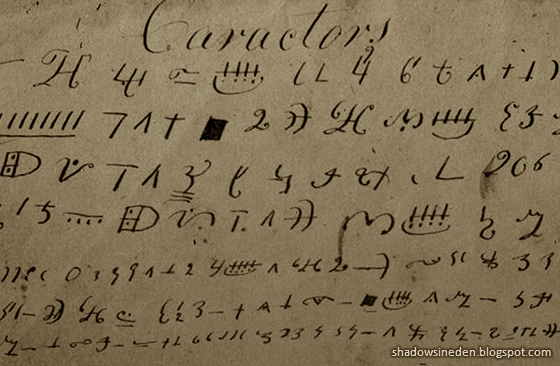
With his Tengwar script Tolkien attempted to suggest the language of angels. But he made no claim to any authenticity in this direction. Not so with my next example. The characters on the document below are claimed to be the actual authentic tongue of angels. This photograph, which came to light as recently as [5]2012, is apparently the only evidence we have for the appearance of the characters on the gold plates alleged to have been unearthed from a Native American burial mound by Joseph Smith, the self-styled prophet and founder of the [6]Church of Jesus Christ of Latter-day Saints, known informally as the Mormons. No hard evidence for these plates has ever been produced, so this transcription purported to be from one of them, apparently written by Smith himself, is our only record of the appearance of the script which Smith translated as the Book of Mormon.

The only evidence for the appearance of Joseph Smith's angelic language is this photograph of a passage purportedly from one of the gold plates of the original Book of Mormon.
 Smith named the script ‘Reformed Egyptian’: a language unknown either to linguists or cryptographers. He might have been incautious in specifying the name of the purported language. To give it an Egyptian connection invites comparison with an existing script such as Coptic. But it bears no resemblance either to Coptic, Demotic, Syriac, or any other [7]regional written language. The devil is in the term 'reformed', which can mean anything and everything that one chooses it to mean.

Demotic text as a vernacular form of Egyptian hieroglyphs written beneath such hieroglyphs on the Rosetta stone. Neither Demotic (which itself could be described as 'reformed Egyptian') nor any other regional language of the time bear any more than a superficial resemblance to the Mormon characters.
And so we must judge this script on this one surviving example – a photograph of an alleged transcription whose whereabouts are unknown of an original for which we have no evidence. Why, when the copyist presumably had the original before him, and knew therefore how much space he had at his disposal to write the passage, do the characters become squeezed for space towards the paper’s fold? These scrawled characters are, remember, purported to be the actual authentic language of angels: they literally are the [8]basis upon which a new religion has been founded.

A [9]detail of the transcript alleged by Joseph Smith to be the language of angels.
The alleged transcript seems intriguing, but when compared with the sophisticated mystery of the text in the undeciphered Voynich manuscript, or Tolkien’s elegant Tengwar, it appears clumsy and amateurish – bearing in mind that, if the script is genuine, the writer did not have to invent, but merely copy. Certainly when viewed alongside the superior accomplishments of Tolkien and the unknown author of the Voynich manuscript, and when considered objectively, outside of any context of religious belief, the characters in the transcript would appear to be a fabrication, and a mediocre one at that.

Perhaps it is to regret that our faith apparently needs foundations of some material evidence on which it can be built. For if that claimed material evidence cannot be produced, or seems for one reason or another not to hold up to scrutiny, where does that leave us? What we might consider to be the truth of faith is something which is experienced in our hearts, in our innermost being, and that is where the voices of angels are most clearly heard.
Hawkwood


Notes:

[2] Tengwar is the name of the script itself. The language is called Valarin, after the Valar immortals: Tolkien’s angels. 

[3] The Elvish Linguistic Fellowship, with the appropriate acronym of E.L.F.

[4] Catalogued as MS 408 in the Yale University Library.

[5] The top half of this image – the half which includes the transcript – was known earlier, but the whole uncropped photographic plate was discovered among the effects of the Hicks photographic collection in December, 2012. The title The Book of the Generations of Adam can just be read on the lower fold.

[6] Please see my previous post A Harvesting of Souls about the Church of Mormon archives.

[7] According to paragraph 64 of chapter 1 of Joseph Smith's 1838 History, the characters were identified as "Egyptian, Chaldaic (sic), Assyriac (sic), and Arabic" by a Professor Charles Anthon in New York. Two of these four terms - Chaldean and Syriac (or Assyrian?) - are incorrect, and Anthon later distanced himself from any involvement, denying that he had validated the script. In any event, the characters are unrelated to these four bona fide languages of the Levant recognized by scholars. The four specified languages all stem from Aramaic, which would fit Smith's time frame, and which therefore would be the most appropriate language for the script, but which strangely is the one language which Smith (or Anthon) did not name.

The right-to-left reading Aramaic-derived Syriac (left) bears no resemblance to Smith's script. One is left to wonder why Smith took the risk of specifying the four languages which he claimed comprised his characters. Perhaps he considered that such names might lend his document an aura of authenticity - but did he seriously imagine that no one would actually check what he claimed for his mysterious script? In this linguistic sense, the claimed authenticity of Smith's document is comparatively easy to disprove.

[8] This post focuses on the purported characters of the Mormon angel script. The textual content and linguistic style of the Book of Mormon I regard as a separate issue, but clearly if the characters themselves are open to doubt, then the entire book and the story of its alleged coming to light must also be reasonably called into question, as in turn must the whole foundation of Mormon belief.

[9] From my own experience of devising such imaginary scripts I know that one has to consciously resist lapsing into forms which are already familiar from one's own language. The letter forms of H,L,M,D,V,T and Z can all be seen in this detail, as can various numerals: 4,6,2,3, and even ½. Were these characters copied from a totally unknown language (that is: one that was unknown at the time to Smith), the chances of this happening would be reduced to a negligible coincidence.

The 'H' in particular (above), which is repeated no less than five times in just this detail, typically follows the form of the capital 'H' in 19th-century penmanship. Curiously, another character, seen at 9 o'clock in the detail, is identical to the astrological sign for the planet Saturn (right). Clearly this could be coincidental - but it is not the sort of coincidence that copying the characters of an unknown language should produce. 


Note added 9 January 2015: I have only recently discovered the remarkable work of Ian James, who has created, not just one or two, but many different language scripts, all with authentic historical and ethnic origins, and all of which can be written coherently. These scripts are of such a creative order that (it has to be said) their level of sophistication, and the fact that they actually can be written with a lingual coherence, surely leaves the example of Joseph Smith floundering in the world of crude fabrication.

A quatrain from Omar Khayyâm, written in Ian James' Bostani script which is derived from Ancient Persian and Arabic sources.
 Ian James' website: Sky Knowledge.

Saturday, May 24, 2014

A Harvesting of Souls

If you who are reading this are Catholic, or Baptist, or Jewish, or Muslim, or Neo-pagan, or agnostic or atheist, whatever your belief or non-belief, the chances that one of your deceased relatives has recently converted to the Church of Mormon are actually quite high. Deep in the impregnable heart of Granite Mountain in Utah are the high-security archives of the [1]Church of Jesus Christ of Latter-day Saints, informally known as the [2]Mormons. These ever-growing archives so far list the names of some ten billion individuals garnered from all histories, cultures and geographies, and are recorded with a conscientious attention to detail that could reasonably be described as obsessive. But what end does this gargantuan exercise in religious bureaucracy serve?

A corridor in the Granite Mountain vaults.
It’s to do with converts. In religion, it usually is. Joseph Smith, the self-styled prophet and founding father of the Mormon Church, realized that if the living could offer potential fertile ground for swelling the numbers of his new religious movement, what possibilities for doing this must exist among the legions of the departed? The dead were, after all, [3]compliantly unresisting to new persuasions. All that would be needed would be to know the specific name of the deceased, then use a living member of his movement to act as a temporary host to the name – and a new [4]convert to the faith was created.

And so this practice of the harvesting of souls has continued, and continues to this day. The moral question of actually asking the permission of that person’s surviving kin does not apparently figure in the Mormon scheme of things. What counts is eventually bringing the whole of the human race who have ever been a part of recorded history into the Church of Mormon. So far, the Church of Mormon is about a sixth of the way there. But before you object to this dubious practice (which, if you care about the moral rights and beliefs of your ancestors, you rightfully should), it might be worth looking at the viability of what is happening with all those billions of names in Granite Mountain, Utah.

The entrance to the Granite Mountain vaults, bored into the mountain itself.
The whole point of conversion, surely, is that the soul in question, whether living or dead, has undergone some sort of an epiphany which prompts the conversion. If such an experience has not taken place, then what does a conversion count for? A forced or unsolicited conversion is a mere hollow thing, a sham made under coercion. The current tragic and shameful plight of the abducted Nigerian schoolgirls is a case in point. Their captors claimed that the girls had converted to Islam – a claim which can only be treated with the scorn that it deserves, and yet another example of Islamists shooting themselves in the foot. In this sense, which is the only morally valid sense, the near-century-long Mormon practice of converting the dead by proxy has so far produced exactly zero new members to their faith.

The Family History Library in Salt Lake City.
On the plain below Granite Mountain in the Mormon-founded Salt Lake City is the more accessible Family History Library. Here members of the public can seek out their own ancestral lines, and perhaps discover (which seems to provide a strong motivation) that they might have a family connection with the aristocracy, or even with royalty. But is such a discovered blue blood connection really so remarkable? Not really, as it turns out. Because of the exponential growth of human populations, as long as you go back far enough in time, you almost certainly can turn up some famous name in your lineage. A considerable proportion of the western world apparently can genetically claim the Emperor Nero as an ancestor. Ah, but who would want to? But even this claiming of ancestors is not quite as cut-and-dried as it seems.

We predominantly inherit our DNA through the mitochondrial DNA of our mothers. It makes considerably more sense to trace our lineages through our maternal side than, as is the common practice at least in Western society, through our paternal parentage. A paternal family tree is a thing on paper, a mere compiling of male heirs. When it comes to inherited information, however, it makes little sense to science. But even this is not quite the end of the story.

The towering genius of William Shakespeare or the dark ruthlessness of Cesare Borgia: fragments of both might be contained in who you are.
Although they might not be inherited in a genetic sense, because matter in nature is not destroyed but transformed and recycled, we all have atoms in our bodies that once were a part of Shakespeare or Darwin or Emily Dickenson – or on the downside, one or other of the Borgias. It is a part of our human heritage, and it falls to us to balance these forces within us that make us what we are. And what we truly are cannot be determined by the religious beliefs of someone if those beliefs are not our own, however fervently they might imagine it to be so.
Hawkwood


Notes:
[1] Joseph Smith, the Church’s founder (the anonymous portrait, left), claims to have discovered the Book of Mormon in 1823 in the form of a series of bound gold plates which he alleged that he unearthed from a Native American burial mound. The plates apparently were inscribed with characters in an unknown language, but having been given a device in the form of a special stone by an angel called Moroni, Smith found that he could read the text, which he then dictated as the Book of Mormon. Smith alleged that the angel then claimed the plates back, and no hard evidence for their existence has ever been produced. Having ordered a printing press establishment destroyed that was critical of both his beliefs and his polygamy, Smith, then in jail over the incident, was shot and killed when an angry mob stormed his place of incarceration. He was 38.

[2] Two Angels: Mormon and Moroni were the names of two father-son angels/ancient prophets alleged by Joseph Smith to have been involved in the production of the gold plates that were the original Book of Mormon. In an apparent attempt to imbue the New World with some Old World respectability, Smith claimed a New World scenario for the ancient events related in the Book of Mormon, which claims are unsupported either by the archaeological record or by contemporary DNA mapping.

[3] Baptizing the Dead: This practice of baptizing the dead, known as ‘baptism by proxy’ or ‘vicarious baptism’ has been performed by the Church of Mormon since 1840. The Church claims that the departed are given an option to decline the ceremony, but in all honesty, how can those performing the ceremony possibly know this? Are they communing with the dead to determine this? Such practices are forbidden under Biblical Mosaic law, so an inherent Christian doctrinal contradiction would seem to be present in the ceremony. The entire basis for the practice probably stems from a mistranslation from the Greek of the Old Testament Septuagint, where the term does not actually mean 'baptism' as such, but 'ritual washing', which would be entirely appropriate for the recently deceased. So it seems that the tradition is another example of a religious practice which has been founded upon a misunderstanding.  

[4] A Puzzle for Islamic Law: If your forebear happened to be an adherent of Islam, the curious situation now exists in which, although in Islamic law the prescribed penalty for apostasy is death, your forebear, being already dead, is beyond sentence. What are you going to do? 


Sources:
Steve Jones: In the Blood: God, Genes and Destiny. Harper Collins, 1996. The substance of this post is drawn from the first chapter of Professor Jones’ book, in which the geneticist relates his own experience of his visit to the Family History Library.

Bill Bryson: A Short History of Nearly Everything. Doubleday, 2003. At over 600 pages, this particular history is not as short as its whimsically ironic title suggests, but it is a generous gold mine of information, discussing each discipline of science with an entertaining accessibility of language which makes its hefty length flash by. It is the source of the statements in my post’s last paragraph.

The top three photographs are from official Church of Jesus Christ of Latter-day Saints websites. The Voynich Manuscript is catalogued as MS 408 in the Yale University Library.